

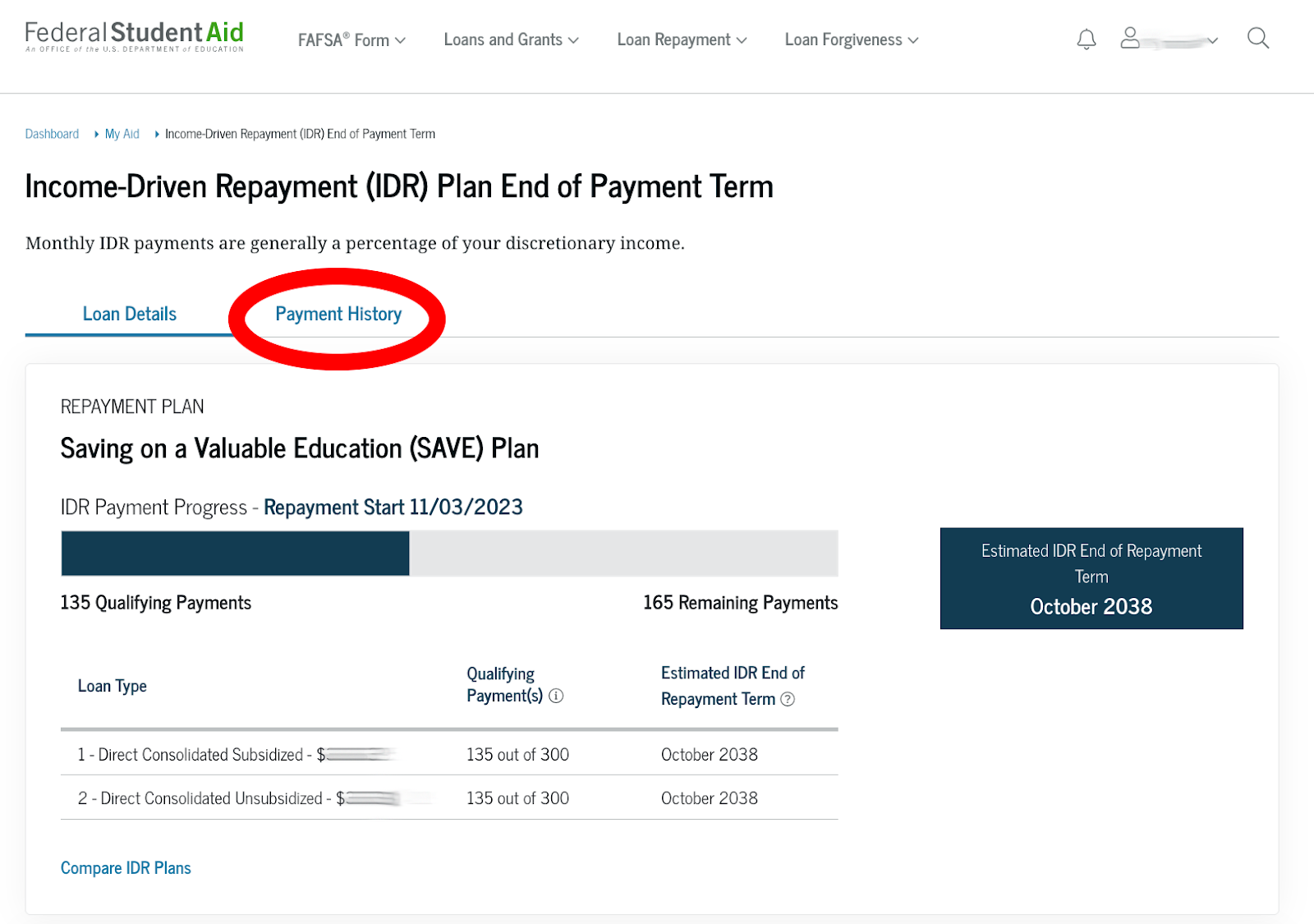
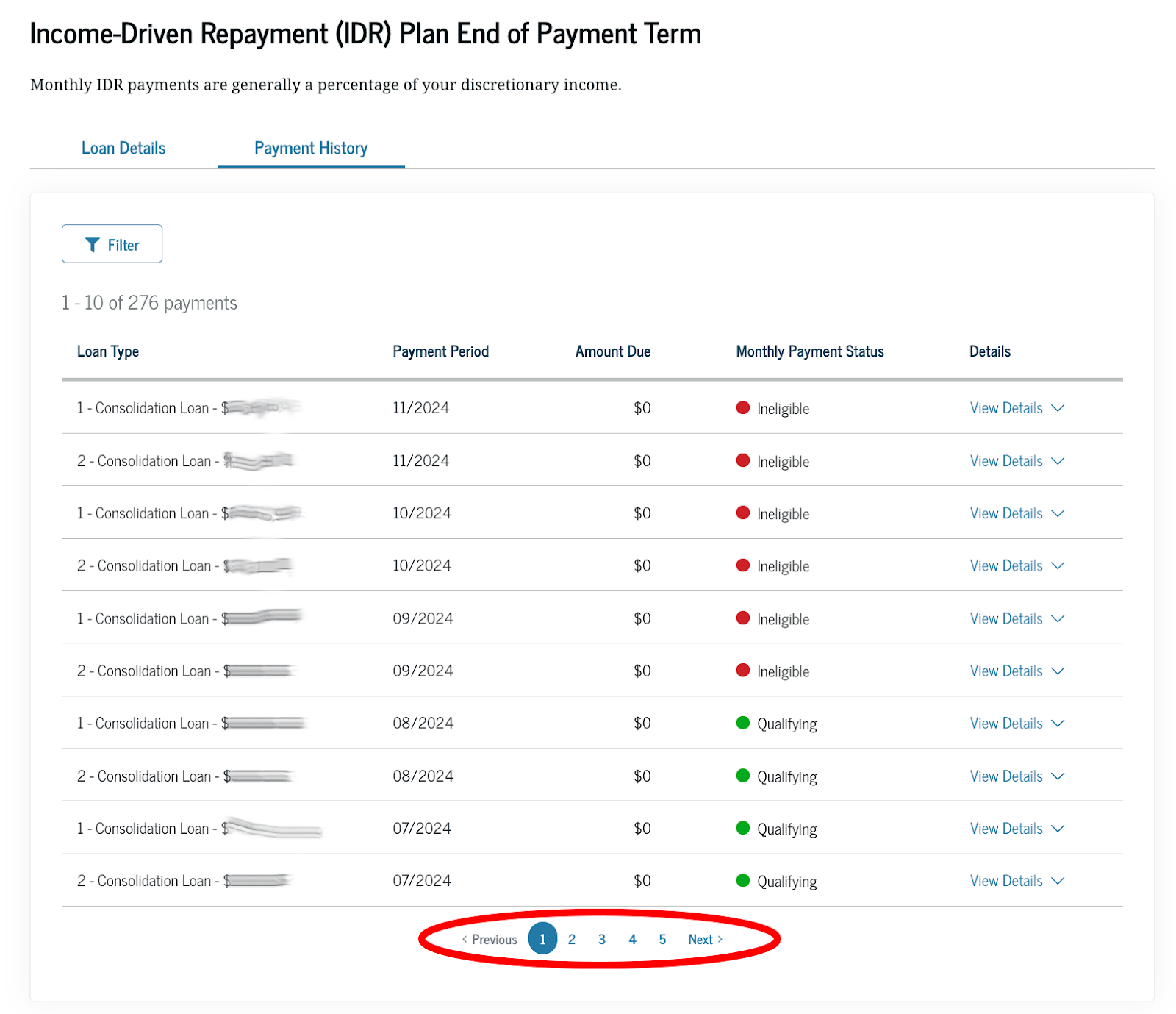
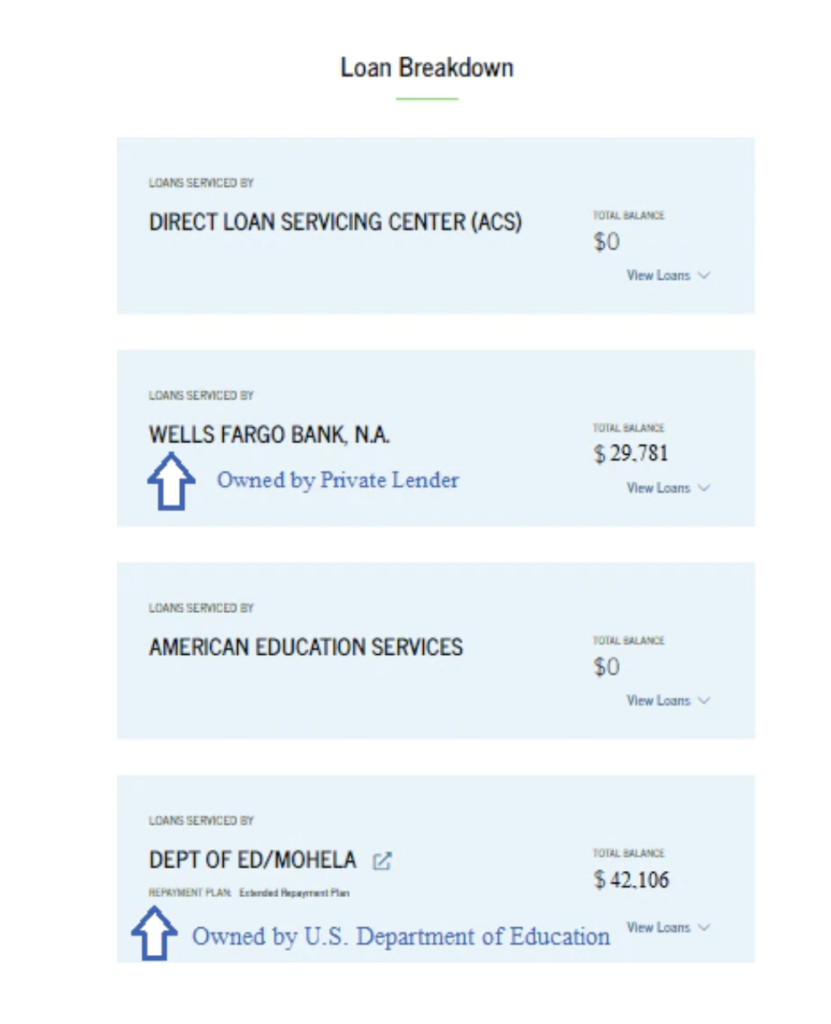


If you have federal student loans, now is a really good time to check to make sure they’re in good standing. After you miss nine months of payments, federal student loans go into default. Once your loans are in default, the government can garnish your wages, take your tax refund, take a portion of your federal benefits (like Social Security), and even sue you to pay off your defaulted loans. The government has paused its student loan collection powers for now, but collections could turn back on soon. If your loans are in default, it is a good time to check and take action to get them back on track. You have options to get your loans back into good standing! 

Studentaid.gov was recently improved to make it easier to remove your loans from default. If you are logged in, you can use the new Defaulted Loans Support Center to enter into a rehabilitation agreement, consolidate your loans, or make a payment on your loans online. The online rehabilitation agreement makes it easier than ever before to rehabilitate your loans for most borrowers. We have a new step-by-step guide on entering into a rehabilitation agreement here. 

Are you in default? Share your story with us here.

On July 1, 2026, new rules went into effect and made major changes to many borrowers’ student loan repayment options. Watch this short webinar below on what you need to know about the new repayment changes (run time: 15 minutes).

This webinar is brought to you by NCLC and the International Rescue Committee in Sacramento, with support from the California Department of Financial Protection and Innovation.


What Has Changed?

On July 1, 2026, two new repayment plans became available: the Repayment Assistance Plan (RAP) and the Tiered Standard Plan. Not everyone is eligible for these new repayment plans. 

There are now two different repayment tracks for borrowers. If you only have loans from before July 1, 2026, you may be eligible for more repayment options, including older IDR plans, such as IBR. However, if you take out new loans or consolidate your loans after July 1, 2026, you will only be able to use the RAP and Tiered Standard Plans to repay Direct Loans you took out for your own education. If you have Parent PLUS loans and you borrow or consolidate after July 1, 2026, your repayment options on those loans are even more limited. Consider your options carefully before consolidating or taking out new loans!

How are Parent PLUS Loans impacted? Options for Parent PLUS Loans have changed significantly and depend on whether or not you consolidated your loans or took out any new loans before or after July 1, 2026.

  • Did you consolidate your Parent PLUS Loans before July 1, 2026? They may still be eligible for an IDR plan, but you must apply for and make one payment in the Income-Contingent Repayment (ICR) plan before July 1, 2028. After you make one payment in ICR, you can then switch to IBR.
  • If you didn’t consolidate before July 1, 2026, and didn’t take out any loans after that date, IDR is no longer available for your Parent PLUS Loans, but you may be eligible for the older fixed plans, including the Standard or Extended plan.
  • Did you consolidate or take out any new loans after July 1, 2026? Your Parent PLUS Loans, including consolidated Parent PLUS Loans, are only eligible for the Tiered Standard Plan.

Older repayment plans are being phased out: The SAVE plan is ending now, and the ICR and PAYE plans will end by July 1, 2028. 

But the IBR plan will continue to be available for many borrowers. Borrowers who only have loans from before July 1, 2026, will still be able to use IBR for their Direct Loans, and FFEL Loans will continue to be eligible for IBR.   

New borrowing limits: There are also new borrowing limitations for both student and parent borrowers, and the GRAD Plus loan program is ending. This means it may be harder to pay for school in the future.


Check Your Repayment Options: 

  • Log in to your account on StudentAid.gov and check which repayment plan you’re currently enrolled in.
  • Use the Repayment Calculator to compare plans side-by-side using your imported tax data or recent paystubs. There may be a number of different repayment plans available to you.
  • Want to change plans? You can apply for a new Income-Driven Repayment (IDR) Plan online or via a paper application. To sign up for other repayment plans, contact your loan servicer. Note: The new IDR paper application that allows you to enroll in the RAP plan was just released today, October 1, 2026.Some borrowers have been experiencing problems when trying to enroll in RAP using the online IDR application and may need to use the paper application instead. We are not sure when the online application errors will be fixed. Contact your servicer if you need help.
  • Struggling to pay? Contact your loan servicer immediately to explore other repayment options or request temporary forbearance or deferment to keep your account in good standing.

Update: On September 29, the Department of Education announced that the deadline to sign up for auto pay to receive a temporary 1% interest-rate reduction was changed from September 30 to December 31, 2026.

September is an important month for many federal student loan borrowers this year. Two important deadlines are coming up now:

  1. December 31, 2026: Deadline to sign up for auto pay to receive a temporary 1% interest-rate reduction.
  2. Late September/early October: The first group of borrowers who received notices about the end of SAVE are reaching their 90-day deadline to choose a new repayment plan.

1. Sign up for auto pay by December 31st to get a temporary 1% interest-rate reduction

If you have Direct Loans and sign up for auto pay by December 31, 2026, you can receive a 1% interest-rate reduction on your student loans. If you are already enrolled in auto pay, you don’t need to sign up again, and you should automatically get this benefit. The temporary interest rate reduction runs through June 30, 2028. You can sign up for auto pay through your online account with your loan servicer or by calling your servicer. The deadline to sign up for this benefit was originally September 30, 2026, but the Department of Education just announced that they are extending the deadline to December 31, 2026.

What you should do now to get the interest rate reduction:

  • Log in to your online account on your loan servicer’s website and check whether you are enrolled in auto pay. 
  • If you aren’t enrolled in auto pay, sign up on your online account with your servicer before December 31, 2026.
  • If you have multiple servicers for your Direct Loans, you need to check each of your accounts and repeat these steps.

Once you are signed up for auto pay, check your accounts regularly to make sure your payments are processed correctly and the right amount is being taken from your account. If you have any issues with your auto payments, contact your servicer.

Unfortunately, this interest rate reduction is only available for Direct Loans that were issued after July 1, 2012. For more information, see here.


2. If you’re still in SAVE, check your notices to see if your 90-day deadline is coming up

The SAVE plan is ending. Notices started to go out in early July to let people know they have 90 days to apply to switch to a new plan. If borrowers don’t act within 90 days of their notice, they will be moved to a standard plan, which is likely to require higher monthly payments. 

Some borrowers will reach their 90-day deadline in late September, but not all. Borrowers are being sent notices on different dates, and the 90-day period starts on the date of the individual notice, so borrowers have different deadlines to change plans. Some borrowers have not yet received a notice, so their 90-day period has not yet started.

For more information, see our short webinar on the SAVE plan ending (run time: 12 minutes).

Did you get a notice in early July?

If you received your 90-day SAVE notice during the first week of July, your deadline may be coming up at the end of September. he notice you get often won’t tell you an actual date to switch plans. Instead, it will just say you have 90 days from the date of the notice to switch, so you may have to do some math to figure out your deadline. If you get multiple notices with different dates, you should go by the earliest date to be on the safe side. 

What you should do if your deadline is coming up:

  • Choose a new repayment plan. You can use the Repayment Calculator or call your servicer to see whether there is another plan you can apply for that you can afford and that makes sense for your situation. You may be eligible for a different IDR plan that bases your payments on your income and family size.  RAP, IBR, PAYE, and ICR are all IDR plans. 
  • You can apply for IDR plans online at studentaid.gov/idr. You can also contact your loan servicer for help switching plans, including switching into fixed plans. 
  • If you can’t afford any plans, you can contact your loan servicer and request a temporary forbearance. A forbearance will temporarily stop your payments and keep your loan from becoming delinquent or defaulting. But forbearances have downsides: there are limits on how long you can be in forbearance, and interest will continue to accrue while you’re in forbearance, so your balance will increase. Forbearance is a temporary fix, not a long-term solution, but it can buy time to figure out how you’ll manage your loans while preventing your loan from going into default.
  • If you don’t apply to switch plans before your 90 day deadline is up, you will likely be placed on the Standard or Tiered Standard plan, depending on whether you have any loans issued after July 1, 2026. The Standard and Tiered Standard plans are more expensive for many borrowers than the IDR plans.
  • Don’t panic: Even if you miss the deadline and are switched to a standard plan, you can still apply to switch to an IDR plan or request a forbearance later. 

If you haven’t received your notice to switch yet:

If you’re still on the SAVE plan and don’t think you’ve received a notice yet to switch, pay close attention to any notices you get from your servicer. Check your email, your mail, and your inbox on your online account with your servicer.

You do not have to wait until you receive your notice to switch plans. You can switch plans now if you are ready. Switching soon might be a good choice if you want to make progress on paying down your loan or earning credit toward loan forgiveness in Public Service Loan Forgiveness (PSLF) or Income-Driven Repayment (IDR).

The SAVE plan is ending. Borrowers enrolled in the SAVE plan for their federal student loans are starting to get notices that they have 90 days to switch into a new repayment plan. Watch this short webinar below on what you need to know about SAVE ending (run time: 12 minutes).

This webinar is brought to you by NCLC and the International Rescue Committee in Sacramento, with support from the California Department of Financial Protection and Innovation.


SAVE is Ending

Again, the SAVE plan is ending. Notices are being sent out now letting people know they have 90 days to switch to a new plan. Borrowers may be sent notices on different dates, and the 90-day period will start on the date of the notice, so borrowers will have different deadlines to change plans.

If you get one of these notices, you need to act quickly. If you don’t enroll in a different repayment plan by the end of your 90-day period, you will likely be placed in the Standard plan (or Tiered Standard plan if you took out any new loans or consolidated loans after July 1, 2026). Standard and Tiered Standard plan payments are based on your loan balance, not your income, and are often much higher than payments in SAVE or other income-driven repayment (IDR) plans. 

For help choosing a new plan, use the Department of Education’s Repayment Calculator tool and see here for more information about choosing a repayment plan. You can apply for a new IDR plan online at studentaid.gov/idr. 


When will I get my notice to switch? 

These notices are being sent in waves. Some borrowers have already received them, but others have not yet. If you’re still on the SAVE plan, you need to pay close attention to any notices you get from your servicer. Check your email, your mail, and your inbox on your online account with your servicer.

From what we have heard, the notice you get won’t tell you an actual date to switch plans. Instead, it will just say you have 90 days from the date of the notice to switch, so you may have to do some math to figure out your deadline. If you get multiple notices with different dates, you should go by the earliest date to be on the safe side. Even if you miss the deadline and are switched to a standard plan, you can still apply for an IDR plan later. 

You do not have to wait until you receive your notice to switch plans. You can switch plans now if you are ready. Switching soon might be a good choice if you want to make progress on paying down your loan or earning credit toward loan forgiveness in Public Service Loan Forgiveness (PSLF) or Income-Driven Repayment (IDR).


What should I do if I can’t afford payments in a new plan? 

If you realize you cannot afford a new plan, you have options.

First, you can request to switch plans again. Use the Repayment Calculator or call your servicer to see whether there is another plan you can afford or that makes more sense for your financial situation.

Second, if you cannot afford your payment in any plan, you can request a temporary forbearance. A forbearance will temporarily stop your payments and keep your loan from becoming delinquent or defaulting. But forbearances have downsides. There are limits on how long you can be in forbearance, and interest will continue to be charged to your loan while in forbearance — so how much you owe will increase. Forbearances are a temporary fix, not a long-term solution, but they can buy time to figure out how you’ll manage your loans while preventing your loan from going into default.

On July 1, 2026, a number of changes to student loan borrowers’ options will go into effect. How you are impacted by these changes depends on your situation —whether you’re currently in school, in repayment, or planning to borrow for school in the future. Parents who take out student loans for their children’s education will also be impacted. 

This article discusses what you need to know and what options you’ll have after July 1, 2026, including:

  1. What is changing on July 1?
  2. How is the new income-driven repayment plan, RAP, different from other repayment plans? 
  3. How is the new Tiered Standard Plan different from other plans? 
  4. I am currently repaying federal student loans. What do these changes mean for me? 
  5. I borrowed Parent PLUS loans for my child’s education — will I be impacted?
  6. I want to borrow federal student loans to go to school in the future. 
  7. I am currently in school. What do these changes mean for me?

It is more important than ever to have a plan for student loan repayment so that your loans do not go into default. Navigating all of the changes can be challenging, but the Student Loan Borrower Assistance Project is here to help, with guidance on understanding your loan situation, repaying your loans, loan forgiveness and cancellation programs, and postponing payments when you need time to figure out a plan.


What is changing on July 1?

On July 1, 2026, new rules on student loan repayment options and borrowing limits will go into effect. That will: 

  • Add a new income-driven repayment plan option, called the Repayment Assistance Plan (RAP), which will be available for most borrowers. 
  • Create two separate repayment tracks for Direct Loan borrowers, with different repayment options depending on whether the borrower took out any new loans (or consolidated existing loans) on or after July 1, 2026:
    • Existing borrowers who took out all of their loans before July 1 will keep most of their existing repayment options – for now – and will add the new RAP option. Many existing borrowers can continue with their current repayment plans. But the SAVE plan is being eliminated, and the new rules will eliminate the PAYE and ICR plans in July 2028.
    • Borrowers who take out any new loans on or after July 1, or who consolidate their existing loans after July 1, will only have two potential options: the new RAP plan or the new Tiered Standard Plan.   
  • End the Grad PLUS loan program (a type of loan for graduate and professional schools that previously allowed students to borrow up to the full cost of attendance) for any borrowers starting a program on or after July 1. 
  • Place new limits on how much students and parents can borrow in federal student loans, with limited exceptions for students who are currently enrolled and took out loans before July 1. These changes will primarily impact graduate and professional students and parents who take out loans for their children’s education.  

In addition,  borrowers enrolled in the SAVE plan will start receiving notices that they must switch to a different repayment plan because the SAVE plan is ending. For more on the end of SAVE, read our article on what borrowers in SAVE need to know.  


How is the new income-driven repayment plan, RAP, different from other repayment plans? 

On July 1, the Department of Education will begin allowing Direct Loan borrowers to enroll in RAP, a new income-driven repayment (IDR) plan that calculates borrowers’ monthly payments off of a percentage of their income and cancels any remaining balance after 30 years of repayment. As in other IDR plans, payments in RAP will count towards Public Service Loan Forgiveness (PSLF).  

Who is eligible?

All Direct Loans taken out for your own education are eligible for RAP. (Parent PLUS loans and consolidation loans containing Parent PLUS loans are not eligible.) 

How are payments calculated?

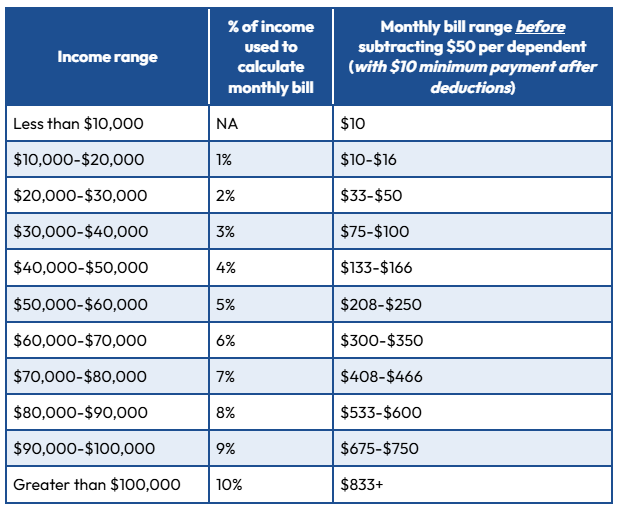
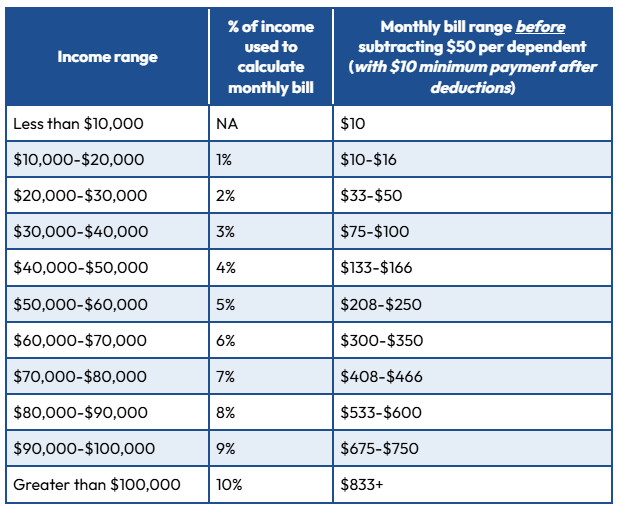
Monthly payments will be calculated as a percentage of the borrower’s total income (using adjusted gross income, or AGI) minus $50 per month per dependent, with a minimum $10 payment: 

Table listing income range compared to monthly bill range before subtracting $50 per dependent

What makes RAP different?

RAP has some important pros and cons that are different from the existing income-driven repayment plans. 

Pros:

  • Your loan balance will always decrease while you’re in the RAP plan and making on-time payments because any interest that accrues during a month that is not paid off via your monthly payment will be waived (canceled). In addition, if your monthly payment does not reduce your principal by at least $50 on its own, the government will reduce your principal by up to $50.   
  • Many borrowers will be able to pay off their loans sooner in RAP than in other IDR plans and will pay less in total over time.  

Cons: 

  • Your monthly bill may be more expensive than it would be in the other IDR plans, particularly if you took out your loans after 2014, are low income, high income, or have a spouse or children. The RAP plan uses a very different repayment formula than the other IDR plans, and all borrowers must pay a minimum of $10 a month, no matter how little they make. 
  • Your maximum repayment period until you qualify for forgiveness of any remaining loan amount will be longer. In the RAP plan, you will not qualify to have your loans forgiven until you have made 30 years of payments, unlike 20-25 years in the other IDR plans. (However, most borrowers will repay in full before reaching 30 years, and will stop making payments then.) 
  • Time in RAP will not count towards forgiveness in the IBR plan. This means that if you eventually want to switch to IBR, you may have more years until you reach forgiveness. 

For some borrowers, the benefits of a steadily decreasing loan balance and a potentially faster payoff may outweigh the risk of higher payments and a longer wait for loan forgiveness. To compare your potential IDR options, visit our page on all of the IDR plans and check out Federal Student Aid’s Repayment Calculator. 


How is the new Tiered Standard Plan different from other plans? 

A new fixed repayment plan, the Tiered Standard Plan, will also become available on July 1, 2026, but it will only be available to borrowers who take on at least one new loan after that date. This is the plan borrowers’ Direct Loans will automatically be placed in if they take out loans after July 1, 2026 and do not request the RAP plan. 

Who is Eligible?

You must borrow a new loan after July 1, 2026, or consolidate your existing loans, to be eligible for the Tiered Standard Plan. Only Direct loans are eligible.

How is the Tiered Standard Plan different?

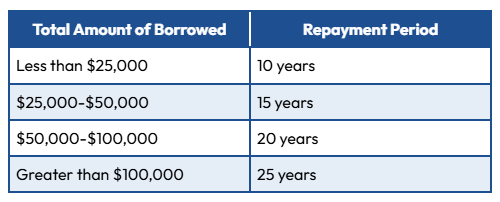
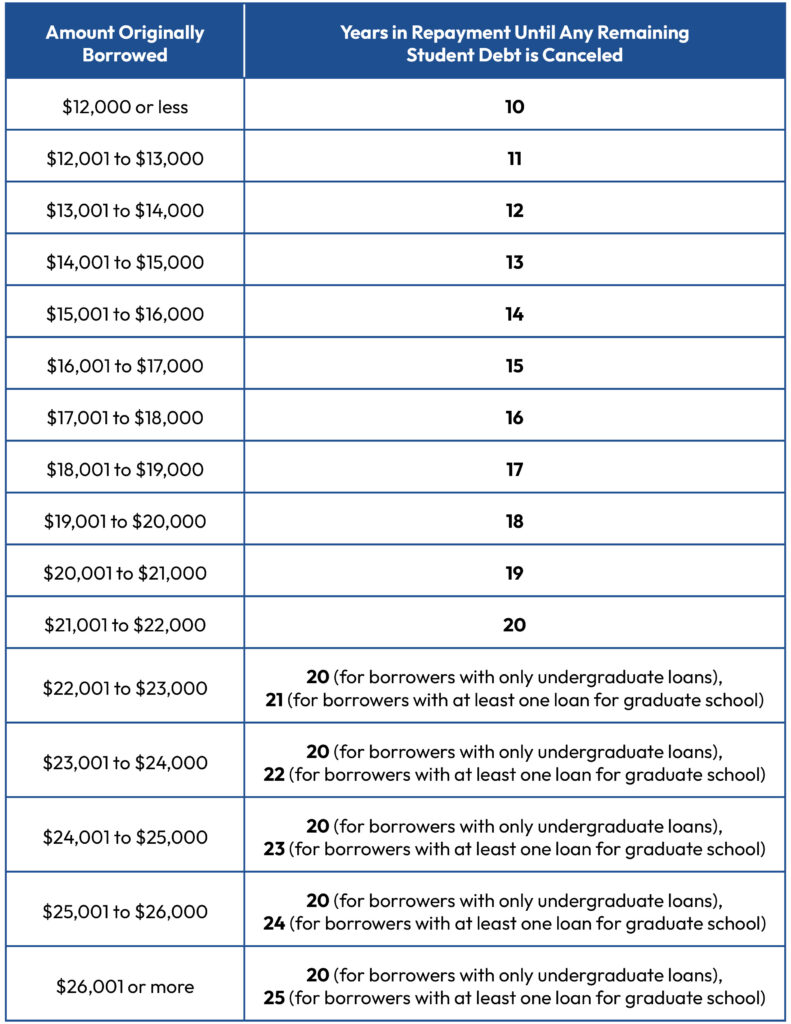
Like the old Standard plan, this plan generally requires the same payment every month and is designed to pay off a borrower’s loan in full by the end of their repayment period. But under the new Tiered Standard Plan, borrowers’ repayment periods will be based on their total outstanding Direct loan amount and will vary from 10 to 25 years. 

That means many borrowers will have a longer repayment period in the Tiered Standard Plan than in the Standard plan for pre-July 2026 borrowers.  Borrowers can always make extra payments to pay off their loans faster. 

Other things I should be aware of?

Time spent in the Tiered Standard Plan will not count towards Public Service Loan Forgiveness. 

To compare all of your repayment plan options, visit our page on repayment plans. To see what your monthly bill would be on the other plans, visit the Federal Student Aid’s Repayment Calculator. 


I am currently repaying federal student loans. What do these changes mean for me? 

If you are currently repaying federal student loans, the changes that take effect on July 1, 2026 might not impact you. 

The changes on July 1, 2026 will only impact you if: 

  1. You are enrolled in the SAVE plan and need to enroll in a new repayment plan. Starting on or after July 1, 2026, borrowers enrolled in the SAVE plan will be forced to pick a new repayment plan. If you are enrolled in SAVE and do not take out a new loan or consolidate any loans after July 1, 2026, you will be eligible for IBR and the new RAP plan, among other options for existing borrowers. You can learn more about the end of the SAVE plan in The SAVE Plan is Ending: What Borrowers in SAVE Need to Know.
  1. You take out a new loan or consolidate after July 1, 2026. If you take out even one new loan, or consolidate any of your existing loans, you will lose access to your current repayment options. Instead, you have to repay all of your Direct Loans in either the Tiered Standard plan or the RAP plan. You should consider whether you can afford payments in these plans before consolidating or taking on any new federal student loans. 
  1. You want to access the benefits of the new RAP plan. All Direct loans for your own education are eligible for the RAP plan starting July 1, 2026. 
  1. You owe Parent PLUS loans borrowed for your child’s education. More information on Parent PLUS loans is in the next section. 

If you only have loans from before July 1, 2026, you will continue to have the same access to the existing IDR plans, IBR, ICR, and PAYE, as well as the Standard, Graduated and Extended plans. But, the ICR and PAYE plans will end on July 1, 2028, and if you are in ICR or PAYE, you will have to switch plans when they end. 


I took out Parent PLUS loans for my child’s education — will I be impacted? 

The July 1 changes will have a dramatic impact on many parents who took out Parent PLUS loans to pay for their child’s education. The impact will depend on whether you have already consolidated your Parent PLUS loans and whether you take out any new loans. 

  1. If you consolidated your Parent PLUS loans before July 1, 2026, and you do not take on any new loans after July 1, 2026, then you can pay your Consolidation loan in an income-driven repayment plan if you enroll in IDR before July 1, 2028. Generally, you will have to enroll first in the ICR plan, and then after one payment you can switch to the IBR plan. If you do not switch out of ICR before the plan ends on July 1, 2028, you will be automatically switched to IBR then.
  1. If you did not consolidate your Parent PLUS loans before July 1, 2026, then you will not be able to repay them in an income-driven repayment plan. Your options will be limited to fixed repayment plans like the Standard or Extended plan, or, if you consolidate or take out a new loan after July 1, to the new Tiered Standard plan.  
  1. If you consolidated your Parent PLUS loans before July 1, 2026, but you take out any new loans (or consolidate loans) after July 1, 2026, then you will not be eligible to repay any of your Parent PLUS loans (or Consolidation loans that repaid Parent PLUS loans) in an income-driven repayment plan. Instead, you will have to pay them in the new Tiered Standard plan. 
  1. If you are planning on borrowing at least one Parent PLUS loan  after July 1, 2026, then your options to repay it will be limited. Any Parent PLUS loans borrowed after July 1, 2026 will only be eligible for the Tiered Standard Plan. Additionally, after July 1, the amount that you will be able to borrow in Parent PLUS loans will be more limited.

Some people have loans for their own education, as well as Parent PLUS loans for their children’s education. If you have both types of loans, you can still repay loans for your own education in an income-driven repayment plan even if your Parent PLUS loans are not eligible. You will just have to repay your Parent PLUS loans in a separate plan, and you should not consolidate them with loans for your own education.  If you consolidate your own loans with any Parent PLUS loans, the entire consolidation loan will need to be repaid in the Tiered Standard plan. 


I want to borrow federal student loans to go to school in the future. 

If you aren’t already enrolled in school, but want to go to school and take out loans in the future, your options will be more limited. Many students who go to school after July 1, 2026, will not be able to borrow as much in federal student loans as students who attended school before that date. This applies to students who go to school for the first time, return to school after stopping a prior program, or return to school for a new program. This change will primarily impact people who go to graduate or professional school and families that rely on Parent PLUS loans (loans taken out by parents for their children’s education). 

Generally, if you enroll in a program after July 1, 2026: 

  • There are new limits on how much students can borrow for graduate and professional education. If the Department of Education considers a program to be a “graduate” program, you can borrow up to $20,500 per year and a total limit of $100,000. If you’re in a “professional” program, you can borrow up to $50,000 per year and a total limit of $200,000. 
  • There are no more Grad PLUS loans — a loan type for graduate and professional programs that previously could cover up to the full cost of attendance. 
  • There are new limits on Parent PLUS loans.  Parents can only borrow up to $20,000 per child per year, and a total of $65,000 in Parent PLUS loans per child. 
  • Borrowers will be subject to a lifetime loan limit of $257,500 for any federal student loans ever borrowed, excluding Parent PLUS loans. This limit will apply regardless of whether any of those loans were paid off or canceled.  

In addition, when it comes time to repay your new student loans, you will be limited to only two options: the Tiered Standard Plan and the RAP plan. (Parent PLUS borrowers will be limited to only the Tiered Standard Plan.)  If you already have Direct Loans, then taking out new loans will change your repayment options on all of your Direct Loans. You will lose access to the existing repayment plans and will only be able to repay your Direct Loans in the Tiered Standard Plan or the RAP plan. 


I am currently enrolled in school. What do these changes mean for me? 

If you are currently enrolled, both the new loan limits on how much you can borrow and the changes to repayment options could impact you. 

Loan Limits

If you are currently enrolled in school and took on at least one federal student loan for the program you are enrolled in before July 1, 2026, then the graduate and professional loan limits discussed above will not apply to you while you are completing your program. But, if you switch programs or switch schools, you will be subject to the new loan limits. 

The new limits on Parent PLUS loans will not apply to you if you are currently enrolled in school and either took out a Direct loan before July 1, 2026 or your parent took out a Parent PLUS loan for you before that date for the program you are currently enrolled in.  But the limits will apply if you switch schools, withdraw, or complete your program. The limit will not apply to you if you switch majors within the same degree. 

Repayment Options

If you are enrolled in school and take on a new loan after July 1, 2026, all of your Direct Loans will only be eligible for the RAP plan or the Tiered Standard plan, discussed above, even if you took out some loans for your program before July 2026. Current students are not exempt from the repayment changes.

The Department of Education recently announced that it would provide a temporary, additional interest rate reduction to people with federal student loans who sign up for auto pay. 

Starting July 1, 2026, people who are enrolled in auto pay or who sign up for auto pay by September 30, 2026, will get a 1% reduction in their student loan interest rate. Currently, borrowers on auto pay already get a .25% interest rate reduction, so this new change will increase that benefit temporarily to 1%. The additional interest rate reduction lasts through June 30, 2028. This benefit will apply to all Direct Loans that were issued after July 1, 2012, including Parent PLUS Loans. 

A lower interest rate means you could pay less on your student loan debt over time. While this temporary benefit won’t solve the student loan crisis, it’s still a good way to save some money. 


How do I get the lowered interest rate?

You need to sign up for auto pay with your loan servicer by September 30, 2026. To do this, log in to your account on your loan servicer’s website and select auto pay under the repayment options menu. If you have more than one loan servicer, you’ll need to do this for each of those accounts.

If you’re already signed up for auto pay, you don’t need to do anything else, and the interest rate reduction will be applied automatically. 


Does it matter what type of payment plan I’m enrolled in?

No. It generally doesn’t matter what type of payment plan you’re enrolled in, as long as you are signed up for auto pay, you should automatically receive the interest rate reduction beginning July 1, 2026. But if you’re on the SAVE plan you first need to switch plans and sign up for auto pay again in order to get this benefit. 


What if I’m in default on my loans?

Unfortunately, you can’t just start making payments on your federal loans once they’re in default to get this benefit. You first have to take steps to get your loans out of default in order to then sign up for auto pay and get the interest rate reduction. 

Right now, the two common ways most borrowers get their loans out of default are consolidation or loan rehabilitation.  

A loan rehabilitation is less risky right now for most borrowers in default, but it takes nine months to complete. In a loan rehabilitation, you enter an agreement to make nine full, on-time, reasonable and affordable payments over nine months to remove your loans from default. If you haven’t already started this process, you won’t have time to do this before September 30, 2026–the deadline to sign up for the temporary increased interest rate reduction on auto pay. See our page on the ins and outs of loan rehabilitation. 

You may be able to consolidate your loans to get them out of default in time to sign up for auto pay by the September 30th deadline; however, there are major downsides to consolidating loans right now. If you consolidate your loans to get out of default right now, you will lose access to many repayment plans on all your loans going forward. In addition, you will likely lose any time you’ve earned on the loans being consolidated that would count towards forgiveness in income-driven repayment plans. For more information on these risks, see our page on consolidation.

The SAVE plan was created in 2023 and was the most affordable student loan repayment option, but it was challenged in court and is now being eliminated by the Department of Education. This article covers what the 7 million people enrolled in the SAVE plan need to know now that the SAVE plan is ending.


Why is the Department of Education eliminating the SAVE plan?

The Department of Education agreed to eliminate the plan to settle a lawsuit brought by Missouri and several other states. The Department also requested that the court enter judgment for Missouri and vacate most of the 2023 rules that created the SAVE plan. On March 10, 2026, a federal court entered the judgment and order as the Department requested. 


What do I need to know if I’m already on the SAVE Plan?

You will not be able to stay in the SAVE plan for long. You will need to enroll in a different repayment plan soon, likely within 90 days of July 1, 2026. The Department has announced that loan servicers will begin sending notices to borrowers enrolled in SAVE on or around July 1, 2026, telling them to enroll in a different repayment plan within 90 days. This means you will probably need to switch plans by the end of September 2026. 

Note: You  may also have received emails from the Department of Education in March or April 2026 warning you about these upcoming changes, but the 90-day deadline for switching plans should not start until servicer emails are sent sometime around July 1. 

If you do not enroll in a different repayment plan by the end of your 90-day period, the Department has said you will be automatically reassigned to another plan, likely the Standard Repayment Plan. Payments in the Standard plan are based on the borrower’s loan balance, not their income, and are often much higher than payments in SAVE or other income-driven repayment plans.

After switching plans, you will start getting monthly bills.  You will be required to make payments unless you qualify for a $0 payment in your new plan or you request a forbearance or deferment to postpone payments. 


How do I pick a new plan?

If you are currently in SAVE and must switch plans, you can use our website to learn more about other repayment options and how to think about choosing a plan. Explore other income-driven repayment (IDR) options that base your monthly payments on your income and family size:  

  • Income-Based Repayment (IBR), 
  • Pay As You Earn (PAYE), and 
  • Income-Contingent Repayment (ICR)

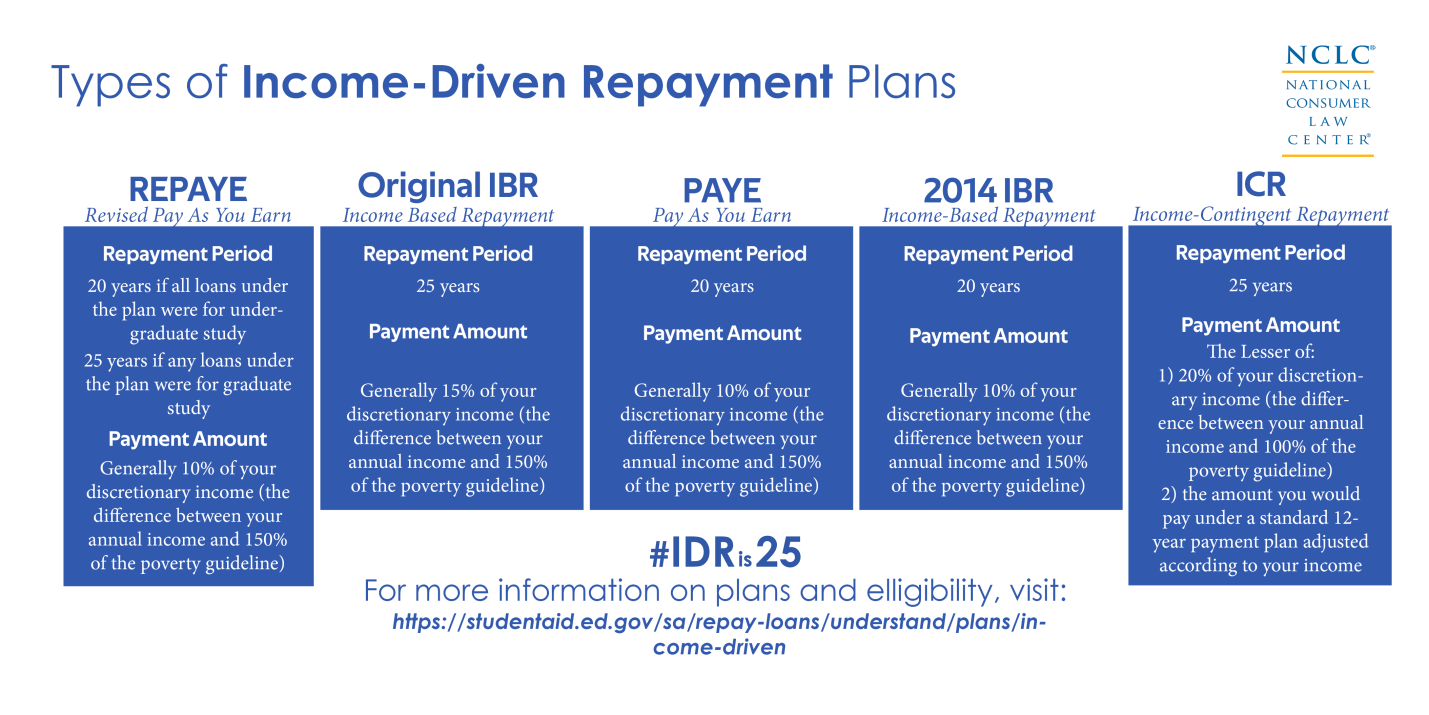
Each of these IDR plans have different eligibility criteria, but they all base payments on income and family size and promise cancellation of any remaining debt after 20 to 25 years in repayment. Depending on your income and family size, your payments may be as low as $0 per month in these plans.  

You may also be interested in the Repayment Assistance Plan (RAP), a new income-driven repayment plan that will be available on July 1.  RAP is different from the other IDR plans: 

  • It uses a different formula to calculate payments, and does not offer $0 payments no matter how low your income is. 
  • It has the longest repayment period before any remaining debt is cancelled (30 years).
  • It provides more help to make progress in paying down your loans: it cancels any interest not covered by your monthly payment (like SAVE did) and it provides a small principal reduction of up to $50 per month for some borrowers.

RAP may be a good fit for you if you want to fully pay off your loans and you want to get any interest not covered by your monthly payments cancelled. However, RAP may not be a good option for you if you are low-income, because you may face higher monthly bills and be in repayment for a longer period of time before your loans are cancelled. 

Other options include the Standard and Extended plans, which set payments based on the amount of your loan balance and require you to fully repay your loans within a set number of years. Typically borrowers finish repayment sooner but have higher monthly payments in the Standard Plan than in IDR plans.

You can use the government’s Loan Simulator to estimate your monthly payments,  the total amount you’ll pay, and the period you’ll pay in each of the  repayment plans that you are eligible for.  Right now, Loan Simulator does not provide payment estimates for the RAP plan, but you can use the nonprofit EDCAP’s calculator to estimate your payments in RAP.  

You can apply for income-driven repayment plans online at studentaid.gov.  


Do I have to wait until July 1 to change plans?

No, you do not have to wait to switch plans. You can apply for a new plan now, but you cannot yet request the Repayment Assistance Plan (RAP) because it is a new plan that will not be available until July 1. 

It might make sense to switch plans now if: 

On the other hand, it might make sense to wait until July 1 to switch plans if: 

  • you want to enroll in RAP, which won’t be available until July 1, or
  • you do not qualify for a $0 payment in another plan and cannot afford the payments you would owe in other plans. 

Waiting until July 1 will give you more time before you need to make payments, but be aware that interest will continue to be charged while you wait. 

Once you have been accepted into a new repayment plan, you should expect to start receiving bills again unless you are eligible for a $0 payment in your new IDR plan.      

Note:  SAVE was the most affordable repayment plan, and your monthly bills  in SAVE were probably based on your income from two or more years ago. Your new payments will most likely be higher in whatever plan you switch to, both because other plans are more expensive than SAVE and because your payments will likely be based on more recent income, which may have gone up. 


What happens if I’m moved to a plan with payments I can’t afford?

If you realize you cannot afford your new plan – regardless of whether you chose your plan  or were automatically switched by the Department – you have options.

First, you can request to switch plans again. Use the Loan Simulator or call your servicer to see whether there is another plan you can afford or that makes more sense for your financial situation.

Second, if you cannot afford your payment in any plan,you can request a temporary forbearance. A forbearance will temporarily stop your payments and keep your loan from becoming delinquent or defaulting. But, forbearances have downsides:  there are limits on how long you can be in forbearance, and interest will continue to be charged to your loan while in forbearance — so how much you owe will increase. Forbearances are a temporary fix, not a long term solution, but they can buy time to figure out how you’ll manage your loans.

For  official government information about the plan to eliminate SAVE, borrowers can visit the Department of Education’s website.


For more background about the history of the SAVE plan and the lawsuits surrounding it, see our previous blog posts on this issue.

This post provides more  updates and information covered in our previous post on what Parent PLUS borrowers need to do to lower their payments due to changes under a new law, the Big Bill. Check out the previous post for more information on what happens if you borrow a new loan (or a new Parent PLUS loan) on or after July 1, 2026.

If you are currently repaying a Parent PLUS loan, you need to act fast if you want to have the option to repay it in an income-driven repayment (IDR) plan. If you do not apply to consolidate Parent PLUS loans quickly, so that the consolidation loan is issued before July 1, 2026, you will not be able to pay those loans in an IDR plan moving forward. If you haven’t yet applied to consolidate your Parent PLUS Loans, act now so you don’t miss the July 1, 2026 deadline.

Generally, it takes 4 to 6 weeks for a consolidation application to be processed. But, don’t wait to apply to consolidate! The longer you wait,  the less likely the consolidation loan will be issued before the deadline.

Once your Parent PLUS loans have been consolidated, you must sign up for an IDR plan before July 1, 2028. If you do not, you will not be able to pay the consolidation loan containing a Parent PLUS loan in an IDR plan in the future. 

If you are enrolled in an income-driven repayment plan, the Department of Education determines your monthly payment based on your income and your family size, not how much you owe. If your income decreases, so does your monthly payment. For many borrowers, income-driven repayment plans are much more affordable than other repayment plans. Some low-income borrowers can even have $0 monthly payments! 

What if my consolidation loan is disbursed after the July 1, 2026 deadline? 

If your loan is disbursed on or after the July 1, 2026 deadline, it will change the repayment options available on all of the Direct Loans you owe. You will NOT be able to sign up for any IDR plan for the consolidation loan containing the Parent PLUS loans. If you take on any loan after July 1, 2026 any consolidation loans that contain Parent PLUS loans will only be eligible for the new Tiered Standard Plan.

Is there anything I can do to stop the consolidation if I think I will miss the July 1, 2026 deadline? 

Yes, before the consolidation is completed, the servicer will send you a letter listing which loans should be consolidated and telling you that it will finish processing the consolidation application if it does not hear from you within 10 days. If you get this letter and it looks like the consolidation loan will be issued after the July 1st deadline, you can call your servicer to cancel the consolidation. 

How do I consolidate my Parent PLUS loans?

You can apply online by logging into your account on studentaid.gov and completing the online application. When you apply online, you can select which loans you want to consolidate. Make sure you select your Parent PLUS loans! If your loans are in default, you will need to manually enter them into the online form. You can also apply using a paper or PDF application, available here. 

When you apply to consolidate your loans, you can also submit an application to repay your loans in an IDR plan.  At first, the consolidation loan will likely only be eligible for the Income-Contingent Repayment (ICR) plan. But after you make one payment in ICR, you can then apply to switch into the Income-Based Repayment (IBR) plan, which offers lower payments than ICR for most borrowers.

More information on how to consolidate your loans is available here.

The CFPB announced last week that borrowers affected by Navient’s misconduct will soon begin receiving payments. 

In September 2024, the Consumer Financial Protection Bureau (CFPB) announced that it was permanently banning Navient from servicing most federal student loans due to illegal practices that harmed borrowers. Navient was also ordered to pay $100 million in relief to affected borrowers and a $20 million civil penalty to the CFPB. 

If Navient was the servicer of your federal student loans in the past, you may soon receive a payment.  This news highlights the CFPB’s important role in delivering compensation and critical relief for people harmed by illegal business practices. For more information about the settlement, visit the CFPB’s page on the Navient lawsuit. 


What do borrowers have to do to receive payment from the settlement?

The CFPB will mail checks to borrowers who are eligible for payment under the settlement, and borrowers do not need to do anything. The CFPB has provided information about these payments, including instructions for borrowers who believe they are entitled to a payment. 

If you have questions about the Navient settlement, you can reach out to the administrator of the CFPB settlement, Rust Consulting, via the following methods:  


What was the CFPB lawsuit against Navient about?

The CFPB’s lawsuit was filed in 2017 and accused Navient of engaging in harmful practices. Navient, formerly known as Sallie Mae, was once the nation’s largest student loan servicer, servicing over 12 million borrowers’ accounts. The CFPB alleged that Navient engaged in unfair and abusive practices, violating the Consumer Financial Protection Act of 2010 (CFPA) and the Fair Credit Reporting Act (FCRA). 

The lawsuit alleged that Navient engaged in the following misconduct: 

  • Forbearance steering – Navient steered borrowers facing long-term financial hardships into costly forbearances, which increased their overall debt burden, rather than informing them about income-driven repayment plans (IDR), which could have lowered their monthly payments, in some cases, to $0.
  • Misleading borrowers about IDR recertification – Navient did not adequately inform IDR-enrolled borrowers of the requirement to recertify annually and did not inform them of the consequences of submitting an incomplete recertification application, which led to an increase in borrowers’ monthly payments and delayed loan cancellation. 
  • Misapplication of payments – Navient misallocated payments intended to cover multiple loans. This resulted in borrowers incurring late fees, accruing interest, and drops in credit scores.  
  • Reporting false negative information about disabled borrowers – Navient misreported information to the credit reporting agencies about borrowers who were totally and permanently disabled. Navient made it appear that these borrowers had defaulted on their loans when, in fact, their loans had been discharged due to their disability.  
  • Deceiving borrowers about cosigner release – Navient told private loan borrowers they could apply for cosigner release if they paid down their loans in a certain way; however, after the borrower paid down their loans as instructed, Navient denied or delayed the release. 
  • Misleading borrowers about credit score improvements and effects of loan rehabilitation – Navient, through Pioneer Credit Recovery (a debt collection company owned by Navient), wrongly told borrowers in default that records reflecting late payments and delinquencies prior to default would be deleted from their credit reports when those records could not be deleted after a loan is rehabilitated. 

As a result of the lawsuit, Navient voluntarily stopped servicing most federal student loans in 2021, and the CFPB ban makes this change permanent. 

The CFPB lawsuit and settlement follow a previous settlement in which 39 state attorneys general required Navient to pay $1.85 billion in relief for unfair and deceptive practices.


What does the CFPB Navient ban mean for borrowers?

Navient is banned from servicing Direct Loans. 

The settlement agreement with Navient permanently bans Navient from servicing Direct Loans. Direct Loans are federal student loans made directly to borrowers by the Department of Education. These loans are owned by the Department, but the government relies on private companies like Navient to perform servicing functions, including sending bills, collecting payments, and advising borrowers about their payment options. 

Navient is banned from servicing FFEL Loans. 

Although new FFEL loans stopped being made in 2010, private companies like Navient still own, manage, and service a large portfolio of old FFEL loans. In February 2024, Navient transferred servicing of its entire FFEL loan portfolio, consisting of almost 3 million borrowers, to MOHELA. The CFPB ban ensures that Navient will not acquire any new ownership interest or service FFEL loans again in the future. 

Today, the Department announced that it would delay plans to involuntarily collect on defaulted federal student loans. Before the announcement, millions of borrowers were facing potential seizure of their federal tax refund this tax season, and wage garnishment notices were set to begin going out this month. 

The announcement means that borrowers should be protected from losing their tax refunds this tax season as a result of student debt. It also means that borrowers should be temporarily protected from losing a portion of their wages due to federal student loan default. Borrowers should also continue to be protected from seizure of federal Social Security benefits, as the pause on benefit seizures the Department announced last summer remains in effect. 

The Department did not specify when it will resume default collections or how long the delay will last. It did note that the delay is intended to enable the Department to implement major student loan repayment changes, including the creation of a new student loan repayment plan, called RAP, that will be made available on July 1, 2026.  We don’t yet know the details of the Department’s plans. We will share more as we learn more and will update guidance for borrowers. For now, borrowers can use the time offered by the delay in collections to take stock of their student loan situation. Borrowers in default can take action to get out of default before collection resumes. And borrowers who have fallen behind on their loans but are not yet in default can take actions to prevent default.

On December 23, 2025, the Department of Education announced it would begin garnishing wages of borrowers in default on their federal student loans. Garnishment notices to the first 1,000 borrowers were scheduled for mailing by January 7, 2026. After this first round of notices, the Department expects to send additional notices to more borrowers in the coming weeks.  

If your student loans are in default, you are at risk of having your wages garnished for collection. Your federal student loans generally go into default if you have not made payments for more than 270 days. In an earlier blog post, we discussed wage garnishments and provided tips for borrowers who receive such notices. Unlike most creditors, the government can garnish up to 15 percent of your disposable pay without a court order. Unless you take action, the garnishment will continue until the amount you owe is paid off.


Do not ignore the wage garnishment notice – you must act quickly. 

If you receive a wage garnishment notice, do not ignore it. You must take steps immediately after receiving a notice of proposed wage garnishment. 

Even if you haven’t received a notice, you should check to see if your loans are in default and if you are at risk of collection actions. If you are not sure whether your loans are in default, you can check your loan status by logging into your studentaid.gov account or by contacting your loan servicer. You can also check your credit report to see if the Department has reported your loan as in default. 

If you have received a notice of proposed garnishment, there are steps you can take to object to the garnishment notice and request a hearing, which is typically conducted through a written review of your objections. You must act quickly to avoid a potential garnishment order from being sent to your employer. For more information about this process, see our page on dealing with wage garnishments.

Below are some of the reasons you can raise for objecting to the default:

  • Statutory Discharge. If you believe you are eligible for statutory discharge, such as Total and Permanent Disability (TPD) Discharge, Borrower Defense, or Closed School Discharge, you should immediately submit a discharge application and object to the garnishment based on your eligibility for a loan discharge. 
  • Financial Hardship. You can  object to the garnishment based on financial hardship if you believe the garnishment would leave you unable to afford basic life expenses, such as rent, food, and medical costs. 
  • Recent Employment. If you have recently started employment after being unemployed for at least 12 months due to an involuntary separation of employment,  you can object to the garnishment notice. 

Protect your wages by taking steps to get your loans out of default. 

Don’t wait for a garnishment notice to take steps to protect your wages. There are actions you can take now to get your loans out of default and avoid wage garnishment and other collection actions.  

If you are in default, you can take steps now to get your loans out of default through loan loan rehabilitation or consolidation.

Under a loan rehabilitation, borrowers agree to make nine consecutive, on-time monthly payments based on their income. Once nine payments are made, the loans will be returned to good standing and removed from default. If you submit a rehabilitation application within 30 days of receiving a wage garnishment notice and you make the first payment within that timeframe, you will not be subject to garnishment. If you apply for rehabilitation after the Department has already started garnishing your wages, the garnishment will stop after the fifth monthly payment is made in accordance with the rehabilitation agreement. 

Under a consolidation, you can combine multiple loans or convert one of your federal student loans into a new Direct Consolidation loan. If you are eligible for consolidation, the new consolidated loan will pay off your defaulted loans, bringing your loan current and out of default. You must act quickly to consolidate, because a borrower cannot use consolidation to get out of default if a garnishment order is in place. 

Note: Wage garnishment is just one of many tools the federal government can use to collect on your defaulted student loans. The government can also seize your tax refunds, offset your federal benefits, and even in some cases sue you. If your loans are in default, don’t wait to act. Protect your money from being seized by taking steps to get out of default. Once you are back in good standing, you may be able to lower your monthly student loan payments by applying for an income-driven repayment plan.


Have you received a wage garnishment notice? Share your story with NCLC.

The Department of Education is garnishing wages to collect on defaulted federal student loans for the first time in over five years. We anticipate changes to the process, but the Department has not released many details about it. If you have received a notice of proposed wage garnishment, share your experience with NCLC, so that we can better understand what is happening and advocate for changes to the system. You can share your story here.

The SAVE plan was created in 2023 as the most affordable student loan repayment option, but a legal challenge led by the state of Missouri has resulted in the plan being temporarily blocked. On December 9, 2025, the Department of Education announced that it agreed to a settlement to end the case, and filed a motion asking for the case to be resolved with an order that the SAVE rules must largely be vacated. This article covers what student loan borrowers – especially the 7 million people enrolled in the SAVE plan – need to know about likely changes coming to the SAVE plan.

Overview


What does the settlement say?

In the settlement, the Department of Education agrees to the following terms:

  • The Department will not permit anyone else to enroll in SAVE (or the plan that SAVE replaced, called REPAYE), and it will deny any pending applications for SAVE.
  • The Department will work to move borrowers already enrolled in SAVE out of SAVE and into a different repayment plan.
  • The Department will not forgive any loans through the SAVE Plan (or through the plan that SAVE replaced, called REPAYE).
  • The Department will not implement any provisions of the 2023 repayment rules that created the SAVE plan with one exception: it will implement a provision that allows certain types of deferments and forbearances to count as qualifying time toward loan forgiveness in income-driven repayment plans. This provision is 34 C.F.R. § 685.209(k)(4)(iv). 
  • The rest of the 2023 repayment regulations, including the SAVE plan, will be vacated, and the Department will conduct a negotiated rulemaking to formally repeal the rules and make further changes to the rules that may be needed. 
  • For the next 10 years, any time that the Department plans to cancel or forgive more than $10 billion in federal student loans within a one-month period, the Department will notify Missouri.

Is the settlement final?

No. The Department has said that it will not implement the settlement agreement until it is approved by the court. The settlement has been submitted to the court, but as of December 12, the court has not yet acted or set a schedule for when it will.


Can I still sign up for the SAVE plan? 

No. The Department of Education stopped allowing borrowers to sign up for the SAVE plan in the Spring of 2025, and under the settlement, the Department would not permit any more borrowers to enroll in SAVE. 


What if I’m already on the SAVE Plan?

You likely will not be able to stay in the SAVE plan for long and will likely start receiving student loan bills soon.  

Under the settlement, the Department agrees to work to move all of the borrowers currently in the SAVE plan out and into a different repayment plan. The settlement does not say how soon borrowers will have to move out of the SAVE plan. In its press release, the Department of Education said that borrowers in SAVE will have “a limited time” to select a new repayment plan.  The Department has not said what repayment plan the Department will move borrowers into if they do not select a new repayment plan.

Borrowers should expect that when they select a new repayment plan — or are switched into a new repayment plan if they do not select one themselves — they will begin receiving monthly student loan bills again and will be expected to make payments. Since summer 2024, borrowers enrolled in the SAVE plan have been in a forbearance, meaning they have not been billed or required to make payments. That forbearance will likely come to an end soon. However, after the SAVE forbearance ends, you can request a temporary forbearance to postpone payments while you consider your repayment options and potentially rework your budget.

Borrowers currently enrolled in SAVE do not have to wait to switch plans.  If you are currently in SAVE, you should consider learning more about other repayment options, using the Loan Simulator to estimate your payments in other plans, and potentially applying for a new repayment plan. 

But be forewarned – SAVE was the most affordable repayment plan, and your last payments in SAVE were likely based on your income from two or more years ago. Your new payments will most likely be higher in whatever plan you switch to, both because other plans are more expensive than SAVE and because your payments will likely be based on more recent income, which may have gone up. You may want to give yourself some time to rework your budget and consider all of your options before diving into a new plan.

For the most up-to-date information, borrowers should visit the Department of Education’s website.


If I’m not enrolled in SAVE and not trying to enroll in SAVE, does this settlement impact me?

It might.  In addition to agreeing not to use the SAVE plan, the settlement also agrees not to implement most of the rest of the changes to the repayment rules made in 2023 – some of which were big improvements for borrowers in all income-driven repayment plans, not just SAVE. For example, as a result of this settlement:

  • Borrowers who consolidate their loans now are likely to lose all credit for any time they have already earned towards IDR forgiveness for making payments on their loans prior to consolidating. That means borrowers who consolidate their loans may have to spend more years in repayment as a result of this settlement. (This should not impact borrowers who previously consolidated their loans.)
  • Enrolling and staying enrolled in IDR will be more burdensome. The 2023 rules allowed borrowers to agree to data-matching to simplify enrolling and staying enrolled in IDR by allowing the Department of Education to access their income information from their tax filings to set income-driven repayment (IDR) payments, so that borrowers do not have to reapply and submit documentation of their income every year for IDR The settlement would prevent that, and force borrowers to jump through more hoops to manage repayment. The 2023 rules also aimed to reduce defaults by providing for automatic enrollment in IDR for borrowers who fall behind on higher, standard payment amounts; the settlement blocks that as well.
  • Borrowers who were steered into forbearances or repayment plans that don’t count towards IDR forgiveness will not be able to “buy back” that past time they missed out on by making additional payments to cover those prior months in nonqualifying status. Note that the settlement does not impact the separate PSLF rules, which will continue to allow borrowers to “buy back” time for purposes of PSLF forgiveness only.

More Information about the SAVE forbearance:

What is the SAVE forbearance?

Borrowers enrolled in the SAVE plan have been placed in a forbearance—meaning borrowers in SAVE are not currently required to make payments. But the Department has started charging interest on these loans again, since August 1, 2025, so borrowers in the SAVE forbearance will see their student loan balances increase the longer they stay in the SAVE forbearance. 

Additionally, the months spent in the SAVE forbearance do not count towards IDR or Public Service Loan Forgiveness (PSLF), meaning borrowers are missing out on making progress toward becoming debt-free in those programs.

And the SAVE forbearance is likely to come to an end soon, with borrowers required to switch into other plans, after the litigation concludes.

I’ve met the number of payments for IDR cancellation. Can I still have my loans canceled while I’m in the SAVE forbearance?

No. As a result of the litigation, the Department stopped providing IDR cancellation to borrowers enrolled in the SAVE plan, even if they have met the required number of qualifying payments. And in the settlement, the Department agrees not to cancel loans through the SAVE plan. Borrowers in SAVE who have 25 years of qualifying payments (300 months) should consider requesting to switch to the IBR or ICR plans, as they will be eligible to have their loans cancelled in IBR or ICR now. This is particularly important for borrowers who reach 300 months before the end of 2025 because loans cancelled through 2025 will be protected from federal tax consequences. Loans cancelled through IDR after 2025 may be treated as “income” and subject to income taxes.

Note: In October 2025, a court ordered that the Department treat any borrower enrolled in SAVE who reaches 300 months of qualifying IDR payments before the end of 2025 AND who applies to switch to IBR or ICR before the end of 2025 as having qualified for loan cancellation in 2025. This should protect the borrower from having to pay federal taxes on their cancelled debt. If the borrower waits until after 2025 is over, any debt they have cancelled through IDR may be treated as taxable income. Therefore, borrowers in SAVE who have 300 months (25 years) of qualifying IDR payments should strongly consider applying to switch to IBR or ICR before December 31, 2025.  

Should I switch out of the SAVE plan now or wait until it’s eliminated? 

It depends on your goals, but you might not have long before it is eliminated regardless. 

If you want to get your loans cancelled through Public Service Loan Forgiveness (PSLF) or IDR, it’s important to know that time spent in the SAVE forbearance does not count as qualifying time toward the 10 years in repayment required for PSLF or toward the 20 to 30 years in repayment required for IDR cancellation. Additionally, borrowers cannot make qualifying payments toward IDR or PSLF cancellation while they are in the SAVE plan. 

Instead, borrowers who want to continue making progress in IDR or PSLF should consider switching to a different IDR plan, such as IBR, where they can continue earning credit toward IDR or PSLF cancellation.  While some borrowers will face higher payments in IBR, PAYE, or ICR, some borrowers who are eligible for $0 payments in SAVE will also be eligible for $0 payments in IBR, PAYE, or ICR. It is worth using the Loan Simulator to check if you are eligible for a $0 payment in other plans and, if not, whether the payments in another plan are affordable to you.

If you can’t afford payments in another plan right now, or need to focus your money on another financial goal (such as  paying off a higher interest debt), then it might be fine to leave your loan in the SAVE forbearance for now.  Just realize that you might not have much longer before you are forced out of SAVE and into another plan where you’ll have to make payments again. And if you don’t request to switch plans and the Department forces you out of SAVE, it may not switch you to the best plan for you. Additionally, so long as you are in the SAVE forbearance, your balance will go up with interest and you won’t be making progress toward being student-debt free.


What about the PSLF “buyback” process?

There is another option for borrowers in the SAVE forbearance who want to continue earning credit towards PSLF. Some borrowers have been able to get credit toward PSLF forgiveness for time in the SAVE forbearance through the PSLF “buyback” process. The PSLF rules allow borrowers to “buy back” past months that did not count towards PSLF by paying the amounts that they would have needed to pay under an IDR plan during those months. But right now, the buyback process is only available to borrowers who already have 10 years of qualifying employment and will be eligible for cancellation through PSLF now if their past months in forbearance are counted. Borrowers earlier on in their PLSF journey cannot yet use the buyback process. 

Also, while some borrowers have reported that the Department allowed them to “buy back” months in the SAVE forbearance by making a lump sum payment for those months based on the same monthly rate that they were paying in SAVE before the forbearance started, the Department may not continue to calculate buyback payments that way. The Department has said this way of calculating buyback rates only applies if the forbearance was less than a year. But the SAVE forbearance has now been going on for over a year. It is therefore unclear how the Department will calculate how much borrowers will owe under the buyback process for months the borrower was in the SAVE forbearance going forward.

For more background about the history of the SAVE plan and the lawsuits surrounding it, see our previous blog posts on this issue.

Did you know that the government can take your tax refund to collect your defaulted federal student loans?

The government has begun seizing tax refunds from borrowers in default for the first time since 2020. It can even take refunds that include thousands of dollars of Child Tax Credits and Earned Income Tax Credits — financial lifelines for working families. Read on to find out how to check if you’re on the list for tax refund seizure, how to protect your tax refund, and how to get your federal student loans out of default. 

Generally, federal student loans default after 9 months of nonpayment. There is no time limit on collection of federal student loans, so even if you haven’t heard anything about your loans in a long time, the government could still act to collect your debt.


How can you tell if the government is going to take your tax return to collect your student loan debt? Dial before you file.

Before you file your taxes with the IRS, call the Treasury Department’s Treasury Offset Program Call Center at 1-800-304-3107 to see whether you are on the list to lose some or all of your federal tax refund to collect overdue federal debt. 

The government will generally not reach out to tell you that it is going to take your tax refund before it takes it. It may only send one notice when your debt first goes into collection, and many people don’t see it. However, each year, the government creates a list of people who owe the federal government money and who may have their tax refunds taken. The Treasury Department operates the Treasury Offset Program Call Center, a hotline at 1-800-304-3107, that anyone can call to learn whether their name is on the list for some or all of their tax refund to be taken.

When you call, you may not talk to a person. The hotline will ask you to enter your social security number twice to look up whether your name is on the collection list. If your name is on the collection list, the hotline will tell you which federal agency has referred your debt to the Treasury Department for collections. If the Department of Education referred your debt, you probably have student loans in default. 

You can double-check if your federal student loans are in default (and get information about who to contact about those defaulted loans) by logging into your account on studentaid.gov. For more information, click here.

If your name is on the list, the government will seize some or all of your tax refund to collect your outstanding debt unless you take additional steps before filing your taxes. 

Names can be added and removed from the list, so consider calling to check if you are on the list now and then calling again right before you plan to file your taxes.


Ways You Can Protect Your Tax Refund If Your Name Is On the List

If your name is on the list to have your tax refund seized, you should consider filing an extension to file your taxes before October 15th to give you more time to get your name off the list before filing.

If you are on the collection list because of defaulted student loans, the best way to get your name removed from the list is to get your federal student loans out of default. Getting your student loans out of default can take anywhere from roughly one to ten months depending on which steps you use to remove them from default and how quickly the government processes your requests. Information about your options on removing your loans from default is below. If you file after your loans are removed from default, the government will not take your tax refund to collect your debt. 

After getting your loans out of default, call the Treasury Department’s Treasury Offset Program Call Center at 1-800-304-3107 again before filing your taxes to make sure the government has taken your name off the list for tax refund seizure. 

Depending on when you act to remove your loans from default, you may not be able to remove your name from the list by the October filing deadline. If you are entitled to a refund and don’t owe the IRS money, you can file your taxes and still get your refund even after the extended deadline in October (as long as you file within 3 years and get your loans out of default before filing). But talk to a tax professional for more information about whether you should wait to file until your name is off the collection list. There could be downsides to filing your taxes late, depending on your situation. If it turns out you actually owe the IRS money, you’d owe a late-filing penalty if you file after the extended deadline.

Note: if you file your taxes jointly with your spouse but only one of you has defaulted federal student loans, consider talking to a tax preparer about whether you can file an Injured Spouse Allocation Form (IRS Form 8379) with your tax return or separately afterwards to protect a portion of your joint tax return.


Steps You Can Take To Remove Your Loans From Default

Apart from fully paying off your loans, there are generally two ways to get your federal student loans out of default: 

  1. Borrow a new consolidation loan that will collect your defaulted loans or 
  2. Rehabilitate your loans.

In addition, you may be eligible to have your loans cancelled through a loan cancellation or discharge program, which would also stop collection. 

Each of these options have different pros and cons, discussed below. In addition, you can find more information about each method out of default here. 

Consolidation

What is it? 

When you consolidate defaulted federal loans, you borrow a new federal loan that pays off the defaulted loans — including any accrued interest, fines, or fees on the defaulted loans. The defaulted loans are paid off and the new consolidation loan is in good standing. Generally, consolidation is one of the fastest ways to get your loans out of default. More general information about consolidation is available here and more information about consolidating out of default is here.

Who is eligible?

Most borrowers with federal student loans in default are eligible for consolidation. The primary reasons you may not be eligible to consolidate loans out of default are:

  • If you only have a single Direct Consolidation Loan, then you cannot consolidate it again (unless you also have another loan to consolidate with it). 
  • If your student loans are currently being collected through wage garnishment or if there is a judgment against you from a federal student loan court case. 

Are there downsides to consider? 

Yes. If you consolidate your loans right now, there is a risk that you may lose any time towards IDR forgiveness that accrued on your loans before consolidating. So if you’ve spent many years making payments on your loans and are close to having your loans forgiven through IDR, consolidating could delay when your loans are eligible for forgiveness. In addition, if your consolidation loan is disbursed after July 1, 2026, it will have different repayment options than loans disbursed before that date. More information on the pros and cons of consolidating loans is available here and information comparing consolidation to rehabilitation is available here. 

How do I consolidate my loans out of default?

To consolidate defaulted loans, you can either log in to your account on studentaid.gov and complete an online consolidation application, or you can submit a paper application. Applying online is generally easier and faster, and has faster processing times and less risk of error. If you submit a paper application, you will also need to submit an application for an income-driven repayment plan and attach documentation of your income, or agree to make three, on-time, full payments before the loan is consolidated. For most borrowers, applying for an IDR plan will be the most affordable and straightforward option. 

When you submit a consolidation application, you will need to select which loans you’d like to consolidate: Make sure that you select all of your defaulted loans. You can learn which loans are in default by logging in to your student loan account on studentaid.gov and going to the “My Aid” page and scrolling down to loan details. Loans that are in default will say “default” in the loan status column.

For more information on how to apply for consolidation, click here. 

How long does it take for my loans to be removed from default? 

Generally, it takes the Department of Education 4-6 weeks to complete a consolidation from the date you apply, but the Department says it can take up to 3 months.

Rehabilitation

What is it?

When you rehabilitate a loan, you make an agreement with your loan holder to make 9 months of full, on-time, reasonable and affordable payments, after which your loans will be put back into good standing. Your loans will not be removed from default until you have made the 9 months of required payments. More detailed information about rehabilitation is here. 

Note: If you start making payments in a rehabilitation agreement after January, you may not be able to complete the rehabilitation and remove your loans from default by October (the tax filing deadline if you request an extension). If you make 5 rehabilitation payments before filing your taxes, the Department of Education says that you may be able to stop the government from taking your tax refund — however, there is no guarantee. If you choose to try to protect your tax refund by rehabilitating your loans, then you should make sure to call the Treasury Offset Program Call Center at 1-800-304-3107 before filing to see whether they’ve taken your name off the list for tax refund seizure.

Who is eligible? 

Most borrowers are eligible for loan rehabilitation. However, right now you can only complete a loan rehabilitation on a loan once. (Beginning in July 2027, borrowers will be able to rehabilitate twice.) If you started but did not complete a rehabilitation in the past, you can still use rehabilitation to get your loans out of default. 

Are there downsides to consider? 

Loan rehabilitation takes much longer than consolidation, is more complicated to set up, and requires that you carefully watch your mail so that you can send back the required documentation. If you do not make 9 months of on-time, full payments, your loans will not be removed from default. More information comparing rehabilitation to consolidation is available here. 

How do I rehabilitate my student loans out of default? 

To start the rehabilitation process, you’ll need to contact the group in charge of collecting on your defaulted loan (often called the “loan holder”). To determine who you need to contact, you can log in to your account on studentaid.gov, or you can call the Default Resolution Group at 1-800-621-3115 and ask who you should contact about rehabilitating your loans out of default. If you have Direct Loans or other loans held by the Department of Education, you will need to talk to the Default Resolution Group to set up a rehabilitation agreement. But if you have other loan types, you may need to call a different phone number. 

When you call your loan holder, you can ask to set up a rehabilitation agreement. 

Make sure you ask for a rehabilitation agreement — not a payment plan or repayment agreement. Only rehabilitation agreements will remove your loans from default. 

When you ask for a rehabilitation agreement, your loan holder will ask you for information about how much money you make so they can determine your monthly rehabilitation payment amounts. They will then ask you to submit documentation, usually your tax filings, proving how much money you make and will send you a written rehabilitation agreement that lists how much you must pay each month in the rehabilitation agreement. You must sign and return the agreement and provide documentation proving your income for your rehabilitation to begin. For more information about what to expect when entering into rehabilitation, click here.

After 9 months of on-time, full payments, your loans will be removed from default and placed back into good standing. It is important that you have a plan for repaying your loans moving forward once your loans are removed from default. 

If you cannot complete your rehabilitation agreement before filing your taxes, call your loan holder and see if it will agree to stop collections. It may be possible to stop collections if you agree to rehabilitate soon after receiving a notice of default or after 5 months of rehabilitation payments. However, this may not work in all cases. Before you file your taxes, make sure to call the Treasury Department’s Treasury Offset Program Call Center at 1-800-304-3107 to confirm that your name is not on the list. 

Loan Discharge and Cancellation Programs 

Federal student loans, including loans in default, can be cancelled (also called “discharged”) in certain situations, such as if you are unable to work due to a permanent disability. If all of your loans in default are cancelled, then you will no longer have loans in default and will not have your tax refund seized.

But it can take months (or sometimes even years) for your loan discharge application to be decided. In some discharge programs, like the Total and Permanent Disability Discharge Program, the government should stop collections (including stopping any tax refund seizures) once it has received your application. However, this is not guaranteed for all discharge programs, and even when it is guaranteed the government might not quickly remove you from the list to have your refund seized. If you have submitted a discharge application, you should still call the Treasury Offset Program Call Center at 1-800-304-3107 to confirm that your name is not on the collection list before filing your taxes. If you are on the list, consider contacting the Default Resolution Group or your loan holder to tell them that you have applied for a discharge and ask if collections can be stopped.

If you have Parent PLUS loans and want access to more affordable monthly payments, you will need to act soon – likely before April 1, 2026. By taking action now, you can make your Parent PLUS loans eligible for an Income-Driven Repayment (IDR) plan, which sets payments as a portion of your income each year and offers many people lower payments compared to the Standard Repayment plan. But the door is closing: If you don’t act in time, then your Parent PLUS loans will be locked out of IDR plans permanently, which may leave you with unaffordable student loan payments in the future.

Parent PLUS loans are federal student loans taken out by parents to help pay for their child’s education. Not sure if you have a Parent PLUS loan? See how to find out what types of loans you have here.

To make your Parent PLUS loans eligible for an IDR plan, you have to first apply to consolidate your Parent PLUS loans into a new Direct Consolidation Loan. Under a new law, the Big Bill, any Consolidation Loan containing a Parent PLUS loan must be issued before July 1, 2026 to be eligible for an IDR plan. The Department of Education says it typically takes 4-6 weeks for a consolidation to be completed after a borrower submits a consolidation application but can take longer, so it recommends that interested borrowers apply to consolidate by April 1, 2026. You can sign up to repay your Direct Consolidation loan in an Income-Driven Repayment (IDR) plan, which you must do before July 1, 2028. 


What’s the advantage of an IDR plan? 

On an IDR plan, each year your student loan monthly payment is set based on your income and family size—not on how much you owe. As a result, IDR payments are often much lower than payments in other plans, especially for borrowers with low incomes or high debts, and payments go down if your income decreases.  In addition, in an IDR plan, your loans are canceled after a certain number of years in repayment. Learn more about IDR here. 


Here is what you need to know:

1. If you already have a Parent PLUS loan, you must consolidate your loan well before July 1, 2026 – probably before April 1, 2026 –  and must enroll in an IDR plan before July 1, 2028 to ensure those loans will be eligible for an IDR plan in the future. 

You must take two steps if you want to be able to repay yourParent PLUS loans using an IDR plan now or in the future. 

  • First, you must apply to consolidate your Parent PLUS loans well before July 1, 2026 – probably before April 1, 2026. Parent PLUS loans consolidated into a Direct Consolidation Loan before July 1, 2026 will be eligible for IDR.  To meet that  deadline for the new Consolidation Loan,  the Department recommends applying to consolidate Parent PLUS loans before April 1, 2026 to ensure your application is processed in time. You can apply to consolidate online here. You can learn more about consolidating your loans here.
  • Second, you must enroll your resulting Consolidation Loan in an IDR plan before July 1, 2028, or you will lose the opportunity to enroll in IDR in the future. You can apply to repay your Consolidation Loan in IDR when you apply to consolidate. At first, the Consolidation Loan will likely only be eligible for the Income-Contingent Repayment (ICR) plan. But after at least one payment in ICR, you can then apply to switch into the Income-Based Repayment (IBR) plan, which offers lower payments than ICR for most borrowers. You do not have to apply for ICR when you consolidate, but you must apply for ICR and make at least one payment in it before July 1, 2028 or you will lose the opportunity to enroll in IDR in the future.  

On July 1, 2028, repayment plans options will change again and the ICR plan will disappear. But if you have taken the two steps above — (1) consolidated your Parent PLUS loans by April 1, 2026, and (2) enrolled in ICR by July 1, 2028 — then you’ll continue to be eligible for IBR, and will be automatically switched from ICR to IBR if you haven’t already switched. This is good because IBR offers lower payments and better terms than ICR for most people.   

What if I have already consolidated my Parent PLUS loans?

If you have already  consolidated your Parent PLUS loan into a Direct Consolidation Loan, then you do not have to consolidate it again. But if you haven’t already enrolled the Consolidation Loan in an IDR plan (including ICR, IBR, or PAYE), then you must enroll in ICR before July 1, 2028 or you will lose the opportunity to enroll in IDR in the future. Additionally, you should double check that your consolidation loan is a Direct Consolidation Loan. If it is a FFEL Consolidation Loan (only issued before July 2010), then you will likely need to apply to consolidate it into a Direct Consolidation Loan to enroll in IDR. Here’s how you can check what type of loan you have. 

2. If you borrow a new Parent PLUS loan or consolidate your Parent PLUS loan and the loan or consolidation is made on or after July 1, 2026, then you will not be able to enroll them in an IDR plan. 

The Big Bill changes the repayment rules for all new federal student loans made on or after July 1, 2026. New loans will have to be repaid using one of two new repayment plans: 

  • the Tiered Standard Repayment Plan, which has fixed monthly payments paid over 10 to 25 years based on the amount you owe, or
  • the Repayment Assistance Plan (RAP), a new IDR plan with payments based on your income.

Unfortunately, Parent PLUS loans and Consolidation Loan containing Parent PLUS loans (including double consolidation loans) are not eligible for RAP. Therefore, all new Parent PLUS loans and Consolidation Loans that contain Parent PLUS loans made on or after July 1, 2026 will have to be repaid using the new Tiered Standard plan. This will mean Parent Plus borrowers with low incomes or high student loan burdens will not have a good option to reduce their payments to a more affordable amount.  

3. If you consolidate or borrow a new loan after July 1, 2026, then your already existing Parent PLUS loan or Consolidation Loan containing a Parent PLUS loan will not be eligible for IDR. 

The Big Bill raises the stakes on borrowing new loans (or consolidating loans) after July 1, 2026 for people who already have loans. If you consolidate or borrow even one loan after that date, then you will have to repay your new loans using one of the two new plans – Tiered Standard or RAP – AND all of your existing Direct loans will have to switch to these new plans. And again, because this deadline applies to the making of new loans, which only happens weeks or months after a borrower has applied for new loans, it could impact borrowers who apply to consolidate after April 1, 2026. 

The stakes are especially high for Parent PLUS borrowers, because borrowing or consolidating after this time will mean that even your existing Consolidation Loan that contains a Parent PLUS loan will no longer be eligible for IDR.

This is because Parent PLUS loans, Consolidation Loans containing Parent PLUS loans, and double Consolidation Loans containing Parent PLUS loans are not eligible for the RAP plan. So if you apply to consolidate existing loans or borrow new loans and the loan is issued on or after July 1, 2026, then you will only be able to repay Parent PLUS Loans and Consolidation Loans that contain Parent PLUS loans using the new Tiered Standard plan. 

What if I consolidated my Parent PLUS loans before April 1, 2026 to get access to IDR, but then I take out another loan after July 1, 2026? 

Unfortunately, if you take out a new loan or consolidate a loan after July 1, 2026, then you will lose access to IDR for any Consolidation Loans you have that contain Parent PLUS loans, even if you previously jumped through all the hoops to make them eligible for IDR.  For many Parent PLUS borrowers, this will mean losing access to more affordable monthly payments.

When people think of a typical person dealing with student loan debt, they may not imagine someone over 60. But unfortunately, the student loan debt crisis impacts millions of Americans of all ages, including older people. In fact, people over 60 are the fastest-growing demographic with student loan debt. Millions of older people are struggling with repayment challenges, and it can be confusing to know where to turn.

The AARP Foundation, in partnership with NCLC, has created three new videos to help older borrowers understand their options. These easy-to-understand videos go hand-in-hand with NCLC’s Student Loan Help video series to help borrowers navigate their way out of debt and default.

The new videos from the AARP Foundation and NCLC answer key student loan questions on topics including:

  • Public Service Loan Forgiveness (PSLF): Learn how you might be able to get your federal student loans completely forgiven if you work in public service, such as for the government or a non-profit organization.
  • Total & Permanent Disability (TPD) Discharge: Find out if you qualify to have your federal student loans canceled if you are unable to work due to a medical condition.
  • Getting Out of Default: Learn about the consequences of defaulting on student loans and the steps you can take to prevent collections and get back on track.

Watch free videos from the AARP Foundation and NCLC today to learn your rights and options for dealing with student loan debt.

The SAVE plan was created in 2023 as the most affordable student loan repayment option, but it’s currently blocked by the courts, and Congress decided to eliminate the plan by July 2028. This article covers what student loan borrowers need to know now about the SAVE plan.


Can I still sign up for the SAVE plan? 

No. Due to court cases challenging the SAVE plan, the Department of Education stopped allowing borrowers to sign up for the SAVE plan in the Spring of 2025. 


What if I’m already on the SAVE Plan?

Borrowers already enrolled in the SAVE plan were automatically placed in forbearance while the court cases are being resolved, meaning these borrowers are not required to make payments right now. Read on for more about the SAVE forbearance.   

Additionally, as a result of the Big Bill that was signed into law on July 4, 2025, the SAVE plan, along with a few other IDR plans, will be eliminated for all borrowers by July 1, 2028. Borrowers will not be able to remain in the SAVE plan after that date, and it is possible the plan will be eliminated sooner.  Any borrowers still enrolled in SAVE on July 1, 2028 will be automatically switched to a different plan then. 

For the most up-to-date information, borrowers should visit the Department of Education’s website.


What You Need to Know if You are Currently on the SAVE Plan:

What is the SAVE forbearance?

Borrowers enrolled in the SAVE plan have been placed in a forbearance—meaning borrowers in SAVE are not currently required to make payments. But the Department has started charging interest on these loans again, since August 1, 2025, so borrowers in the SAVE forbearance will see their student loan balances increase the longer they stay in the SAVE forbearance.  

Additionally, the months spent in the SAVE forbearance do not count towards IDR or Public Service Loan Forgiveness (PSLF), meaning borrowers are missing out on making progress toward becoming debt-free in those programs.

I’ve met the number of payments for IDR cancellation. Can I still have my loans canceled while I’m in the SAVE forbearance?

No. As a result of court orders, the Department has stopped providing IDR cancellation to borrowers enrolled in the SAVE plan, even if they have met the required number of qualifying payments. Borrowers in SAVE who have 25 years of qualifying payments (300 months) should consider requesting to switch to the IBR or ICR plans, as they will be eligible to have their loans cancelled in IBR or ICR now. This is particularly important for borrowers who reach 300 months before the end of 2025 because loans cancelled through 2025 will be protected from federal tax consequences. Loans cancelled through IDR after 2025 may be treated as “income” and subject to income taxes.

Note: In October 2025, a court ordered that the Department treat any borrower enrolled in SAVE who reaches 300 months of qualifying IDR payments before the end of 2025 AND who applies to switch to IBR or ICR before the end of 2025 as having qualified for loan cancellation in 2025. This should protect the borrower from having to pay federal taxes on their cancelled debt. If the borrower waits until after 2025 is over, any debt they have cancelled through IDR may be treated as taxable income. Therefore, borrowers in SAVE who have 300 months (25 years) of qualifying IDR payments should strongly consider applying to switch to IBR or ICR before December 31, 2025.

Should I switch out of the SAVE plan now or wait until it’s eliminated? 

It depends on your goals. If you want to get your loans cancelled through Public Service Loan Forgiveness (PSLF) or IDR, it’s important to know that time spent in the SAVE forbearance does not count as qualifying time toward the 10 years in repayment required for PSLF or toward the 20 to 30 years in repayment required for IDR cancellation. Additionally, borrowers cannot make qualifying payments toward IDR or PSLF cancellation while they are in the SAVE plan. 

Instead, borrowers who want to continue making progress in IDR or PSLF should consider switching to a different IDR plan, such as IBR, where they can continue earning credit toward IDR or PSLF cancellation.  While some borrowers will face higher payments in IBR, PAYE, or ICR, some borrowers who are eligible for $0 payments in SAVE will also be eligible for $0 payments in IBR, PAYE, or ICR. It is worth using the Loan Simulator to check if you are eligible for a $0 payment in other plans and, if not, whether the payments in another plan are affordable to you.

If you can’t afford payments in another plan right now, or need to focus your money on another financial goal (e.g., paying off a higher interest debt), then it might be fine to leave your loan in the SAVE forbearance for now.  Just realize that your balance will go up with interest, you won’t be making progress toward being student-debt free, and at some point, the SAVE forbearance will end (and the SAVE plan will be fully eliminated), and the Department will start billing you again.    

What about the PSLF “buyback” process?

There is another option for borrowers in the SAVE forbearance who want to continue earning credit towards PSLF. Some borrowers have been able to get credit toward PSLF forgiveness for time in the SAVE forbearance through the PSLF “buyback” process. The PSLF rules allow borrowers to “buy back” past months that did not count towards PSLF by paying the amounts that they would have needed to pay under an IDR plan during those months. But right now, the buyback process is only available to borrowers who already have 10 years of qualifying employment and will be eligible for cancellation through PSLF now if their past months in forbearance are counted. Borrowers earlier on in their PLSF journey cannot yet use the buyback process. 

Also, while some borrowers have reported that the Department allowed them to “buy back” months in the SAVE forbearance by making a lump sum payment for those months based on the same monthly rate that they were paying in SAVE before the forbearance started, the Department may not continue to calculate buyback payments that way. The Department has said this way of calculating buyback rates only applies if the forbearance was less than a year. But the SAVE forbearance has now been going on for over a year. It is therefore unclear how the Department will calculate how much borrowers will owe under the buyback process for months the borrower was in the SAVE forbearance going forward.

For more background about the history of the SAVE plan and the lawsuits surrounding it, see our previous blog posts on this issue.

On July 4th, President Donald Trump signed the One Big Beautiful Bill (“Big Bill”) into law. The biggest changes for borrowers include new limits on how much they can borrow in federal student loans, big changes to both current and future borrowers’ repayment options, and changes that will make it harder for borrowers who were harmed by their schools to get debt relief. Unfortunately, for many low-income borrowers, these changes will make paying for college even more difficult. In addition, the bill has changes happening on many different timelines, adding even more complexity to an already confusing system. This blog explains what the bill will mean for current and future student loan borrowers and lays out when those changes will likely occur.

What Does This Bill Do?

  1. The Big Bill creates a new income-driven repayment plan. 
  2. The Big Bill will end the SAVE Plan and other income-driven repayment plans, leaving only the Income-Based Repayment (IBR) Plan and RAP Plans after July 1, 2028.
  3. The Big Bill changes borrowers’ repayment options if they borrow any loans after July 1, 2026.
  4. The Big Bill ends most Parent PLUS borrowers’ access to any Income-Driven Repayment plan.
  5. The Big Bill Ends the Grad PLUS loan program and creates new limits on how much students and parents can borrow in federal student loans. 
  6. The Big Bill makes it harder for borrowers to get relief after their school closes or their school harmed them. 
  7. The Big Bill will allow borrowers to rehabilitate loans up to two times to remove them from default. 


1. The Big Bill creates a new income-driven repayment plan. 

The Big Bill creates the Repayment Assistance Plan, or RAP plan, a new income-driven repayment plan that is very different from the existing IDR plans. Unlike the existing IDR plans, even the poorest student loan borrowers must make a minimum payment of at least $10 a month, regardless of whether or not they fall below the federal poverty line and regardless of their family size. Monthly payments will be calculated as a percentage of the borrower’s total income (using adjusted gross income, or AGI) minus $50 per month per dependent: 

Table detailing monthly bill range per income range

Like the SAVE plan, the RAP plan will waive any interest not covered by the borrower’s monthly payment. Additionally, unlike SAVE or other existing plans, the RAP plan will reduce borrowers’ principal by up to $50 if the payment does not do so. 

The RAP plan is significantly more expensive for borrowers than the SAVE plan, but will also be more expensive than the other existing IDR plans for low-income borrowers. 

Unlike existing IDR plans that provide cancellation after 10-25 years, the RAP plan will only provide cancellation after 30 years of qualifying payments. 

The Big Bill specifies that the RAP plan should be available to borrowers beginning on July 1, 2026. 


2. The Big Bill will end the SAVE Plan and other income-driven repayment plans, leaving only the Income-Based Repayment (IBR) Plan and RAP Plans after July 1, 2028.

In addition to creating a new IDR plan, the Big Bill instructs the Department of Education to eliminate the PAYE, ICR, and SAVE plans by July 1, 2028 – and it could happen sooner. After those plans are eliminated, borrowers whose loans were all disbursed before July 1, 2026 will have the following repayment options: 

  1. Standard Repayment Plan 
  2. RAP
  3. Income-Based Repayment (IBR)
  4. Graduated and Extended Plans 

For most borrowers, the required monthly payments in these plans will be significantly higher than payments in the SAVE Plan. This will therefore be an expensive change for many borrowers to deal with. 

The Bill makes small changes to the Income-Based Repayment plan so that more existing borrowers will be eligible for it. As a result of the Bill, borrowers no longer have to show that they have a “partial financial hardship” to be eligible for the plan. Additionally, as discussed below, the Bill will allow certain Parent PLUS loan borrowers to enroll in IBR – though they’ll have to jump through hoops first. 

Otherwise, IBR remains unchanged for existing borrowers: Borrowers that took on loans before July 1, 2014 will be in “old IBR,” meaning that their monthly payments will be calculated as 15% of any income they earn above 150% of the federal poverty guidelines for their family size (with $0 payments for borrowers who earn less than 150% of the guidelines), and they will receive cancellation after 25 years of qualifying payments. Borrowers that took on loans between July 1, 2014 and July 1, 2026 will be in “new IBR” meaning that their monthly payments will be 10% of any income they earn above 150% of the federal poverty guidelines for their family size (again, with $0 payments for those who earn less than 150% of the guidelines), and they will receive cancellation after 20 years of qualifying payments. 

If borrowers enrolled in one of the eliminated plans (SAVE, PAYE, or ICR) do not choose another repayment plan by the time those plans are eliminated, then their Direct Loans taken out for their own education will be placed in the RAP plan and any FFEL loans and any Direct Consolidation loans that repaid a Parent PLUS loan will be placed in the IBR plan. 


3. The Big Bill changes borrowers’ repayment options if they borrow any loans after July 1, 2026.

Borrowers that take on any new loan — including borrowers that consolidate an existing federal loan —on or after July 1, 2026 will only be eligible for two repayment plans: the standard repayment plan or the RAP plan. 

The Big Bill changes standard repayment for loans issued on or after July 1, 2026 and determines the repayment length based on the total amount borrowed.

Table of repayment periods for the Big Bill

Borrowers pursuing Public Service Loan Forgiveness (PSLF) should note that while payments in a 10-year standard plan qualify for forgiveness, payments in standard plans with repayment periods longer than 10 years do not qualify. As a result, borrowers that take on more than $25,000 in loans after July 1, 2026 will only be able to use the RAP plan to make qualifying payments towards PSLF. 

In addition, borrowers that take out loans after July 1, 2027 will not be able to use the economic hardship or unemployment deferments to pause payments if they cannot afford them. In addition, borrowers will only be able to be in many forbearances for up to 9 months during a 2-year period. These new limits on postponing payments in times of financial distress, combined with eliminating $0 payments for new borrowers living in or near poverty, mean that financially distressed borrowers will have fewer options to avoid falling behind and into default.  


4. The Big Bill ends most Parent PLUS borrowers’ access to any Income-Driven Repayment plan.

    The Big Bill significantly changes Parent PLUS borrowers’ repayment options. Only Parent PLUS borrowers that consolidate their loans before July 1, 2026 and are enrolled in any IDR plan between now and July 1, 2028 will be eligible for an income-driven repayment plan after the SAVE, ICR, and PAYE plans are eliminated on or before July 1, 2028. Those borrowers will be eligible for the Income-Based Repayment (IBR) plan. They will not be eligible for RAP. Existing Parent PLUS borrowers who do not jump through these hoops in time will be locked out of income-driven repayment options, which could make it very difficult to manage their loans if they cannot afford fixed payments. 

    Borrowers that take on new Parent PLUS loans or consolidate their existing Parent PLUS loans after July 1, 2026 will only be eligible for the new standard repayment plan. If borrowers consolidate or take on Parent PLUS loans after July 1, 2027 those loans will not be eligible for the economic hardship or unemployment deferments and will only be eligible for up to 9 months of many forbearances in a 2 year period. This could mean increased hardship and defaults for low-income Parent PLUS borrowers in the future.

    Parent PLUS borrowers should consider consolidating now, before July 1, 2026, and enrolling in the Income-Contingent Repayment (ICR) Plan so that they can preserve their ability to make reduced payments in an IDR plan in the future.  


    5. The Big Bill Ends the Grad PLUS loan program and creates new limits on how much students and parents can borrow in federal student loans. 

      The bill ends the Grad PLUS loan program, a type of loan for graduate and professional schools that previously allowed students to borrow up to the full cost of attendance, for any borrowers starting a program on or after July 1, 2026. 

      The bill also adds a number of new limits on how much students and parents can borrow in federal student loans, with limited exceptions for students that have already borrowed loans and are currently enrolled. 


      6. The Big Bill makes it harder for borrowers to get relief after their school closes or their school harmed them. 

        Federal student loan borrowers are entitled to loan cancellation in certain situations where their school engaged in misconduct (the Borrower Defense program) or closed before they completed (the Closed School Discharge program). The bill does not end these relief programs, but does make changes to the program rules that will make it harder for borrowers to access relief. Specifically, in 2022, the Department of Education made improvements to the rules for both of these programs to make it easier for eligible students to receive relief. The Bill makes it so that those rule improvements only apply to loans issued after July 1, 2035. That means that existing loans will be subject to the older rules that make it more difficult for borrowers to get relief. 


        7. The Big Bill will allow borrowers to rehabilitate loans up to two times to remove them from default. 

          Currently, borrowers can only use a rehabilitation agreement to remove their loans from default once. Starting July 1, 2027, borrowers will be able to use rehabilitation to exit default twice. 


          What should borrowers do now?

          If you have loans now, little is changing immediately — but you should make sure all of your contact information is up to date on studentaid.gov and with your loan servicers, and keep an eye out for coming changes. 

          While the bill changes student loan borrowers’ rights, the changes won’t happen immediately – most will not happen until July 2026 or later.  For now, borrowers’ repayment options remain the same. However, the Department will likely begin changing its student loan rules over the next year, and those rule changes could impact your loan situation. You should make sure that you are receiving up to date information from the Department of Education and from your student loan servicer. 

          If you are currently enrolled in the SAVE plan, you should also expect that once that plan is eliminated your monthly payments will likely increase. Consider using the Student Loan Simulator to estimate your monthly payment in Income-Based Repayment (IBR), since that plan will remain available to current borrowers. You may want to begin thinking about whether there are changes you can make to your budget to accommodate a higher monthly student loan payment. 

          If you already have loans, taking on loans (or consolidating) after July 1, 2026 could make your repayment options worse. 

          Finally, if you have Parent PLUS loans, consider whether it makes sense to consolidate those loans before July 1, 2026 and enroll in the Income-Contingent Repayment (ICR) plan to preserve your eligibility to make payments based on your income.

          On May 5, 2025, the federal government restarted collections on federal student loans that are in default. That means if you haven’t made a payment on your federal student loans in more than 270 days, you could soon face serious consequences. If you take action now, you may be able to stop or delay collections. Help is available—don’t wait until your paycheck, benefits, or tax refunds are gone! 

          Watch NCLC’s video on student loans in default now for more information. You can also use NCLC’s Student Loan Toolkit to help you identify what options you may have to deal with your student loan debt.


          What can the government do to collect student loan debt? 

          If you’re in default, the Department of Education can:

          • Garnish up to 15% of your paycheck;
          • Seize your federal tax refunds;
          • Take up to 15% of your Social Security benefits, as long as your remaining monthly benefit stays above $750–the government has said they will not be taking Social Security benefits right now, but this may restart again at any time;
          • Send your account to debt collectors; and
          • Report negative information to credit bureaus.

          Unlike other types of debt collection, the government can take these steps without going to court (in some limited cases, the government may file a lawsuit to collect the debt, but this is not required and doesn’t happen often). There is no statute of limitations on collecting federal student loan debts. This means you could face collection actions for debts that are years old. 

          Student loan debt collection can hurt your ability to get housing, car loans, or even certain jobs. If you have federal loans in default or are behind on your federal student loan payments, including Direct Loans, Perkins Loans, and FFEL Loans, take steps now to avoid collection.


          What should you do right now?

          1. Check to see if your loans are in default.

          Check if you’re in default on your federal student loan by logging into your account at studentaid.gov. A warning box should appear at the top of your Dashboard letting you know if you have student loans in default. From your Dashboard, you can also click on “View Loans” to review the status of each of your loans to see if you are in default, if you are delinquent (behind on your payments but not yet in default), or if you are in good standing. You can also check the status of your federal student loans by logging into your account with your loan servicer. 

          2. See if you qualify for loan forgiveness or cancellation.

          One way to deal with defaulted student loans is to see if you qualify to have your loans forgiven or canceled through one of the Department of Education’s loan discharge programs. For example, if you are disabled and can’t work, you may be able to have your loans canceled and discharged, even if they are in default, through the Total and Permanent Disability Discharge Program. See our page on cancellation and forgiveness options, or watch this video to see if you qualify. 

          3. If you are in default, take steps to get out of default.

          If you are in default, look at options for getting out of default. Right now, there are only two real ways to get your loans out of default if you cannot afford to pay the loans in full. You can either complete a loan rehabilitation or consolidate your loans to get them out of default. Once you are out of default, make sure to sign up for an income-driven repayment plan (IDR) if you can’t afford the standard repayment and want to avoid falling behind on your loan payments again. Watch our video on dealing with default for more information.

          4. If you aren’t in default, but you are struggling with payments, consider signing up for an IDR plan.

          If you are not yet in default, but you are struggling to afford your loan payments or are delinquent, look into an income-driven repayment (IDR) plan. Your payments could be as low as $0 per month, and you could earn credit toward loan forgiveness while in an IDR plan. If you can’t afford an IDR plan, consider a deferment or forbearance to temporarily pause your student loan payments. Watch our video on different options for managing your student loan repayments.

          5. If you got a notice of an upcoming collection action, review your options for stopping it.

          If you’re facing a collection action that you don’t agree with, such as a tax refund or Social Security benefits offset, you can either challenge the debt if you believe it’s invalid or already paid, or request a financial hardship review if you can’t afford collections and are facing some serious financial hardship such as an eviction, utility shut-off, or forclosure. The steps to try to stop a collection action may be different depending on what type of collection you’re facing. The government may also be changing the way it collects and manages student loan defaults in the future, so make sure to check the Federal Student Aid website page on collections for updates on the process.

          Note: It can be difficult to stop a collection action from happening, so you should still look at other options to get out of default to avoid any more collections from taking place. For more information, visit the Federal Student Aid website’s collections page.

          On April 25, we published this story urging borrowers to screenshot their IDR progress tracker in case the government removes this important information. On April 28, the government removed the tracker. You may still be able to access your IDR payment count by logging into your studentaid.gov account and navigating to https://studentaid.gov/app/api/nslds/payment-counter/summary.

          In January, we shared that the Department of Education had added important new information to studentaid.gov showing borrowers their progress toward being debt-free through Income-Driven Repayment (IDR) plans. As we reported, borrowers could log into their accounts on studentaid.gov and see an IDR progress tracker showing how many months of qualifying payments they had made in IDR. They could also see how many more years and months of payments they would need to make until they would be eligible to have any remaining loan balance cancelled.

          However, recently we have seen the federal government remove lots of information from government websites, and this IDR progress tracker could be removed at any time. Borrowers should therefore save this information while they can, in case it is removed from their accounts. Do it today!

          Why save the IDR progress tracker? If the IDR progress tracker is removed from borrowers’ accounts, it will be much harder for borrowers to make informed decisions about how to manage their loans. For example, right now, if you consolidate your loans your consolidation loan will start with no months credited towards IDR forgiveness, regardless of how long you were in an IDR plan previously. Without the tracker, it will be difficult for borrowers to know how much time toward cancellation they stand to lose.

          The tracker also helps borrowers see how much time remains until their loans are eligible for cancellation in an IDR plan. Removing the tracker would make it harder for borrowers to make sure they actually get their loans cancelled when they are eligible for cancellation, and to dispute any mistakes the government or their servicers may make by failing to credit borrowers for qualifying time in repayment.   

          We are encouraging borrowers to screenshot their IDR progress tracker on studentaid.gov and to save it as soon as possible. Here’s how to do it:

          1. Log into your federal student aid account on studentaid.gov.
          2. You should now see your “student aid dashboard.” On the right hand side of the screen, there is a new section showing you how much time is left until the IDR End of Payment Term. This is how many more years and months of qualifying payments you will need to make before you qualify to have any remaining balance on your student loans canceled. Below is an example of what you are looking for on your dashboard:
          1. Take a screenshot of your dashboard that includes this IDR End of Payment Term information and save it to your files. (Or print the page to PDF and save to your files.)

          If that’s all you have time or energy to do, stop there. But if you want to have records of all of your qualifying months of payments, and especially if you attended school during different time periods and have multiple loans that have different payment counts, continue with the following steps to save more of your information. This additional information will put you in the best position to protect the progress you’ve already earned against any attempts to take it away or any servicer mistakes.

          1. Click on “View IDR Progress,” which will take you to a page where you can see your qualifying payment count for each of your federal student loans. Under “Qualifying Payment(s)” you will see, for each of your loans, how many qualifying payments you have already made toward qualifying to have the remaining balance of your loan cancelled via IDR. Again, consider saving screenshots, or printing to PDF and saving to your records. An example is below:
          1. Next, click “Payment History.”  This page will show you, for every month since you started repaying each of your loans, whether the Department recorded that month as a “qualifying” payment month toward your IDR payment term, vs “ineligible.” An example is below.  Screenshot (or save as PDF) the full payment history for each of your loans for your records. Only ten entries may show up at a time, so make sure you take a picture of each page of payments. 

          We hope that the Department will not take this critical information away from borrowers, but it is best to be prepared in case it does.

          Are you enrolled in IDR and working towards being debt free? Share your story.

          This week, the Department of Education announced that it plans to begin forced collection on federal student loans that are in default as soon as May 5, 2025. That means it will begin seizing money from some borrower’s tax refunds, Social Security benefits, and – later this year – paychecks. 

          Starting forced collections will be a big change: collection has been paused for most borrowers since March 2020. And with more than 5 million people currently in default and thus at risk of forced collections, a huge number of people across the country stand to suddenly see a big hit to their pocketbooks.

          The government only uses forced collection against loans that are in default. Loans generally default after 270 days of missed payments. However, during pandemic payment pause and other temporary relief programs in effect from 2020 until 2024, most collections were paused and missed payments generally did not put loans closer to defaulting. As of now, 5.3 million people have federal student loans in default, and another 4 million are at risk of defaulting later this year. 

          But there are things borrowers can do to protect themselves. Below, we share what we know about the government’s plans to begin forced collections. Then we walk through options borrowers have to protect themselves against forced collections and to manage their student loan debt.


          The Government’s Plan To Begin Collection of Defaulted Student Loans

          The Department’s announcement says that it plans to start forced collection using the Treasury Offset Program beginning May 5, 2025. It says it will not begin garnishing paychecks until after sending out garnishment notices “later this summer.” When it does, it can seize up to 15% of borrowers’ paychecks to pay off federal student loans in default. 

          The Treasury Offset Program takes money from tax refunds and certain government benefits (the biggest being Social Security retirement and disability benefits) to collect on defaulted debts owed to the federal government. 

          • Tax refund seizures: The government can seize a borrower’s whole federal tax refund (and, in some states, their state refund) to collect on a defaulted federal student loan. The only limit is that the government can’t seize more than the total amount of the debt. The government can only seize a tax refund that hasn’t yet been sent to the taxpayer – if you’ve already gotten your refund this year, then you should not be at risk of any tax refund seizure until 2026. 
          • Social Security seizures: The government can take up to 15% of monthly Social Security retirement and disability benefits to collect on a defaulted federal student loan. In January, the Biden Administration announced that to prevent student loans from pushing people into poverty, it would protect 150% of the federal poverty level (about $1,883 / month) in Social Security benefits from seizure. But we do not yet know if the Trump Administration will honor that commitment to protecting Social Security benefits.

          We do not yet know if the government will begin seizing tax refunds and Social Security benefits immediately on May 5, or if borrowers will have a couple more months before that happens. Generally, the Department must provide notice that it is going to start forced collection against a borrower and provide them time to object or remove their loans from default. Under the Biden Administration, the Department said that it would provide legal notices to borrowers already in default and would not begin seizing tax refunds or Social Security benefits for at least two months until after the notices had been sent. But the Trump Administration has not said whether it will do this, so it is unclear whether the government is going to provide notice and the opportunity to object to all borrowers before collecting, or whether it will only provide notice to  those who are newly in default and were not subject to collections before the COVID-19 payment pause began. 

          Regardless, for borrowers in default who have not yet received their tax refunds this year, or who rely on Social Security benefits, acting fast is the best way to protect these payments from being seized.


          What Borrowers Can Do To Protect Themselves

          1. Find Out if You Have Student Loans in Default

          The first step to protecting yourself against forced collections is to figure out if you have any federal student loans in default. The best way to do this is to log into your account on the Federal Student Aid website, studentaid.gov. There you’ll find a dashboard with your loan information, including how much you owe and the status of your loans (in repayment, grace period, forbearance, deferment, delinquent, or in default). If you’re in default, you may also see a warning that says so at the top of your account dashboard. For more about understanding your loan information, see here.

          If your loans are currently in default, you may face collections as soon as May. And if your loans are delinquent, they may default after 270 days of delinquency.  

          Federal student loans become delinquent after a missed payment. After 3 months of missed payments, the delinquency is reported on your credit reports. Then, after 9 months of missed payments, loans go into default. However, you have options when your  loans are delinquent that will  prevent them from going into default. You should consider using forbearances or deferments to bring your loans current and you can apply for an IDR plan to make payments more affordable in the future. 

          The Department of Education said that it would be emailing borrowers in default over the next couple weeks. But don’t rely on receiving an email – the Department does not have email addresses or other contact information for all borrowers in default. (To update your contact information, go to studentaid.gov and update it there AND contact your loan servicer to update your contact information with them.)

          Share Your Story:  Many borrowers are doing their best but find themselves in default when they can’t afford student loan payments following a medical issue, job loss, divorce, or withdrawing from school, and aren’t told about options to reduce or postpone payments. Share your story about how you wound up in default or how default has impacted you.

          2. Figure Out if You Are Expecting Payments That Could Be Seized 

          Your situation will be most urgent if your loans are already in default AND if you are expecting to receive the type of payments that the government may begin seizing first. The most common payment types that could be seized first are:

          • Social Security: If you receive Social Security disability or retirement benefits, those may be at risk of partial seizure soon. That’s a good reason to act now. (Supplemental Security Income, or SSI, is protected from seizure.)
          • Tax refunds:
            • If you have filed your taxes and are expecting a refund that you haven’t received yet, that refund could be at risk of seizure – a good reason to act now.
            • Similarly, if you haven’t yet filed your taxes this year and expect a refund when you do, that refund could be at risk of seizure. You might consider requesting an extension and waiting to file until after you have addressed your loan default.
            • On the other hand, if you have already received your tax refund this year, or aren’t due a refund, then you are not at immediate risk of having your refund seized. What you’ve already received is safe. It wouldn’t be until when you file taxes next year that you would face tax refund seizure. 

          If you are not expecting a tax refund or Social Security payment, then you should have more time to address your loan default before wage garnishments begin later this year.

          3. Consider Options to Discharge (Cancel) Your Student Debt

          If you have a federal student loan in default, you should consider whether it’s eligible for cancellation through one of the current discharge programs. For example, you may be able to cancel your federal student loans if: 

          • you have a serious disability that prevents you from working;
          • your school closed before you completed your program;
          • your loans were taken out in your name without your knowledge;
          • your school lied to you about important information about the program you would attend, the outcomes of graduates, or the type of federal aid you’d receive, or they engaged in aggressive and deceptive recruitment.

          For more information about discharge programs, and how to apply, see here. You may be able to apply to cancel your loans through one of these programs and request to have collections stopped on your loans while your application is considered. 

          Additionally, you may be eligible to have your student loans discharged through bankruptcy, but doing so is difficult. And it is often considered a last resort because it impacts your credit and involves a lot of time and expense. Bankruptcy may still make sense for some borrowers; more information is available here. 

          4. Consider Options to Get Out of Default – And to Stay Out of Default

          If you’re in default but you are not eligible for a loan discharge, then you may want to get your loans out of default to prevent or stop forced collections. Getting your loans out of default has other benefits too, including improving your credit and restoring your eligibility for federal student aid if you want to go back to school.

          There are generally two ways to get out of default: consolidation and rehabilitation. 

          1. Consolidation means taking out a new federal Direct Consolidation Loan to pay off your defaulted loans. It is generally the fastest and most straightforward way to get out of default (and can be done online at studentaid.gov), but there are some downsides. One downside is that, as a result of a recent change in approach, you will lose any credit you have earned toward having your loans forgiven in an income-driven repayment plan. You may be able to see how much credit you could lose by logging into studentaid.gov and looking for the “End of IDR Payment Term” information on your dashboard.
          1. Rehabilitation means entering into a rehabilitation agreement with your loan holder and making nine months of on-time payments in amounts set based on your income. If you successfully complete the rehabilitation, then your loans will be removed from default and put back in repayment. Rehabilitation takes much longer than consolidation, and if forced collections begin on you before you enter a rehabilitation agreement, then collections may continue for months while you make rehabilitation payments.  

          There are pros and cons to each option, and the Department of Education has a comparison chart and more details here. Additionally, borrowers should be aware that you are generally limited to only using each option once, so not all borrowers will be eligible to rehabilitate or consolidate out of default. 

          Whichever path you choose, you will want to avoid defaulting again after getting your loans out of default. For most borrowers, the best way to do that is to enroll in an income-driven repayment plan (which may offer payments as low as $0 / month) or to make use of forbearances and deferments that temporarily postpone payments during periods you can’t afford to pay. 

          5. Other Ways To Protect Yourself from Collections

          If you aren’t eligible to have your loans cancelled and you can’t get them out of default through consolidation or rehabilitation, there may still be something you can do to protect yourself from forced collections.

          For example, if having money taken from your Social Security benefits would prevent you from being able to pay your living expenses, you can request relief from Social Security seizures  based on financial hardship.  

          Or, it is possible that the government’s information is wrong and your loans should not be in default, or the amount they are claiming you owe is wrong, or you should be temporarily protected from collections (often called “in stopped collections”) because you have applied for a discharge. You can request to review your student loan records and you can raise an objection to collection. For more information about how to request your records and object to collection, see here. 

          Are you at risk for forced collections after struggling with student loan debt?  How could it impact your family? Share your story.

          On March 26, 2025, the Department of Education reopened the online application for Income-Driven Repayment (IDR) plans for federal student loan borrowers. Borrowers can now apply to enroll in, switch between, or update their income in IDR plans at studentaid.gov. 

          This follows a very stressful period for student loan borrowers. On February 21, the Department pulled down the IDR application. The Department said it was doing so in response to a recent court order in a lawsuit challenging the SAVE plan, but did not tell borrowers how long it would be down, what was changing, or what their options for managing their loans would be. This created widespread confusion and financial stress for people trying to sign up for IDR or keep their payment amounts affordable in IDR.   

          The online application is now back up, but there are some important changes that borrowers need to know about. Significantly, borrowers can no longer sign up for the SAVE plan on the online application. This blog post will cover what borrowers need to know now that the IDR application is back up, including:

          Open Question: What will happen to borrowers who previously applied for SAVE or the plan with the lowest monthly payment and whose application wasn’t been processed?


          What Borrowers Need to Know Now

          Changes to the IDR Application

          The online IDR application is now available to borrowers again. The paper/PDF application is not yet available as of March 27, but should be posted here (under “Loan Repayment”) when available. [Update 4/9/25: The paper/PDF application is now available.]

          The Department made changes to the IDR application. The biggest changes are to the plans the borrower can request:

          1. The IDR application no longer allows borrowers to sign up for the SAVE plan. 
          2. The IDR application no longer allows borrowers to request to sign up for the IDR “plan with the lowest monthly payment.” Prior versions of the IDR application listed this option first and noted it was “Recommended.” This was a useful option to borrowers as it allowed them to enroll in IDR without having to worry about the details of each of the four IDR plans to figure out which plans they were eligible for and which plans would be best for them.  

          Open Questions: 

          As of March 28, 2025, the Department has not said what will happen if a borrower requests to sign up for a plan that they are not eligible for – in the past, the borrower would be enrolled in the most affordable plan the borrower is eligible for. 

          As of March 28, 2025, the Department has not said what will happen to borrowers who submitted IDR applications before the SAVE and “lowest monthly payment” options were removed. There is a huge backlog of applications requesting one of those two options that have not yet been processed. Right now, it is unknown how those applications will be handled and whether some borrowers will be forced to reapply.   

          As a result, borrowers must now choose between the following three IDR options when they sign up:

          • Pay As You Earn (PAYE),
          • Income-Based Repayment (IBR), and
          • Income-Contingent Repayment (ICR).

          PAYE, IBR, and ICR generally require borrowers to make higher payments than they would in the SAVE plan. But they might still be a better option than a standard or graduated plan for people struggling with the loan payments, and all three plans are PSLF qualifying. A few key differences between the plans are below:

          • PAYE and IBR offer most borrowers lower payments than ICR.
          • For people repaying debt for graduate school, PAYE offers a shorter timeline to forgiveness than IBR or ICR (20 vs 25 years). 
          • IBR is the only plan available to borrowers with older Federal Family Education Loans (FFEL).
          • Although all three of these plans promise to forgive any remaining loan balances after 20 or 25 years of qualifying payments, the government is currently not providingforgiveness to borrowers in PAYE and ICR – only to borrowers in IBR. 
          • ICR is the only plan available to borrowers repaying Parent PLUS loans, and is only available if they consolidate those loans.

          For more information about PAYE, IBR, and ICR, see here.  

          Additionally, borrowers who are married but file their taxes separately will now be subject to different rules about how their payments will be calculated in IDR, including whether they will need to provide their spouse’s income and whether their spouse will be included in their family size. These calculations will now be based on the rules as they existed before July 2023, instead of the rules used between July 2023 and February 2025.


          Expect Delays in Processing Applications

          While reopening the IDR application process is important, it’s only the first step. All pending and newly submitted applications still have to be processed and new payments calculated, and that could take a long time. The Department has said that applications are still not being processed as back-end changes are being made. When processing starts up again, there will be a big backlog of applications to work through – reportedly the backlog is already around 1 million unprocessed IDR applications. So borrowers should be prepared for long delays in processing their IDR applications. 

          What can borrowers do if they cannot afford their current student loan bills while waiting for their application to be processed?

          • Contact their loan servicer and ask to be placed in a processing forbearance. The processing forbearance pauses their obligation to make payments and counts, for up to 60 days, toward PSLF. Some servicers may automatically place borrowers in this processing forbearance, but borrowers should be prepared to request it. 
          • After 60 days, borrowers will be put into a general forbearance if their application has still not been processed. The general forbearance will not count toward IDR or PLSF, but will continue to pause payments. Servicers should automatically place borrowers in this general forbearance if their processing forbearance ends before their application is processed. However, borrowers have reported that this has not happened consistently. Borrowers should watch their email and mail closely for communication from their servicer, and if they are sent a monthly bill before their IDR application has been processed, they should call their servicer and ask for a forbearance.

          Borrowers may also be eligible for other deferments or forbearances that allow them to temporarily pause payments, and some count toward PSLF. Follow these links for more information about deferments and forbearances.


          Annual Income Recertification Deadline Changes

          The Department also announced that it would be changing income recertification deadlines for many borrowers to help address the problems caused by shutting down the IDR application and suspending processing.

          One of the biggest problems with the Department’s decision to shut down the IDR application last month was that many borrowers received notices that they had to submit their annual income update (called “recertification”) to keep their payments from suddenly jumping by hundreds or even thousands of dollars, but they couldn’t submit this information. That’s because borrowers need to use the same IDR application that they used to enroll in an IDR plan to submit their new income and family size information each year, but the Department pulled down the applications and stopped processing all IDR application forms. 

          On March 26, the Department announced that it was pushing back recertification deadlines for most borrowers currently enrolled in PAYE, IBR, or ICR to no earlier than February 2026. The Department had already pushed back recertification deadlines for borrowers in SAVE to no sooner than February 2026. 

          A few caveats:

          • The Department said servicers have begun pushing back recertification deadlines, but that it “will take time.” So some people may still be told incorrectly that they have to recertify this year.
          • Borrowers who were due to recertify on or before February 20, 2025 (ie, before the IDR application was paused), and who did not submit their application to recertify by their due date, may have already had their monthly bills jump as a result. Borrowers in this situation should fill out the IDR application for returning borrowers  as soon as possible now to have their payments recalculated and potentially lowered – but expect delays in processing.
          • Borrowers who were due to recertify after February 20, 2025 and who couldn’t because the application was down may have unfairly had their monthly bills jump. The Department says its loan servicers are working to fix this now by returning these borrowers to the lower monthly payment amount they had before their recertification deadline. If this is not fixed for borrowers, or if they suffered other harm as a result of the error, borrowers should call their servicer and demand that they fix it. 

          Consolidation Application is Back Up – But Beware

          The online consolidation application, which was also temporarily removed, is also back online as of March 26, 2025. This means borrowers can once again apply online to consolidate their loans – i.e., take out a new Direct Consolidation loan to pay off other federal student loans. Borrowers may want to consolidate to get out of default, to get access to ICR if they have Parent PLUS loans. (Read more about consolidation here.), or to change an older loan type (like a FFEL or Perkins loan) into a Direct Loan. 

          But borrowers should beware that the Department announced that it is interpreting a recent court order to, at least for now, block if from applying an important rule that preserved borrowers’ credit for time they had earned toward reaching forgiveness in IDR when they consolidate. 

          This means that if borrowers apply to consolidate their loans now, they risk losing credit for all of the qualifying time that counted towards IDR forgiveness, and their new consolidation loan will start with zero qualifying months. 

          For example, a borrower in PAYE who has an IDR qualifying payment count of 120 months (i.e., 10 years) on all of her loans would need to make 10 more years of qualifying payments to then have any remaining debt forgiven. But if that borrower consolidates now, her IDR qualifying payment count would be reset to 0, and she would have to make 20 more years of qualifying payments before she could have any remaining debt forgiven in PAYE. 

          For this reason, borrowers should check their IDR qualifying payment count on studentaid.gov before deciding whether to consolidate. When deciding whether to consolidate, knowing how much time toward reaching loan forgiveness the borrower stands to lose is important.

          For more information about how to see the IDR qualifying payment count, and what it means, click here.

          Note that consolidating should not impact PSLF qualifying time that a borrower has already earned, since a separate rule protects that time. However, there is a risk that if the IDR payment count resets this may also mess up a borrowers’ PSLF qualifying time.  


          Other Changes – And the Department’s Explanation

          The Department said that it made changes to the IDR application because it is interpreting a February court order to temporarily block all of the changes to IDR that were included in a 2023 rule issued by the Department of Education, even though many of those changes weren’t challenged in the lawsuit.  

          This includes temporarily blocking the following reforms to IDR that were part of the 2023 rules:

          • The SAVE plan
          • Making it easier for borrowers to stay enrolled and to maintain affordable payments in IDR by automatically updating their enrollment each year if they provide consent
          • Reducing default by automatically signing borrowers up for an IDR plan if they fall behind on standard payments (if they consent)
          • Stopping the practice of forcing borrowers to restart the clock toward their 20/25-year forgiveness timeline at 0 when they consolidate their loans
          • Counting more periods of deferment or forbearance towards IDR forgiveness
          • Allowing defaulted borrowers to access the IBR plan
          • Changes to how payments are calculated for borrowers who file their taxes as “Married filing separately” 

          In addition to blocking these changes, the Department’s announcement also suggests that it is interpreting the court order to temporarily block two additional, longstanding benefits of IDR: 

          • The promise that the government will cancel any remaining loan balance for borrowers in Pay As You Earn (PAYE) or Income-Contingent Repayment (ICR) after they have made 20 or 25 years of qualifying payments.
          • Partial interest subsidies that help reduce runaway balance growth for borrowers in the PAYE and ICR plans.

          For more background on the lawsuits challenging the SAVE plan that led to this mess, see here.

          For more information on the February court order issued in a lawsuit challenging the SAVE plan, see Part 1 here. 

          Lawsuits brought by several states challenging the SAVE Plan have led to a series of court orders—and big changes by the Department of Education—that have created chaos for borrowers. In response to new court decision in February 2025, the Department has temporarily suspended the application process for all income-driven repayment (IDR) plans, including the Income-Based Repayment (IBR) plan, Pay As You Earn (PAYE) plan, Income-Contingent Repayment (ICR) plan, and the SAVE plan. In addition, the Department has suspended the online consolidation application, but it is still accepting consolidation applications that are submitted by paper or PDF. 

          This blog walks through how different groups of borrowers are impacted by this pause and explains their options, as of March 20, 2025:

          1. Where Do Things Stand For Borrowers Enrolled in the SAVE Plan
          2. Where Do Things Stand for Borrowers Enrolled in IBR, PAYE, or ICR?
          3. Where Do Things Stand for Borrowers In Standard Plans Who Want to Enroll in IBR, PAYE, ICR, or SAVE?
          4. Where do things stand for borrowers that want to consolidate their loans?

          Where Do Things Stand For Borrowers Enrolled in the SAVE Plan 

          1. The SAVE Forbearance

          Last summer, in response to a court order that temporarily blocked aspects of the SAVE plan, the Department of Education placed all roughly 8 million borrowers who had already enrolled in SAVE in the “SAVE forbearance.” The SAVE forbearance temporarily pauses billing and payments for borrowers enrolled in SAVE. 

          Here is key information about the SAVE forbearance:

          • All borrowers who were enrolled in SAVE should have been placed automatically in the SAVE forbearance. Borrowers cannot opt out of the forbearance.
          • Borrowers in the SAVE forbearance are not required to make payments 
          • Borrowers in the SAVE forbearance are not being charged interest. 
          • Borrowers in the SAVE plan are not required to recertify their income while the SAVE forbearance is in effect. 
          • Time spent in the SAVE forbearance does not count as qualifying time towards having loans eventually canceled through IDR or Public Service Loan Forgiveness (PSLF). This means borrowers in the SAVE forbearance are currently missing out on making progress toward becoming debt-free in those programs. 

          We do not know how long the SAVE forbearance will last. The February court order should not change or end the SAVE forbearance. 

          2. How Can Borrowers in the SAVE Forbearance Make Progress Toward Public Service Loan Forgiveness (PSLF) or IDR Cancellation Now?

          Many borrowers in the SAVE forbearance are concerned about missing out on making progress toward having their loans canceled through PSLF (which offers cancellation after 10 years of qualifying payments while working in public service) or IDR (which offers cancellation after 10-25 years of qualifying payments in IDR plans). 

          The Department has said that borrowers in the SAVE forbearance cannot earn credit toward PSLF or IDR cancellation by opting out of the forbearance. In addition borrowers cannot earn credit by continuing to make payments while in the SAVE forbearance. The Department says that any payments borrowers in the SAVE forbearance make during the forbearance will simply be applied to the borrower’s future bills.

          Instead, the Department has said there are currently only two ways borrowers currently in the SAVE forbearance can earn credit toward PSLF or IDR cancellation, but both have serious problems:

          A. Switch to a different repayment plan?

          Borrowers in the SAVE forbearance can apply to switch to a different repayment plan that will allow them to continue making payments and earning credit toward loan cancellation in PSLF or IDR. Payments in any income-driven repayment plan (including IBR, PAYE, and ICR) or a 10-year standard plan are considered qualifying payments toward PSLF or IDR cancellation.

          Currently, there are two problems with this:

          • Borrowers cannot switch to a different IDR plan right now because the application is closed and the Department of Education has paused application processing.
            • However, borrowers who want to switch IDR plans might consider submitting a paper/PDF IDR application requesting to switch and calling their servicer to request a processing forbearance while they wait for their application to be processed. The processing forbearance pauses their obligation to make payments and counts, for up to 60 days, toward PSLF.  Borrowers should keep records that they submitted an application to switch plans (for example, by mailing it to their servicer via certified mail with return receipt).
          • Some borrowers in SAVE may not be eligible to switch to a qualifying 10-year standard plan because they have already spent more than 10 years in repayment or because they consolidated their loans and are subject to a different repayment term.  

          Additionally, all of these plans typically have higher monthly payments than SAVE and may not be affordable.

          B. Request to Buy Back Credit in PSLF or IDR?

          Another option that the Department says borrowers in the SAVE forbearance can use is to  request to “buy back” credit toward PSLF for time in the forbearance. New rules allow borrowers to “buy back” certain months that did not count towards PSLF or IDR cancellation by arranging to pay the amounts that the borrower would have needed to pay during those months under an eligible plan. However, these buy back options do not appear to be functional right now and might not be something borrowers can rely on.

          The PSLF buy back process is new and does not appear to currently be operating. Additionally, it is not clear how the Department will calculate how much borrowers will owe under the buy back process for months the borrower was in the SAVE forbearance. For more information about how to “buy back” credit toward PSLF, click here.

          The IDR buy back is new and has not been set up. Additionally, it is part of the same rules that are being challenged in the SAVE litigation and may be impacted or blocked via the litigation. Borrowers cannot currently use or count on the IDR buy back process to get credit toward IDR cancellation.


          Where Do Things Currently Stand for Borrowers Enrolled in IBR, PAYE, or ICR?

          1. Payments Continue for Borrowers Enrolled In IBR, PAYE, and ICR

          Borrowers in ICR, IBR, and PAYE are NOT part of the SAVE forbearance and should plan to continue making their regular payments. If a borrower can no longer afford their regular payments, they can call their servicer to request that they be put in a forbearance or a deferment to temporarily pause payments. However, be careful: many types of forbearances and deferments do not count towards PSLF or IDR forgiveness, and interest may continue to be charged. 

          2. Borrowers in IBR, PAYE, and ICR with recertification deadlines now face an impossible situation

          All borrowers in IDR plans are generally required to update their income and family size information every year so their payments can be adjusted to reflect their current circumstances. This process is called “recertification.” 

          While recertification was paused during the COVID-19 payment pause, recertification deadlines resumed on February 1, 2025. While some servicers have begun telling borrowers that their recertification deadlines will be pushed back to no sooner than February 2026, that has not happened across the board. Many borrowers have been told that their deadline is not being pushed back. Every borrower has an individualized recertification deadline; borrowers can check their student loan account or contact their loan servicer to find out what their recertification deadline is. 

          Borrowers who have upcoming recertification deadlines are facing an impossible situation: many servicers are telling them they must recertify, but to recertify, borrowers must submit and their servicer must process an IDR application. Because those applications are down right now and servicers aren’t processing the applications, borrowers cannot recertify and will miss their deadline through no fault of their own.

          If borrowers miss their deadline to recertify in IBR, PAYE, or ICR, their payments will be recalculated based on a fixed payment plan that doesn’t account for their income or what they can afford. As a result, borrowers will see much larger bills. Additionally, borrowers in IBR will have any accrued interest on their account capitalized, which means they’ll have to pay more over time. 

          The Department of Education could protect against those unfair harms to borrowers by extending recertification deadlines, just as it already has for borrowers in SAVE, but as of March 20, many borrowers are still reporting that they’re being required to recertify now. 

          What can borrowers do if they face a recertification deadline while the IDR application is unavailable? There aren’t any good or certain options for borrowers put in this situation, but borrowers should first confirm what their recertification deadline is with their servicer. If their recertification deadline is coming up soon, borrowers might consider submitting a paper/PDF application and keeping records that they submitted it on time. For example, a borrower can mail a copy to their servicer via certified mail with return receipt. Borrowers can then call their servicer to request a processing forbearance while they wait for their recertification application to be processed. The processing forbearance pauses their obligation to make payments and counts, for up to 60 days, toward PSLF. 


          Where Do Things Stand for Borrowers In Standard Plans Who Want to Enroll in IBR, PAYE, ICR, or SAVE?

          Borrowers cannot currently enroll in any of the income-driven repayment plans—IBR, PAYE, ICR, or SAVE. That is because the Department of Education has taken the online application down and suspended processing of applications.

          We do not know how long this IDR application suspension will last, as the Department of Education has not responded to questions or provided guidance. Additionally, after the suspension ends, there may be significant delays in processing applications due to backlogs of applications. 

          Borrowers who want to enroll in IBR, PAYE, ICR or SAVE because they cannot afford their current payment plan do have some options to avoid delinquency and default:

          1. Apply for a deferment that pauses payments, some interest, and may qualify toward PSLF or IDR – examples include an economic hardship deferment, cancer deferment, or National Guard Duty deferment. More information about these deferments and how to apply is available here.
          2. Submit a paper/PDF application for IDR and contact your servicer to request a processing forbearance. The Department states that servicers should first place borrowers who apply for SAVE or other IDR plans in a “processing forbearance” of up to 60 days while the servicer processes the application. During the processing forbearance, borrowers will not have to make payments and will earn qualifying payment credit toward IDR or PSLF cancellation, but will be charged interest. After 60 days is up, if your application still has not been processed and you cannot afford to make payments, you may request a general forbearance (which will not earn credit toward IDR or PSLF). 
          3. Contact your servicer and request a forbearance because you cannot afford your payments right now. This will pause your payments but you will not earn time toward IDR or PSLF and you may be charged interest. 

          Where do things stand for borrowers that want to consolidate their loans? 

          Consolidating federal student loans is a way of combining them by taking out a new Direct Consolidation loan to pay off your other federal student loans, and is sometimes used by borrowers to gain access to a more affordable IDR plan, to become eligible for PSLF, or to get out of default. See here for more information on consolidation.

          Along with removing the IDR application, the Department of Education has temporarily removed the online application to consolidate loans, which for many borrowers was the easiest and fastest way to consolidate their loans.

          Borrowers can still apply to consolidate their loans now using a paper/PDF consolidation application, available here. 

          But there are risks to attempting to consolidate right now:

          • First, there is a risk that consolidating loans will result in losing all of the credit the borrower previously earned toward reaching IDR cancellation at the end of their 10 to 25 year IDR repayment term, and will have to start over at 0. This is because the student loan rules that protect borrowers from losing IDR credit for time they’ve already spent in repayment when they consolidate are part of the same set of rules being challenged in the SAVE lawsuits. We do not yet know whether the Department of Education considers this part of the rules to be blocked, and the court order is unclear. We need to await clarity from the Department of Education.  
          • Second, because IDR applications are not currently being processed, borrowers may find that they cannot consolidate and repay their new consolidation loan in IDR. Even if a borrower is currently in an IDR plan, when they consolidate, they’ll be removed from that plan and will need to reapply – which they currently cannot do.
            • This is particularly a problem for borrowers with loans in default. Traditionally, consolidation has been a critical pathway out of default. But borrowers can only consolidate out of default if they either (a) simultaneously apply for IDR or (b) agree to make three months of payments at an “affordable” level worked out with their default servicer before consolidating. Because borrowers can’t apply for IDR right now, the simpler path (a) may not be available. Additionally, if borrowers cannot enroll in IDR after getting out of default, they may not be able to afford their payments and may default again.

          This blog post explains the legal implications of recent court orders in ongoing lawsuits challenging the SAVE plan. For what this means for borrowers, see Part 2 here. 

          Last spring, Missouri and several other states filed lawsuits challenging the U.S. Department of Education’s efforts to reduce student loan burdens through the new SAVE repayment plan. These lawsuits are ongoing; there are no final decisions yet. But the lawsuits have already resulted in a series of changing court orders temporarily barring the Department of Education from offering key SAVE plan benefits. As a result, borrowers’ options to manage their loans have changed suddenly multiple times.  This has been frustrating and confusing for people trying to manage their loans.  

          In this post, we explain where things stand as of March 20, 2025 in the SAVE litigation. For those who want more information, we then provide additional background about the SAVE plan and the lawsuits challenging it. In Part 2, we break down exactly what the recent court orders mean for student loan borrowers.

          The SAVE plan is the newest income-driven repayment plan for federal student loans, created by the Biden Administration in 2023. For most borrowers, SAVE offers lower monthly payment amounts than other plans, prevents loan balances from growing so long as borrowers make their required payments, and reduces the amount of interest that borrowers will pay. It also shortens the number of years some borrowers need to make payments. Parts of the SAVE plan went into effect in the summer of 2023, and all of it was scheduled to go into effect on July 1, 2024, though many aspects of SAVE have been temporarily blocked by court order.


          What is the latest in the litigation challenging the SAVE plan?

          In February 2025, the Eighth Circuit Court of Appeals affirmed a district court’s order preliminarily enjoining (i.e., temporarily blocking) the Department of Education from providing loan cancellation to borrowers enrolled in the SAVE plan who had reached the end of their repayment term by making 10 to 25 years of qualifying payments (with the applicable number of years dependant on the size of the borrower’s loan and whether they borrowed for graduate school). The Eighth Circuit also instructed the lower court to expand the scope of the preliminary injunction to block the “entire SAVE Rule,” not just the cancellation provided through the SAVE plan. 

          It is not clear whether the Eight Circuit’s order only blocks the SAVE plan, or whether it blocks the entire set of income-driven repayment rules that the Department of Education adopted in 2023 that included the SAVE plan. The Department of Education has not yet stated how it interprets the order. As a result, there is uncertainty about whether other aspects of the 2023 rules are blocked, including provisions that protect borrowers from losing credit for all of their prior payments towards IDR cancellation when they consolidate their loans, provisions changing how payments are calculated for borrowers who file taxes as Married Filing Separately across all IDR plans, and changes that reduce burdens on borrowers and unnecessary defaults by simplifying recertification and enrolling borrowers who fall behind on standard plan payments in IDR plans. 

          The Eighth Circuit did not provide a final decision on the legality of the SAVE plan. It only decided whether the Department can offer borrowers the benefits of the SAVE plan while the plan is being challenged in court. The case now returns to the district court to continue.


          How has the Department of Education responded to the new court decision?

          In response to Eighth Circuit’s February order, the Department of Education has temporarily suspended access to all income-driven repayment (IDR) plans, including the Income-Based Repayment (IBR) plan, Pay As You Earn (PAYE) plan, Income-Contingent Repayment (ICR) plan, and the SAVE plan. It has done so by suspending the online income-driven repayment application, removing links to the paper/PDF IDR application, and by pausing processing of all IDR applications, including the applications that had been submitted before February but had not yet been processed.   

          This means that borrowers cannot currently enroll in any of the IDR plans. Additionally, it means that borrowers already enrolled in IDR cannot switch from one IDR plan to another, or complete their annual recertification of their income needed to keep their payments affordable in their plan. This is causing tremendous frustration, fear, and financial problems for borrowers. 

          The Department has also temporarily removed its online application to consolidate loans, though paper/PDF consolidation applications are still available on its website. Borrowers may find that if they are seeking to consolidate and repay their new consolidation loan via IDR, that they cannot have their applications processed right now and cannot get into IDR. Additionally, there is some risk that borrowers that do consolidate may lose any IDR-qualifying time that they earned on their loans before consolidation. 

          For more information about how the Court order impacts borrowers, visit Part 2 here. 


          Further Reading: Background About The SAVE Regulations and the Lawsuits Challenging Them

          The SAVE Regulations

          In July 2023, the Department published final rules that changed portions of the existing Income-Driven Repayment (IDR) regulations and replaced the old REPAYE plan with a new, more affordable plan, SAVE. Later that month, the Department partially implemented the SAVE plan and put the following provisions into effect: 

          1. Substantially lowering monthly payments by increasing the amount of income excluded when the Department calculates a borrower’s monthly payments based on income;
          2. Not charging any borrower enrolled in the SAVE plan interest that isn’t covered by their monthly payment–an important reform to ensure borrowers’ loan balances don’t go up even as borrowers make payments; 
          3. No longer counting spousal income for married borrowers who file their taxes separately in the SAVE plan (making it the same as the other IDR plans). 

          At the same time, the Department transferred all borrowers who were enrolled in REPAYE into SAVE, and allowed other borrowers to begin enrolling in SAVE.  

          In February 2024, the Department began implementing another portion of the SAVE plan that shortened the number of years some borrowers need to make payments to as few as 10 years of payments, and canceled 153,000 borrowers’ loans. 

          On July 1, 2024, the rest of the regulations were scheduled to go into effect. Those provisions included: 

          1. Reducing monthly payments by half–from 10% of income to 5% of income–for loans that paid for a borrower’s undergraduate education on the SAVE plan; 
          2. Providing new options to allow borrowers to share their tax income with the Department of Education so that it is easier to enroll and stay enrolled in any income driven repayment plan without having to fill out a paper application; 
          3. Stopping interest capitalization when borrowers leave the ICR, PAYE, or SAVE plans; 
          4. Streamlining and improving aspects of all of the income driven repayment plans, like providing a common “family size” definition and providing credit for time spent in specific forbearances and deferments;
          5. Allowing borrowers to keep credit towards IDR cancellation for payments made before they consolidated their loans. 

          The Lawsuits Seeking to Block the SAVE Plan

          In Spring 2024, over half a year after the Department began implementing portions of the SAVE plan, two groups of state attorneys general filed lawsuits challenging the regulations that created the SAVE plan: 

          • Eleven states, led by Kansas, filed suit in Kansas federal court.
          • Six states, led by Missouri, filed suit in Missouri federal court. 

          Many of the states challenging the SAVE plan had also challenged President Biden’s student loan cancellation plan, which was struck down by the Supreme Court in June 2023. In particular, Missouri argued that it should be allowed to challenge the SAVE plan, just as it had been allowed to challenge the cancellation plan, because it would reduce the number of people in student loan debt and thus reduce the amount of money that its state-affiliated loan servicer, MOHELA, earned from government servicing contracts.

          In challenging the SAVE plan, the states argued that the plan is too generous to borrowers and that the Department of Education lacks authority to create a plan with payments this low, or to promise loan forgiveness after even 20 or 25 years of payments. These lawsuits surprised many people familiar with the student loan system, as Congress ordered the Department of Education to create payment plans based on borrower income 30 years ago and every presidential administration since has created or continued to offer similar plans.

          The states challenging the SAVE plan asked the court for a preliminary injunction ordering the Department of Education to stop applying the SAVE regulations while the lawsuits are ongoing. This has already resulted in a number of conflicting and changing court orders temporarily blocking different parts of the plan as well as other portions of the rules applicable to ICR and PAYE. This has caused tremendous disruption and confusion for borrowers. 

          There have been no final decisions yet. We anticipate that as this litigation continues, there may be more orders that create more upheaval. Additionally, there has recently been reporting that the Republican majority in Congress is considering permanently blocking the SAVE plan.

          To follow the SAVE litigation, you may use the links below to track the court dockets: 

          Missouri case:

          Kansas case:

          On January 16, 2025, the U.S. Department of Education announced that federal student loan borrowers can now, for the first time, see how many months of progress they have toward having any remaining balance on their loans cancelled through the Income-Driven Repayment  (IDR) plans. Borrowers can see this information by logging in to their Federal Student Aid account at studentaid.gov. Borrowers should consider taking screenshots or otherwise save records of their IDR qualifying payment counts in case this information is ever disputed or removed from studentaid.gov.   

          Below, we cover:

          1. What IDR qualifying payments counts and payment terms are, and why they matter.
          2. How borrowers can check their IDR progress and save copies to protect their progress. 
          3. How the one-time payment count adjustment helped fix past errors that prevented borrowers from getting as much IDR qualifying credit as they should.

          What are IDR qualifying payment counts and payment terms, and why do they matter?

          Income-Driven Repayment (IDR) plans were designed to offer borrowers an affordable option to repay their loans. IDR plans generally set monthly payment amounts based on the borrower’s income and family size each year. Additionally, because some borrowers will not make enough to fully repay their loans, even after paying for 20 years or more, IDR plans offer a “light at the end of the tunnel” – a requirement that after a certain amount of time in repayment, any remaining balance on the loan will be cancelled. The new tool on studentaid.gov shows the borrower their IDR payment term, how many qualifying months of payments they have made, and how many more months of qualifying payments they must make before the outstanding balance on their loans will be cancelled. Here’s what each of these numbers mean. 

          Most IDR plans have a 20 or 25 year “payment term,” meaning that after 20 or 25 years of qualifying monthly payments (i.e., 240 or 300 monthly payments) any remaining balance on the loan will be cancelled. You can learn more about the payment terms of each of the IDR plans here.

          The SAVE plan, created by the Biden Administration in 2023, offers shorter payment terms – between 10 and 19 years – for people who borrowed less than $21,000 in federal student loans, including most community college students. However, the SAVE plan is currently tied up in the courts following legal challenges led by Missouri and Kansas, and Republicans members of Congress have recently listed cutting the SAVE plan and raising student loan payments as a potential way to pay for proposed tax laws.

          “Qualifying payments” mean monthly payments, or certain other repayment statuses, that count toward reaching the end of the IDR payment term and qualifying to have any remaining balance cancelled. Months with the following payments or statuses are considered qualifying payments:

          • full, on-time payments in any of the IDR plans (including the SAVE plan, REPAYE plan, PAYE plan, IBR plan, and ICR plan), including months where the borrower owed $0 in their IDR plan
          • full, on-time payments in a 10-year Standard plan,
          • all time in the COVID-19 Payment Pause, 
          • time in some types of deferments or forbearances or deferments

          IDR qualifying payment counts show the number of months of qualifying payments the borrower has already made toward the total number of qualifying months required for cancellation through the IDR program. Similarly, the time until the end of the IDR payment term shows how many more years and months of qualifying payments the borrower will have to make until they qualify to have any remaining balance cancelled. 

          Example:  Ava is enrolled in the PAYE plan and has a 20-year IDR payment term, meaning any remaining loan balance will be cancelled after she makes a total of 240 qualifying monthly payments. Ava has been making qualifying payments on her loans since January 2013 and now has an IDR qualifying payment count of 144 (12 years of 12 monthly payments). Ava has to make 8 more years of qualifying payments (96 more qualifying payments) until she reaches the end of her IDR payment term and any remaining balance is canceled. 

          Importantly, some borrowers will pay off their loans before the end of their IDR payment term. Because IDR payments are set based on income rather than on the loan amount, some borrowers end up fully repaying their loans in IDR plans before the end of the IDR payment term. Once the borrower has repaid their loan balance in full, the loan is paid off and they do not have to make any more payments, even if there is more time left in their IDR payment term. Additionally, borrowers who work in public service may be eligible for loan cancellation after 10 years of qualifying payments through the Public Service Loan Forgiveness (PSLF) program.


          How can borrowers check their progress toward having any remaining loan balance cancelled through IDR?

          To check your progress toward reaching the end of your IDR payment term and having any remaining balance on your loan cancelled, take the following steps:

          1. Log into your federal student aid account on studentaid.gov.
          1. You should now see your “student aid dashboard.” On the right hand side of the screen, there is a new section showing you how much time is left until the End of IDR Payment Term. This is how many more years and months of qualifying payments you will need to make before you qualify to have any remaining balance on your student loans canceled. Below is an example of what you are looking for on your dashboard:
          1. Consider taking a screenshot and saving it to your files, or printing the page to PDF and saving it to your files. This could be useful if the Department of Education stops presenting or updating this information on studentaid.gov, or if you have a dispute with your servicer or the Department about your qualifying time toward loan cancellation.
          2. Next, click on “View IDR Progress,” which will take you to a page where you can see your qualifying payment count for each of your federal student loans. Under “Qualifying Payment(s)” you will see, for each of your loans, how many qualifying payments you have already made toward qualifying to have the remaining balance of your loan cancelled via IDR. Again, consider saving screenshots, or printing to PDF and saving to your records. An example is below:


          1. Next, click “Payment History.”  This page will show you for every month since you started repaying each of your loans, whether the Department has recorded that month as a “qualifying” payment month toward your IDR payment term, vs “ineligible.” An example is below. If you click on the filter, under “Payment Status” you can select not qualifying to see all of the months that have been marked ineligible on each loan. Look for any months marked as “ineligible” that you think might be a mistake. If you find any errors, consider filing a complaint and request for correction with the FSA Ombudsman. And again, consider saving screenshots or PDFs of the full payment history for each of your loans for your records. Only ten entries show at a time, so make sure you take a picture of each page of eligible and ineligible payments. 

          How did the one-time payment count adjustment impact qualifying payment counts and IDR progress?

          The newly visible IDR payment counts reflect adjustments made under the one-time payment count adjustment (also known as the “IDR Account Adjustment”) first announced in 2022. For many borrowers, these adjustments increased their qualifying payment count by correcting for past servicing and record-keeping errors that prevented borrowers from getting as much qualifying time toward reaching IDR cancellation as they would have if the system was working. 

          The one-time payment count adjustment was completed in phases, and has already helped the 1.45 million borrowers who qualified to have their loans cancelled through IDR plans over the last four years. Previously, only 50 (!) borrowers had their loans cancelled through IDR plans. 

          The Department of Education announced on January 16, 2025, that it had largely completed the one-time payment count adjustment, and that the qualifying payment counts now viewable on studentaid.gov reflect the adjustments to borrowers’ accounts.

          For more information about the one-time payment count adjustment, see here.

          On December 20, 2024, the Department of Education announced that it is temporarily pausing the processing of Total and Permanent Disability (TPD) discharge applications. The TPD processing pause will last from December 20, 2024, to early March 2025. 

          The processing pause will give the Department time as it moves the management of the TPD program to studentaid.gov. Last May, the Department implemented a similar processing pause as it transitioned most of the servicing tasks under the PSLF program to studentaid.gov.

          What is the Total and Permanent Disability (TPD) Discharge Program? 

          Total and Permanent Disability Discharge (TPD) is a loan discharge program that allows borrowers who are disabled and cannot work to have their federal student loans canceled. To cancel loans under the TPD program, the borrower must be totally and permanently disabled and unable to engage in any substantial gainful employment activity. You can find more information on the TPD discharge program and the eligibility requirements here. 

          Why is the Department pausing TPD discharge processing?

          In the past, the Department of Education had a contract with Nelnet, a student loan servicing company, to handle all applications for TPD discharges.. However, the Department of Education is now taking steps to move certain loan servicing tasks to the new Unified Servicing and Data Solution (USDS) servicing environment. Applications for TPD and other special programs, such as Public Service Loan Forgiveness (PSLF), will now be handled internally by private contractors working with the Department of EducationEducation, called Business Process Operation (BPO) vendors. Because of this transition, Nelnet will no longer service or process discharges under the TPD program. Additionally, borrowers will be able to apply for TPD and track their TPD applications on their studentaid.gov accounts.

          Can I apply for TPD discharge during the processing pause? 

          Yes, borrowers can continue to submit TPD applications during the pause, but some discharges may not be finalized until the transition process is completed in spring 2025. Borrowers submitting applications during the pause should keep a copy of their completed TPD applications and all supporting documents. They should also keep a copy of any notices or communications they receive from the Department regarding their TPD application. 

          Will I have to continue making payments on my loans if I submit a TPD application during the processing pause? 

          No, borrowers who submit a TPD application during the processing pause will be placed in forbearance until the processing pause ends in early March 2025. 

          How does the processing pause affect the processing of automatic TPD discharge for eligible veterans and borrowers receiving Social Security Disability benefits?

          Under current regulations, the Department is allowed to automatically discharge the loans of disabled borrowers receiving disability benefits under the VA or Social Security program. These borrowers do not have to apply for a TPD discharge. The Department of Education works with the VA and SSA to identify and contact borrowers who may be eligible for an automatic discharge of federal student loans. If a borrower who is contacted does not opt-out, their loans are then automatically discharged. At this moment, we do not expect the processing pause to impact automatic TPD discharge for veterans and eligible SSA borrowers. We will update this blog if that changes in the future.

          What should borrowers expect after the processing pause is completed in March? 

          Even after the processing pause is over, borrowers should expect delays in getting updates about their TPD application status.  The Department of Education and its contractors will likely have a backlog of applications that will take time to process. 

          What changes should borrowers expect once the TPD program transition process is completed? 

          Once the TPD program is moved to studentaid.gov in March, borrowers will be able to manage their TPD discharge application on studentaid.gov.  

          Borrowers will still be able to submit TPD applications by fax, email, or mail, but they will now have the option to submit their applications on studentaid.gov as well. According to the Department, borrowers will be able to perform the following tasks on studentaid.gov: 

          • Use form wizards to complete and submit their TPD application form; 
          • Track the status of their TPD applications; 
          • Digitally upload forms and information supporting their application for TPD discharge; Apply for reconsideration in the event their application is denied; 
          • Request forbearances while their TPD application is in process;
          • Designate or revoke an authorized representative; and 
          • Get additional information about the TPD program.

          Last spring, Missouri and several other states filed lawsuits challenging the U.S. Department of Education’s efforts to reduce student loan burdens through the new SAVE repayment plan. These lawsuits are ongoing and there are no financial decisions yet. But the lawsuits have already resulted in a series of changing court orders temporarily barring the Department of Education from offering key SAVE plan benefits. As a result, borrowers’ options to manage their loans have changed repeatedly and often quite suddenly. This has been frustrating and confusing for people trying to manage their loans. 

          In this post, we first explain where things currently stand for student loan borrowers as of January 7, 2025, and what options are available to borrowers. For those who want a deeper dive, we then provide background about the SAVE plan and the lawsuits challenging it. Because the litigation is ongoing and the situation will continue to change for borrowers, borrowers should check the Department of Education’s website for the most up-to-date information. 

          The SAVE plan is the newest income-driven repayment plan for federal student loans, created by the Biden Administration in 2023. For most borrowers, SAVE offers lower monthly payment amounts than other plans, prevents loan balances from growing so long as borrowers make their required payments, and reduces the amount of interest that borrowers will pay. It also shortens the number of years some borrowers need to make payments. Parts of the SAVE plan went into effect in the summer of 2023, and all of it was scheduled to go into effect on July 1, 2024, though many aspects of SAVE have been temporarily blocked by court order.


          Where Do Things Currently Stand for Borrowers Enrolled in SAVE?

          The SAVE Forbearance

          Following a court order in August 2024 temporarily blocking the Department of Education from offering borrowers lower payments and other benefits through the SAVE plan, the Department of Education placed all borrowers who had already enrolled in SAVE in the “SAVE forbearance.”

          The SAVE forbearance temporarily pauses billing and payments for borrowers enrolled in SAVE. Borrowers will not be charged interest while in the SAVE forbearance. We do not know how long the SAVE forbearance will last, as it will likely depend on the litigation and how the Department of Education responds to it, but in December the Department said they expect it to last for six more months or longer. 

          Here are key facts about the SAVE forbearance:

          • All borrowers who were approved for enrollment in SAVE should have been placed automatically in the SAVE forbearance. Borrowers cannot opt out of the forbearance.
          • Borrowers in the SAVE forbearance are not required to make payments and will not be charged interest for as long as the SAVE forbearance remains in effect. 
          • Borrowers in the SAVE plan are not required to recertify their income while the SAVE forbearance is in effect. 
          • Time spent in the SAVE forbearance does not count as qualifying time towards having loans eventually canceled through IDR or Public Service Loan Forgiveness (PSLF). This means borrowers in the SAVE forbearance are currently missing out on making progress toward becoming debt-free in those programs. 

          How Can Borrowers in the SAVE Forbearance Make Progress Toward Public Service Loan Forgiveness (PSLF) or IDR Cancellation Now?

          Many borrowers in the SAVE forbearance are concerned about missing out on making progress toward having their loans canceled through PSLF (which offers cancellation after 10 years of qualifying payments while working in public service) or IDR (which offers cancellation after 10-25 years of qualifying payments in IDR plans). 

          The Department has said that borrowers in the SAVE forbearance cannot earn credit toward PSLF or IDR cancellation by opting out of the forbearance or simply continuing to make payments in SAVE. (The Department says that any payments borrowers in the SAVE forbearance make during the forbearance will simply be applied to the borrower’s future bills.)  

          Instead, the Department has said there are currently only two ways borrowers currently in the SAVE forbearance can earn credit toward PSLF or IDR cancellation:

          1. Switch to a different, eligible repayment plan 

          Borrowers in the SAVE forbearance can apply to switch to a different, qualifying repayment plan that will allow them to continue making payments and earning credit toward loan cancellation in PSLF or IDR. Payments in any income-driven repayment plan or the 10-year standard plan are considered qualifying payments toward PSLF or IDR cancellation.

          This fall, income-based repayment (IBR) was the only IDR option available for borrowers to switch into from SAVE. However, on December 18, 2024, the Department of Education announced that borrowers in SAVE can now switch to two additional IDR plans in addition to IBR: Pay As You Earn (PAYE) or Income-Contingent Repayment (ICR) – if they meet the eligibility requirements for those plans. The Department had previously closed PAYE and ICR to most new enrollments, but reopened the plans to give borrowers more options with SAVE under threat. Borrowers can apply for these IDR plans online here.

          Unfortunately, for most borrowers, monthly payments will be much higher in PAYE, IBR, or ICR than in SAVE. Additionally, not all borrowers are eligible for each of these plans. Finally, while borrowers can now apply to switch to these plans, there will be delays in actually having their applications processed. IDR application processing was paused in August as a result of the court orders, and as of January 7 processing has not yet fully resumed. The Department has indicated that processing will resume soon, but borrowers should still expect lengthy delays as servicers catch up on a backlog of applications. 

          2. Request to Buy Back Credit in PSLF or IDR

          Another option for borrowers in the SAVE forbearance is to  request to “buy back” credit toward PSLF or IDR cancellation for time in the forbearance. New rules allow borrowers to “buy back” certain months that did not count towards PSLF or IDR cancellation by arranging to pay the amounts that the borrower would have needed to pay during those months under an eligible plan. 

          The PSLF buy back process is new and is still getting up and running. Right now, the PSLF “buy back” process is only available to borrowers who already have 120 months of eligible employment while in repayment, and whose use of the buy back process to get credit for time in the SAVE forbearance (or other forbearances) will complete their total 120 qualifying PSLF payments needed to reach forgiveness. So only a small number of borrowers are able to use the PSLF buy back process right now. Additionally, it is not entirely clear how the Department will calculate how much borrowers will owe under the buy back process for months the borrower was in the SAVE forbearance. For more information about how to “buy back” credit toward PSLF, see the student aid website.

          The IDR buy back process is not yet available at all. The rules allowing borrowers to buy back IDR credit are new and haven’t yet been implemented—meaning there is a plan, but not yet an available process for borrowers to buy back credit towards IDR cancellation. We do not know when the process will be available to borrowers. Additionally, the IDR buy back credit process is part of the same rules that are being challenged in the SAVE litigation; it is therefore at risk from the SAVE lawsuits as well. All of this means that borrowers cannot currently use or count on the IDR buy back process to get credit toward IDR cancellation.


          Where Do Things Currently Stand for Borrowers Not Already Enrolled in SAVE?

          Payments Continue for Borrowers Enrolled In Other IDR Plans

          Borrowers in the other IDR plans (ICR, IBR, and PAYE) are NOT part of the SAVE forbearance and should plan to continue making their regular payments. 

          Borrowers enrolled in ICR, IBR, or PAYE have until at least February 1, 2025 to recertify their income to stay enrolled in their plan (if they have not already done so following the payment pause). Recertification deadlines vary, and many borrowers will have recertification dates that are later in 2025 or as late as January 2026 – contact your servicer to find out your deadline to recertify to remain in your payment plan. 

          Borrowers That Want to Enroll in SAVE May Apply But Will Face Delays and Uncertainty  

          Borrowers who are not yet enrolled in SAVE may still apply for the SAVE plan. Borrowers can apply online here. However, for now, their applications will not be processed and will be put on hold as a result of the litigation. 

          While a borrower’s SAVE application is on hold, the Department has stated that its loan servicers should place the borrowers’ loans in forbearance. The terms of the forbearance are complicated: 

          • Processing forbearance: The Department states that servicers should first place borrowers who apply for SAVE or other IDR plans in a “processing forbearance” of up to 60 days while the servicer processes the application. During the processing forbearance, borrowers will not have to make payments and will earn qualifying payment credit toward IDR or PSLF cancellation, but will be charged interest. 
          • General forbearance: After 60 days, if the servicer has not finished processing the application or has placed it on hold, then the servicer should put the borrower into a “general forbearance” until the application is fully processed. During this general forbearance, borrowers will not have to make payments and will not be charged interest. However, they will not earn qualifying payment credit toward IDR or PSLF cancellation during this time.

          For the most up-to-date information from the Department of Education, borrowers should check their website.


          Further Reading: Background About The SAVE Regulations and the Lawsuits Challenging Them

          The SAVE Regulations

          In July 2023, the Department published final rules that changed portions of the existing Income-Driven Repayment (IDR) regulations and replaced the old REPAYE plan with a new, more affordable plan, SAVE. Later that month, the Department partially implemented the SAVE plan and put the following provisions into effect: 

          1. Substantially lowering monthly payments by increasing the amount of income excluded when the Department calculates a borrower’s monthly payments based on income;
          2. Not charging any borrower enrolled in the SAVE plan interest that isn’t covered by their monthly payment–an important reform to ensure borrowers’ loan balances don’t go up even as borrowers make payments; 
          3. No longer counting spousal income for married borrowers who file their taxes separately in the SAVE plan (making it the same as the other IDR plans). 

          At the same time, the Department transferred all borrowers who were enrolled in REPAYE into SAVE, and allowed other borrowers to begin enrolling in SAVE.  

          In February 2024, the Department began implementing another portion of the SAVE plan that shortened the number of years some borrowers need to make payments to as few as 10 years of payments, and canceled 153,000 borrowers’ loans. 

          On July 1, 2024, the rest of the regulations were scheduled to go into effect. Those provisions included: 

          1. Reducing monthly payments by half–from 10% of income to 5% of income–for loans that paid for a borrower’s undergraduate education on the SAVE plan; 
          2. Providing new options to allow borrowers to share their tax income with the Department of Education so that it is easier to enroll and stay enrolled in any income driven repayment plan without having to fill out a paper application; 
          3. Stopping interest capitalization when borrowers leave the ICR, PAYE, or SAVE plans; 
          4. Streamlining and improving aspects of all of the income driven repayment plans, like providing a common “family size” definition and providing credit for time spent in specific forbearances and deferments;
          5. Allowing borrowers to keep credit towards IDR cancellation for payments made before they consolidated their loans. 

          The Lawsuits Seeking to Block the SAVE Plan

          In Spring 2024, over half a year after the Department began implementing portions of the SAVE plan, two groups of state attorneys general filed lawsuits challenging the regulations that created the SAVE plan: 

          • Eleven states, led by Kansas, filed suit in Kansas federal court.
          • Six states, led by Missouri, filed suit in Missouri federal court. 

          Many of the states challenging the SAVE plan had also challenged President Biden’s student loan cancellation plan, which was struck down by the Supreme Court in June 2023. In particular, Missouri argued that it should be allowed to challenge the SAVE plan, just as it had been allowed to challenge the cancellation plan, because it would reduce the number of people in student loan debt and thus reduce the amount of money that its state-affiliated loan servicer, MOHELA, earned from government servicing contracts.

          In challenging the SAVE plan, the states argued that the plan is too generous to borrowers and that the Department of Education lacks authority to create a plan with payments this low, or to promise loan forgiveness after even 20 or 25 years of payments. These lawsuits surprised many people familiar with the student loan system, as Congress ordered the Department of Education to create payment plans based on borrower income 30 years ago and every presidential administration since has created or continued to offer similar plans.

          The states challenging the SAVE plan asked the court for a preliminary injunction ordering the Department of Education to stop applying the SAVE regulations while the lawsuits are ongoing. This has already resulted in a number of conflicting and changing court orders temporarily blocking different parts of the plan as well as other portions of the rules applicable to ICR and PAYE. This has caused tremendous disruption and confusion for borrowers. 

          There have been no final decisions yet. We anticipate that as this litigation continues, there may be more orders that create more upheaval. Additionally, there has recently been reporting that the Republican majority in Congress is considering permanently blocking the SAVE plan.

          To follow the SAVE litigation, you may use the links below to track the court dockets: 

          Missouri case:

          Kansas case:

          Over 6 million borrowers are in default on their federal student loans. Before the pandemic, these borrowers faced forced seizures of their wages and antipoverty benefits, including through wage garnishment, Social Security benefits offset, and seizure of their federal tax refunds–including the Child Tax Credit and Earned Income Tax Credit. Additionally, default damaged their credit scores, rendered them ineligible for student aid to return to school and finish their degrees, and ultimately limited their economic mobility. For many, getting out of default was overly complicated or had become impossible because they had already exhausted their limited options for removing their loans from default. 

          However, the Fresh Start program has temporarily protected borrowers from the harsh consequences of default and provided a streamlined path for borrowers to have their loans removed from default. The opportunity to get out of default through Fresh Start and the protections from collection and other consequences of default the program offers will end on September 30, 2024.  As the program winds down, borrowers should be aware of the changes ahead and the actions they can take to remove their loans from default before the program expires.


          Key Benefits of the Fresh Start Program 

          Borrowers have until September 30, 2024, to access these important benefits of the Fresh Start program:

          • Removal of Loans from Default: Borrowers who have eligible loans in default can get their loans out of default quickly and easily before the Fresh Start deadline and so avoid the negative consequences of default that may otherwise resume as soon as October. Upon removal from default, the borrower will be eligible for access to affordable repayment plans that could reduce their monthly payments to as low as $0, based on their income, as well as other relief options such as forbearances. 
          • Access to Financial Aid: Before the Fresh Start program, borrowers in default were not able to access financial aid to continue their education. Under the Fresh Start program, these borrowers can apply for financial aid, and their loans are automatically removed from default upon receiving new financial aid. This option will no longer be available after September 30. 
          • Pause on Collection: Defaulted borrowers are protected from collection until the program expires on September 30. This protection will expire, and collection will resume if the borrower does not request removal of loans from default on or before that date. 
          • Negative Credit Reporting: Until September 30, Fresh Start-eligible borrowers will be protected from negative credit reporting. However, negative credit reporting will resume if the defaulted loan is not removed from default at the end of the Fresh Start period. 

          How to Request a Fresh Start

          Enrollment in Fresh Start is easy and can be done over the phone by contacting the Department’s Default Resolution Group at 1-800-621-3115, online at myeddebt.ed.gov, or by mail at P.O. Boz 5609, Greenville, TX 75403. 

          Borrowers with eligible loans held by a Guaranty Agency can also contact their GA (GA contact information is available here). 

          After September 30, borrowers will no longer be able to use Fresh Start to get out of default. Please visit our Fresh Start page for more information about Fresh Start enrollment. 


          Loans That Are Eligible for Fresh Start

          Most defaulted federal student loans are eligible for Fresh Start benefits, including defaulted: 

          • Direct Loans,
          • Perkins loans held by the Department of Education, and 
          • most Federal Family Education Loan (FFEL) loans (held by the Department of Education and commercial lenders) that defaulted before the pandemic.

          Please visit our Fresh Start page for a list of loans that are not covered under the Fresh Start program. 


          Will collection start after Fresh Start ends? 

          Loans that are not removed from default by September 30 may be subject to default collection. The Department is yet to announce its plans for default collection after the Fresh Start period expires, but in the past, default collection has included negative credit reporting, collection notices, wage and Social Security benefit garnishment, seizure of tax refunds, and sometimes collection lawsuits. 


          Will negative credit reporting resume after September 30th? 

          Due to the Fair Credit Reporting Act, loans that have been delinquent for more than seven years should not appear on a borrower’s credit report. The Department instructed the credit reporting agencies and guaranty agencies to delete the tradelines of these loans. Therefore, loans in delinquency for greater than seven years should not appear on a borrower’s credit report and should not be reported after the Fresh Start period ends on September 30.  

          However, negative credit reporting will resume on loans that have been delinquent for less than seven years if the loans are not removed from default by the end of the Fresh Start period. The defaulted loan will be reported as in collection with the original date of delinquency. 


          If I use Fresh Start to get out of default, can I apply for rehabilitation in the future? 

          Normally, you can rehabilitate a loan only one time. But Fresh Start will not count as your one chance at rehabilitating your loan(s). So, if you use Fresh Start to get out of default, you will still have the option to rehabilitate if you redefault in the future – provided you have not done so in the past. 


          Can I apply for Income-Driven Repayment (IDR) when I request a Fresh Start? 

          If you request Fresh Start to get out of default by September 30, you will be eligible to apply for an IDR plan, which reduces your monthly payment based on your income. Unfortunately, online IDR applications have been temporarily paused, but you may still apply for IDR using a PDF or paper application. Borrowers have been told to expect delays in IDR application processing, but you should be placed in a forbearance (meaning you do not have to make payments) until your IDR application is processed –contact your servicer to request a “processing forbearance” if they do not put you in one. 

          If your loan is removed from default and you do not enroll in IDR, your loan will be placed on the standard repayment plan, which may not be affordable to you; if it is not affordable, you can request to switch to IDR. 

          Borrowers who do not use Fresh Start to get out of default by September 30 will remain in default and will not be eligible for IDR. They will have to rehabilitate or consolidate to get out of default and apply for IDR, which is a more complicated process than enrolling in Fresh Start. This is why borrowers should consider getting out of default with Fresh Start while the program is still available. 

          By acting now—whether through enrolling in Fresh Start or applying for IDR after enrollment into Fresh Start, borrowers can enter repayment, avoid the harsh consequences of default, and set themselves on a more stable financial path.

          Each year, thousands of borrowers struggle with repaying their federal student loan debt after they attended predatory schools that lied or withheld important information to get them to enroll, or closed and prevented them from completing their program. These borrowers are often left with debt but without a valuable degree–or often any degree at all. And without relief, many of these borrowers wind up in default. 

          The Department of Education has two critical programs that can provide much needed relief to these borrowers: borrower defense and closed school discharges. But too few borrowers have been able to get the relief they needed through these programs. As a result, in 2022, the Department of Education revised its rules for these and other relief programs to make them more accessible to more borrowers. However, a federal court has stopped the Department from using its new rules until a lawsuit challenging the rules is resolved. Here’s what borrowers need to know about the court case and information about what it means for borrowers who are applying for relief under these programs. 


          Background on the Court Challenge

          Before the 2022 rules went into effect, a trade organization that represents for-profit colleges, Career Colleges & Schools of Texas (CCST), filed a lawsuit in federal court in Texas that challenged large portions of the rules. CCST asked the court to order that the Department delay when the rules would go into effect. The court denied that request. 

          However, CCST appealed the decision to the Fifth Circuit Court of Appeals. Immediately after the appeal was filed, the Fifth Circuit ordered that the Department could not use the new rules while the appeal was being decided. On April 4, 2024, the Fifth Circuit reversed the lower court’s decision and ordered that the Department of Education may not use the 2022  borrower defense and closed school discharge rules until the lower court finishes deciding the entirety of CCST’s lawsuit. That means that for now, the Department can only use its old, less borrower-friendly rules to decide new borrower defense and closed school discharge applications for student loan relief. That’s bad news for borrowers, though they can continue to apply for relief. 


          What Comes Next In The Courts?

          The case now goes back to the trial court to consider the for-profit group’s challenge to the borrower defense and closed school discharge rules. It is unclear how the trial court will rule, whether all or portions of the rules will survive the challenge, and whether its decision will be appealed. However, we expect that there will be a final decision in the case sometime within the next year or two. 


          What Does This Mean For Borrowers? 

          Although the Department of Education cannot use the 2022 borrower defense and closed school discharge rules, it has said that it will continue accepting applications and will decide those applications using the older rules that were in effect before the 2022 regulations. Although the old rules make it harder for borrowers to get relief, it can still be worthwhile to apply. Borrowers can currently apply for borrower defense online and can continue to submit a paper application for a closed school discharge to their student loan servicer. 

          Closed School Discharge Applicants

          Although the new rules allowed the Department to automatically provide relief to some borrowers that did not complete their program because their school closed, under the old rules, borrowers must apply for relief. The closed school discharge application is relatively straightforward and the Department has typically been able to issue decisions on applications within a few weeks. However, in recent months, borrowers have reported that they have waited for months for a decision on their application. 

          Borrower Defense Applicants

          If you have already applied for a borrower defense discharge, this court opinion will only affect you if you submitted your application after November 16, 2022. Applications submitted before then are covered by the settlement agreement in the Sweet v. Cardona lawsuit. The attorneys representing borrowers in this lawsuit have an FAQ about the settlement agreement here. 

          • If you applied for borrower defense relief before June 22, 2022, you are a class member in the Sweet lawsuit and your application will be handled according to the terms of the settlement. 
          • If you applied for borrower defense between June 22, 2022 and November 16, 2022, you are a post-class member in the settlement agreement for the Sweet v. Cardona lawsuit and your application will be decided according to the terms of the settlement agreement. 
          • If you applied for borrower defense after November 16, 2022, then you are not impacted by the Sweet lawsuit and your application will be decided by the Department of Education under the old borrower defense rules that were in place prior to the 2022 rules. We expect that the Department may be slow to decide on these applications, so borrowers should anticipate lengthy waits.
            • If your loans were issued before July 1, 2017, your application is subject to the standard in 34 CFR § 685.206(c) and the procedures described in 34 CFR § 685.222.
            • If your loans were issued between July 1, 2017 and July 1, 2020, your application is subject to the standard and procedures described in 34 CFR § 685.222.
            • If your loans were issued after July 1, 2020, your application is subject to the standard and procedures described in 34 CFR § 685.206(e).    

          Tip: Borrowers that apply for borrower defense can put their loans into forbearance while their application is being decided. However, those months in forbearance won’t count as qualifying time toward having your loans forgiven through Public Service Loan Forgiveness (PSLF) or income-driven repayment plans like SAVE or IBR. As a result, borrowers may want to keep their loans in repayment while their applications are decided so that they will be closer to PSLF or income-driven repayment cancellation if their borrower defense application is denied.

          Whether you are just starting your student loan journey or have been dealing with student loan debt for decades, you can use NCLC’s newly created Student Loan Toolkit to help you take charge of your student loan situation and move forward. Download the toolkit today!

          The Toolkit explains the basics of the student loan system, how to assess your own student loan situation, and your options for managing your student loan debt. It includes fillable pages where you can record your own student loan information to help you work through your situation and track your progress toward becoming debt-free. Finally, the Toolkit includes information on how and when to get additional help with your student loans, as well as other useful resources.

          While the Toolkit is addressed to student loan borrowers, it can also be used by financial counselors, legal aid attorneys, and other advocates who work with people with student loan debt. The content is useful as a resource to borrowers, counselors, and attorneys alike, and the fillable pages can be used to guide meetings with borrowers, collect key information, and document information for the borrower to refer back to as needed. 

          The Toolkit was adapted from the National Consumer Law Center’s book, Surviving Debt. Surviving Debt has been a leading resource for nearly 30 years, providing practical advice on how to deal with crushing debt of all types. Surviving Debt is available for free online at library.nclc.org/book/surviving-debt. You can also purchase a print copy at library.nclc.org/SD/subscribe. 


          NCLC’s Toolkit and the Launch of the DFPI Student Loan Empowerment Network in California

          NCLC created this Toolkit as part of an important new initiative launched this month to empower borrowers and expand access to free student loan support in California. This initiative, led by the California Department of Financial Protection and Innovation (DFPI), has created a new Student Loan Empowerment (SLE) Network. The SLE Network connects California student loan borrowers with free expert, trusted and personalized support that can break the detrimental cycles of debt and generational poverty. The SLE Network organizations are community-based and legal aid organizations that provide free financial coaching and legal assistance, including help signing up for income-driven repayment plans and applying for federal student loan forgiveness programs. NCLC, as the SLE Network Training and Quality Assurance partner, has developed the Student Loan Toolkit in collaboration with and support from DFPI.

          For more information about the SLE Network, or to request help (for borrowers in California), visit studentloanhelp.dfpi.ca.gov or call (888) 774-2227.

          Consolidation Deadline Extended to June 30, 2024

          Today, the  Department of Education announced that the consolidation deadline to take advantage of the payment count adjustment has been extended until June 30, 2024.  Borrowers with older federal student loans that are not held by the Department need to apply to consolidate those loans into a Direct Consolidation Loan in order to get additional credit toward having their loans canceled through income-driven repayment (IDR) or Public Service Loan Forgiveness (PSLF) under the payment count adjustment.  Borrowers with these loans who missed the previous April 30th deadline will now have one more opportunity to consolidate their loans into the Direct Loan Consolidation program to take advantage of the payment count adjustment. 


          Borrowers Will See Their Credit Toward Loan Forgiveness in September 2024

          The Department also announced that the payment count adjustment should be complete in September 2024 and that borrowers should then be able to see a full and accurate account of their progress toward loan forgiveness through either income-driven repayment and PSLF.
          The payment count adjustment has already helped almost 1 million borrowers achieve forgiveness of their student loans. Don’t miss out on this opportunity. If you have a loan that needs to be consolidated to get credit toward loan forgiveness, apply to consolidate today. Read below to see if you need to consolidate your loans by June 30th to get credit toward loan forgiveness.

          More information on the payment count adjustment. 


          Do I need to consolidate my loans to get additional credit toward debt relief?

          If you have privately-held FFEL Loans, Perkins Loans, or Health Education Assistance Loans (HEAL), then you need to apply to consolidate those loans by June 30, 2024, to be eligible for additional credit for loan forgiveness on those loans. 


          How do I know if I have FFEL Loans, Perkins Loans, or Health Education Assistance Loans (HEAL) that are privately held?

          Log in to your account on studentaid.gov. On your Dashboard click on “View Details.” Scroll down to “Loan Breakdown.” You only need to worry about loans with a balance and can ignore loans that show a $0 balance.  

          If the name of the loan servicer starts with “Dept. of Ed” or “Default Management Collection System,” then that loan is held (owned) by the federal government and does not need to be consolidated. If the name of the loan servicer starts with either a company’s name or a school’s name, the loan is privately held and needs to be consolidated by June 30th in order to get credit toward debt relief. 
          See our page on loan holders for more information.

          What does this look like on studentaid.gov?

          See the example photo of what the Loan Breakdown looks like. In this example, the borrower has two loans with outstanding balances, one that is already owned (held) by the Department of Education and doesn’t need to be consolidated, and one that is owned (held) by a private lender that needs to be consolidated by June 30th to get credit toward debt relief.


          I have loans I need to consolidate – what do I do next?

          To apply for a loan consolidation, go to www.studentaid.gov/loan-consolidation/. The application will walk you through the steps. You can also print a paper application. Borrowers with privately-held FFEL, Perkins, or HEAL loans should apply to consolidate as soon as possible—but no later than June 30, 2024—to get the full benefits of the adjustment. As part of the application, you can also apply for the SAVE plan or another payment plan option. The whole process typically takes less than 30 minutes.

          Note that you should only consolidate these loans into the federal Direct Loan program.  Refinancing these loans with a private company will make them ineligible for the account adjustment and for IDR and PSLF.

          In an earlier post, we shared information about the new student debt relief plan that President Biden announced on April 8, 2024. The Department of Education later published proposed regulations for most of the new plan. You can now see the full details of how the Biden Administration is proposing to provide relief to borrowers in the following categories:

          • Borrowers who have had their balances balloon with interest and now owe more than they did when they began repayment; 
          • Borrowers who have been trapped in debt for two decades or more; 
          • Borrowers have missed out on debt cancellation programs that they are eligible for; and
          • Borrowers who took out debt for certain low-value or closed programs.

          Under the proposed regulations, millions of borrowers who owe more now than they originally borrowed would have some or all of the amount their balance has grown due to interest canceled. These borrowers would not have their full debt canceled, but their debt would be reduced. 

          Borrowers in the other three categories could have their debts fully canceled. This includes borrowers who entered repayment on or before July 1, 2005 (or July 1, 2000 for those who borrowed for graduate school) and borrowers who are eligible for existing loan cancellation programs but who have been blocked by red tape.

          As of April 24, 2024, the Administration has not yet released proposed regulations for providing relief to borrowers whose financial hardship prevents them from being able to pay back their loans in full; it says those are still coming.


          How do I share my thoughts about the new debt relief plan?

          Anyone may submit comments on the proposed student debt relief plans by May 17, 2024. Borrowers and those who work with borrowers may wish to submit comments in support of the proposal and can do so at regulations.gov.  You can also share your thoughts on the new plan with us on our Share Your Story page. NCLC may include what we hear from borrowers in our comments to the Department of Education.

          NCLC shares stories about borrower issues with policymakers on a regular basis. Share Your Story here.

          The deadline to apply to consolidate many older federal student loans to be included in the one-time payment count adjustment is Tuesday, April 30th. 

          The one-time payment count adjustment is a big deal. Federal student loan borrowers are supposed to have their remaining loans canceled after 10 to 25 years of payments in the income-driven repayment (IDR) program or 10 years of payments through Public Service Loan Forgiveness (PSLF), but decades of past servicing errors have prevented borrowers from getting credit for all of their time in repayment. This program fixes that and helps make sure borrowers get all of the credit they should toward being debt free. Nearly a million student loan borrowers have already had their loans canceled thanks to this program, and millions more will get closer to having their balances canceled after the adjustment is completed. 

          Most borrowers are eligible for this credit automatically and will not have to do anything to see their student loan accounts adjusted with this credit. But millions of borrowers with Federal Family Education Loans (FFEL) and Perkins Loans will have to apply to consolidate those loans into the federal Direct Loan program by April 30, 2024 in order to be eligible for this additional credit toward debt relief—don’t miss out! 

          NCLC has written a lot about the one-time payment count adjustment to make sure as many people as possible get closer to having their student loans canceled. See our previous blog on this issue or read below to learn if you need to apply to consolidate your loans by April 30th to get credit toward loan cancellation.

          The Department of Education released a blog in December 2023 with information on how the payment count adjustment is going. Read the Department’s blog, Seven Things to Know About the Student Loan Payment Count Adjustment, for important updates and tips about how you can benefit from the payment count adjustment.


          Do I need to consolidate my loans to get additional credit toward debt relief?

          If you have privately-held FFEL Loans, Perkins Loans, or Health Education Assistance Loans (HEAL), then you need to apply to consolidate those loans by April 30, 2024 to be eligible for additional credit for loan forgiveness on those loans. 

          If you have federal student loans that are owned and managed by the Department of Education (including any Direct Loans), you don’t need to do anything to benefit from this adjustment—your account will be updated automatically. 

          If you took out loans at different times, you may also want to apply to consolidate those loans by April 30th to maximize your credit toward the payment count adjustment. Watch the video below from the Education Debt Consumer Assistance Program for more information.


          How do I know if I have FFEL Loans, Perkins Loans, or Health Education Assistance Loans (HEAL) that are privately held?

          Log in to your account on studentaid.gov. On your Dashboard click on “View Details.” Scroll down to “Loan Breakdown.” You only need to worry about loans with a balance and can ignore loans that show a $0 balance.  

          If the name of the loan servicer starts with “Dept. of Ed” or “Default Management Collection System,” then that loan is held (owned) by the federal government and does not need to be consolidated. If the name of the loan servicer starts with either a company’s name or a school’s name, the loan is privately held and needs to be consolidated by April 30th in order to get credit toward debt relief.

          What does this look like on studentaid.gov?

          See the example photo of what the Loan Breakdown looks like. In this example, the borrower has two loans with outstanding balances, one that is already owned (held) by the Department of Education and doesn’t need to be consolidated, and one that is owned (held) by a private lender that needs to be consolidated by April 30th to get credit toward debt relief.


          I have loans I need to consolidate – what do I do next?

          To apply for a loan consolidation, go to www.studentaid.gov/loan-consolidation/. The application will walk you through the steps. You can also print a paper application. Borrowers with privately-held FFEL, Perkins, or HEAL loans should apply to consolidate as soon as possible—but no later than April 30, 2024—to get the full benefits of the adjustment. As part of the application, you can also apply for the SAVE plan or another payment plan option. The whole process typically takes less than 30 minutes.
          Note that you should only consolidate these loans into the federal Direct Loan program.  Refinancing these loans with a private company will make them ineligible for the account adjustment and for IDR and PSLF.


          After I consolidate, when will I see credit toward loan forgiveness on my account?

          The Department of Education is working to review all borrowers’ loans for the payment count adjustment right now, but it will likely take a long time to finish the process. Some borrowers have already been told their loans are being forgiven through the payment count adjustment. The Department of Education plans to set up a system on studentaid.gov for borrowers to track how much credit they have toward IDR loan cancellation, but this feature is not available now. If you think you should be eligible for forgiveness now or after your loans are consolidated, contact the FSA Ombudsman for help. 
          If you are pursuing Public Service Loan Forgiveness (PSLF), you can track how many qualifying payments you have on your online account with MOHELA. Remember, you need to submit an Employment Certification Form (ECF) for each public service job you held while in repayment in order to get credit for PSLF. If you recently consolidated your loans to take advantage of the payment count adjustment, it may take a while for your account with MOHELA to be updated to reflect your qualifying payments. We wrote about this issue recently for PSLF borrowers.

          See our info sheet on consolidating loans by April 30, 2024 to be eligible for additional credit for debt relief.

          Overview


          The Department of Education is temporarily pausing processing of PSLF applications & forms

          Recently, the Department of Education announced that it is temporarily pausing the processing of all Public Service Loan Forgiveness (PSLF) forms as it transitions the servicing of PSLF to studentaid.gov.  

          From May through July 2024, the following PSLF activities will be paused: 

          • PSLF form processing—During this period, you can still submit PSLF forms, but they will not be processed until after the pause ends.
          • Payment count updates—Your payment counts won’t be updated during the processing pause, but all payments—including payments made during the pause—should be reflected on your StudentAid.gov account at some point after the pause ends.
          • Forgiveness of loans—If you reach loan forgiveness during the processing pause, you can still submit your last Employment Certification Form (ECF) to apply to have your loans forgiven, but your application will not be processed until after the pause ends. Unless you request a forbearance while your forgiveness application is processed, you will still be required to make payments until your application is reviewed and approved. Any payments you make beyond the 120 qualifying payments should be refunded to you or applied to any other outstanding federal student loans you may have. 

          PSLF borrowers should download their information from their MOHELA account before April 30th

          Borrowers should be prepared for errors to come up during the pause and the transition. To be ready to dispute any potential errors, you should download all PSLF tracking and payment count information currently available on your online account with MOHELA by April 30th, before the pause goes into effect. 

          For more tips on how to save this information, see the video from the Education Debt Consumer Assistance Project (EDCAP) below.


          Why is the Department pausing PSLF processing?

          The temporary PSLF processing pause is part of the Department’s implementation of the new student loan servicing contracts, often called the USDS contracts. For more information on the USDS contract and how it will impact borrowers, see the Department’s website explaining this process and read our previous blog post on these servicing changes. 

          One of the many changes under these new USDS contracts is that the Department is moving away from having MOHELA service all PSLF accounts, and is separating the handling of the PSLF program from other aspects of servicing a loan. That means that in the future, a borrower could have their loans serviced by another servicer, such as Nelnet, and could make their payments to Nelnet, even while a separate entity processes the borrower’s PSLF forms and tracks their PSLF qualifying payments. 

          Although the Department’s announcement states that it is transitioning the PSLF program from MOHELA to the Department of Education via studentaid.gov, the Department will not actually be directly servicing borrowers’ PSLF accounts after the transition is made. Instead, the Department will rely on its private contractors (called “BPO contractors” or BPOs), to handle most of the PSLF servicing responsibilities. The BPOs will work under the FSA brand, meaning that they will identify themselves as FSA, and not private contractors. The BPOs will process PSLF employment paperwork, make qualifying payment and forgiveness determinations, and update the borrowers’ studentaid.gov accounts. 

          Though the PSLF program will be handled by the BPO contractors after the transition, it is not entirely clear how this will impact other aspects of loan servicing. The loan servicers, including MOHELA, will still be responsible for sending bills and collecting payments for borrowers who are pursuing PSLF relief. We will update this blog as we get more information from the Department on the roles and responsibilities of the loan servicers after the transition to studentaid.gov and the BPOs. 


          Is my account still with MOHELA during the pause?

          If you are pursuing PSLF and your loans are already being serviced by MOHELA, your loan will still be serviced by MOHELA during the pause. MOHELA will  continue to perform regular servicing tasks such as sending borrowers billing statements, collecting payments, applying forbearances to borrowers’ accounts, and reporting loan information to the Department of Education.  

          MOHELA will also still be available to answer basic PSLF account questions and refer borrowers to PSLF resources. Borrowers will still be able to log into their MOHELA account and studentaid.gov to access their loan information. However, because errors may occur during the processing pause and transition to the BPOs, PSLF borrowers should save their records from their online MOHELA accounts before April 30th in case these disappear during the pause or transition. 


          Is MOHELA still going to service my loans after the transition to the new BPOs?

          Maybe. Right now, MOHELA is the only loan servicer that services student loan accounts for borrowers who have submitted PSLF Employment Certification Forms. However, under the new USDS contract, all loan servicers will be able to service PSLF accounts. MOHELA will no longer be the only PSLF loan servicer. At some point in the future, the Department may transfer some accounts from MOHELA to other loan servicers. Make sure your contact information is up to date with your loan servicer and the Department of Education on studentaid.gov, so you don’t miss any notices about your loans being transferred.


          Do I still have to make payments on my loans during the processing pause?

          Yes! The temporary pause on PSLF processing is not a payment pause. Borrowers are still required to make timely monthly payments to MOHELA.  


          Should I still submit my PSLF Employment Certification Form (ECF) during the processing pause?

          It depends. If you will reach 120 qualifying PSLF payments during the pause and need to submit your ECF to apply for forgiveness, you can still do so, but it is best to do so using the Department’s online PSLF Help Tool. Be aware that your application for forgiveness will not be processed until after the pause ends, and it may take several months for the review to be completed. 

          If you are not close to forgiveness yet, it may be best to wait to submit your ECF until the pause is over to submit your form. But if you do submit the ECF during the pause, it is best to do so using the online PSLF Help Tool to reduce the risk of your paperwork getting lost in the transition. 


          What should PSLF borrowers expect after the pause ends?

          We anticipate substantial PSLF processing delays after the pause ends. Borrowers should be prepared for significant delays in processing Employment Certification Forms (ECF), updating PSLF payment counts, and processing loan forgiveness applications for eligible borrowers. 

          Additionally, it is very likely that some borrowers’ account information, including qualifying payment counts, may be inaccurately reported on studentaid.gov or may not be reported at all for some time after the processing pause. Therefore, as mentioned above, we strongly advise borrowers to download all PSLF payment count and tracking information from MOHELA by April 30th, as that information may not be available or accessible on MOHELA’s website during and after the processing pause. 


          Having an issue with MOHELA during the PSLF processing pause?

          If you have problems with your loan servicer that you can’t resolve, file a complaint with the FSA Ombudsman. You can also share your story with NCLC to help us make the student loan system better for borrowers.

          So far, over 4 million people have gotten student debt cancellation as a result of relief programs and fixes to those programs by the Biden Administration. However, the biggest student debt relief program proposed by the Biden Administration, which would have provided up to $20,000 in debt relief for tens of millions of working and middle class borrowers, was blocked by the Supreme Court last summer.

          President Biden Announces New Student Debt Relief Plans that Aim to Provide Debt Relief to 30 Million Americans

          On Monday, President Biden announced that the Department of Education was working on new rules that aim to expand some amount of federal student loan debt relief to roughly 30 million Americans. The plan aims to provide relief to: 

          • Borrowers who have had their balances balloon with interest, 
          • Borrowers who have been trapped in debt for two decades or more, 
          • Borrowers have missed out on relief that they are eligible for, 
          • Borrowers who took out debt for certain low-value or closed programs,
          • Borrowers whose financial hardship prevents them from being able to pay back their loans.

          Under the proposal, 25 million borrowers who owe more now than they originally borrowed would have some or all of the amount their balance has grown due to interest canceled. These borrowers would not have their full debt canceled, but their debt would be reduced. Other borrowers, including those who entered repayment more than 20 or 25 years ago and those eligible for existing loan cancellation programs but who have been blocked by red tape, would have their debts fully canceled.  

          After decades of mismanagement of the federal student loan program that has left many borrowers with more debt than when they entered repayment, and has prevented millions from benefiting from loan forgiveness programs that they were eligible for, this proposal to make things right is a breath of fresh air. This proposal is especially important to borrowers who have been the most burdened by the student loan system and its failures. This includes students from low-income families, first-generation college students, students who attended predatory for-profit schools, borrowers with less than a 4-year degree, and Black and Latino borrowers. President Biden’s student debt relief proposal, if implemented, would do tremendous good.

          But borrowers should be aware that this is just a proposal and there is no guarantee that they will get the relief proposed.  There are still a lot of steps between a proposal and an actionable policy, and, as with the prior debt relief plan, there may be efforts by politicians and interest groups to block the plan before borrowers can benefit.


          What should borrowers do?

          Because this debt relief plan is just a proposal, and there is no guarantee that it will happen and won’t be blocked by opponents, we encourage borrowers to focus for now on pursuing the debt relief programs currently available. That may include applying for existing loan relief programs you may be eligible for, consolidating into the Direct Loan program to benefit from better relief programs, and figuring out and enrolling in the best loan payment plan for you. 

          Borrowers can also submit comments on the new debt relief plan rules when they are published.  We’ll provide an update here on the blog when that happens.

          Finally, consider sharing your story with NCLC to help us make the student loan system better for borrowers. How would this debt relief plan impact you and your family?

          This week there have been two big student debt relief announcements from the Biden Administration. Today, President Biden announced that 277,000 more people are having their federal student loan debt canceled. And Monday, President Biden announced plans for new debt relief rules that aim to provide some measure of debt relief to nearly 30 million Americans with student loans.

          This article covers what borrowers need to know about today’s debt relief announcement. A second article, available here, covers what borrowers need to know about President Biden’s plans to expand debt relief to 30 million people.

          President Biden Announces 277,000 More People Are Having Their Remaining Federal Student Loans Canceled

          Today, President Biden announced that the Department of Education is canceling the remaining federal student loan balances for an additional 277,000 people. That brings the total number of people who have had federal student debt canceled during this administration to 4.3 million.

          The debt relief announced today is the result of three different programs:

          1. SAVE Plan:  206,800 borrowers are having their remaining loan balances canceled through the SAVE payment plan. 

              Under the SAVE plan, monthly payments are based on income and family size, and any remaining balance is forgiven after between 10 and 25 years of payments. Borrowers are eligible for cancellation in SAVE after 10 years of payments if they originally borrowed $12,000 or less for college.  Each additional $1,000 in borrowing adds another year or repayment, up to a maximum of 20 years for people who only borrowed for undergraduate education, and 25 years for people who have loans for graduate school. 

              For borrowers enrolled in SAVE, cancellation is automatic once they meet their required amount of time in repayment. Since the SAVE plan was created last summer, nearly 8 million borrowers have enrolled and almost 360,000 borrowers have had their loans canceled.

              How can you benefit?  For more information about how you can enroll in and benefit from the SAVE plan, see here.

              2. One-Time Payment Count Adjustment:  65,700 borrowers are having their remaining loan balances canceled through income-driven repayment programs (IDR) as a result of fixes to their payment counts through the one-time payment count adjustment. 

                This one-time account adjustment, which is going on right now, was adopted by the Biden Administration after investigations revealed that decades of loan servicing mistakes and system failures had prevented most borrowers from getting credit for all of their time in repayment—meaning borrowers were stuck in debt when they should have been eligible for loan forgiveness through an income-driven repayment program.  Prior to these fixes, fewer than 100 borrowers actually received loan forgiveness through IDR, but today 996,000 borrowers have finally gotten this long-awaited relief. 

                How can you benefit?  Most borrowers with Direct Loans will be automatically included in the one-time payment count adjustment without having to take any action. However, borrowers with older loan types, including commercially-held FFEL loans and Perkins loans, must consolidate their loans into the Direct Loan program by April 30, 2024 to be included in the payment count adjustment. 

                For more information about the one-time payment count adjustment and how to make sure you are included, see here.

                3. Public Service Loan Forgiveness (PSLF): 4,600 borrowers are having their remaining loan balances canceled through the improved Public Service Loan Forgiveness (PSLF) program. 

                  PSLF provides loan cancellation after 10 years of qualifying payments while working in public service for the government or a qualifying nonprofit. The program was long beset by problems that prevented people from benefiting, but recent changes by the Biden Administration have resulted in far more public service workers actually getting debt relief through the program. Over 875,000 borrowers have now gotten debt relief through PSLF.

                  How can you benefit?  For more information about PSLF, and how to apply, see here.

                  Did you receive debt relief through any of these programs? If so, we’d love to hear from you. Please consider sharing your story with NCLC to help us make the student loan system better for borrowers.

                  President Biden’s original student loan cancellation plan was struck down by the U.S. Supreme Court in June 2023. Read below for more information about what happened at the Supreme Court and President Biden’s new plan to provide debt relief. You can also use our website to help explore whether you are eligible for other cancellation programs that are still in place.

                  On June 30, 2023, the Supreme Court struck down President Biden’s plan to provide relief to millions of low-income Americans who are struggling with student loan debt.

                  After the Supreme Court struck down the student debt cancellation plan, President Biden announced he would pursue an alternative pathway to provide debt relief to borrowers.


                  What was President Biden’s original plan to cancel student loan debt?

                  On August 24, 2022, President Biden announced that the government would offer one-time federal student debt relief to borrowers who made less than $125,000, or $250,000 for spouses that file their taxes jointly. All eligible borrowers could receive up to $10,000 in cancellation, and borrowers who received Pell grants while in college could receive up to $20,000 in cancellation.

                  Lawsuits challenging President Biden’s debt relief plan put the program on hold. In February 2023, the U.S. Supreme Court heard two cases challenging the debt relief plan. NCLC advocates were with borrowers in the courtroom and on the steps of the Supreme Court during the arguments to defend student loan cancellation.


                  What did the Supreme Court decide?

                  On June 30, 2023, the Supreme Court issued decisions in the cases striking down President Biden’s student loan relief plan. By a 6-3 vote, the majority  decided that the HEROES Act (a national emergency law) did not give the Department of Education authority to cancel a portion of student loan debt to help borrowers recover from the pandemic. The Court did not address whether any other laws give the President or the Department of Education authority to cancel student debt.


                  What now for student loan borrowers counting on debt relief?

                  Although the Supreme Court struck down President Biden’s plan, you may have other options to get debt relief. There are several programs to cancel some or all of your federal loans or have them forgiven, depending on your situation. You can see if you are eligible for other cancellation programs that are still in place.

                  After the Supreme Court struck down the student debt cancellation plan, President Biden announced he would pursue an alternative pathway to provide debt relief to borrowers.


                  What is President Biden’s new plan for student loan relief? 

                  The Supreme Court’s opinion on debt relief is limited. The Supreme Court only said that the Department of Education is limited to what it can do for borrowers using national emergency authority under the HEROES Act. Its opinion does not prevent the Biden Administration from pursuing debt relief using other legal authority. 

                  After the Supreme Court issued its decision, President Biden announced that he would pursue a new plan for relief for borrowers using the Higher Education Act, the federal law that governs the federal student loan programs. However, the new plan will be different from the old plan that was blocked by the Supreme Court. 

                  The Department of Education began the process of developing regulations for this new student debt relief plan in 2023.  In April 2024, the Department published proposed regulations that would provide relief to the following categories of federal student loan borrowers:  

                  • Borrowers who have had their balances balloon with interest and now owe more than they did when they began repayment, 
                  • Borrowers who have been trapped in debt for two decades or more, 
                  • Borrowers have missed out on debt cancellation programs that they are eligible for, and
                  • Borrowers who took out debt for certain low-value or closed programs.

                  Under the proposed regulations, millions of borrowers who owe more now than they originally borrowed would have some or all of the amount their balance has grown due to interest canceled. These borrowers would not have their full debt canceled, but their debt would be reduced. Other borrowers, including those who entered repayment on or before July 1, 2005 (or July 1, 2000 for those who borrowed for graduate school) and those eligible for existing loan cancellation programs but who have been blocked by red tape, would have their debts fully canceled. 

                  The Department of Education has also said that it plans to propose another regulation to provide relief to borrowers experiencing financial hardship that prevents them from being able to fully pay back their loans. As of April 24, 2024, that proposal has not yet been published.

                  Borrowers should be aware that these are just proposed regulations and there is no guarantee that they will get the relief proposed.  There are still a lot of steps between a proposal and a final, implemented policy. And, as with the prior debt relief plan, there may be efforts by politicians and interest groups to block the plan to prevent borrowers from getting relief.


                  How do I share my thoughts about the new debt relief plan?

                  Anyone may submit comments on the proposed student debt relief plans that were released in April 2024 by May 17, 2024. Borrowers and those who work with borrowers may wish to submit comments in support of the proposal.  You can also share your thoughts on the new plan with us on our Share Your Story page. NCLC may include what we hear from borrowers in our comments to the Department of Education.

                  The deadline for borrowers to update their income to stay in their income-driven repayment (IDR) plans has been extended again for borrowers whose loans were covered by the payment pause. The earliest that borrowers with these loan types will have to update their income and family size for their IDR plan is September 2024.

                  Usually borrowers enrolled in income-driven repayment plans, such as the SAVE plan, must update their income and family size every year to stay in their plan. This is called recertification, and it typically happens every year around the anniversary of when the borrower first enrolled in their IDR plan. As a result, the recertification deadline is different for every borrower

                  Because of the COVID-19 Payment Pause, the requirement to recertify each year was temporarily suspended for all of the loans that were paused. The payment pause ended on September 1, 2023. Previously, the Department of Education announced that borrowers whose loans were covered by the payment pause would not need to recertify before March 1, 2024 at the earliest. 

                  However, the Department of Education recently announced that it was extending the deadline to help support borrowers returning to repayment.  Now, all borrowers whose loan payments were paused during the pandemic and who are already enrolled in an IDR plan will have until at least September 2024 to update their income and family size.


                  How do I know when I’ll have to recertify?

                  Borrowers can generally find their own official recertification date in their student aid portal on studentaid.gov, or by asking their servicer. Additionally, borrowers should expect to get a reminder from their servicers about 2 to 3 months before their recertification is due. Borrowers with Direct Loans who have a recertification date before November 2024 should expect that date to be extended until at least November 1, 2024, if not later. As explained below, you must submit your paperwork at least 10 days before your recertification date to avoid negative consequences.   


                  Don’t Wait Until the Last Minute to Recertify

                  Knowing roughly when your recertification will be due is helpful, but don’t count on having up until your exact recertification date to get your paperwork in. The official recertification date can be misleading because it is really the date for the servicer to use; borrowers are generally required to submit their online or paper recertification form well before the recertification date to be considered “on time.”  

                  Your completed recertification form is generally due 35 days before your official recertification date. If you miss this deadline, your next billing statement might not reflect your new income information, but you can still stay in the plan so long as you submit your form by 10 days before your official recertification deadline. If you miss this deadline, your monthly bill may suddenly increase. In some plans, missing the deadline may also lead to being removed from the plan entirely. 

                  The Department provides this example: 
                  “Say your IDR anniversary date is Nov. 1, 2024. You’ll first hear from your servicer about recertifying in August 2024. Then your income information will be due Sept. 25, 2024, and the absolute latest you can turn in your information will be Oct. 22, 2024, before you are placed on the Standard Repayment Plan.”


                  What To Do If You Miss Your Recertification Deadline

                  If you do miss the deadline, don’t panic, but do act quickly: contact your servicer, submit your income documentation as soon as possible so you can get your monthly payments recalculated, and request a temporary forbearance if you can’t afford your current bills until your monthly payments are recalculated.

                  Most borrowers can recertify online. For more information about recertification, see here.


                  What happens if my servicer told me I had to recertify already (or sometime before September 2024)?

                  Before the Department announced this change, some borrowers received messages from their loan servicers telling them they had to recertify in February or March 2024. If that happened to you and you have Direct Loans or other loans that were covered by the payment pause, you will be able to stay in your IDR plan even if you missed the deadline your servicer told you.  If your payment went up – either because you missed the deadline or you recertified on time but your income was higher — the Department has said it will reset your monthly payment back to your prior monthly payment amount until your new recertification deadline.  If you recertified already and your payment went down, you’ll get to keep your new, lower monthly payment amount for now.

                  If you have problems with your loan servicer that you can’t resolve, file a complaint with the FSA Ombudsman.

                  Today, the Biden-Harris Administration announced that nearly 153,000 borrowers enrolled in the Saving on a Valuable Education (SAVE) Plan are getting their loans canceled thanks to early implementation of the shortened time to forgiveness component of the new repayment plan. We previously wrote about this issue in our January blog post, but the first round of borrowers eligible for cancellation will now officially receive the good news that their loan balances have been wiped out.

                  This big news is an important reminder that many more borrowers could be eligible for loan forgiveness if they take a few key steps–including signing up for the SAVE plan and applying to consolidate FFEL, HEAL, or Perkins loans by April 30, 2024.


                  When can I qualify for loan cancellation under the SAVE Plan?

                  Starting this month, borrowers enrolled in the SAVE Plan who originally took out $12,000 or less in federal student loans, and who have made at least 10 years of qualifying payments, will have any remaining balance on their loans automatically canceled. People who borrowed more than $12,000 may also be able to get their loans canceled sooner. And thanks to the one-time payment count adjustment, borrowers may be able to get retroactive credit for time already spent in repayment. 

                  See the table below for when a borrower will be eligible to have their debt canceled based on how much they originally borrowed in federal student loans.


                  Do I need to do anything to get credit toward loan forgiveness under the SAVE program? 

                  If you are already enrolled in SAVE, you do not have to do anything other than remain in the SAVE program and continue making any required monthly payments. Once you reach the required amount of time in repayment (see the table above), the Department will cancel your remaining balance automatically. You should get an email or a letter when this happens. 

                  If you are not enrolled in SAVE, you will need to sign up if you want to benefit from this new timeline for loan cancellation. 


                  I have Direct Loans, how do I sign up for the SAVE Plan? 

                  If you have Direct Loans that you took out for your own education (remember Parent PLUS loans are not eligible for SAVE), you can sign up for SAVE online at studentaid.gov/idr or by calling your student loan servicer and asking for help enrolling in SAVE. Applying online should take about 10 minutes or less.


                  What if I have FFEL, HEAL, or Perkins Loans?

                  If you have older federal student loan types, including FFEL, HEAL, and Perkins Loans, you first have to consolidate those loans into a new Direct Consolidation Loan. On the consolidation application, you’ll be asked what type of repayment plan you want to enroll in. You can then select that you want to sign up for the SAVE plan. The whole process should take about 30 minutes or less.

                  Important: If you apply to consolidate your loans by April 30, 2024, then you may get more credit toward loan cancellation under the one-time payment count adjustment. For more information on consolidation, see our blog post on the deadline here.


                  What if my loans are in default?

                  If your student loans are in default, you can take advantage of the Fresh Start program to get out of default and sign up for SAVE. If you have defaulted FFEL, HEAL, or Perkins loans, you still have to consolidate to enroll in SAVE.  


                  What if I have Parent PLUS loans?

                  Unfortunately, Parent PLUS borrowers are generally not eligible for SAVE, although they may be able to access the plan for a limited time through a more complicated workaround (see here for more).


                  Were your loans canceled under the new SAVE plan? Tell us!

                  NCLC is collecting stories from borrowers who have benefited from cancellation programs such as the SAVE plan. If you got the good news that your loans were canceled, or if you want to tell us about other issues with your student loans, share your story with us here. Your stories help us advocate to make the student loan system work for borrowers.

                  To help fix massive past problems in the student loan system that prevented people from getting the credit they should have toward loan forgiveness, the Department of Education is currently working on giving borrowers retroactive credit toward loan forgiveness. The Department is calling this credit a “one-time payment count adjustment.” The goal of the payment count adjustment is to help borrowers who have been hurt by loan servicing failures get the credit they should for the time they have already spent in repayment. This will help millions of borrowers get closer to having their loan balances canceled–in fact, over 900,000 borrowers have already had their loans canceled through this fix so far.   

                  Most borrowers will be eligible for this credit automatically and will not have to do anything to see their student loan accounts adjusted with this credit. But borrowers with certain types of student loans will have to apply to consolidate those loans by April 30, 2024 in order to be eligible for this additional credit toward debt relief.


                  Do I need to consolidate my loans to get additional credit toward debt relief?

                  If you have FFEL Loans, Perkins Loans, or Health Education Assistance Loans (HEAL) that are privately held, you need to apply to consolidate by April 30, 2024 to be eligible for additional credit for loan forgiveness on those loans.

                  If you have federal student loans that are owned and managed by the Department of Education (including any Direct Loans), you don’t need to do anything to benefit from this adjustment– your account will be updated automatically. 


                  How do I know if I have FFEL Loans, Perkins Loans, or Health Education Assistance Loans (HEAL) that are privately held?

                  Log in to your account on studentaid.gov. On your Dashboard click on “View Details.” Scroll down to “Loan Breakdown.” You only need to worry about loans with a balance and can ignore loans that show a $0 balance.  

                  If the name of the loan servicer starts with “Dept. of Ed” or “Default Management Collection System,” then that loan is held (owned) by the federal government and does not need to be consolidated. If the name of the loan servicer starts with either a company’s name or a school’s name, the loan is privately held and needs to be consolidated by April 30th in order to get credit toward debt relief.

                  What does this look like on studentaid.gov?

                  See the example photo of what the Loan Breakdown looks like. In this example, the borrower has two loans with outstanding balances, one that is already owned (held) by the Department of Education and doesn’t need to be consolidated, and one that is owned (held) by a private lender that needs to be consolidated by April 30th to get credit toward debt relief.


                  I have loans I need to consolidate – what do I do next?

                  To apply for a loan consolidation, go to www.studentaid.gov/loan-consolidation/. The application will walk you through the steps. You can also print a paper application. Borrowers with privately-held FFEL, Perkins, or HEAL loans should apply to consolidate as soon as possible—but no later than April 30, 2024—to get the full benefits of the adjustment. As part of the application, you can also apply for the SAVE plan or another payment plan option. The whole process typically takes less than 30 minutes.


                  After I consolidate, when will I see credit toward loan forgiveness on my account?

                  The Department of Education is working to review all borrowers’ loans for the payment count adjustment right now, but it will likely take a long time to finish the process. Some borrowers have already been told their loans are being forgiven through the payment count adjustment. The Department of Education plans to set up a system on studentaid.gov for borrowers to track how much credit they have toward IDR loan cancellation, but this feature is not available now. If you think you should be eligible for forgiveness now or after your loans are consolidated, contact the FSA Ombudsman for help. 
                  If you are pursuing Public Service Loan Forgiveness (PSLF), you can track how many qualifying payments you have on your online account with MOHELA. Remember, you need to submit an Employment Certification Form (ECF) for each public service job you held while in repayment in order to get credit for PSLF. If you recently consolidated your loans to take advantage of the payment count adjustment, it may take a while for your account with MOHELA to be updated to reflect your qualifying payments. We wrote about this issue recently for PSLF borrowers.

                  Last year, the Department of Education awarded new student loan servicing contracts to five companies: CRI, EdFinancial Services, Maximus Education, LLC, MOHELA, and Nelnet. The goal of the changes is to improve student loan servicing, provide better customer service to borrowers, and hold servicers more accountable for their mistakes. The changes will go live this spring. NCLC released a report today analyzing the changes and the potential impact on student loan borrowers’ rights and experiences.

                  While some of the changes will be straightforward to implement, there are a number of changes that are murkier and more complex. NCLC will be monitoring how the Department implements and oversees these changes. 

                  The new contracts include changes that NCLC has been advocating for to improve how loans are serviced, such as:

                  • new standards to evaluate servicers based on the quality of service they provide to borrowers; 
                  • new compensation and financial incentives for servicers based on how effective they are at helping borrowers avoid delinquency and default; 
                  • changes to how special types of loans are serviced, such as borrowers seeking PSLF and Total & Permanent Disability discharges; and 
                  • creating a single entry point through studentaid.gov where borrowers can manage their loans.

                  These changes will hopefully result in big improvements for borrowers, but there will be challenges in the process. 
                  If you have problems with your loan servicer, share your story with NCLC to help make the student loan system work.

                  A number of student loan borrowers have reached out to NCLC in the last few months regarding issues with Public Service Loan Forgiveness (“PSLF”) and the one-time payment count adjustment. Borrowers are reporting problems with how MOHELA is counting their eligible payments after consolidating their loans, including that their accounts are incorrectly showing zero qualifying payments for PSLF. 

                  If you have recently consolidated your loans and submitted your Employment Certification Form in order to be eligible for credit toward PSLF, don’t panic if your payment counts aren’t updated correctly yet. The PSLF credit counts are only temporarily reset to zero after borrowers consolidate and will be corrected in the coming months. 

                  Under the current payment count adjustment, borrowers will get PSLF credit for past time working in public service while in repayment before consolidating. The account adjustment is helping millions of borrowers get closer to loan forgiveness, but the process is still ongoing. Many borrowers will not see accurate adjustments to their accounts until later in 2024.

                  For the latest updates on the payment count adjustment, including a timeline of when the review will be completed, visit the Department of Education’s website at: https://studentaid.gov/announcements-events/idr-account-adjustment.


                  MOHELA is warning borrowers of the problem

                  MOHELA, the loan servicer for the PSLF program, has stated that payment counts for PSLF may temporarily show zero qualifying payments. This can be really confusing for borrowers who were told they needed to consolidate their loans in order to be eligible for PSLF or to maximize their eligibility for PSLF.

                  MOHELA recently added the following warning messages on borrowers’ PSLF payment count tracker:


                  What does this mean for you?

                  If you recently consolidated your loans to take advantage of the one-time payment count adjustment, it may take a while for your account to be updated to reflect your qualifying payments for PSLF. Don’t panic yet if you have received a message saying you have zero qualifying payments. If you think you should be eligible to have your loans forgiven now under PSLF but are being denied, or if you are having other issues with loans, file a complaint with the FSA Ombudsman.

                  Remember that consolidating ineligible loans is only one step to getting credit for PSLF. You also have to submit your PSLF Employment Certification Form for each public service job you held while in repayment (including for time during the payment pause), in addition to making qualifying payments each month. Use the checklist below to make sure you’re on track for PSLF. And if you have issues, let us know!


                  Make sure you’re on track for PSLF

                  • Use the PSLF Help Tool to make sure you are in a qualifying repayment plan, have qualifying employment, and have qualifying loans for PSLF.
                  • Consider consolidating your loans before April 30, 2024 to take full advantage of the one-time payment count adjustment. This might mean consolidating loans that would otherwise be ineligible for PSLF—such as FFEL, HEAL, and Perkins Loans—into a new Direct Consolidation Loan. It might also mean consolidating your Direct Loans together to maximize the credit you can get toward PSLF, such as if you took out separate loans for undergraduate and graduate programs that have different repayment histories. See our page on the one-time payment count adjustment for more information.
                  • Submit your PSLF Employment Certification Form (ECF) using the PSLF Help Tool to fill it out and send it to your employer to sign. You will need to submit a separate ECF for each public service job you have worked while in student loan repayment in order to get credit for that time toward PSLF. Be sure to include ECFs for qualifying jobs worked during the payment pause.
                  • Review your account with MOHELA, the loan servicer for PSLF. If MOHELA is not your loan servicer for all of your federal student loans, then you likely have a loan that is not currently eligible and need to consolidate to become eligible, or you have not submitted your first PSLF form yet.
                  • File a complaint with the FSA Ombudsman if you are still having issues. You should also file a complaint if you think you should be eligible for PSLF now but have denied or have not heard anything about your application.
                  • Contact a lawyer if you are still having problems with PSLF.
                  • Share your story with NCLC to help us make PSLF work for borrowers!

                  And What Borrowers Can Do When Their Servicer Fails Them

                  Federal student loan borrowers are entering their fourth month of repayment since the end of the payment pause in September 2023. For many, the return to repayment has created uncertainty and anxiety about managing an additional monthly payment and understanding loan repayment options, and about 40% of borrowers missed payments the first month. Contributing to the confusion, the Department’s loan servicers have committed numerous widespread and documented errors in billing borrowers and managing their loans. 

                  The Department has announced that its federal student loan servicers, MOHELA, Advantage, EdFinancial, and Nelnet, failed to send or did not send timely billing statements to approximately 3.2 million federal student loan borrowers during the first month of repayment. As a result, the Department imposed financial penalties on these servicers, totaling $9.3 million. The largest fine, $7.2 million, was imposed on MOHELA at the end of October 2023 for failing to send billing statements on time to 2.5 million borrowers. 

                  In addition, the Department documented other errors committed by loan servicers during the first month of repayment, including:

                  • Failing to properly convert borrower accounts to the new SAVE repayment plan; 
                  • Sending incorrect monthly bills to borrowers; 
                  • Failing to keep borrowers with pending Borrower Defense (BD) applications in forbearance; and 
                  • Failing to send IDR disclosures after converting borrower accounts from the older REPAYE plan to the new SAVE plan. 

                  Protections Made Available to Borrowers Harmed by Return to Repayment Servicing Errors

                  To protect borrowers from the negative impact of servicing errors during the return to repayment, the Department has instructed servicers to place all borrowers negatively impacted by the errors documented above into an administrative forbearance period until the errors are corrected. During this period, these borrowers will not be required to make any payments, and any interest that accrues during the forbearance will be canceled. Additionally, any months spent in this forbearance status will count towards loan forgiveness under Public Service Loan Forgiveness (PSLF) and income-driven repayment (IDR) plans.  

                  Servicers must notify impacted borrowers that their loans have been placed in an administrative forbearance and provide the reason for doing so. Additionally, they must offer to refund recent payments made by impacted borrowers and pay any non-sufficient funds (NSF) or overdraft fees incurred as a result of these servicer errors.

                  More Servicing Problems Documented by the CFPB

                  In addition to the servicing errors identified by the Department, the CFPB published a new report documenting numerous servicing problems facing borrowers during the return to repayment, including but not limited to long call wait times, delayed processing of IDR applications, and inaccurate and untimely billing statements. On average, borrowers are waiting over an hour (73 minutes) to speak with a servicer representative. As of late October 2023, the Department’s servicers had a staggering 1.25 million IDR applications waiting to be processed.   

                  My Account was Impacted by a Servicing Error; What Should I Do?

                  Borrowers who believe that they were impacted by one of the five servicing errors found by the Department should automatically be placed in an interest-free administrative forbearance and should receive credit towards loan forgiveness under PSLF and IDR during months while the error is being remedied. Borrowers who believe that they were impacted by one of these errors but who have not been notified that they’re receiving this remedy should contact their loan servicer about the error, explain what the error was and if it is ongoing, and request to be included in the relief, including placement in an interest-free administrative forbearance with credit toward PSLF and IDR until it is resolved.

                  Additionally, borrowers may request a refund if they overpaid because their servicer miscalculated their monthly payment in IDR, experienced an auto-debit without receiving a bill in advance, or were charged overdraft fees or non-sufficient fund fees when they were charged without proper notice.  

                  Borrowers can call and, in some cases, email or chat with their servicers to request relief.   

                  Borrowers who experience other types of servicing errors beyond those documented by the Department of Education and borrowers who request relief from their servicer but do not get it should consider filing a complaint with the Department of Education’s Federal Student Aid Ombudsman office to be considered for relief. Borrowers should also consider filing a complaint with the Consumer Financial Protection Bureau (CFPB).    

                  Share Your Story

                  Borrowers can also share their stories about servicing errors with NCLC. We share borrower stories with the Department, lawmakers, and policy advocates on a regular basis to help make things better for borrowers.

                  Today, the Biden-Harris Administration announced that some borrowers will soon begin receiving debt cancellation after as few as 10 years in repayment, instead of the 20 to 25 years of payments previously required for most borrowers.

                  Starting in February, borrowers who are enrolled in the Saving on a Valuable Education (SAVE) Plan and who originally took out $12,000 or less in federal student loans will have any remaining balance on their loans canceled after 10 years of qualifying time in repayment. People who borrowed more than $12,000 may also benefit: For every additional $1,000 borrowed, the borrower will have one additional year in repayment added, up to a maximum of 20 years (for borrowers repaying only undergraduate loans) or 25 years (for borrowers repaying at least one graduate loan).

                  The table below shows when a borrower will be eligible to have their debt canceled based on how much they originally borrowed in federal student loans.

                  Borrowers who have made payments after they were eligible for forgiveness should get a refund of those amounts. The Department of Education has an FAQ with more details about how this program will work here.

                  What do borrowers need to do to benefit?

                  Borrowers who are already enrolled in SAVE do not have to do anything other than remain in the SAVE program and continue making any required monthly payments. Once borrowers in SAVE reach the required amount of time in repayment, the Department will cancel their remaining balance. Borrowers should get an email and/or letter when this happens.

                  Borrowers who are not enrolled in SAVE should enroll if they want to benefit from this new timeline to loan cancellation. Below is how borrowers with different loan types can enroll in SAVE:

                  • Borrowers with Direct Loans that they took out for their own education (as opposed to Parent PLUS loans that they took out for their child’s education) can enroll in SAVE directly. Enroll online at studentaid.gov/idr or by calling your student loan servicer and asking for help enrolling in SAVE. Applying online should take about 10 minutes or less.
                  • Borrowers with older federal student loan types, including Federal Family Education Program Loans (FFEL or FFELP) and Perkins Loans, can also enroll in SAVE by consolidating their loans into a Direct Consolidation Loan and requesting to repay it using SAVE. The whole process should take about 30 minutes or less. Find out whether you have these older loan types by using the Department of Education’s Loan Simulator, checking your loan details on studentaid.gov, or calling the Federal Student Aid Information Center (FSAIC) at 1-800-433-3243.

                  If possible, consolidate by the end of April 2024 to be included in the one-time account adjustment (discussed below) and get more of your time in repayment counted toward loan forgiveness.

                  • Borrowers with loans in default can take advantage of the Fresh Start program to get out of default and enroll in SAVE. Find out how to request a Fresh Start here. Borrowers who have defaulted FFEL or Perkins loans must consolidate to enroll in SAVE.

                  Unfortunately, Parent PLUS borrowers are generally not eligible for SAVE, although they may be able to access the plan for a limited time through a more complicated workaround (see here for more).

                  What time counts toward the 10 years?

                  This used to be a very complicated question, but thanks to the Administration’s one-time payment count adjustment, any past time in repayment between July 1, 1994 and now will be counted as qualifying time toward loan forgiveness in the SAVE plan. This includes:

                  • all time in repayment (not in a forbearance, deferment, grace period, or default), no matter which payment plan they were on;
                  • all time between March 2020 and September 2023 (when payments were paused due to the pandemic), whether or not the borrower made payments.

                  Additionally, some prior time in deferments and forbearances will count, including:

                  • all time spent in economic hardship deferments;
                  • all time spent in any deferment (except in-school deferment) prior to 2013;
                  • 12 or more months of consecutive time in forbearance;
                  • 36 or more months of total time in forbearance
                  • borrowers can also submit a complaint to the Federal Loan Ombudsman to ask that shorter periods of forbearance be counted if their loan servicer told them they weren’t eligible for IDR.

                  For consolidated loans, any time in repayment before consolidation also counts.

                  After the one-time payment count adjustment is completed in roughly July 2024, borrowers will generally need to make payments in an IDR plan to continue accruing more time toward forgiveness.

                  What now for borrowers?


                  After nearly three years, the student loan payment pause officially ended on September 1st. Borrowers will start getting their first bills in September that will be due sometime in October. The bills are supposed to come at least three weeks before they are due.

                  NCLC has heard from a number of borrowers in recent weeks who are worried about repayments beginning again. Advocates and borrowers have also reported troubling issues with loan servicers giving out incorrect payment information, having long call-wait times, and processing paperwork incorrectly.

                  Have problems with your loans?

                  If you are having issues with your loan servicer or are concerned about repayment, share your story with us today, so we can tell lawmakers exactly what borrowers are facing. You can also file a complaint with the Department of Education’s Student Loan Ombudsman Office to try to get your issue resolved and report problems directly to the Department of Education.


                  What is the Department of Education doing to help borrowers now?

                  Even though the Supreme Court struck down President Biden’s cancellation plan, and repayment is beginning again, there is still some good news for borrowers. The Department of Education understands that not everyone is ready for returning to repayment. There are a number of relief options available to borrowers right now to help make this transition easier.

                  Here are some of the programs the Department is offering to help borrowers now: 
                  • The new SAVE plan —helping many borrowers lower their monthly student loan payments and get closer to loan cancellation.
                  • The one-time payment count adjustment —helping borrowers get closer to student loan forgiveness through the income-driven repayment or Public Service Loan Forgiveness programs.
                  • Fresh Start for borrowers in default —for a limited time, borrowers can get their loans out of default quickly and easily!
                  • Special on-ramp period for borrowers who can’t make payments yet —if borrowers emerging from the payment pause miss payments during this period they won’t be considered delinquent, placed in default, or referred to debt collection agencies (but interest will still be added to your loans).


                  What’s next for student loan cancellation?

                  The Department of Education is working on a new student loan debt relief plan after the Supreme Court struck down President Biden’s original plan in June. It’s still too early to tell what may come of this process, so borrowers should not count on this.

                  You can also see if you are eligible for other cancellation programs that are still in place —you may be eligible for cancellation or loan forgiveness under one of those programs now!


                  What about the new SAVE plan?

                  The new SAVE plan was announced this past summer as a new way for borrowers to save more on their student loan payments while also working toward having their loans canceled or forgiven sooner. The SAVE plan is one of several income-driven repayment plans that borrowers can sign up for now. 

                  Under the SAVE plan, you may be eligible for lower monthly payments based on your income and household size. If you are signed up for the SAVE plan, your loan balance won’t increase while you’re making payments because of special waivers for interest under this program. 

                  The SAVE plan may not be the best plan for everybody, but if it’s a good fit for you, you may be able to save hundreds of dollars each month on your student loan payments!

                  You can also use the Department of Education’s Loan Simulator Tool to find out if the SAVE plan is right for you or if you would be better off in another repayment plan. See the video below for more details on using the Loan Simulator Tool.


                  Where can I find more information on returning to repayment?

                  See our Return to Repayment page and use the checklist below for more information on how you can prepare for student loan payments to begin again.


                  Your Return to Repayment Checklist

                  • Check your current loan information on StudentAid.Gov. 
                  • Update your contact information with your loan servicers and the Department of Education.
                  • See if you are eligible to have your loans canceled or forgiven.
                  • Get a Fresh Start on student loans in default.
                  • Choose a payment plan that’s right for you —consider an IDR plan like the new SAVE plan.
                  • Consider enrolling in auto-debit payments to lower your interest rate and make managing payments easier.
                  • Think about consolidating FFEL, HEAL, & Perkins loans by April 30, 2024 (updated from the original deadline of December 31, 2023) to benefit from the payment account adjustment and become eligible for the SAVE plan.
                  • Watch out for scams!
                  • Find one-on-one help with your loan situation.

                  The COVID-19 Payment Pause ended on September 1, 2023. This means that in September borrowers will get their first student loan bills in nearly three years. The first bills will be due sometime in October. The bills are supposed to come at least three weeks before they are due.

                  You should be on the lookout for your first bill now. Your bill will tell you what your loan payment will be and when it will be due. The Department of Education also has resources on its website about preparing for student loan payments to begin again.


                  Take These Steps to Prepare for Repayment:

                  1. Check your current loan information

                  Log into your account at studentaid.gov to determine what kinds of federal student loans you have, how much you owe, who holds your loans, what the status of your loans is (including whether your loans are in default), what repayment plan you are enrolled in (if any), and who your loan servicer is. This information will help you understand your current situation and your options.


                  2. Update your contact information

                  While you’re in your studentaid.gov account, update your contact information to make sure you don’t miss important emails or letters about your loans. Then, log into your loan servicer’s website and update your contact information in your profile there too. Your loans may have been transferred to a new loan servicer during the pandemic, and you may need to set up a new online log-in with your new servicer.


                  3. See if you are eligible to have some or all of your loans canceled

                  Although the U.S. Supreme Court struck down President Biden’s one-time debt relief plan, there are a number of other programs that still provide some borrowers a chance to have their loans canceled or forgiven.  Learn about these programs on our Cancellation & Forgiveness page. You may even be eligible for retroactive credit toward loan forgiveness through the Department of Education’s one-time payment count adjustment.


                  4. Get a Fresh Start on loans in default

                  If you have loans in default, take advantage of the time-limited Fresh Start program to remove your loans from default. Requesting a Fresh Start is fast and easy, and will make you eligible for IDR plans and other relief options.


                  5. Find out what your monthly payments will be and consider your payment plan options

                  Contact your loan servicer online or by phone to get an estimate of what your monthly bill will be in September. Too high? You can change payment plans. Use the Department of Education’s Loan Simulator Tool to find a repayment plan that works for you.

                  • Consider requesting an income-driven repayment (IDR) plan. An IDR plan can make your student loan payments more affordable, depending on your income and family size, and could be as low as $0 per month. For a limited time, you can enroll in an IDR plan over the phone by calling your servicer without having to fill out any paperwork. You can also apply online or using a paper form.  And with the new SAVE plan, interest won’t be added to your loan balance while you’re making payments and you may be eligible to have your loans forgiven sooner!
                  • If you are already on an IDR plan and your income has decreased since the payment pause went into effect, consider recertifying your plan now to try to get a lower payment when repayment resumes. For a limited time, you can recertify over the phone. You can also recertify online or using a paper form. 
                  • If you think your payment amount seems wrong, contact your servicer. It’s possible they made a mistake. You may also be able to switch plans to get a lower monthly payment amount if there wasn’t a mistake. If you still think the payment amount is wrong, you can file a complaint with the Federal Student Aid Ombudsman.
                  • If none of the payment plans are affordable to you, consider options to postpone your payments when the pause ends:  Deferments and forbearances allow you to temporarily postpone making student loan payments when you can’t afford them. Additionally, the Department of Education announced an “on-ramp” period to help borrowers who are still struggling during the first year of repayment. From October 1, 2023, through September 30, 2024, borrowers with loans that were covered by the payment pause who miss payments during the on-ramp period will not be considered delinquent, have their loans placed in default, or be referred to debt collection agencies.

                  6. Make a plan for how you’ll make payments

                  If you want to use auto-debit, enroll or re-enroll in it through your loan servicer’s website or by contacting your loan servicer. Remember, you get a .25% reduction in your student loan interest if you sign up for auto-debit payments.


                  7. Consider consolidating FFEL and Perkins Loans

                  If you are interested in pursuing loan relief through income-driven repayment (IDR) or Public Service Loan Forgiveness (PSLF) and have a FFEL or Perkins Loans, consider consolidating those loans into a new Direct Consolidation Loan. Consolidating FFEL and Perkins loans will give you access to more IDR plans and will be eligible for the PSLF program. And if you consolidate before April 30, 2024 (updated from the original deadline of December 31, 2023), you can take advantage of the Department of Education’s one-time account adjustment to get more credit toward IDR and PSLF loan cancellation. For more on the pros and cons of consolidation, see our page on consolidating loans.

                  Under the CARES Act, Congress paused payments on most federal student loans due to the ongoing COVID-19 pandemic. President Trump and President Biden both extended the federal student loan payment pause multiple times. The payment pause is now over, as it ended on September 1, 2023. This means that student loan interest has now resumed. Borrowers with federal student loans will get their first bills on their loans in more than three years beginning in September, and payments will be due starting in October 2023.

                  The Department of Education’s webpage about the COVID-19 relief provides more information about the payment pause, as well as advice for preparing for repayments to resume.

                  Common questions:


                  Which loans were eligible for the payment pause? 

                  The payment pause applied to all federal student loans held by the Department of Education, including:

                  • Direct Loans,
                  • Defaulted FFEL loans,
                  • And any other federal student loans that are currently held by the Department of Education,

                  The payment pause did not apply to private student loans. It also did not apply to borrowers with commercially-held Federal Family Education Loans (FFEL) that are not in default and school-held Perkins Loans. To get more information on finding out if your loan is held by the Department of Education or a commercial lender, visit our page on loan holders.


                  Did interest accrue during the payment pause? 

                  No. The interest rate was lowered to 0% for all eligible loans during the payment pause through the end of August 2023. This means interest was not charged on covered loans during the suspension and your student loan balance should not have grown during this time. Some borrowers were able to take advantage of the 0% interest rate and pay down the principal balance of their loans while the payment pause was in effect. 


                  Will the payment pause count toward IDR and PSLF Loan Forgiveness? 

                  Yes. The months spent in the payment pause will count towards IDR and PSLF Forgiveness. But you have to take steps to make sure that you are otherwise eligible for IDR and PSLF Forgiveness. See our page on IDR cancellation and PSLF for more information and to make sure you are on track for loan forgiveness.


                  One-time Adjustments to Help  Borrowers Qualify for IDR and PSLF

                  The Department of Education is conducting a one-time adjustment of borrowers accounts to give more borrowers credit toward IDR and PSLF loan forgiveness. This adjustment will happen automatically for most borrowers, but there may be a few steps you need to take to make sure you get credit toward loan forgiveness. See our page on the one-time account adjustment for more information.


                  Did I have to recertify my IDR plan during the payment pause? 

                  If you were enrolled in an IDR plan before the pandemic, you do not need to recertify again until at least September 2024. This date may change. Your loan servicer will contact you about recertifying. You can recertify early if you have experienced a decrease in income and want to see if you can get a lower payment now.


                  Did collection continue on my student loans during the payment pause? 

                  No. During the payment suspension, no collection activities should have occurred on loans in default that were covered by the payment pause. This means there should have been no collection calls, no wage garnishment, and no money taken out of your tax refunds or Social Security benefits to collect on your defaulted loans. Now that the payment pause has ended, collection will not begin right away for most borrowers because of the Department of Education’s Fresh Start program. For more information about this program, including how to quickly and easily get your loans out of default through this program to prevent future collection, see our page on Fresh Start.


                  What if my loans were not covered by the payment pause? 

                  If you had a federal student loan that was not covered by the payment pause, such as a commercially-held FFEL Loan or a Perkins Loan, you may have been able to consolidate your loan into a Direct Loan program to be eligible for the payment suspension and interest pause.

                  There are other benefits to consolidating your loans, even now that the payment pause has ended. If you consolidate your loan, you might also be eligible for other benefits such as a better IDR plan. There are downsides to consider before you consolidate, and some borrowers are not eligible to consolidate. Borrowers can learn more about the pros and cons of consolidating as well as how to apply for one on our consolidation page.


                  Get ready to return to repayment on your student loans, visit our page on Return to Repayment.

                  After the Supreme Court struck down President Biden’s student loan cancellation plan, President Biden announced a number of new actions  to help student loan borrower. One of those actions was rolling out a new, more affordable student loan payment plan, called SAVE. 

                  While some of the benefits of this new plan will not be available until next year (July 2024), three important aspects of the plan will become available to borrowers later this summer. Below, we  explain what’s different about the SAVE plan from all the other payment plans, who is eligible for the new plan, what benefits of the plan will be available this summer, what parts of the plan will become available in July 2024, and how you can enroll.


                  How is the SAVE plan different?

                  The SAVE plan is the newest Income- Driven Repayment (IDR) plan, and it will replace the current REPAYE plan. IDR plans all work in the same way: they set a borrower’s monthly payment amount based on how much the borrower makes and how many people are in their family, and then cancel any remaining debt after a certain number of years in repayment (generally 20 or 25 years). They are intended to be a more affordable option for borrowers who can’t afford payments on a standard 10-year payment plan. 

                  Compared to the other IDR plans, the SAVE plan will:

                  • offer much lower monthly payments,
                  • shorten the number of years some borrowers will need to make payments, 
                  • prevent balances from increasing while borrowers are making payments
                  • reduce the amount of interest and total amount that most borrowers will pay on their loans. 

                  And, under the SAVE plan, more low-income borrowers will be eligible for $0 monthly payments.  


                  Who is eligible for the new SAVE plan? 

                  Borrowers who have Direct Loans for their own education are eligible for the new SAVE plan. This includes most student loan borrowers. Unfortunately, Parent PLUS loans – federal loans taken out by parents for their children’s education – are not eligible for the SAVE plan. 

                  Other federal student loan types, including FFEL Loans and Perkins Loans, are only eligible for the SAVE plan if the borrower first consolidates their loans into a new Direct Consolidation Loan. More information about consolidating federal loans into a Direct Consolidation Loan can be found here. 

                  Not sure what type of loans you have? Start here.


                  What parts of the SAVE plan will be available this summer before payments resume?

                  Three important parts of the SAVE Plan will become available this summer.

                  First, the new SAVE plan will decrease the amount of money most borrowers will have to pay each month, as compared to the other available IDR plans. The SAVE plan increases the amount of income that will not be included when the Department of Education calculates a borrower’s monthly payments. The Department excludes this amount so that it can go towards borrowers’ necessary living expenses. Under the SAVE plan, the amount of income that will be protected from payments will increase from 150% of the Federal Poverty Line to 225% of the Federal Poverty Line. People who make less than 225% of the Federal Poverty Line for their family size will have a $0 monthly payment. For people who make more than 225% of the federal poverty line, until July 1, 2024, monthly payments will be 10% of only that portion of the borrower’s income above that amount. The Department estimates that these changes will make half a million people eligible for $0 payments, and will save other borrowers at least $1,000 a year.

                  Here are the 2023 income limits for 225% of the Federal Poverty Line:

                  Second, the Department will stop charging any borrower enrolled in the SAVE plan interest that is not covered by their monthly payment. That means that unlike other IDR plans, borrowers will not see their total loan balance increase while making payments in the plan. 

                  Third, the Department will stop counting spousal income for married borrowers who file their taxes separately in the SAVE plan. This is a change from the current REPAYE plan, which counted spousal income even if the borrower filed their taxes with their spouse, and will result in lower monthly payments for some married borrowers who file taxes separately.


                  What additional benefits of the SAVE plan will become available in July 2024? 

                  The SAVE plan will reduce most borrowers’ monthly payments even more when it is fully implemented next summer by cutting payments in half on undergraduate loans. Beginning on July 1, 2024, borrowers enrolled in the SAVE plan will owe the following monthly payments:  

                  • 5% of a borrower’s income above 225% of the Federal Poverty Line (FPL) if they only have undergraduate loans (ie, monthly payment = 0.05 x (monthly income – 225% FPL for the month);
                  • 10% of a borrower’s income above 225% of the Federal Poverty Line if they only have graduate loans;
                  • A weighted average of between 5% and 10% of the borrower’s income above 225% if they have both undergraduate and graduate loans.

                  After July 1, 2024, the SAVE/REPAYE plan will also change how long some borrowers will need to be in repayment before the Department cancels any remaining balance on their loan. If a borrower originally borrowed $12,000 or less on all loans enrolled in the SAVE plan, they will receive cancellation after 10 years in repayment. ED will add an additional year of repayment for each additional $1,000 borrowed above that level, up to a maximum of 20 or 25 years. People who borrowed $22,000 or more in only undergraduate loans will receive cancellation at 20 years, whereas people who borrowed at least one graduate loan and borrowed $27,000 or more will receive cancellation at 25 years.

                  There will also be a number of additional improvements to SAVE and the other IDR plans, including new options to allow borrowers to share their tax information with the Department of Education going forward to make it easier to enroll and stay enrolled in an IDR plan without having to fill out an application each year. For more details on these changes, see here.


                  How can I enroll in the SAVE plan? 

                  All borrowers who are currently enrolled in the REPAYE plan, or who enroll in REPAYE going forward, will automatically be enrolled in the SAVE plan. This is because SAVE is replacing REPAYE.

                  You can enroll in SAVE now by completing an IDR application on studentaid.gov/idr and selecting either REPAYE or SAVE.

                  All borrowers who enroll in the REPAYE plan will be automatically enrolled in the SAVE plan once it becomes available later this summer/fall.

                  You can also enroll in the SAVE plan by calling your student loan servicer. When you call, you should request to be enrolled in the SAVE or REPAYE plan – it shouldn’t matter which of these names you or they use. Your servicer will ask you about your family size and how much money you make each year. If you enroll over the phone, it is a good idea to doublecheck  to make sure that you were properly enrolled in the SAVE plan by logging into your studentaid.gov account a couple weeks after you enrolled. If you were correctly enrolled, your account will show you as enrolled in the REPAYE (or SAVE) plan. If not, you should resubmit your IDR application by logging into your account and completing an IDR application on studentaid.gov/idr.

                  On Friday, July 14th, the Department of Education announced that it was sending notice to 804,000 borrowers who had spent 20 to 25 years in repayment on their federal student loans that their remaining balance would be canceled. This announcement marks the first big wave of loans being forgiven through the Income-Driven Repayment (IDR) programs that were first created in the 1990s. The IDR programs allow borrowers to make payments based on their income and forgive any remaining balances after borrowers accrue 20 or 25 years of qualifying time in repayment. This particularly large batch of canceled balances is the result of a recount of borrowers’ qualifying time in the program under the Income-Driven Repayment Account Adjustment announced last year. 

                  Under the IDR Account Adjustment, the Department is putting millions of borrowers closer to being debt free after 20 to 25 years in repayment by counting more past time—including all time in repayment and some periods of time in forbearance and deferments—towards IDR forgiveness. The Department adjusted the accounts of borrowers who had reached or exceeded the number of qualifying months toward forgiveness first; however, the Department will continue adjusting all borrowers’ accounts until 2024. Borrowers who are not yet at cancellation will see an adjustment to their accounts next year that will reflect their updated number of qualifying months toward cancellation of any remaining balance. For more information about the details of the IDR Account Adjustment, see our blog post here.


                  What do I need to know if I’m eligible for loan cancellation now through IDR?

                  The Department of Education has begun emailing borrowers who are eligible to have some or all of their outstanding loans forgiven. These borrowers have 30 days to opt out; otherwise, the Department will move forward with canceling the balance of their eligible loans. You do not have to apply for forgiveness, it will be automatic if you do not opt-out. Most borrowers will not want to opt out; borrowers who have loans forgiven through IDR before December 31, 2025 do not have to report their canceled loans for federal income tax purposes. However, they may have to report the cancellation for state tax purposes in a handful of states.  

                  One reason to consider opting out of this initial wave of cancellation is if you have multiple outstanding federal student loans and only some are eligible for cancellation now. By opting out and consolidating your loans, you could effectively make all of your loans eligible for forgiveness now. It’s important that you check to see if you have any commercially-held FFEL loans, school-held Perkins loans, or HEAL loans–these loan types are only eligible for the IDR Account Adjustment if they are consolidated into a Direct Consolidation Loan (learn more about the types of federal loans here and consolidation here). Through April 30, 2024 (updated from the original deadline of December 31, 2023), the Department of Education is crediting Direct Consolidation Loans with the longest amount of qualifying time of the loans that were consolidated (some examples of what that means are here). Therefore, if a borrower has some loans that are eligible for IDR forgiveness now, and consolidates those loans with other loans, the entirety of the new Direct Consolidation Loan will be canceled in the coming months as the Department continues to implement the IDR Account Adjustment.

                  Borrowers have until April 30, 2024 (updated from the original deadline of December 31, 2023) to consolidate their loans to take full advantage of the IDR Account Adjustment.


                  Why did the Department implement an IDR Account Adjustment? 

                  The IDR Account Adjustment is a fix to address long-standing problems in the student loan system that resulted in inaccurate payment counts and borrowers being wrongly denied credit toward IDR forgiveness. In 2021, the National Consumer Law Center and Student Borrower Protection Center reported that millions of borrowers had been in repayment for 20 years or longer yet only 32 had actually had their loans forgiven through IDR. A number of lawsuits and investigations revealed the reason why: 

                  • Numerous lawsuits and state investigations revealed that, in violation of Department rules, student loan servicers were steering borrowers into long-term forbearances when borrowers called seeking help because they couldn’t afford their standard payments, instead of informing them of their eligibility for a lower payment in IDR. If borrowers had been properly serviced, many would have been enrolled in an IDR plan with a payment as low as $0 per month and would have earned credit toward IDR forgiveness for that time.  
                  • An NPR investigation exposed that servicers’ records of borrowers’ past qualifying time toward IDR forgiveness were inaccurate and unreliable. Problems included that servicer account transfers often resulted in lost payment histories, failures to give credit for some payments and qualifying deferments, differences in the ways that servicers determined which payments were qualifying for IDR purposes, and that servicers simply weren’t keeping track of who had reached cancellation or tracking borrower progress toward cancellation.
                  • A 2022 GAO report found that significant data gaps on borrowers’ accounts were preventing borrowers from receiving the cancellation they were legally entitled to. It also found that the Department failed to provide borrowers with sufficient information about IDR cancellation. Further, it found that neither servicers nor the Department provided borrowers with a count of how much progress they had made towards cancellation or a way to request that the time towards cancellation be verified. 
                  • Borrowers are often encouraged to consolidate their loans to simplify repayment or access new repayment programs, but previously—without the borrower realizing it—borrowers would lose all of the time they’d already earned towards IDR forgiveness when they consolidated. In other words, their 20-year payment clock would reset without anyone warning them. 

                  The IDR Account Adjustment—and the cancellation that the Department recently announced—are an effort to fix these historical inaccuracies and longstanding errors that deprived millions of borrowers of progress toward loan forgiveness promised by the IDR program.. 
                  While the cancellation announced on July 14th is worth celebrating, it doesn’t include all 4.4 million people who have been in repayment for over 20 years. A key reason for that is that the Department of Education excluded time in default from the IDR account adjustment. This remains an area for continued work, as the borrowers hurt most profoundly by forbearance steering are the low-income borrowers who never got the help they needed to access an IDR plan and whose loans defaulted as a result. NCLC will continue to fight to ensure that these borrowers receive the debt relief they would have secured if the system had worked as intended.

                  After the Supreme Court struck down the student debt cancellation plan, President Biden announced he would pursue an alternative pathway to provide debt relief to borrowers. The new approach involves using authority under the Higher Education Act, the federal law that governs the federal student loan programs, to provide debt relief to borrowers.  

                  President Biden stated that this approach will take longer than his prior plan, which used a national emergency authority because the Department of Education will go through a longer legal process to develop the debt relief plan rules while seeking public input along the way. This process is called “negotiated rulemaking,” and it typically takes several months and often a year or more.  The new debt relief plan that will be developed through this process could be similar to the prior plan or could be quite different. Borrowers can and should share what they think should be included in a debt relief plan this time around. 

                  The Department of Education began the negotiated rulemaking process by inviting the public to submit written comments on debt relief or to speak in a virtual hearing.  Anyone who is interested in the topic of debt relief and what the government should do about debt relief–including student loan borrowers–should consider submitting a comment or requesting to speak. You can submit a comment sharing your student loan story, why debt relief is important, or thoughts on what you think the government should do about debt relief online here by July 20, 2023. If you want to speak at the virtual public hearing on July 18, 2023, you should email negreghearing@ed.gov no later than noon, Eastern time, on July 17. The message should include your name, the topics you plan to address, and what times you are available to speak. Speakers selected will get 4 minutes to speak. 

                   This public comment period is only the first step in the negotiated rulemaking process. Next, the Department will seek nominations for people to serve on a rulemaking committee and will select committee members. The Department will then present proposals to the committee to discuss and vote on. After the committee meetings, the Department will publish a proposed rule that the public can read and comment on. Finally, the Department will publish a final debt relief rule.

                  The chart below summarizes each phase of the negotiated rulemaking process.

                  Today, the Supreme Court struck down President Biden’s plan to provide relief to millions of low-income Americans who are struggling with student loan debt. Borrowers were counting on debt relief to manage their payments when bills resume in September for the first time in three years.


                  What did the Supreme Court decide?

                  By a vote of 6-3, a majority of the Supreme Court decided that the states challenging student debt relief have the right to bring their lawsuits and that the HEROES Act (a national emergency law) did not give the Secretary of Education authority to cancel a portion of student loan debt to help borrowers recover from the pandemic. The Court did not address whether any other laws give the Secretary of Education authority to cancel student debt for some or all of the borrowers who would benefit from the current plan. 

                  To block President Biden’s debt relief plan, the conservative majority on the Supreme Court broke from existing precedent and well-established limits on the Court’s authority to allow these cases to proceed. The majority concluded that although the HEROES Act gave the Secretary of Education broad authority to alter any student loan laws to provide borrowers relief in response to a national emergency, the student debt relief program was simply too significant a program for the Secretary to pursue under the HEROES Act without Congress specifically stating that loan cancellation was one of the relief options allowed under that law.  This decision creates a new limit on how the Secretary of Education can use that law to provide student loan borrowers relief in response to national emergencies.


                  What now for borrowers?

                  Although the Supreme Court struck down President Biden’s plan, borrowers do have other options to get debt relief. President Biden also has the power to act now to protect borrowers. Fortunately, the Supreme Court’s opinion on debt relief is limited. The Supreme Court only said that the President is limited to what it can do for borrowers using national emergency authority under the HEROES Act. It does not prevent the Biden Administration from pursuing debt relief using other legal authority. 

                  Every option must be on the table to ensure that Americans with student loan debt can get the relief they need now. There is no time to wait. The Administration must act fast to deliver promised relief to worried borrowers and prevent the federal government from sending bills Americans cannot afford to pay in September. 

                  We will continue to provide updates on this website with additional news and information on the next steps for borrowers. 

                  For now borrowers can find more information and help with their student loans by visiting these pages on our website:

                  On June 14, 2023, the Federal Trade Commission (FTC) announced that it settled a lawsuit against Arete Financial Group (Arete Financial) for operating an illegal student debt relief scheme and that it will send checks totalling $3.3 million to 37,844 borrowers harmed by the company. 

                  Arete Financial was sued by the FTC for lying to borrowers about being affiliated with the Department of Education, falsely promising to reduce or eliminate student loan payments, and charging borrowers upfront or recurring fees. According to the FTC, the company was running a debt relief scam – a frustrating and common scheme where a company offers debt relief to student loan borrowers, charges expensive fees, and never provides the promised relief.


                  I got a check in the mail from the FTC. What do I do and how do I know this isn’t a scam?

                  If you receive a check as part of this settlement, you should cash it within 90 days. 

                  A payment or claim form sent by the  FTC for this settlement will include an explanation about the settlement and details about the case. The case is also listed at ftc.gov/refunds, along with the name of the company issuing payments and a phone number for questions.

                  You can find answers to common questions about FTC refund payments on the FTC’s Refund FAQ page. If you have any other questions, you can call the refund administrator at 855-678-0558.

                  Watch out for debt relief scams!

                  Don’t pay a company to help you settle your student loan debt or reduce your payments. Debt relief companies frequently charge expensive fees and upfront costs and never deliver on the promises they make to reduce your debt. And they can’t do anything that you can’t do yourself, or with the help of your loan servicer, for free. The Consumer Financial Protection Bureau (CFPB) has a list of red flags for identifying student loan relief scams.

                  For more help with your student loan debt, see our page on Dealing with Debt.

                  If you have been a victim of a debt relief scam, file a complaint with the FTC and CFPB.

                  NCLC’s Student Loan Borrower Assistance Project has launched a newly updated website with comprehensive resources for student loan borrowers and advocates. 

                  For student loan lawyers and advocates, the website provides tools to assist with working through difficult student loan issues, ways to connect with NCLC to get help with cases, and a calendar of upcoming trainings and events. For borrowers (and everyone!), the website provides useful, easy-to-understand information about navigating student loan options and preparing to return to repayment for the first time in over three years in September.

                  The website will be updated to reflect the results of the anticipated U.S. Supreme Court releases its decision concerning the fate of President Biden’s student debt cancellation plan. 

                  Watch the video below to explore the new features of NCLC’s Student Loan Borrower Assistance website.

                  By Kyra Taylor, National Consumer Law Center and Winston Berkman-Breen, Student Borrower Protection Center

                  This blog is the third post in a three part series about the IDR Account Adjustment and the continued flexibilities available to borrowers seeking Public Service Loan Forgiveness. Information about the IDR Account Adjustment is available in the first post and second post here.

                  Over the last twenty years, millions of low-income student loan borrowers have fallen into default because their servicer failed to inform them that they would be eligible for a $0 IDR plan. Instead, servicers placed these borrowers in expensive forbearance and deferments which extended their repayment time and caused substantial amounts of interest to accrue. When those forbearances and deferments ended, those borrowers were left with a gargantuan bill, but still didn’t have the resources to pay. As a result, they defaulted, and many faced the severe consequences of federal loan default: wage garnishment, tax refund seizure, and the seizure of other federal benefits. Had these  borrowers been properly made aware of the option to have a low or $0 IDR plan payment, they could have avoided default and debt collection altogether.

                  The Department has recognized this system failure, and sought to address it via the IDR Account Adjustment, a one-time recount of past time in repayment that will get many borrowers closer to IDR cancellation. However, the Department has inexplicably excluded time in default from the IDR Account Adjustment. As a result, defaulted borrowers may have had their loans for over 10, 15, or 20 years, but time in default will not count towards cancellation even after the Income Driven Repayment Account Adjustment has been applied to their account. This is a grave oversight that will extend these borrowers’ repayment periods, prevent them from reaching PSLF cancellation, and will leave them vulnerable to defaulting on their loans again. 

                  Note: Borrowers whose loans were in default before the pandemic should know that the Department of Education is operating its Fresh Start program, which will, upon request by the borrower, remove their loans from default, improve their credit score, and make them eligible to borrow additional federal loans. Although these loans will not receive IDR credit for their time while in default, once their loans are removed from default through Fresh Start, they will again be eligible for low or $0 payments through an IDR plan. More information on the Fresh Start program can be found here. 

                  A Hypothetical Example of How Excluding Default Will Affect Borrowers:

                  Kelly’s story

                  2000: Kelly finishes an associates’ degree program in Child Development, for which she borrowed $20,000 and also used a Pell Grant. 

                  2000-2001: Kelly struggles to make payments for a year because she cannot find a job. She becomes pregnant with her first child, which means she can no longer forego buying food to pay her student loans.

                  2001-2005: Rather than telling her about IDR plans as a way to manage her loans, Kelly’s servicer steers her into forbearances and deferments for 4 years, and then she defaults when she loses her job. During this time, thousands of dollars of interest accrued on her account. She is only able to find work as a call center worker during this time.

                  2005-2015: Her loans are in default for 10 years. From 2006-2015 she gets a job as a teacher’s aid. From 2011 until 2015, the government seizes her tax refund to pay her loans—money she needed to pay medical bills. In 2015, Kelly learns she can consolidate her loans to remove them from default. When she consolidates her loans, the significant fees associated with default and the additional interest that accrued are capitalized into her loan’s principal, which means her account starts to accrue interest on interest.

                  2015-2018: Kelly struggles to make payments and stops making payments because she becomes ill with a chronic illness.

                  2018-2020: Kelly’s loans go into default again, but her health improves and she is able to begin working as a teacher’s aide again.

                  2020-2023: Pandemic Payment Pause

                  2023: Kelly opts in to Fresh Start and removes her loans from default.

                  After the account adjustment, Kelly will only have approximately 7 years that will count towards IDR forgiveness, even though she’s had federal loans for 23 years.  Although Kelly has worked in public service for 7 years, none of that time will count towards PSLF because that public service employment occurred while her loans were in default. 

                  Did you default on your federal student loans? Please share your story with us here. 

                  By Kyra Taylor, National Consumer Law Center and Winston Berkman-Breen, Student Borrower Protection Center

                  This blog is the second post in a three part series about the IDR Account Adjustment and the continued flexibilities available to borrowers seeking Public Service Loan Forgiveness. Information about the IDR Account Adjustment is available in the first post here and the third post here.

                  From 2021 until October 31, 2022, the Department of Education implemented a limited waiver of some of the requirements for Public Service Loan Forgiveness (PSLF) to make it easier for borrowers who worked in qualifying public service to reach cancellation after 120 qualifying months of repayment. The limited PSLF waiver extended PSLF credit for past time that wouldn’t normally qualify for PSLF forgiveness and temporarily waived other requirements of the program. Borrowers who submitted an employer certification form or completed the PSLF Help tool while the waiver was in effect before October 31, 2022, will receive the full benefits that were available during that time. 

                  Although the Limited PSLF Waiver has expired, the IDR Account Adjustment in effect now will help public service workers qualify for complete student loan debt cancellation through the federal Public Service Loan Forgiveness (PSLF) program. This is because PSLF requires public service workers to make payments on their loans on either the 10-year standard repayment plan or on one of the IDR plans. By retroactively treating all time in repayment as IDR credit, the Account Adjustment makes all past time in repayment qualify for PSLF forgiveness. The Account Adjustment will also allow borrowers to count certain time in forbearance and deferment toward PSLF because, as discussed above, that time will also be treated as IDR credit.

                  In many ways, the IDR Account Adjustment works to extend the Limited PSLF Waiver. Borrowers who did not apply by the October 31 Waiver deadline can still receive almost all of the same benefits through the Account Adjustment. 

                  The IDR Account Adjustment only provides credit to Department-held loans. However, it  allows borrowers with FFEL or Perkins loans held by third parties to receive credit for the time that accrued on those loans if the borrower consolidates them into a  Department-held Direct Consolidation Loan before April 30, 2024 (updated from the original deadline of December 31, 2023). Additionally, borrowers who have HEAL loans held by third-parties can receive IDR credit on those loans if they consolidate them before April 30, 2024 (updated from the original deadline of December 31, 2023) with a Direct or FFEL loan that already accrued some IDR-eligible time (for more information, see the Department’s FAQ here).  

                  This deadline is also critical for borrowers pursuing PSLF forgiveness who have Perkins, FFEL, or HEAL loans-regardless of whether they are held by the Department or held by a third-party. These loans are not eligible for PSLF cancellation unless they are consolidated into a Direct Consolidation Loan. For this reason, it is critical for borrowers to determine whether they need to consolidate their loans before the April 30, 2024, deadline in order to benefit from the Account Adjustment. Unlike the Waiver, there is no deadline by which public service workers must certify their employment to receive PSLF credit.

                  Importantly, Parent PLUS Loan borrowers—federal student loans taken out by parents to pay for their child’s education—are eligible to benefit from the Account Adjustment and to count those IDR credits toward PSLF if they work in public service. This is especially important for these borrowers, as they were not eligible for the earlier PSLF Waiver, and can act now to receive those benefits. Unfortunately, Parent PLUS Loan borrowers should be aware that once they consolidate their loans they will only be eligible for the Income Contingent Repayment Plan (ICR) within the IDR plans, which is the most expensive of the plans. For borrowers who are close to the 120 payments needed for PSLF cancellation, or who are close to the 20 or 25 years for cancellation through IDR, this may not be an issue. But borrowers who plan to make several years of IDR payments in order to qualify for cancellation should confirm that an ICR plan payment will be affordable to them. More information on the various IDR plans is available here.

                  Note: The Account Adjustment differs from the earlier Limited PSLF Waiver in two important ways. First, for all borrowers, the Waiver temporarily ended the requirement that borrowers maintain public service employment at the time their loans are forgiven. That rule is now in effect, which means that even if a borrower receives enough PSLF credit for cancellation through the Account Adjustment, they will not be eligible for cancellation if they are no longer working full-time in public service. If they return to full-time public service in the future, they will then be eligible for cancellation. Second, normally teachers seeking debt cancellation under both the Teacher Loan Forgiveness program and PSLF, each of which requires qualifying work, cannot count the same period of work toward both programs. This restriction was lifted during the Waiver, but is back in effect now.

                  Including Parent PLUS Borrowers Who May Receive Credit Towards Public Service Loan Forgiveness (PSLF)

                  By Kyra Taylor, National Consumer Law Center and Winston Berkman-Breen, Student Borrower Protection Center

                  This blog is the first post in a three-part series about the IDR Account Adjustment and the continued flexibilities available to borrowers seeking Public Service Loan Forgiveness. For information about how the Account Adjustment will impact PSLF borrowers, see the second post here.

                  The Income-Driven Repayment plans set borrowers’ monthly payment amount based on their income and provide them with cancellation of their remaining balance after 20 or 25 years of repayment. For low-income borrowers, these plans may result in low or $0 monthly payments and are critical tools to help them avoid financial distress, delinquency, and default. However, an NPR investigative report revealed that there were sweeping problems with how the IDR plans were managed and how records were kept—problems that resulted in only a handful of borrowers receiving IDR cancellation even though millions should have been eligible. One significant barrier between borrowers and an IDR plan was poor communication: loan servicers failed to tell borrowers that they were eligible to enroll in an IDR plan or provided them with inaccurate information about their repayment status and options. 

                  In addition, these issues affected borrowers aiming for Public Service Loan Forgiveness, which cancels a borrower’s federal student loans after they make 120 payments on an IDR plan or the standard 10-year plan while they were employed by a qualifying public service employer. 

                  In response, in April 2022, the Department of Education announced that it would engage in a one-time adjustment of borrowers’ accounts to correct for prior missed opportunities to enroll in an IDR plan, errors in recordkeeping, and other mistakes that harmed borrowers. More information about how the one-time adjustment will affect borrowers’ accounts is below. 

                  What Will Count And What Won’t Count After the IDR Account Adjustment Is Applied

                  Under the account adjustment, the time that accrued after July 1, 1994 will now be counted as IDR-qualifying months, even if the borrower was not enrolled in an IDR plan at the time: 

                  • any months in a repayment status, regardless of the payments made, loan type, or repayment plan;
                  • 12 or more months of consecutive forbearance or 36 or more months of cumulative forbearance 

                  Note: borrowers can also submit a complaint to the Federal Loan Ombudsman’s office here to request that shorter periods of forbearance be counted if the borrower was subjected to forbearance-steering or was not told that they could enroll in IDR

                  • months spent in economic hardship or military deferments after 2013;
                  • months spent in any deferment (except in-school deferment) prior to 2013; and
                  • for consolidation loans, any time in repayment for the loans before they were consolidated.

                  Note: “Consolidation” is done by taking out a new federal Direct Consolidation Loan and using it to pay off an existing federal student loan. It can convert other types of federal loans into Direct Loans. Borrowers who are not sure what type of loan they have can follow these steps to check their accounts. Borrowers can also confirm whether their loans are owned by the Department of Education or whether they are commercially held by following these steps.

                  The following periods still will not count as a IDR-qualifying months: 

                  • Time in default if the borrower defaulted on their loans before March 13, 2020; 
                  • In school deferments;
                  • Months where the borrowers’ loans were subject to a court-judgment.  

                  All Direct Loans and FFEL or Perkins loans owned by the Department of Education are eligible for the account adjustment (including Parent PLUS loans!). These loans have received the COVID-19 payment pause since March 2022. 

                  However, the following loan types will be excluded from the IDR account adjustment unless the borrower consolidates them into a Direct Consolidation Loan before April 30, 2024 (updated from the original deadline of December 31, 2023):  

                  • Commercially-held FFEL loans 
                  • Perkins Loans that are held by a school 
                  • Health Education Assistance Loan (HEAL) loans 

                  Once the accounts have been “adjusted,” borrowers can continue to accrue additional IDR credits that will eventually result in debt cancellation, but they will have to actively enroll in an IDR plan, recertify their income each year to remain in the plan, and make payments as required (more information on picking an IDR plan is here). The Account Adjustment will only give credit for past time in forbearances, deferments, and non-qualifying plans, and will only occur once (i.e. it will not apply after the account has been adjusted). 

                  Note for Parent PLUS Loan borrowers: normally Parent PLUS Loans are not eligible to enroll in an IDR plan until they are consolidated into Direct Consolidation Loans, at which point they become eligible for one plan, the Income Contingent Repayment plan (ICR). While ICR is more generous than standard repayment, it is one of the most expensive IDR plans. Through the Account Adjustment, Parent PLUS Loan borrowers will soon have IDR credits— even if they haven’t consolidated. However, Parent PLUS borrowers who will not achieve cancellation when the account adjustment occurs will need to consolidate their Parent PLUS loan so that they can receive more IDR credits in the future and eventually achieve cancellation. Right now, borrowers will not lose any time in repayment when they consolidate, so Parent PLUS Loan borrowers should consider whether to consolidate their Parent PLUS loans by the current April 30, 2024 (updated from the original deadline of December 31, 2023) deadline.

                  Maximizing the Account Adjustment: Consolidating Loans Held By Third-parties And Loans With Different Repayment Periods

                  As discussed above, borrowers who have loans that are held by third parties must consolidate those loans into a Direct Consolidation Loan (loans that are always held by the Department of Education) to benefit from the IDR account adjustment. 

                  However, borrowers that have loans with different periods of time in repayment should also consider consolidating those newer and older loans together so that the Direct Consolidation Loan is credited with the longest period of repayment that accrued on the older loans before consolidation. Otherwise, only the loan that reached 20 or 25 years of qualifying repayment would be cancelled, leaving the newer loans to stay in repayment. 

                  Example: 

                  Mary took out a Direct loan (Loan #1) in 2000 to complete an associates degree. In 2001 that loan went into repayment. Mary then was in repayment for 9 years. In 2010, Mary took out another Direct loan (Loan #2) to return to school. Loan #1 was in an in-school deferment while she was in school from 2010-2012 to complete her associates degree. Both Loan #1 and Loan #2 went into repayment again in 2012. Mary has never been in default. 

                  If Mary doesn’t consolidate: 

                  • Loan #1= 9 years in repayment (2001-2010) + 11 years in repayment (2012-2023)= 20 years in repayment & will be cancelled. 
                  • Loan #2= 11 years in repayment (2012-2023). Loan #2 will need 9 more years of repayment to get to cancellation under the IDR plans. 

                  If Mary does consolidate: 

                  • The new consolidation loan (Loan #1 + Loan #2) will have 20 years in repayment, because Loan #1 accrued 20 years of qualifying time. Mary will have all of her debt cancelled. 

                  Example B:

                  Fred began his bachelor’s degree and took out a Direct loan. That loan, Loan #1, went into repayment in 1995. Fred returned to school part time to complete his bachelors degree and took out another Direct Loan (Loan #2). While he was in school, he did not use an in-school forbearance and kept Loan #1 in repayment.  Loan #2 went into repayment in 2005.  Fred went into default on Loan #1 in 2006, but has stayed in repayment on Loan #2. Fred has only borrowed federal aid for undergraduate programs.

                  If Fred does not consolidate:

                  • Loan #1 will be credited with 11 years in repayment (1995-2006, the time the loan has been in default will not count).
                  • Loan #2 will be credited with 18 years in repayment (2005-2023).

                  = neither loan will receive cancellation.

                  If Fred does consolidate:

                  • The new consolidation loan will be credited with 28 years of repayment (11 years for the time in repayment from 1995-2006 on loan 1 + 17 years for the time in repayment from 2006-2023 on loan 2) and will be cancelled. 

                  Note: borrowers cannot double dip and receive additional qualifying months for the same period of time two loans were in repayment. So Fred will only receive 1 year of qualifying time for 2005-2006 even though both loans were concurrently in repayment. 

                  When Will Borrowers See Changes To Their Accounts? 

                  We expect that the account adjustment will get millions of people to cancellation over the next few months. Currently, the Department is only processing the IDR account adjustment for borrowers who have 240 IDR-qualifying months (if the borrower only borrowed loans for an undergraduate program) or 300 qualifying months (if the borrower borrowed loans for a graduate program) so that their loans can be promptly cancelled. It will apply the account adjustment to all other borrowers’ loans later this or next year.

                  In its FAQ for the IDR Account Adjustment, the Department stated that borrowers who reach cancellation before August 1, 2023 should have their loans cancelled before repayment restarts. It has also stated that borrowers who reach cancellation after August 1, 2023 will go back into repayment when the payment pause is over, but can obtain a refund for payments made beyond 240 or 300 qualifying payments. 
                  When the Department is adjusting all borrowers’ accounts, it will publish the months that count towards IDR cancellation on the borrower’s studentaid.gov account. As soon as the Department has calculated the number of months that borrower needs to obtain cancellation, either the Department or the servicer will send the borrower a notice. If borrowers disagree with the number of months that count after the account adjustment has been applied, then they can submit a complaint to the FSA Ombudsman explaining why they think more months should count.

                  On Tuesday, March 28th, 2023 student loan experts Kyra Taylor, Abby Shafroth, and Alpha Taylor from the National Consumer Law Center and Amy Czulada from the Student Borrower Protection Center discussed how older student loan borrowers can prepare when federal loan repayments are set to restart at the end of August, 2023 at the National Center on Law and Elder Rights.

                  If you missed it, you can view the presentation here, the powerpoint is available here, and a Chapter Summary with additional resources is here.

                  For additional legal trainings to help older Americans, visit the National Center on Law and Elder Rights.

                  Roughly 20% of the 43 million Americans holding federal student loans are in default. Prior to the pandemic, these borrowers faced harsh consequences, including wage garnishment, Social Security benefits offset, and seizure of their federal tax refunds–including the Child Tax Credit and Earned Income Tax Credit.  Additionally, default damaged their credit scores, and limited their economic mobility. For many, getting out of default previously seemed overly complicated or had become impossible because they had already exhausted their limited options for removing their loans from default. However, right now there is good news for borrowers with defaulted loans who need a fresh start

                  In August 2022, the U.S. Department of Education announced its Fresh Start initiative, which provides a pathway out of default for borrowers who defaulted on their federal student loans prior to the pandemic. Through the Fresh Start program, eligible borrowers can sign up to have their loans removed from default and at the same time make their student loan bills more manageable by enrolling in an Income-Driven Repayment (IDR) plan. IDR plans limit monthly payments based on income, and many low-income borrowers have $0 or small monthly payments. The process to sign up for Fresh Start is free and simple–it takes less than 10 minutes. The Fresh Start program is time limited, so borrowers need to act quickly. The program will end one year after the payment pause expires.

                  Additionally, the Fresh Start program provides the following automatic benefits to borrowers with eligible defaulted student loans:

                  • restores access to financial aid for eligible borrowers;
                  • stops collection activities for one year after the payment pause expires;
                  • removes borrowers from the federal Credit Alert Verification Reporting System (CAIVRS), so that they can be eligible for government loans, including government backed mortgages;
                  • restores ability to rehabilitate a defaulted loan if the borrower rehabilitated their loan after March 13, 2020; and
                  • removes the record of default from borrowers’ credit report.

                  NCLC recently hosted a discussion for legal aid attorneys with the Federal Student Loan Ombudsman to discuss the nuts and bolts of the Fresh Start program. The video recording of this conversation is available here. Visit our Fresh Start page for more information about getting your loans out of default with this time-limited program.

                  In November 2022, the Department of Education published final rules that will change regulations governing a variety of federal student loan cancellation programs as well as how interest impacts student loan burdens. The Department made significant changes to the following areas:

                  • Closed School Discharges, which are available when the borrower was unable to complete their program because their school closed;  
                  • Borrower Defense to Repayment, which makes cancellation available when the borrower’s school engaged in misconduct during enrollment or when trying to convince them to borrow federal loans;  
                  • False Certification Discharges, which are available when the borrower’s school falsely certified that they were eligible for or seeking federal student loans even though they were not. 
                  • Total and Permanent Disability Discharges, which are available when the borrower has a long-term or permanent disability that prevents them from maintaining employment; 
                  • Public Service Loan Forgiveness, which discharges a borrower’s remaining debt if they make 10 years of payments and are enrolled in a qualifying public service job;
                  • Interest Capitalization, which is when unpaid interest is added to the borrower’s principal balance, increasing the amount of interest that will be charged going forward. 
                  • How schools may include arbitration clauses and class action waivers in their contracts with students, which directly affects how borrowers may hold schools accountable for misconduct in court. For more information about how predatory schools have used these contract terms to prevent their misconduct from becoming public, click here. 

                  The new rules will go into effect on July 1, 2023. 

                  Across the board, these rules are a huge improvement. The discharge and cancellation program changes expand eligibility for student loan relief and improve access to that relief for eligible borrowers. Both types of changes are critically important: In the past, many borrowers have missed out on much-needed relief due to overly-narrow eligibility rules or unnecessary red tape and paperwork requirements. In addition, the interest capitalization changes will ultimately reduce the amount that student loan borrowers are charged, and will mean that financially struggling borrowers who rely on forbearances or income-driven repayment will be less likely to be punished with ballooning balances. 

                  NCLC will be posting details about these new rules, and tips about how to use them, from time to time between now and July 1, when they go into effect. In addition, NCLC publishes a Student Loan Law Treatise for attorneys working on student loan issues which discusses these rules in depth.  In the meantime, here is a quick preview of the very significant improvements the new rules will make for student borrowers: 

                  Closed School Discharge: Borrowers who were unable to complete their program because their school closed are eligible to have the loans they took out to attend the closed school cancelled, to receive refunds of any amounts paid towards those loans, and to have any negative credit history for those loans deleted from their credit report. The new rules will make it easier for borrowers to obtain relief; the Department estimates that it will result in $3.42 billion in discharges for borrowers whose schools closed before 2023. The new rules implement the following changes: 

                  • Borrowers who did not complete their program at the school, a branch of the school, or a teach-out and attended the school within 180 days of its closure will be eligible for a closed school discharge–even if, after the school closed, they enrolled in a different school. This is an improvement from the prior rules, which denied relief to  some borrowers who withdrew less than 180 days before closure or transferred credits from the closed school to a new school. 
                  • The new rules significantly expand when the Department will provide automatic relief to borrowers, without requiring that they submit a closed school discharge application, and will provide discharges sooner after the school closes. Under the new rules, the Department will automatically provide a closed school discharge within 1 year of the school’s closure to borrowers who either are not offered a “teach-out” to complete their program or who do not accept a teach-out. Additionally, borrowers who enroll but do not complete their program through a teach-out or by transferring to another branch campus will be given a discharge within 1 year of their last date of attendance. 
                  • The Department expanded its definition of when a school is “closed.” The new rules state that a school is closed when it stops the programs that enrolled the majority of students.  
                  • Where a school required the borrower to complete a prerequisite credential (like a certificate program or an associates’ degree) before allowing them to complete the program they intended to enroll in (like a bachelor’s degree program), the new rules allow a borrower to discharge the debt for both the prerequisite program and the program they intended to enroll in. 

                  Borrower Defense to Repayment Discharge: The new rules increase access to relief for borrowers who were harmed by unfair school recruiting and enrollment. Once they go into effect on July 1, 2023, the new rules will apply to all pending and future borrower defense applications, regardless of when the loan was issued. The rules make a number of changes to who is eligible for relief and the process to obtain relief. 

                  1. The new rules expand the types of misconduct that make borrowers eligible for relief. Under the new rules, borrowers who were harmed by their school’s misrepresentations and omissions related to their education or employment prospects or were subject to aggressive and deceptive recruitment are entitled to relief.  The new rules specify a list of new types of each of these categories of misconduct that will entitle borrowers to relief. 
                  2. The new rules eliminate restrictions on when a borrower can apply for relief, ensuring that borrowers do not lose out on relief simply because they find out about their rights too late. 
                  3. If a borrower’s claim is granted under the new rules, their loans taken out to attend that school will be discharged, they will receive a refund of all payments made on that loan, and the Department will delete all negative credit history associated with the loan. 
                  4. The new rules allow state agencies and legal aid organizations to submit borrower defense claims on behalf of groups of students who went to the same school. 
                  5. The new rules require the Department of Education to resolve borrower defense claims within 3 years of when the borrower applies. This is in response to the multi-year delays that borrowers have faced in the past. And there are teeth: If the Department fails to resolve the claim in time, the loans covered by the application will be unenforceable. 

                  Note: The Department of Education is already in the process of providing debt relief to borrowers who attended specific schools. To see more information, see our blog post here. 

                  Total and Permanent Disability: The Department has made it significantly easier for borrowers to discharge all of their federal loan debt if they are disabled and cannot work.

                  1. The new rule allows nurse practitioners, physician’s assistants, and osteopathic doctors–not just medical doctors–to attest that a borrower is disabled, making it easier for borrowers to get proof of their disability. 
                  2. The new rule expands which recipients of Social Security benefits may obtain a disability discharge without additional proof of disability. The existing rules only allow borrowers who are categorized by the Social Security Administration (SSA) as Medical Improvement Not Expected (MINE) to be eligible for a discharge. Under the new rules, additional Social Security statuses will be eligible: 
                    1. borrowers whose disability onset date is five years before the total and permanent disability application; 
                    2. borrowers who are receive compassionate allowance Social Security benefits;
                    3. borrowers who are categorized as Medical Improvement Possible.
                    4. borrowers who are receiving Social Security benefits based on a disability or SSDI benefits and are set for a review at 3 or 5-7 years
                  3. Under the new rule, borrowers will not be subject to income monitoring after they receive a discharge, and will only have their loans reinstated if they borrow new federal loans within 3 years of applying for a discharge. 
                  4. The new rules also expands the process for the Department to discharge borrowers’ loans without an application when it receives data from VA showing that the borrower is unemployable because of a service connected disability or data from SSA showing that the borrower is eligible for a discharge. 

                  Public Service Loan Forgiveness: The new rules will reduce some of the barriers that have in the past prevented borrowers working in public service jobs from getting their remaining debts cancelled after 10 years in repayment. The new rules will make permanent some of the elements of the temporary PSLF waiver that ended October 31. 

                  1. The new rule will count more types of payment towards forgiveness, including payments that are late, payments made in installments, and late payments. In addition, the new rule will count more types of deferment and forbearance towards forgiveness, and creates a process for borrowers to receive credit for periods of ineligible forbearance and deferment if they make payments equivalent to what they would have owed under an IDR plan (including credit for periods where the borrower would have owed $0 monthly payments).  
                  2. The new rule clarifies which organizations that are not 501(c)(3) organizations are qualifying “public service” organizations, and simplifies what counts as “full time employment.” 
                  3. The new rule will allow borrowers to count qualifying payments on Direct Loans before they consolidated their loans towards forgiveness, using a new approach to ensure consolidation does not wipe out past progress toward forgiveness.
                  4. The new rule also formalizes a reconsideration process for borrowers whose applications are denied. 

                  Interest Capitalization: The new rules reduce the amount borrowers will ultimately be charged on their loans by ending interest capitalization except where it is required by Congress. Interest capitalization is when interest that has not yet been paid is added to the borrower’s principal balance, causing even more interest to be charged going forward because interest is charged as a percentage of the new, higher principal balance. Under the current rules, interest is frequently capitalized in the federal student loan system, but under the new rules interest will no longer be capitalized in the following instances:

                  • When the borrower first enters repayment;
                  • After a forbearance;
                  • When a borrower enters default;
                  • When switching out of (or not recertifying on time for) a Pay As You Earn, Revised Pay As You Earn, or Income-Contingent Repayment Plan;
                  • During periods of negative amortization (ie, when the borrower’s monthly payments are less than the amount of interest charged each month) in Income-Contingent Repayment or the alternative repayment plan.

                  An NCLC representative served on the negotiated rulemaking committee that recommended these rules to the Department, and we applaud the Department for adopting them.  Check back on this site (and, if you’re an attorney, our Student Loan Law Treatise) for more information about these regulatory changes as July 1 approaches.

                  On August 24, 2022, President Biden announced that to provide Americans still recovering financially from the pandemic with breathing room when student loan payments resumed at the beginning of 2023, the federal government would cancel up to $20,000 in federal student loans for eligible borrowers beginning this fall. However, because of recent lawsuits attempting to block President Biden’s cancellation plan, cancellation is now on hold while the cases are being litigated. The Supreme Court will hear arguments on the cancellation plan in February, and should issue a decision by the end of June. 

                  Because courts have prevented the Biden Administration from canceling any debt while the litigation is ongoing, the White House has extended the student loan payment pause that was set to expire at the end of December 2022. The payment pause has now been extended until 60 days after the litigation is resolved. If the litigation is not resolved by June 30, 2023, the Department of Education has said that repayment will begin again by 60 days later – i.e., on or around September 1, 2023. 

                  This extension is necessary to ensure that low- and middle-income borrowers, who were promised an opportunity to have their debt canceled before repayment resumed, are not harmed by being forced to resume making payments before they can get debt relief. This is particularly important in light of projections that borrowers would face unprecedented levels of financial distress and loan default if required to make loan payments without first receiving debt relief.

                  The extension of the payment pause is also good news for borrowers who have been in limbo and worried whether they would have to make payments soon on debt they have been told would be canceled. Until the cases are resolved, or June 30, 2023 (whichever comes first), borrowers will not have to worry about resuming payments on their student loans. The interest rate freeze will remain in place as well, so borrowers will not have to worry about their loan balances increasing while they await a decision. 

                  For more information about the payment pause extension, see the Department of Education announcement here, and our prior blog post about what the pause means for borrowers here.  

                  Where can I find more updates about cancellation? 

                  If you are one of the 26 million people who have already applied or have already been told by the Department of Education that you are eligible for relief, you likely have questions about what the recent court cases challenging cancellation mean for your student loans. For more information about the lawsuit, see our recent blog post here. You can find more updates about the original plan for the student debt relief program here. For updates on the status of the cancellation plan, sign up for email updates from the Department of Education here. 

                  For more information about other types of student debt relief, visit our page here. 

                  Share your story!

                  What would your life look like if you had to make student loan payments without getting the debt relief promised? How would student debt relief benefit you and your family?

                  Please share your story with us here so we can continue to uplift the voices of borrowers and explain how these decisions impact real people. 

                  Over 26 million Americans have either applied for student debt cancellation or received notice that they will be approved for cancellation if they do not opt out since the application opened in mid-October. That’s roughly 1 in every 10 American adults. If you are one of those 26 million people, by now you’ve probably heard the bad news that court orders on November 11 and 14 blocked President Biden’s plan to cancel up to $20,000 in student loan debt for low- and middle-income people. The Biden Administration is appealing, asking higher courts–including the Supreme Court–to lift the blocks so it can cancel debt, and the legal challenges are far from settled. But the court orders, issued less than two months before the payment pause is set to expire, have created massive confusion for borrowers about the status of their student loans, the likelihood of cancellation, and whether they are going to have to make payments in January for the first time in nearly three years. 

                  Below we summarize what is going on in the courts, and what borrowers can do while the legal fight continues.

                  What is going on in the courts? 

                  Since President Biden announced the plan to cancel up to $20,000 in federal student loan debt for low- and middle-income Americans in August, several groups and politicians that oppose giving relief to student loan borrowers have filed lawsuits in courts across the country challenging the Biden Administration’s authority to provide debt relief and asking the courts to block the plan. They have filed cases in several courts they believed would be friendly to their claims, hoping to find a judge willing to block debt relief.

                  Two of those lawsuits–one filed by the Pacific Legal Foundation and one by a Wisconsin group–have already been rejected by courts, and the Supreme Court has denied requests to intervene. 

                  In a third case, brought by six states (Nebraska, Missouri, Arkansas, Iowa, Kansas and South Carolina) asking the courts to block debt cancellation, the court similarly dismissed the case. But the Eighth Circuit Court of Appeals, a higher court, issued a temporary order blocking cancellation while it considers the states’ appeal. The court did not rule that cancellation is unlawful, but it said that there are “substantial questions of law which remain to be resolved.” On November 18, the Biden Administration petitioned the Supreme Court to overturn the order and allow the Administration to move forward with canceling debt. 

                  Notably, the six states claim that they are seeking to block cancellation because it might harm state finances by reducing the amount of taxes they might be able make borrowers pay in the future and because with fewer people in debt, the student loan servicer MOHELA would make less money that it might pass on to Missouri. At the same time, they ignore that debt cancellation offers over $46 billion in financial relief to working and middle-class residents in their states alone. The district court dismissed the case after finding that the states are not actually harmed by debt relief and so cannot sue.  

                  Finally, in a fourth case, spearheaded by an organization that advocates for tax cuts for businesses, a judge in Texas ordered that the cancellation plan be struck down entirely. To be clear, this is not the final word: the decision has been roundly criticized as wrong on the law by legal experts, and the Biden Administration has already appealed it. But to comply with the order, the Biden Administration has temporarily stopped accepting and processing applications for debt relief. 

                  In summary:  Two cases challenging student debt cancellation have been thrown out entirely by the courts. A third case was thrown out by a court, but a higher court is nonetheless placing a temporary block on debt cancellation while it considers the appeal. And in a fourth case, a judge ruled the cancellation program unlawful in a decision that has been widely criticized by legal experts. And the Biden Administration is appealing the orders blocking it from moving forward with debt relief. The battle in the courts continues.

                  What now? 

                  To comply with the court order from the judge in Texas, the Department of Education has stopped processing cancellation applications and has removed the online application from its website. 

                  For borrowers who have already applied for cancellation, the Department of Education has said it will update borrowers via email with news about the cancellation program and the status of their individual applications, but it will not take any further steps to cancel student debt under the debt relief plan at this time. Borrowers will not need to reapply for debt relief, and unless the Department asks for more information, you do not need to do anything.

                  For borrowers who did not yet apply for cancellation or who did not provide an email address on their application, you can sign up for updates from the Department of Education here, including updates about whether the application reopens. It is also a good idea to update your contact information with your student loan servicer and on studentaid.gov to help ensure you get updates about your loans and relief opportunities. The online application for debt relief is currently closed due to the court order. Although borrowers can still mail in paper applications, those will not be processed unless the court decisions are overturned. 

                  What is the likelihood that the court decisions will be overturned on appeal?

                  Attorneys with the Student Loan Borrower Assistance Project believe that the decisions blocking cancellation are wrong on the law and should not stand up to further legal scrutiny. Not only do the plaintiffs in these cases lack standing to bring these lawsuits, which should result in their dismissal, but the Biden Administration has broad authority to cancel student loan debt and appropriately used that authority to help relieve student debt burdens now as working and middle class people with student loan debt are trying to recover from the economic stress created by the pandemic. 

                  But unfortunately, we do not have a crystal ball. Different judges have come out differently on these issues so far, and it may take months for the legal challenges to be resolved.

                   What about repayment?

                  At this time, President Biden has not extended the student loan payment pause. Repayments are set to begin again in January 2023. NCLC is working with advocates across the country to push for an extension of the payment pause now that borrowers will not receive cancellation before payments resume as they were promised and expected. Now more than ever, we need to hear from borrowers about the impact these court decisions will have on their lives and what returning to repayment during this time of uncertainty will mean for borrowers. 

                  Share your story!

                  Please share your story with us here, so that we can show the White House that they once again need to step up to protect borrowers from further crisis while we wait for the court appeals to be decided. 

                  Where can I find more updates about cancellation and repayment? 

                  You can find more updates about the original plan for the student debt relief program here. For updates on the status of the cancellation plan, sign up for email updates from the Department of Education here. 

                  For more information about other types of student debt relief, visit our page here. 

                  If you have questions about repayment, visit our page here. 


                  Good news:  The online application for the Biden Administration’s student debt cancellation is now officially open! 

                  And the application is fast and easy–you don’t need to submit any documents or even log-in to your StudentAid.gov account.  It will probably take you 5 minutes or less to apply.  You can apply now on your cell phone or on a computer.  The application is available in both English and Spanish.

                  That means you can apply today to have $10,000 to $20,000 in eligible federal student loan debt canceled.  Apply now at studentaid.gov/debtrelief/apply.

                  APPLICATION LINKS:

                  Detailed FAQ on Cancellation:

                  One Page Checklist on Cancellation:

                  A paper application should be available later as well.

                  The application will be open through the end of next year (until December 31, 2023), but the Biden Administration is urging borrowers to apply as soon as possible since student loan bills are scheduled to resume in January 2023.  It may take 4-6 weeks after you apply for the Department to approve your application and  apply the cancellation to your account. 

                  Here are answers to a few common questions about this new cancellation program: (more…)

                  On October 6, 2021, the Department of Education announced it would temporarily change the rules for PSLF so that more borrowers could obtain cancellation. The waiver will only last until October 31, 2022. Borrowers will need to take steps prior to October 31, 2022 in order to qualify for the waiver. 

                  While the PSLF waiver expired on October 31, the Department of Education has announced that some flexibilities will continue until May 1, 2023. For more information, visit the Department’s fact sheet here.

                   Typically, to have your loans canceled under the normal PSLF rules, you must:

                  • have Direct Loans,
                  • work full-time in a qualifying public service job,
                  • be in an income-driven repayment plan, 
                  • make 120 monthly payments (10 years). 

                  Under the PSLF limited waiver, the following now counts: 

                  • time in the wrong repayment plan,
                  • time making payments on the wrong type of loan (so long as you consolidate into a Direct Loan before the waiver ends), and
                  • time in forbearance or deferment.

                  Significantly, the waiver now allows borrowers with FFEL loans, Perkins loans, and some Parent PLUS loans to receive credit for time their loan was in repayment  while working in public service. Additionally, borrowers who will have 120 months or more of credit toward PSLF after the waiver is applied do not need to still be working in a public service job to receive cancellation. The waiver is only available through the end of October 2022. 

                  Apply for the Waiver

                  If you are only applying for PSLF for loans taken out for your education, you need to take the following steps before end of the day October 31, 2022 to receive the waiver credit:

                  • Apply to consolidate any FFEL or Perkins loans into a Direct Consolidation Loan (if you haven’t already done so) before October 31st. Under the waiver, you will receive credit for the time you were making payments on the old loans while you were working in a public service job. The new consolidation loan does not need to be disbursed by October 31st, you just need to apply for it by the deadline. 
                  • Submit Employer Certification Forms (signed by you and your employer) for all of your public service jobs after you started paying on your loans. If you use the PSLF help tool to create the form, you will be included in the waiver, even if you submit the form after the deadline.

                  The Department of Education recently announced that time counted under the IDR adjustment will also count towards PSLF for Parent PLUS loans, regardless of whether those loans have been consolidated with other loan types. As a result, borrowers with Parent PLUS loans should submit an employer certification form for all time spent working in public service jobs, even if they’ve been told they were ineligible for PSLF in the past. 

                  If you have Parent PLUS loans, you may qualify for the PSLF waiver if you have other loans as well. The waiver rules are different for Parent PLUS borrowers and depend on your specific situation. Before taking any steps to apply for the waiver, you first need to make sure you qualify and what steps are right for your situation. You still need to complete any required steps before October 31, 2022 to receive the waiver. 

                  Read the following to find out if you are eligible for the PSLF waiver with Parent PLUS loans and how to apply:

                  • If you have other loans, such as Direct, FFEL, or Perkins loans, in addition to your Parent PLUS loans, then you may qualify for the PSLF waiver. To get the waiver credit, you need to consolidate your loans into a new Direct Consolidation Loan before October 31, 2022. You will then get credit for time in repayment under the original loans. 
                    • Note: If you won’t have 120 months of payments under PSLF after the waiver is applied, you will need to enroll in an income-driven repayment plan. Consolidation loans that contain Parent PLUS loans are only eligible for the Income Contingent Repayment Plan (ICR). Because ICR is not the most generous repayment plan, it might make sense to apply for multiple consolidation loans to take advantage of more affordable IDR plans–borrowers should speak with a student loan attorney to determine which plan makes sense for them. However, the Parent PLUS loan must be consolidated with at least one loan of a different type to qualify for the waiver. Parent PLUS loans that are consolidated alone are excluded from the waiver. 
                  • If you only have Parent PLUS loans, you will not qualify for relief under the PSLF waiver. However, you can still consolidate your Parent PLUS loans into a new Direct Consolidation Loan and start working toward PSLF now. You just won’t get credit for any repayments made before the consolidation. If you do consolidate your Parent PLUS loans, you will have to enroll in an IDR plan and make 120 qualifying payments to have your loans canceled under PSLF. Currently, the only IDR plan these consolidation loans would be eligible for is the Income Contingent Repayment (ICR) plan. 

                  For more information on the waiver, visit StudentAid.gov/PSLFWaiver.

                  Over the last few months, the Department of Education has made a number of groundbreaking announcements that will provide debt relief to millions of people with student loans. In addition to the big announcement that most people with federal student loan debt can apply to have $10,000 to $20,000 of that debt cancelled, the Department has also announced it will fully cancel the debts borrowers took on to attend four large predatory schools– Marinello Schools of Beauty, Corinthian Colleges, ITT Tech, and Westwood College–without requiring those borrowers to apply. In addition, the Department has announced it will discharge the debts and provide refunds to borrowers covered by a group borrower defense application submitted by the Massachusetts attorney general which requested relief for borrowers who attended the Medical Assistant or Medical Billing and Coding programs at Kaplan Career Institute in Massachusetts between 2009 and 2012. The Department will discharge $14.5 billion in debts for 1.1 million borrowers who attended these four schools. 

                  Providing automatic relief is a major, and welcome, shift in how the Department treats borrowers harmed by predatory schools. For the last seven years, the Department has rarely extended relief to borrowers unless they submitted complex applications that proved how their school harmed them. This imposed an unrealistic burden on most borrowers, who often have no idea that this type of relief program exists. Unaware of their eligibility for relief, borrowers harmed by their school struggle to make payments and often fall into default. The Department’s decision to automatically provide relief to eligible borrowers means that no eligible borrowers will fall through the cracks and continue to suffer from these unfair debts.  

                  As more group discharges are announced, we will summarize the details here. 

                  When do borrowers need to have attended the schools to receive automatic relief?  

                  • ITT: Students who attended in 2005 through its closure in 2016.
                  • Corinthian: Students who attended a Corinthian-owned school between 1995 through its closure in 2015. 
                  • Marinello: Students who attended between 2009 through its closure in 2016.
                  • Westwood: Students who attended in 2002 until its closure in 2016. 

                  If a borrower attended one of these schools outside of the covered time period, they should consider submitting an individual application for borrower defense. (We discuss how to apply below.) 

                  Which loan types are included in these group discharges? 

                  Borrowers with outstanding Direct, FFEL loans, and Department-held Perkins loans (the most common types of federal student loans) borrowed to attend the four predatory schools will receive relief on those loans.  All types of Direct and FFEL loans, including Parent PLUS loans, are included. Borrowers will have their eligible outstanding debt discharged and will have any adverse credit history related to these loans deleted from their account. 

                  Borrowers with Department-held loans will also receive a refund of payments made on those loans (Department-held loans include all Direct Loans; more information about how to see whether a borrower’s loans are Department-held is available here.). However, borrowers who fully paid off their loans will not receive a refund of amounts paid. 

                  • Note on refunds: Borrowers that attended a group discharge school and who submitted individual borrower defense applications before June 22, 2022—including borrowers with commercially-held loans and borrowers who paid off their loans—will be eligible for a refund if the settlement in the class action lawsuit Sweet v. Cardona receives final approval from the court. More information about that lawsuit can be found here. 

                  When will this relief appear on borrowers’ accounts? 

                  We don’t know for sure. However, in the coming months, borrowers should expect to see their outstanding balance discharged and adverse credit history deleted. Refund checks will likely take substantially longer. We do not know if all of these discharges will be processed before repayment restarts as scheduled on January 1, 2023, but Department officials have told us that eligible borrowers’ loans will be placed in forbearance–meaning borrowers will not have to make payments on them—until the loans are cancelled. 

                  Borrower Tip: In the meantime, borrowers should verify their contact information on their studentaid.gov account and with their servicer account to make sure that they will receive any updates that the Department sends out and any refund checks.  

                  Borrowers who attended other schools can apply individually for borrower defense relief. 

                  If you attended a different school and are curious about how to apply for borrower defense cancellation, there are resources for you, including:

                  We would love to hear from you about what this loan cancellation will mean in your life. Please share your story with us here.

                  On August 24 2022, President Biden announced that he would cancel $10,000 of federal student loan debt for all borrowers who make less than $125,000 (for individuals) or less than $250,000 (for married couples or heads of households) and $20,000 for borrowers who received a Pell grant when in college and fall under those income thresholds. This is incredible news for the 43 million people who are eligible for relief. The Department of Education estimates that 20 million borrowers may have their loans completely canceled. 

                  But that’s not all: The Department announced that it is extending the payment pause (originally scheduled to end on August 31, 2022) until December 31, 2022, and that it will release its proposed regulations for a more generous income-driven repayment plan in coming days so that monthly payments may be lower for people who still owe federal student loans after cancellation. This is a huge relief for many borrowers whose financial resources have already been stretched due to the pandemic and rising inflation. 

                  We will update this blog post with more information about the implementation of these policies as we know more. But here are some answers we have right now. 

                  9/6/22 UPDATE: The Department of Education has posted an FAQ on the cancellation announcement here and has translated some of the cancellation announcement in Spanish here. 

                  How can I tell if my loans are eligible for cancellation? 

                  Borrowers with any form of Department of Education-held loan (including Parent PLUS loans and graduate school loans)—the same loans subject to the COVID-19 payment pause—are included within this announcement. A full list of which loans are currently eligible is available from the Department of Education here.

                  Note that only existing loans taken out before July 1, 2022 are eligible for cancellation. New loans taken out on or after July 1, 2022 to attend school will not be eligible for cancellation. 

                  9/29/22 UPDATE: Today the Administration stated that borrowers with loans held by third parties (like borrowers with commercially-held FFEL loans or school-held Perkins loans) or who apply to consolidate those types of loans into the Direct Loan program after September 29, 2022 are not currently eligible for cancellation, though it is working with those loan holders to assess whether those loan types could be made eligible in the future. 

                  Private student loans are not eligible for cancellation. 

                  To see what type of loans you have, and how much you owe, log into your account on StudentAid.gov and click the “view details” link at the top right of the My Aid box. 

                  How can I tell if I received a Pell grant, and now could receive $20,000 in cancellation? 

                  Log in to your account on StudentAid.gov, and click the “view details” link at the top right of the My Aid box. At the top of the screen, there is a button that says “My Grants.” If you borrowed a Pell grant, it would appear there, and you will be eligible for $20,000 in cancellation.

                  How can I tell if I am eligible for cancellation based on my income? 

                  To be eligible for cancellation, your income must have been below $125,000 (for individuals) or $250,000 (for married couples or heads of household). 

                  The Department of Education has said that borrowers will be eligible if their income was below the income cap in either of the last two years, and will consider, for example, your AGI from your 2020 or 2021 tax returns. AGI (“adjusted gross income”) is your total income minus certain deductions (you can find that on your tax return if you filed taxes). 

                  If you are currently a dependent student, your eligibility to have your student loans cancelled will be based on your parents’ income. Approximately 6 million borrowers may be eligible for relief automatically because their family filled out the FAFSA application for student aid in the past two years and provided their relevant income on that application.

                  What do I need to do to make sure I get the loan cancellation? 

                  Most borrowers will need to submit an application to the Department to receive loan cancellation, but the application is not yet available. It is expected to be available in early October. Department officials have stated that the cancellation will be automatic for eligible borrowers who have submitted income information over the last two years on a FAFSA form or when certifying their income for an income-driven repayment plan. 

                  While the application for cancellation is not yet available, we recommend taking the following steps today: 

                  • Log in to studentaid.gov and make sure that your contact information is correct and up to date. This will help to ensure that you receive updates about cancellation—and about your loans generally—from the Department of Education. Make sure that your mailing address, phone number, and email addresses listed on your studentaid.gov account are correct.

                  Note: studentaid.gov has recently been crashing as large numbers of borrowers have been trying to log into their account. If you cannot get in, do not give up! Try again at a later time.

                  • Make sure that your student loan servicer has your current contact information. Your servicer may also send out important information about how to access this cancellation. You should make sure that the contact information it has for you is correct. Servicer call centers are currently overwhelmed with questions about cancellation, so if you can, update your contact information online at your servicer’s website. For more information about how to find out who your servicer is and how to contact them, see here.
                  • Sign up for official federal student loan announcements. The Department of Education has said that it will email people who sign up for federal student loan borrower announcements when the application is available. You can sign up for these announcements here: https://www.ed.gov/subscriptions.

                  If I apply for cancellation, can I also apply for other forms of loan relief, like Public Service Loan Forgiveness (PSLF) or Borrower Defense? 

                  Yes! You can apply for multiple forms of relief, and eligible borrowers may be able to have more than $10,000 or $20,000 in debt cancelled through other cancellation programs. 

                  For example, if you worked in a public interest job and have spent more than 10 years in repayment, you may be eligible for complete cancellation under PSLF (and the current, temporary waiver which expands eligibility for relief through October 31, 2022). For more information on the temporary PSLF waiver, click here. To apply for PSLF cancellation, click here. 

                  Additionally, if you enrolled or took out loans because you were lied to or misled by your school, you can also apply for “Borrower Defense” to fully cancel student loans you took out to attend that school, and potentially receive a refund for amounts already paid. For more information on borrower defense cancellation and how to apply, click here. 

                  I made payments during the payment pause. If I am now eligible for cancellation, can I get that money back? 

                  Yes—you can call your servicer to request a refund of any payments made after March 13, 2020. You should request a refund, and make sure it goes through (it may take 6-12 weeks) before applying for student loan cancellation.  Additionally, you may be eligible for an automatic refund without having to request it when you apply for cancellation: Automatic refunds are available if you apply for cancellation and your payments during the pause brought your outstanding balance below the $10,000 or $20,000 that you are eligible to have cancelled.    

                  This is great, but I will still have a balance outstanding if $10,000 or $20,000 is cancelled—will my monthly payments change after cancellation? 

                  If you still have a remaining balance on your loan after cancellation, the Department plans to reamortize the loan based on the new smaller balance, which may result in lower monthly payments. In addition, the Department has announced that it is proposing a new, more generous income-driven repayment plan that would allow many borrowers to cut their income-based payments in half. But that new plan is not yet final—the terms may change and borrowers may not be able to enroll for months.. We will keep you updated. 

                  We’d love to hear from you! How will cancellation affect you and your family? Share your story here.

                  Public service workers (including most government and non-profit employees) are generally eligible for federal student loan cancellation after 10 years in repayment through the Public Service Loan Forgiveness Program, but millions have missed out because the program rules are too complex and borrowers haven’t received sufficient information about the program from the Department of Education or their loan servicers. Fortunately, the Department of Education has temporarily relaxed the rules of the program so that many more borrowers can benefit and can get their loans canceled sooner—or even now. But to take advantage of these changes, many borrowers will need to take action by October 31, 2022.

                  What Is the Public Service Loan Forgiveness Program?

                  The Public Service Loan Forgiveness (PSLF) Program offers to cancel certain types of federal student loans for people who spend 10 years working in public service jobs and meet the program requirements. Public service jobs include work for the government (e.g., public school teacher, police officer) and many non-profit organizations. The Program cancels any remaining balance of a borrower’s Direct student loans after the borrower makes 120 monthly payments (10 year’s worth) under a qualifying repayment plan while working full-time in a qualifying public service job. Although the work and payments must occur at the same time, the 120 months do not need to be consecutive.

                  What Are the Benefits of the Limited PSLF Waiver?

                  Under the limited PSLF waiver, the Department of Education has temporarily waived certain rules of the PSLF Program that have prevented many borrowers from benefiting from the program. For example, many borrowers have been told they are ineligible for the Program because they had the wrong kind of loan, and many did not get credit for all of their time in repayment because they were in the wrong repayment plan or because they consolidated their loans. Borrowers who apply by October 31, 2022 can receive credit toward eventual cancellation for many previous periods of repayment that would otherwise not qualify for PSLF for these and other reasons. This will allow many borrowers to get their loans canceled sooner. 

                  The primary benefits of the waiver are:

                  • Past periods of repayment on loans that were later consolidated will count toward PSLF.
                  • Past periods of repayment in any repayment plan will count toward PSLF. 
                  • Past periods of repayment where payments were late or for less than the amount due will count toward PSLF.
                  • Past forbearance periods of 12 consecutive months or greater, or 36 cumulative months or greater will count toward PSLF. 
                  • The period of service for the Teacher Loan Forgiveness (TLF) Program will also count toward PSLF if you submit a PSLF application form for the same period of time
                  • Borrowers may receive cancellation even if they are no longer employed by a qualifying employer at the time they apply for or receive cancellation.
                  • Past periods of repayment made on Federal Family Education (FFEL) Program loans and Perkins loans will count toward PSLF but only if a borrower consolidates these loans into a Direct Consolidation Loan and applies for PSLF before October 31 (discussed in detail in the next section).

                  What Should Borrowers Do To Take Advantage of the PSLF Waiver?

                  Borrowers must take action to ensure that they receive the benefits of the limited PSLF waiver. All actions must be taken before the waiver deadline of October, 31, 2022.

                  • Step 1: Determine if your current or past employment qualifies you for PSLF. A qualifying public service employer includes governments, 501(c)(3) non-profit organizations, and certain other non-profit organizations. Borrowers can use the PSLF Help Tool to check the eligibility of an employer. 
                  • Step 2: Verify the type of loans you have. Borrowers can log in to studentaid.gov to check the type of loans they have. FFEL, Perkins, and Direct loans are all eligible for the PSLF waiver benefits, but different loans require different actions. Borrowers with Parent PLUS loans can also benefit, but only they also have federal loans they took out for their own education, too. Borrowers who only have Parent PLUS loans cannot benefit from the waiver. More information on how the limited PSLF waiver impacts Parent Plus borrowers can be found here.
                  • Step 3: If necessary, consolidate your loans into a Direct Consolidation Loan. Consolidation is the process of taking out a new Direct Consolidation Loan to replace existing loans. Borrowers can consolidate their loans on studentaid.gov. Detailed instructions on how to consolidate can be found here. Two groups of borrowers should consider consolidation:
                    • FFEL or Perkins Loan Borrowers: FFEL loans and Perkins loans must be consolidated into a Direct Consolidation Loan to benefit from PSLF, and borrowers must submit an application to consolidate by October 31, 2022 to qualify for PSLF waiver benefits. The new Direct Consolidation Loan will then be credited with as many qualifying PSLF payments as whichever previous loan had the most months in repayment before consolidation. Borrowers should submit a PSLF form at the same time as they are applying to consolidate their loans. 
                    • Direct Loan Borrowers: A borrower with multiple Direct loans from different periods of time may want to consider consolidating their Direct loans into one Direct Consolidation Loan by October 31, 20222 because the new loan will be credited with as many qualifying PSLF payments as the oldest Direct loan had accrued. Thus, the new Direct Consolidation Loan could be entirely forgiven sooner.
                  •  Step 4: Submit or generate a PSLF Form (also called an Employer Certification Form) before October 31st, 2022.  Borrowers must submit a PSLF form that reflects any period of work for a qualifying employer since October 2007, when the PSLF program began. Borrowers can get the form online, from loan servicer MOHELA, or using the PSLF Help Tool. Borrowers will need their employers to sign the form to verify their periods of employment, and submit that form. [Update 9/16/22] Because some employers are behind in processing employer certification forms, the Department of Education says that borrowers can still make the waiver deadline if they use the PSLF Tool to  generate a PSLF form by October 31, 2022, so long as they submit that signed form as soon as possible afterwards and it is approved. Borrowers must submit a PSLF Form for every qualifying public service employer they have worked for during their time in repayment since October 2007. Borrowers who are trying to consolidate their loans can and should submit a PSLF form while their consolidation application is being processed. 

                  What If a Borrower Was Previously Denied Relief Under PSLF?

                  Borrowers who were previously rejected for PSLF, either entirely or for certain repayment time periods, can apply again during the waiver period. Borrowers should ensure that all previously submitted PSLF forms were accurate and complete and submit a new application (an employer certification form) if they were denied before October 2021. Borrowers must submit a new application for any periods that were denied before October 31, 2022. 

                  Have Questions? Need More Information?

                  More information on the limited PSLF waiver can be found on the Federal Student Aid website on the waiver. In addition, a detailed FAQ page has been compiled on the waiver and the PSLF Program more broadly. Borrowers can also consult this step-by-step guide by unions and advocacy organizations on what they need to do to access the PSLF waiver benefits.

                  On June 22, 2022, the Department of Education agreed to a proposed settlement agreement in the class action lawsuit Sweet v. Cardona. In that case, a group of federal student loan borrowers sued the Department of Education for ignoring their applications for student loan cancellation under the Department’s “borrower defense to repayment” rules. Those rules allow borrowers to have their federal loans canceled if their school engaged in material misrepresentations, omissions, or other forms of misconduct. 

                  Who Is Impacted by This Proposed Settlement? 

                  Federal student loan borrowers are covered by this class action lawsuit and settlement if they submitted a borrower defense application to the US Department of Education before June 22, 2022. 

                  What Does the Settlement Mean for Borrowers with Pending Borrower Defense Applications?

                  The settlement divides covered borrowers into two groups and provides each group different benefits:. 

                  • Automatically Granted Group (around 200,000 borrowers): The Department of Education will automatically grant the borrower defense applications from borrowers who attended certain schools. Those schools are listed here. Within a year of settlement approval, the Department will discharge (ie, cancel) covered borrowers’ outstanding federal student loans relating to these schools, provide borrowers with refunds of any amounts they previously paid toward these loans, and delete any adverse credit history associated with these loans on borrowers’ credit reports. 
                  • Decision Deadline Group (around 64,000 borrowers): The Department of Education will have specific deadlines by which it must decide all other borrowers’ applications, depending on when the borrower applied for relief. The specific details of these deadlines can be viewed here. Borrowers whose claims are granted will receive a discharge of the outstanding loans associated with their application(s) and a full refund of amounts paid on those loans, and the Department will delete any adverse credit history associated with those loans. If the Department fails to decide a borrower’s application by the deadlines set, it will grant the borrower defense and provide the relief described above.

                  The Department of Education has agreed to put all covered borrowers’ loans in forbearance or stopped collection – meaning borrowers will not have to make payments – and no interest will accrue while it is putting this settlement into effect.

                  What About Borrowers Whose Applications Were Denied?

                  The Department is rescinding all denial notices provided to borrowers between December 2019 and October 2020. Borrowers whose denials are rescinded will either have their borrower defense application automatically granted or decided on the timeline described above, depending on which school the borrower attended. These borrowers do not need to submit another application or additional materials to have their application reconsidered.

                  What About Borrowers Who Submit a Borrower Defense Application After June 22, 2022?

                  The Department of Education has agreed to review and resolve new borrower defense  applications submitted after June 22, 2022 within 36 months (3 years) of when the court approves the settlement. If the Department fails to meet this deadline, it will discharge outstanding loans associated with those applications, provide a full refund of amounts paid on those loans to those borrowers, and will delete any adverse credit history associated with those loans.

                  When Will The Department of Education Put the Settlement Into Effect? 

                  This settlement cannot go into effect without the court’s approval. Court approval includes two steps: preliminary approval and final approval. The court will hold a hearing on whether to grant preliminary approval to the settlement on July 28, 2022. If preliminary approval is granted, the Department of Education will send notice to all class members (i.e., borrowers in the automatically granted group or the decision deadline group) with additional information explaining how they can comment on the proposed settlement. The court will then review those comments and decide whether to provide final approval. 

                  We expect a final decision on the settlement sometime in Fall 2022. This means that if the court approves the settlement, it will likely take effect for many borrowers in 2023. If the court does not approve the settlement, the parties will continue trying the case. Parties will complete summary judgment briefing, and if a decision is not reached, they will proceed to trial. 

                  Have Questions? Need More Information? 

                  The attorneys representing borrowers have posted more information about the lawsuit and the settlement here: https://predatorystudentlending.org/sweet-v-devos-class-members/. 


                  On June 1, 2022, the Department of Education announced that it would cancel all of the federal student loans former Corinthian College students borrowed to attend those schools (Heald College, Everest Institute/College, and WyoTech) from Corinthian’s founding in 1995 through its closure in 2015. The cancellation is based on Corinthian’s widespread and pervasive fraud, including lies used to convince people to enroll and take out student loans. As Secretary of Education Miguel Cardona said, “For far too long, Corinthian engaged in the wholesale financial exploitation of students, misleading them into taking on more and more debt to pay for promises they would never keep.” This action is meant to finally provide justice and redress to Corinthian borrowers.

                  As a result of today’s action, 560,000 student loan borrowers–including approximately 200,000 in default – will have their federal student loans canceled without needing to file an application for relief. This is the largest borrower defense cancellation action the Department of Education has ever taken. All people with outstanding federal student loans for Corinthian should receive the discharge – including borrowers with Direct Loans, commercially-held FFEL loans, and Parent PLUS loans. And, importantly, the discharges will be automatic – the Department has wisely recognized that Corinthian borrowers should get relief without having to jump through any hoops. 

                  In addition to canceling outstanding loans, the Department also announced that it will delete adverse credit history associated with Corinthian loans, and that borrowers whose defaulted Corinthian loans rendered them ineligible for further federal student aid will have their eligibility restored. This will make it easier for former Corinthian students to go back to school and get another shot at education. Additionally, the Department announced that some Corinthian borrowers will receive refunds: borrowers who made payments on Direct loans or Department-held FFEL loans and who still have balances on their Corinthian loans will both have their balances discharged and receive refunds of amounts previously paid. The Department has said that it will take time for borrowers to receive notices and see the debt canceled from their accounts, and likely more time for refunds to be issued, but that the process of notifying borrowers should begin in the coming weeks. 

                  Borrower Tip: The Department has said all of this relief will be automatic, meaning borrowers will not need to do anything to receive it. But, since some people may be entitled to refunds, borrowers should consider contacting their loan servicer to make sure their current address and contact information is on file for any mailed refund checks. 

                  We know that this relief will change many borrowers’ lives. Many people have been waiting years if not decades for the Department of Education to cancel the debts associated with these exploitative schools. In the meantime, we know that most Corinthian borrowers have struggled–through no fault of their own–to repay their Corinthian loans, and that many have experienced default and suffered seizures of their tax refunds and social security benefits, garnishment of their wages, and damaged credit as a result. 

                  We would love to hear from you about what this loan cancellation will mean in your life. Please share your story with us here. 

                  If you attended a different school and are curious about how to apply for borrower defense cancellation, there are resources for you, including:

                  On  April 6, 2022, President Biden directed the U.S. Department of Education to extend the coronavirus-related payment suspension and 0% interest rate on certain federal student loans for four months. The payment suspension was due to expire at the end of April, but it is now extended to August 31, 2022.  

                  Fresh Start for Borrowers in Default

                  The Department also announced that it will give borrowers with loans in default a “fresh start” on repayment by eliminating the impact of delinquency and default and allowing them to reenter repayment in good standing.  This means that loans that are currently being protected from collection through the payment pause (including defaulted Direct, FFEL, HEAL, or Department-held Perkins loans) should be removed from default status and restored to good standing by the time the payment pause ends.  We will post more when we get more details from the Department, but for now, we expect this relief should at minimum mean that:

                  • When the pause ends, borrowers with covered loans should not experience wage garnishment, seizure of their tax refunds, seizure of money from their Social Security benefits, or collection calls. 
                  • Borrowers should be able to enroll in an income-driven repayment plan to get a more affordable monthly student loan bill and to earn credit toward cancellation of any debt remaining after 20 to 25 years in repayment.
                  • The record of default should be removed from borrowers’ credit history.
                  • Borrowers who were ineligible for further student aid because of their default should have their eligibility restored, allowing borrowers to get a second chance at higher education. 

                  Here’s What Borrowers Need to Know About the Payment Pause Extension:

                  The Department of Education’s webpage about coronavirus relief provides details regarding the terms of the payment pause as well as advice for preparing for repayments to resume.   Other than the removal of borrowers from default, the terms of the payment pause will continue to remain the same. This means the pause will continue to include the following terms: 

                  • Covered loans: Relief will continue to apply only to Direct Loans and to any other federal student loans that are currently held by the Department of Education, as well as to all defaulted FFEL loans. This means that borrowers with commercially-held Federal Family Education Loans (FFEL) that are not in default and school-held Perkins Loans will not get relief on those loans under this action. (See info here on how to figure out whether your loans are owned by the Department.)
                  • Payment suspension: For covered loans, monthly payments will be automatically suspended through at least August 31, 2022. This means that borrowers will not be required to make payments, though borrowers who want to make payments during the suspension may do so.  
                  • Temporary 0% interest rate: For covered loans, the temporary 0% interest rate will continue through at least August 31, 2022. This means interest is not being charged on covered loans during the suspension and borrowers’ balances should not grow during this time.
                  • Time in suspension counts toward IDR and PSLF Forgiveness: For borrowers enrolled in income-driven repayment plans (IDR), the months spent in the payment pause will count toward IDR loan forgiveness. The same goes for borrowers working toward Public Service Loan Forgiveness (PSLF): borrowers who otherwise meet PSLF requirements during the suspension will receive credit toward the forgiveness clock during the period of suspension. 
                  • Extension on time to recertify: For borrowers enrolled in IDR, previous extensions of the payment suspension included pushing out the annual recertification deadline to at least the end of the suspension. This extension should work the same way: according to the Department’s website, the earliest borrowers might be required to recertify is November 2022. Borrowers in IDR should continue to check with their loan servicer and the Department of Education’s website to determine when it will be time to recertify their income. Borrowers can recertify at any time, so those who have experienced a decrease in income may recertify sooner to ensure that they have an affordable repayment amount when payments resume.   
                  • No collection on defaulted loans:  During the payment suspension, no collection activities should occur on defaulted covered loans. This means there should be no collection calls, no wage garnishment, and no money taken out of borrowers’ tax refunds or Social Security benefits to collect on defaulted covered loans.

                  The Department of Education’s webpage about coronavirus relief contains more details, including a detailed FAQ for borrowers.  

                  To access or make the most of this continued relief, here are a few actions borrowers with federal student loans might consider taking: 

                  • Borrowers with privately-held FFEL and Perkins loans might consider consolidating into the Direct Loan program to be eligible for the payment suspension and interest pause, and other benefits afforded to Direct loan borrowers (e.g., lower IDR payments under the Revised Pay As You Earn plan). But there are serious potential downsides to consolidation, and some borrowers are not eligible to consolidate, so this is not a good idea or even a possibility for all borrowers. Borrowers can learn more about the pros, cons, and eligibility restrictions for consolidation here. 
                  • Borrowers who are not currently in an income-driven repayment (IDR) plan should consider whether it makes sense to switch into an IDR plan so that the time in suspension counts toward eventual IDR loan forgiveness. Borrowers who do not want to switch to IDR might consider whether to make voluntary payments on their student loans now, even though payments aren’t required so that they can keep making progress toward paying off their loans and becoming student debt-free.

                  What will returning to repayment mean for you? Please share your story with us here.


                  By Abby Shafroth and Persis Yu

                  Earlier today, an NPR investigative report revealed sweeping problems plaguing a federal student loan program intended to provide borrowers affordable monthly payments and loan forgiveness after two decades in repayment. The investigation found that on top of previously documented problems with loan servicer misconduct preventing borrowers from accessing and staying enrolled in income-driven repayment (IDR), sloppy and inconsistent counting of qualifying payments toward forgiveness by servicers may mean borrowers have been robbed of progress toward promised loan forgiveness. Worse, NPR’s findings show that ED and its contractors have long known that this was going on.

                  At the center of the scandal is the income-driven repayment (IDR) program, which sets borrowers’ monthly student loan payments based on their income and promises loan forgiveness after 20 to 25 years of repayment. When Congress passed the first of the modern IDR plans in 1992, it made a promise to borrowers that federal student loan payments would be affordable, and that, through eventual cancellation, student loans would not be a lifetime burden.

                  But the government has broken this promise to borrowers. In particular, a combination of illegal industry practices and needlessly complex public policies have created often insurmountable hurdles for those with the oldest debts to secure forgiveness and have prevented borrowers with more recent loans from accessing the pathway to a debt-free future. Advocates have warned for years that IDR is still unaffordable for many borrowers, that loan forgiveness has proven unattainable, and that other central aspects of IDR’s design are badly flawed.

                  But today’s NPR investigation shows that the problems plaguing the IDR program are even worse than the public previously understood. In particular, NPR found that, even when borrowers are able to navigate the IDR system, the time that those borrowers spend in repayment may not wind up counting towards cancellation due to a number of striking system flaws:

                  • For years, servicers simply did not have systems in place for tracking time borrowers were earning toward cancellation. Servicers instead relied on manual review of borrower payment histories, triggered by a borrower’s request, to figure out how much time a borrower had earned toward cancellation–an approach that invites error. Further undermining these counts, different servicers use different rules for deciding which payments count toward IDR forgiveness.
                  • The underlying payment histories themselves are suspect at best—according to the report, Department of Education documents indicate that relevant information is often missing from account histories. Payment histories are particularly unreliable where an account has been transferred from one servicer to another. Perhaps most unreliable are the payment histories for loans that have been in repayment for 20 or more years already–all of which were at one time serviced by the scandal-plagued former servicer ACS. As the report notes, these borrowers’ IDR payment counts “could be built on the sand of erroneous data.”
                  • Inaccurate payment histories will lead to inaccurate IDR qualifying month counts: Garbage in, garbage out.
                  • Troublingly, borrowers who most rely on the promise of cancellation may experience the most severe undercounting of their time earned toward cancellation. Government documents indicate that there may be particular problems with counting all qualifying time in IDR for borrowers who experienced financial distress, including borrowers whose poverty-level incomes qualified them for $0 IDR payments and borrowers who experienced default.

                  These alarming revelations are yet another example of how the promise of eventual debt forgiveness through income-driven repayment for student loan borrowers is elusive, and how the promise of educational advancement is often instead turned into a lifetime debt sentence. The scale of the problem is staggering: only 32 – yes, not even three dozen – borrowers have ever successfully canceled their loans through IDR, even though 4.4 million borrowers have been in repayment for 20 years or longer, the time frame after which borrowers in IDR plans generally have their loans canceled. More than four million student loan borrowers remain trapped in decades-old debts.

                  And we now know that the payment histories of these borrowers are unreliable at best. Given that IDR cancellation is supposed to happen automatically, miscounting IDR payments means that millions of borrowers will be overpaying on their loans and saddled with debt for years after it should have been forgiven.

                  The Department, however, has the tools at its disposal to rectify this injustice and ensure borrowers do not continue to pay the price for past program errors. We urge the Department to enact an IDR waiver that does the following:

                  1. On a retroactive basis, count all months since the borrower entered repayment following their grace period as qualifying months towards forgiveness. Existing counts of time earned toward loan forgiveness in IDR are unreliable due to decades of errors. The Department can address this through a one-time reset of past counts that resolves the errors in borrowers’ favor, and then ensuring counts are accurately kept going forward.
                  1. Provide relief automatically. All of the data that the Department of Education needs in order to implement the IDR Waiver is readily available through the Department’s National Student Loan Data System. Borrowers should not need to jump through any hoops to get this relief.
                  1. Ensure that all federal loan borrowers, regardless of loan program, have access to the IDR Waiver. While FFEL and Perkins loans borrowers could be eligible for IDR, so many borrowers were not properly advised and so have failed to benefit. The IDR waiver must apply to these borrowers who have been left behind.

                  Such an action would recognize that borrowers have too long suffered at the hands of predatory student loan servicers and broken regulatory oversight that does not check this behavior until too late.

                  ###

                  Abby Shafroth is interim Director of the Student Loan Borrower Assistance project at the National Consumer Law Center, where she focuses on how the student loan system impacts low-income borrowers and borrowers of color.

                  Persis Yu is the Policy Director and Managing Counsel at the Student Borrower Protection Center. Persis is a nationally recognized expert on student loan law and has over a decade of hands-on experience representing student loan borrowers.

                  Have you experienced problems with your payment history or accessing an IDR program?  Have you been in repayment for 20 years or more? Share your story here.

                  Did you attend a predatory school? Please share your story with us here. 

                  A borrower defense to repayment (“borrower defense”) allows borrowers who were misled, defrauded, or subject to illegal behavior by their school to discharge the federal student loan debt they borrowed to attend the school. Borrowers can request a discharge by submitting an application to the Department of Education (“ED”) detailing the school’s misconduct. Given recent news about ED actions to discharge debt for students who attended specific programs at specific schools, this blog explains which groups of borrowers have had applications approved so far and how other borrowers can seek relief. 

                  The borrower defense discharge process has been confusing for borrowers and advocates alike, but understanding the new borrower defense “findings” from the Department of Education (“ED”) may help borrowers complete successful applications for relief. Instead of simply providing relief to defrauded borrowers on a group basis, as it has the power to do, ED has issued “findings,” i.e. established that specific claims from borrowers–at particular programs at particular schools at particular times–are entitled to relief. To obtain a discharge based on these findings, borrowers must complete an application and explain how they experienced the wrongdoing that ED describes in its discharge findings. To help advocates and borrowers decode what they should include in an application, a summary of ED’s current findings (as of August 31, 2021) is below, followed by a summary of what borrowers should consider if they already submitted an application but may be covered by these new findings. 

                  Borrowers and advocates should know that ED is still in the process of making additional findings and is determining which borrowers with other claims or from other schools are entitled to a loan discharge. So even borrowers who attended different schools or did not experience the basis for a discharge described below can still submit borrower defense applications and may receive relief. 

                  When completing an application (available online here), borrowers should describe (in as much detail as possible) every way the school misled them when they were enrolling and they should explain how those misrepresentations harmed them. Borrowers should explain which school official made the misrepresentation, how they discovered the wrongdoing, and what they would have done differently had they known the truth. While not required for relief, borrowers should include any documentation they can find relating to their school that supports their claim, including transcripts, emails or text messages from school employees, copies of advertisements, or other school records. These types of evidence will make the borrower’s claim appear stronger. 

                  What findings has ED made? 

                  As of February 28, 2022, ED has made only a limited number of findings for particular schools. Borrowers who submitted applications stating that they experienced the school misconduct found below have received a complete discharge. 

                  Corinthian Colleges (Heald College, Everest College, WyoTech) 

                  UPDATE, June 2022: ED has announced it will automatically discharge Corinthian Colleges students’ federal student loans. 

                  Corinthian College borrowers should be aware that there are two methods of applying for relief, depending on what claims the borrower is asserting. A borrower who is asserting a job placement rate misrepresentation against a covered program (see below) can apply for relief using a shorter attestation form. Corinthian borrowers who are not covered by the job placement rate findings may be covered by other findings of misconduct (including lies about guaranteed employment transferability of credits) but will need to fill out the general borrower defense application and should explain in their application that they experienced the misconduct described in ED’s findings. Borrowers can select multiple categories of misconduct when completing the form and should be as comprehensive as possible when submitting an application. 

                  • Job Placement Rate Misrepresentations Between 2010 and 2014:

                    ED found that between 2010 and 2014, Heald, Everest, and WyoTech misrepresented job placement rates (i.e. lied about how many students were able to obtain jobs in their field when graduating) when enrolling students in specific programs of study (see ED’s findings here and here) Borrowers can check if they are covered by the findings by looking at the Department’s website; Heald borrowers should look here, Everest and Wyotech borrowers should look here. Borrowers who are covered by the job placement rate findings do NOT need to detail what they experienced, and may instead fill out a short application (download the Heald application here, Wyotech and Everest application here) where they may check boxes indicating that they received job placement rate information and sign to attest that they relied on this information. Borrowers who instead use the online borrower defense application should make sure to check the box indicating that the school made job placement rate misrepresentations.  

                  • Guaranteed Employment, all time periods:

                    ED found that there was a widespread practice throughout Corinthian Colleges of lying to students that they were “guaranteed” to get a job after graduation. Borrowers who attended any Corinthian College at any time and were falsely guaranteed employment should be eligible for discharge if they submit a borrower defense application. When completing a borrower defense application, borrowers who experienced this misconduct should explain as much as possible about which school official (admissions officer, counselor, etc) guaranteed they would get a job after graduation, what the school official said, how the borrower learned it was not true, and how the borrower was harmed by this lie (or what the borrower would have done had she or he known the truth). If possible, the borrower should attach emails, text messages, or advertisements containing the school’s claims that students were guaranteed employment (although this is not required). ED will discharge 100% of the loans of borrowers who successfully assert this finding.  

                  • Transferability of Credit Misrepresentations at all Everest College schools and the Wyotech Laramie campus, all time periods:

                    ED found that all Everest College schools and the Laramie, WY Wyotech campus had a widespread practice of lying to students that the credits earned at the school would be generally transferable. Borrowers who attended any Everest school or the Laramie Wyotech campus at any time and who were falsely told that school credits would be generally transferrable elsewhere should be eligible for discharge if they submit a borrower defense application. In their borrower defense application, borrowers who experienced this misconduct should explain which school official or advertisement stated that credits would transfer, what the school official or advertisement said, and that the borrower relied on the school’s statement(s), and explain how the borrower was harmed by this misrepresentation (e.g. couldn’t transfer credits later). ED will discharge 100% of the loans of borrowers who successfully assert this finding.  

                  ITT Tech 

                  UPDATE, August 2022: ED has announced it will discharge ITT Tech students’ federal student loans. 

                  • Guaranteed Employment for California Students Who Attended Between 2005 and 2016:

                    ED found that school officials and admissions officers at the California campuses of ITT had a widespread practice of lying to students that they were guaranteed employment or would certainly get a job if they attended the school. Borrowers who enrolled in an ITT school in CA between 2005 and 2016 and were falsely guaranteed employment should be eligible for a complete discharge if they submit a borrower defense application. When completing a borrower defense application, borrowers who experienced this misconduct should explain which school official (admissions officer, counselor, etc) or advertisement guaranteed they would get a job after graduation, what the school official or advertisement said, how the borrower learned it was not true, and how the borrower was harmed by this lie (or what the borrower would have done had she or he known the truth). If possible, the borrower should attach emails or text messages containing the school’s claims that students were guaranteed employment. ED will discharge 100% of the loans of borrowers who successfully assert this finding.  

                  • Job Placement and Earnings Misrepresentations Made from 2005 until 2016:

                    ED  “found that ITT made repeated and significant misrepresentations to students related to how much they could expect to earn and the jobs they could obtain after graduation between 2005 and the institution’s closure in 2016.” Borrowers who attended any ITT school between 2005 and 2016 who were told that they would be able to obtain high-paying jobs after graduation should be eligible for a discharge if they submit a borrower defense application.. In their application, borrowers should explain which school official or advertisement told them they would earn specific amounts of money or obtain specific jobs, what they were told by the school official or advertisement, that they relied on those misrepresentations when enrolling, what job(s) they were able to obtain upon graduation and how much they made in those job(s), whether employers told them that an ITT degree was not respected during job interviews, and how they were harmed by the school’s misrepresentations. If possible, the borrower should attach emails, text messages, or advertisements containing the school’s job placement or earnings claims (although this is not required). ED will discharge 100% of the loans of borrowers who successfully assert this finding.   

                  • Transferability of Credits Claims Made from January 2007 until October 2014:

                    ED also recently expanded discharge eligibility for students who were told by ITT officials that credits earned at ITT were transferable to other schools. Borrowers who enrolled in any ITT school between January 2007 and October 2014 and were told that their credits would be transferable to other schools should be eligible for a complete discharge if they submit a borrower defense application. When completing a borrower defense application, borrowers should describe, in detail, which school official told them that credits were transferrable, how they relied upon that information, and whether they were unable to transfer their credits. If possible, the borrower should attach emails, text messages, or advertisements containing the school’s credit transferability claims (although this is not required). ED will discharge 100% of the loans of borrowers who successfully assert this finding.    

                  • Programmatic Accreditation Claims Made Between July 2007 until closure in 2016 Regarding its Nursing Program:

                    ED announced on February 16, 2022, that it would expand eligibility for students who attended ITT’s associate degree in nursing program who were told that the program had the necessary accreditation to get a job in nursing. In reality, ITT repeatedly lost that accreditation because the school failed to meet the accreditor’s standards.  When completing a borrower defense application, borrowers should describe, in detail, that they relied on ITT’s misrepresentations that the school had sufficient accreditation for graduates to get nursing jobs. They should also include information about any problems they experienced getting nursing jobs after attending the program. If possible, the borrower should attach emails, text messages, or advertisements containing the school’s credit transferability claims (although this is not required). ED will discharge 100% of the loans of borrowers who successfully assert this finding. Additional information about this finding is here. 

                  DeVry University

                  • Claims that 90% of Graduates who actively sought employment obtained jobs in their field of study within 6 months of graduating:

                    ED recently announced that it granted the claims of 1,800 borrowers who relied upon DeVry’s misrepresentation that 90% of graduates obtained jobs within their field of study within 6 months of graduating. In reality, the actual placement rate was around 58%, and DeVry often counted the jobs mid-career students already had before enrolling in the school, even though DeVry did nothing to help them find that employment. This finding follows settlements DeVry entered into with the FTC and the Massachusetts and New York Attorneys General pertaining to the similar job placement misrepresentations. This finding is the first time that ED has granted borrower defense claims from an open school, and ED has indicated it will seek to recoup amounts discharged from DeVry.

                    Borrowers filing borrower defense applications should describe in detail whether they saw DeVry’s advertisements regarding these job placement claims or other conversations or emails where DeVry employees made similar claims. Borrowers should disclose whether they received a check from the FTC or state attorneys general settlements. When applying for a discharge, borrowers should attach to their application any advertisements, emails, texts, or written communications they received from the school that made the job placement claims. Borrowers should also describe whether the job placement claims were an important factor in their decision to enroll in the school. Further, applicants should include information about any difficulties they had in obtaining a job after graduating from DeVry. More information about this finding is here.

                  Westwood College 

                  UPDATE, September 2022: ED has announced it will discharge Westwood College students’ federal student loans. 

                  • Transferability of Credits Claims Made from 2002 until 2015:

                    ED has discharged the loans of borrowers who alleged in their borrower defense application that Westwood College officials or advertisements told borrowers that the credits they earned at Westwood were transferrable to other schools. Borrowers who attended Westwood between 2002 and 2015 and enrolled, in part, because the school claimed that the credits earned at Westwood would be transferable should be eligible for a discharge if they submit a borrower defense application to the Department. When completing a borrower defense application, borrowers should describe, in detail, which school official told them that credits were transferrable, how they relied upon that information, and whether they were unable to transfer their credits. If possible, the borrower should attach emails, text messages, or advertisements containing the school’s credit transferability claims (although this is not required).   

                  • Misrepresentation that Graduates In the Criminal Justice Program Could Get Jobs As Police Officers Made from 2004 until 2015:

                    ED found that Westwood college made substantial misrepresentations when it told students in its criminal justice program that they would be able to obtain jobs as police officers, particularly in the Chicago area.  Borrowers who attended a criminal justice program at a Westwood school after being told by school officials or advertisements that the program would lead to a job as a police officer should be eligible for a discharge if they submit a borrower defense application. When applying, borrowers should specify which school official or advertisement claimed criminal justice program graduates got jobs as police officers and should explain what they said. Borrowers should also explain how this misrepresentation harmed them and what they would have done had they known the truth about the program. If possible, the borrower should attach emails, text messages, or advertisements containing the school’s misrepresentations (although this is not required). 

                  • Misrepresentations Regarding Employment Prospects Made From 2002 until 2015:

                    ED recently announced that it granted the claims of over 1,600 students who alleged that Westwood College made substantial misrepresentations to students about their likelihood of finding a job after graduating. Specifically, ED discharged the federal student loan debts of borrowers stated in their application that they relied upon Westwood’s “employment pledge” that graduates would find a job within six months of graduating or would receive help paying their bills, and/or Westwood’s promises that graduates had a placement rate of 80% or more and earned over $50,000. Borrowers applying for relief should provide as much detail in their application as possible about what they were told about graduates’ placement and earnings, including any emails, texts, advertisements, or school brochures documenting these promises. Borrowers should describe how they were unable to find a job after graduating and how Westwood College failed to help pay their bills. More information about this finding is here.

                  Marinello Schools of Beauty 

                  UPDATE, April 2022: The Department has announced it will discharge Marinello students’ federal student loans. 

                  • Misrepresentations about Instruction Quality, All Campuses from 2009-2016:

                    ED announced that it granted over 200 claims from Marinello students who submitted borrower defense applications and asserted that the school made widespread, substantial misrepresentations about the quality of instruction that would be offered at its campuses, including claims that the school did not teach them basic elements of cosmetology, like how to cut hair, and routinely left students without instructors for weeks or months at a time. ED acknowledged that the poor quality of instruction at Marinello made it very difficult for students to pass licensing tests. When completing a borrower defense application, Marinello borrowers should describe in detail what school officials or advertisements told them about instruction at their school, describe the poor instruction they received (particularly if they too experienced periods without an instructor), and describe the harm they experienced because of this misconduct. Borrowers should highlight if they were unable to pass state licensing exams after attending a Marinello school. If possible, the borrower should attach emails, text messages, or advertisements containing the school’s claims about instructional quality, and any documentation relating to failing state licensing exams (although this is not required).

                  Minnesota School of Business/Globe University

                  • Misrepresentations That The Criminal Justice Program Would Allow Graduates to Become a Minnesota Police Officer or Probation/Parole Officer:

                  • ED recently discharged the debts of over 1,000 students from the Minnesota School of Business/Globe University. ED determined that borrowers would be eligible for a discharge if they asserted that the Minnesota School of Business/Globe University misled them when claiming that the criminal justice programs would qualify graduates to become police, parole, or probation officers in Minnesota. That program did not have the right certifications or accreditations for those graduates to get those jobs. This borrower defense finding follows a September 2016 judgement from a Minnesota court that the schools committed fraud when disseminating these claims to students. When applying for relief, students should describe in detail the advertisements or claims the school made regarding the eligibility to become a Minnesota police officer, should explain that the borrower relied on those claims, and should describe the borrower’s difficulties in getting a job after graduation. If possible, the borrower should attach emails, text messages, or advertisements containing the school’s misrepresentations (although this is not required). More information about this finding is here.

                  Court Reporting Institute (CRI) 

                  • Misrepresentations About the Length of Time to Complete The Program, 1998-2006:

                    ED has granted 18 claims from former CRI students who submitted a borrower defense application and explained that CRI lied about the amount of time needed to complete their program. ED acknowledged that just two to six percent of students graduated. When submitting a borrower defense application, borrowers who experienced this misconduct should make sure to explain what school officials or advertisements told them about the length of the program when enrolling, who made those statements, what their experience was in attempting to complete the program, whether or not they completed the program, what they would have done had they known that only two to six percent of students graduated, and how they were otherwise harmed by the school’s conduct. If possible, the borrower should attach emails, text messages, or advertisements containing the school’s claims about how long the program would take and any documents that demonstrate how difficult it was to complete the program (although this is not required). ED will discharge 100% of the loans of borrowers who successfully assert this finding.    

                  What should borrowers do if they attended one of the above schools and already submitted a borrower defense application?

                  • If a borrower’s application alleged claims covered by one of the above findings and the application was denied:

                    The borrower should seek out the help of a student loan attorney. An attorney can help the borrower figure out whether to submit a new application or to try to request a reconsideration of the denial. Additionally, borrowers who applied for relief before October 2019 or who received denials between December 2019 and October 2020 are members of the class-action lawsuit Sweet v. Cardona, which is being litigated by the Project on Predatory Student Lending. That lawsuit challenges ED’s failure to decide borrower defense applications and the unexplained mass denials ED began issuing in December 2019. Borrowers and advocates should watch this case to see if it resolves their applications and to determine whether they need to request a reconsideration of their denial. Borrowers might also consider whether they are eligible for cancellation via a closed school discharge (for example, many ITT students who did not graduate are newly eligible for closed school discharges), a false certification discharge, or a total and permanent disability discharge and apply for that relief instead.  

                  • If a borrower experienced misconduct covered by one of the above findings but did not include those allegations in a borrower defense application he or she already submitted:

                    The borrower should consider submitting a second borrower defense application that raises the misconduct covered by the findings and should review the information above regarding what information to include in the application. 

                  • If a borrower’s application alleged claims covered by one of the above findings but the borrower has not been notified of a decision on the application:

                    The borrower may contact ED’s borrower defense hotline at 1-855-279-6207 to ask about the status of their application. There is often a delay between when ED announces a new borrower defense finding and when the relevant applications are approved and borrowers are notified.

                  The Bottom Line

                  While the Department’s recent announcement of additional borrower defense findings is encouraging, too many borrowers are still waiting for relief. We anticipate that ED will continue to announce more findings. But, we hope that it will begin issuing group discharges so that borrowers who do not know they can apply for a discharge can finally get much-needed relief. Unless and until that happens, borrowers harmed by even widely documented and found school misconduct must apply for relief to get their loans discharged, and borrowers who attended schools that are the subject of existing misconduct findings should understand those findings to increase their chances of accessing relief.

                  On December 22, 2021, President Biden directed the U.S. Department of Education to extend the coronavirus-related payment suspension and 0% interest rate on certain federal student loans for an additional 90 days. The payment suspension was due to expire at the end of January, but it is now extended to May 1, 2022.  

                  Here’s what borrowers need to know about the extension:

                  The Department of Education’s webpage about coronavirus relief states that the terms of the relief will remain the same as the 2020 and 2021 payment extensions.  This means the extension will continue to include the following terms: 

                  • Covered loans: Relief will continue to apply only to Direct Loans and to any other federal student loans that are currently held by the Department of Education. This means that borrowers with commercially-held Federal Family Education Loans (FFEL) that are not in default and school-held Perkins Loans will not get relief on those loans under this action. (See info here on how to figure out whether your loans are owned by the Department.)
                  • Payment suspension: For covered loans, monthly payments will be automatically suspended through at least May 1, 2022. This means that borrowers will not be required to make payments, though borrowers who want to make payments during the suspension may do so.  
                  • Temporary 0% interest rate: For covered loans, the temporary 0% interest rate will continue through at least May 1, 2022. This means interest is not being charged on covered loans during the suspension and borrowers’ balances should not grow during this time.
                  • Time in suspension counts toward IDR and PSLF Forgiveness: For borrowers enrolled in income-driven repayment plans (IDR), the months spent in the payment pause will count toward IDR loan forgiveness. The same goes for borrowers working toward Public Service Loan Forgiveness (PSLF): borrowers who otherwise meet PSLF requirements during the suspension will receive credit toward the forgiveness clock during the period of suspension. 
                  • Extension on time to recertify: For borrowers enrolled in IDR, previous extensions of the payment suspension included pushing out the annual recertification deadline to at least the end of the suspension. This extension should work the same way: according to the Department’s website, the earliest borrowers might be required to recertify is August 2022. Borrowers in IDR should continue to check with their loan servicer and the Department of Education’s website to determine when it will be time to recertify their income. Borrowers can recertify at any time, so those who have experienced a decrease in income may recertify sooner to ensure that they have an affordable repayment amount when payments resume.   
                  • Suspension of collection on defaulted loans: For covered loans that are in default, no collection activities should occur through at least May 1, 2022. This means there should be no collection calls, no wage garnishment, and no money taken out of borrowers’ tax refunds or Social Security benefits to collect on defaulted covered loans. Borrowers in default should consider filing their taxes early in 2022 to improve the chances that their tax refunds will be paid out before May 1 –and before any collection and refund seizures may occur.
                  • Time in suspension counts toward rehabilitation: For borrowers who enter into a rehabilitation agreement to get their covered loans out of default, suspended payments after the date of the agreement will count toward the required nine payments needed to rehabilitate a loan. Any borrowers who haven’t accrued nine months of qualifying suspended or required payments by the end of the payment suspension will have to begin making payments after the payment suspension ends to complete rehabilitation.

                  The Department of Education’s webpage about coronavirus relief contains more details, including a detailed FAQ for borrowers.  

                  To access or make the most of this continued relief, here are a few actions borrowers with federal student loans might consider taking: 

                  • Borrowers with privately-held FFEL and Perkins loans might consider consolidating into the Direct Loan program to be eligible for the payment suspension and interest pause, and other benefits afforded to Direct loan borrowers (e.g., lower IDR payments under the Revised Pay As You Earn plan). But there are serious potential downsides to consolidation, and some borrowers are not eligible to consolidate, so this is not a good idea or even a possibility for all borrowers. Borrowers can learn more about the pros, cons, and eligibility restrictions for consolidation here. 
                  • Borrowers who are not currently in an income-driven repayment (IDR) plan should consider whether it makes sense to switch into an IDR plan so that the time in suspension counts towards eventual IDR loan forgiveness. Borrowers who do not want to switch to IDR might consider whether to make voluntary payments on their student loans now, even though payments aren’t required so that they can keep making progress toward paying off their loan and becoming student debt-free. 
                  • Borrowers with loans in default should consider filing their taxes early in 2022 to improve their chances that any tax refunds they are entitled to will be paid before the payment pause ends–and thus before the Department may resume seizing tax refunds to collect on defaulted loans.  Borrowers may also consider whether this is a good time to get out of default. More information about how to get out of default is available here. 

                  By Persis Yu and Abby Shafroth | December 22, 2021

                  In the coming weeks, tens of millions of American households will face a combination of financial catastrophes: the new Omicron variant rapidly upending our economic recovery, Congress yanking badly-needed Child Tax Credit (CTC) benefits away from working families, and the return after almost two years of debilitating monthly student loan bills. These new hardships will arrive against a backdrop of record-setting increases in the price people must pay for basic goods.

                  New research by the Student Borrower Protection Center and the National Consumer Law Center reveals the devastating effect that this upcoming fiscal cliff will have on households in all 50 states. In particular, our analysis indicates that unless the Biden administration changes course, student loan borrowers currently receiving monthly CTC payments will soon be forced to make an average of $400 in monthly student loan payments at the same time as they lose an average of $400 in direct financial support from the federal government. Overall, we find that without immediate action, millions of Americans will see a negative swing in their household finances averaging $800 per month.[1]

                  This upcoming financial shock will reach borrowers in every corner of the nation, from big cities to small towns and from the mountain West to rural communities in the East. The interactive map below shows the average budgetary swing working families will face on February 1st.

                  Without Action by the Biden Administration, Millions of American Families Will Lose An Average of $800 a Month in 2022

                  Worse, our analysis shows that this upcoming financial shock will have the largest impact on low-income households. Using public data on income levels, student loan balances, Child Tax Credit benefits, and more, we compared how the combination of lost CTC benefits and resumed student loan payments will affect Americans across the income distribution. We found that the upcoming financial cliff will cost the lowest income households an amount equal to more than 38 percent of their income, while it will cost the highest income households an amount equal to less than one percent of their income.[2]

                  The Biden Administration Has to Act Before It’s Too Late to Prevent Financial Devastation

                  Our state-by-state analysis comes on the same day that Fighting Chance for Families released a new poll revealing that almost half of borrowers have no confidence in their ability to make student loan payments should the Biden administration restart payments in February 2022 as planned. This sentiment cut across party lines, being voiced by pluralities of Democrats and Republicans and a majority of independents. At the same time, fewer than 1-in-7 people with student debt reported being “very confident” in their ability to make student loan payments when they come due.

                  The data is clear: restarting student loan payments while allowing CTC payments to expire is a kick in the teeth to all working American households. Allowing these costs to coincide as planned will harm millions, particularly those already in the most difficult financial positions, as the omicron variant threatens our already fragile economic recovery. And this is before even considering the massive operational breakdowns that borrowers are already grappling with as they prepare to return to repayment.

                  COVID-19 is completely indifferent to borrowers’ finances, to the necessity of support for working families, or the massive burden that student loan debt places on Americans. The Biden administration must choose not to be indifferent.

                  ###

                  Persis Yu was the Policy Director and Managing Counsel at the Student Borrower Protection Center. Persis is a nationally recognized expert on student loan law and has over a decade of hands-on experience representing student loan borrowers.

                  Abby Shafroth is a staff attorney at the National Consumer Law Center and focuses on student loan and for-profit school issues.

                  Have you lost your Earned Income Tax Credits or Child Tax Credits because of federal loans in default? Please share your story with us here. 

                  [1] SBPC calculations based on Student Loan Planner and the Department of the Treasury. Considers only households with student loans that received monthly CTC benefits, and assumes for simplicity that their average student loan payment and CTC benefit reflects that of the public as a whole. Given that these borrowers are likely lower-income, making it likely they would qualify for relatively larger CTC benefits and be more reliant on student loans, the above estimates are likely conservative relative to the true financial hit these borrowers face.

                  [2] SBPC calculations based on the Congressional Budget Office, the Washington Post, People’s Policy Project, and the Education Data Initiative. Assumes 10 years remaining in repayment at the restart point. Assumes 10 years remaining in repayment at the restart point. Assumes a single head of household with two children under 6.

                  **The full blog post is available at https://protectborrowers.org/if-payments-resume-and-child-tax-credit-benefits-expire-february-1st-will-mark-a-fiscal-cliff-for-millions-of-households-in-all-50-states/

                  In August, the Department announced that it would automatically discharge the loans of over 323,000 disabled borrowers. These borrowers were identified through a matching program with the Social Security Administration (SSA). This announcement follows the Department’s 2019 decision to automatically discharge the loans of veterans with a service-connected disability. The VA auto discharge program is done under a separate matching program with VA.

                  This is good news for disabled borrowers struggling with student debt. Congress created the Total and Permanent Disability (TPD) program to discharge the federal student loans of all eligible disabled borrowers.  These are borrowers who, because of their disability, cannot engage in gainful employment to pay back their student loans. However, the Department created rules that made it harder for these borrowers to get the relief they are entitled to by law. The rules required borrowers to submit a TPD application with documents verifying their disability. The Department created three pathways to apply for a TPD discharge:

                  • Based on a borrower’s social security disability status,
                  • Based on a borrower’s VA service-connected disability status, and
                  • Based on a disability certification by a physician

                  In addition, after being granted a discharge, borrowers had to report their income yearly for three years. Failing to comply with the reporting requirement resulted in the reinstatement of the previously discharged loan.

                  Only borrowers identified through the SSA matching program qualify for auto discharge

                  In 2016, the Department created a matching program with SSA to identify borrowers who qualify for a TPD discharge based on their disability status. These borrowers are within SSA’s medical improvement not expected category (MINE). Before the Department’s auto discharge announcement, these borrowers had to submit a TPD application even though the Department knew who they were and had access to their information through the matching program. Going forward, these borrowers will no longer have to apply to have their loans discharged. The Department will automatically discharge their loans after receiving their qualifying disability information through the matching program.

                   How will I know when my loans are auto discharged? 

                  The Department started the auto discharge process for the first group of loans last month. It expects to completely discharge all eligible loans by the end of this year. All discharges will be free from federal taxes—borrowers will not have to pay federal income tax on the debt that was discharged. However, some states may tax the discharged amount as income.

                  Borrowers identified through the matching program will receive a letter from the Department informing them that their loans have been approved for automatic discharge. Those borrowers who wish to opt out for any reason will have the option to do so.

                  I am a veteran, but I did not get auto-discharge through the VA matching program; what should I do?

                  Veterans whose loans were not auto discharged under the VA matching program may receive automatic loan discharge under the matching program with SSA if they receive Social Security benefits, and SSA has found them to be totally and permanently disabled and not likely to improve.

                  If a Veteran believes that they are eligible for a TPD discharge based on their service-connected disability but did not receive an automatic discharge under the VA matching program and does not qualify for auto discharge under the SSA matching program, they should submit a TPD application to Nelnet for discharge based on their service-connected disability. Their application should attach VA documents showing that they have a service-connected disability that is 100% disabling or are unemployable due to a service-connected disability.

                  I am not eligible for the VA or SSA matching programs; what should I do?  

                  Borrowers who do not qualify for auto-discharge are not entirely out of luck. They can still apply for a disability discharge by submitting a TPD application to Nelnet. The application must include the completed physician certification form verifying their disability. The certification form is on the second page of the TPD application.

                  What about the income reporting requirement?

                  In addition to the auto discharge policy, the Department announced that it was indefinitely suspending the burdensome yearly income reporting requirements for TPD discharges. This means borrowers will not risk reinstatement of a discharged student loan due to the reporting requirement.

                  Are there more changes coming to the TPD Program?

                  The Department is seeking to make the TPD discharge process less burdensome for disabled borrowers. Through the ongoing 2021 Affordability and Student Loans Negotiated Rulemaking Committee, the Department has proposed:

                  • Eliminating the three-year post-discharge yearly income reporting requirement,
                  • Expanding the number of SSA categories that would allow borrowers to qualify for TPD discharge to include borrowers on SSA’s compassionate allowance list, borrowers in SSA’s Medical Improvement Possible Category (MIP), and borrowers within the MINE category who move on to SSA’s retirement file, and
                  • Accepting TPD Certification from licensed nurse practitioners and physician assistants.

                  These proposed changes were discussed earlier this month during the first session of the rulemaking committee. For the first time, the disability community has a representative on the committee. Borrowers are encouraged to share their stories with the committee through public comment at the end of each committee meeting. The second session of the rulemaking is scheduled for November 1-5, 2021. Please click here for more information on registering to watch the committee’s meetings or to submit a public comment during the meetings.

                  Are you a disabled student loan borrower? Please tell us your story here.

                  Last month, the Department reversed a DeVos era notice which said that federal student loan servicers were not subject to state consumer protection laws. The Devos interpretation said that states’ laws that protect borrowers from servicers’ false and misleading practices were “preempted” by the Higher Education Act (HEA). Preemption is a legal doctrine in which a state law is superseded by federal law. Servicers routinely used the interpretation to fight lawsuits brought to hold them accountable for providing false and misleading information to borrowers.

                  In the recent announcement, the Department clarified that the HEA does not prevent states from holding servicers accountable for improper practices that mislead and harm borrowers. It specifies that the HEA supersedes or preempts state laws only in limited and specific circumstances or when the state law conflicts with federal law.

                  The Department’s new interpretation is good news for student loan borrowers. The interpretation recognizes and endorses greater cooperation between states and the federal government in regulating loan servicers and enhancing protections for student borrowers. Borrowers and state attorneys general often use state laws to hold servicers accountable when they give student loan borrowers false or misleading information about their account status, IDR plans, or eligibility for federal loan forgiveness programs.  

                  Notably, the Department’s new interpretation does not address whether the HEA prevents states from holding servicers accountable when they fail to provide borrowers with important information about their student loans. Servicers are known for not informing borrowers about loan forgiveness and loan discharges programs that would eliminate or reduce the burden of student debt. State laws that hold servicers accountable for such important omissions strengthen protections for borrowers and promote better loan servicing. 

                  Overall, the new interpretation is a step in the right direction to protect borrowers and hold servicers accountable. This reversal signals a new era where servicers can no longer hide under the blanket of federal law and look to the Department to approve their evasion of states’ consumer protection laws.

                  By: Kyra Taylor & Kat Welbeck

                  The promise of the Public Service Loan Forgiveness (PSLF) program is simple. Student loan borrowers who dedicate ten years to working in public service while paying off their student loans should have their remaining federal student loan balances cancelled. However, as evidenced by countless borrower stories and investigations, the promises of the PSLF program are not the reality for millions of public servants. At every turn, borrowers have been let down and buried under debt due to mismanagement and abuse by the Department of Education (ED) and the student loan industry. 

                  The COVID-19 pandemic has laid bare the disgraceful failings of this program. While countless frontline workers upheld their commitments to their communities, ED failed time and time again to uphold its end of the bargain and denied these borrowers loan relief. Indeed, instead of correcting for years of misinformation spread by federal loan servicers and making relief easier to obtain, public servants pursuing loan relief must jump through countless bureaucratic hurdles and extensive delays before they are able to obtain the cancellation they are entitled to.   

                  Legal aid providers are a part of the army of people who work every day to lift up our nation and their communities. Each year, they save millions of Americans from hardship, homelessness, and financial disaster. During the pandemic, they have been on the frontline protecting renters from eviction and homeowners from foreclosure, ensuring that families have access to health insurance and public benefits, protecting low-income workers’ labor rights, advocating on behalf of consumers, and helping to expand fair and equitable access to justice. Legal aid programs are often the first stop for Americans facing a survival crisis, but as legal aid employees have struggled with their own student loan debt, ED has failed to show up for them. ED must restore the promise of PSLF.

                  Legal aid workers have already begun standing up to share their stories and drive policy change. You can join them and submit your PSLF comment to ED here.  

                  Legal aid attorneys, paralegals, managers, and administrative staff are speaking up about the failure of PSLF

                  The PSLF program has been plagued by issues since its inception; notably, 98 percent of public service workers who have applied for debt cancellation through the program have been rejected. A range of servicing abuses have knocked borrowers off track. Servicers have pushed borrowers into ineligible payment plans, miscalculated borrowers’ PSLF-eligible payments, mishandled records and payments, and steered borrowers into forbearance.

                  In July 2021, ED published a notice and request for information seeking public comment on issues related to the mismanagement of PSLF. In the three weeks since launching this public inquiry, ED has received nearly 10,000 comments from affected student loan borrowers and other stakeholders, including many from those working in legal services.

                  These borrowers’ stories make clear that the consequences of errors and breakdowns surrounding PSLF go far beyond a simple rejection rate. Their debt impacts every aspect of their lives and their families’ lives, causing some to delay marriage, children, or homeownership. Their student debt feels like a punishment for serving their community, and it forces them to stretch an already meager salary further. Here are a few examples of the challenges and hardships  legal services providers have shared with the Department of Education via public comment: 

                  Hear legal aid attorneys’ stories:

                  Lisa G: I worked multiple jobs to put myself through college because my family was not in a position to help me….While I am grateful that student loans were available, it is the only way I would be financially able to attend college, I didn’t expect to be 50 years old and still paying on them. I am currently paying on my loans while I am also trying to put my children through college so they don’t get into the debt cycle that I have endured.

                  I started my career as an attorney for Legal Aid representing the indigent making $31,000 with $160,000 in student loan debt. I had two children at the time and lived in subsidized housing because I couldn’t afford housing myself. For the next 15 years I worked for non-profit agencies…When I 

                  inquired about PSLF with my provider, Mohela, they told me there was nothing I had to do (annual certification of your employment was optional) and once I reached 120 payments I should notify them to start the forgiveness process. Because of my low salary, my initial payments were $0, but I was told under the program they still counted towards the 120 payments. A couple of years later I decided I should go ahead and do the employment certification which resulted in my loan being transferred to Fed Loan.

                  Currently my account says I have 102 eligible payments, and 60 that are not eligible….Trying to get proper accounting of my payments has been a nightmare. At each turn I am met with barriers and challenges….I have held up my end of the bargain, I have worked over 10 years in service to others, often putting my own family in near poverty….Now it is time for the department of education to hold up its end.


                  Nicole H.: There are many problems with the Public Service Loan Forgiveness Program. I have been a Public Defender for almost 10 years. However, I will not qualify for loan forgiveness for another 5 years because several of my payments did not count since I was in the wrong payment program. There are also other payments that are “pending review” that were in the right payment plan, but I have no idea why they are possibly not going to count. I cannot get anyone to tell me any information about them. I also can’t get my servicer to recertify my payments for the year. I submitted my application in February…. I love my job and want to keep working in public service, but my loans will never be paid if they are not forgiven. I am on the income-based plan, and my minimum payments are calculated as less than the interest that accrues every month. My total loan balance is going up, not down.

                  Anonymous: I am a legal aid attorney and public servant and have shouldered the burden of providing legal services on the front lines of the COVID-19 pandemic. I have risked my health and the health of my family[] to attend in-person emergency court proceedings on behalf of victims of domestic violence. I have been the[] only attorney in the courthouse, triaging cases I wasn’t assigned because literally no one was left to help those in dire need. In exchange for my commitment to public service and a salary range of about 1/4 of what my colleagues in the private sector earn, I was promised that my student debt would be erased— a promise the Biden Administration should keep. […]

                  I did everything by the books, [and I] have paid every monthly amount[.] [B]ecause of an “agency error”[I] was notified three years ago that some of my loans were never included in my original request to consolidate – bringing my years of service back to 0 on these loans. No one will take responsibility and no one has been able to show me documentation of this error…It feels like a trick….I earned $55,000 as a staff attorney with 8 years of seniority. We delayed having children because we couldn’t afford childcare with my salary and a house payment. Our work is so hard, meeting people at their most vulnerable, tending to them, helping them access justice.

                  Hollee P.: Having come from a low income family myself, and the first to graduate from college, I felt compelled to help those in poverty… In 2003, I began working for Legal Services, a legal aid organization. I left for six years to work for my state in child welfare law but then returned to my old employer. Therefore I have worked a total of 17 years in public interest. However, my loans were FFEL loans so did not qualify for forgiveness. I consolidated after graduation because I was told it would help my rate, but was talked into a 30 year repayment plan. No one told me Perkins loans could be forgiven and once I consolidated I would lose that choice. When the PLSF program began in 2007, no one informed me my loans wouldn’t qualify so I didn’t switch to direct loans until 2015. Even once I chose an income driven repayment plan that counted towards PLSF, I’m not sure if I am still on track or not as Fed Loan Servicing has not been clear with me on this issue…Meanwhile, I have spent my career working with those in poverty, and earn a very low salary by industry standards.

                  Michael F: I have been a public defender for 28 years. My original loan amount for undergrad and law school was somewhere around $60K. I have already paid somewhere around $110K, after a very long deferment, but I will still be paying about $600 per month until I’m dead or for the next 25 years, whichever occurs first. I am 57 years old. My loan provider[,] originally, Navient, never told me that I could convert my loan to a direct consolidated loan that was eligible for forgiveness. Instead, they steered me towards their in-house repayment plans. As of October 2017, I should have been eligible for full forgiveness. After submitting my certification form, I received a response saying that my loan with Navient wasn’t eligible for forgiveness. Converting to an eligible loan takes a phone call or filling out a simple form. Navient never disclosed this to me, and, as a result, I was denied forgiveness. After already paying about $110K on a $60K loan amount, I still owe $80K…When is it enough? How much in interest must I pay to be out from underneath this mountain of debt. Now, my 18 year old is heading off to college. Now, I have to finance his inflated tuition fees on top of trying to stay afloat on my student loan payments. Because our student loan debts are life-long, the financial burdens on us are compounded when our own children are leaving for college and need our financial assistance. This never ends…The cries to our government officials have been loud and unyielding, but yet nothing has been done…We need real and substantive solutions now. 

                  Anonymous: I have dedicated my life to public service. I worked for 10 years as a 9-1-1 operator, I then attended law school. I have spent the last 14 years working for Legal Aid representing indigent citizens in domestic violence matters, public benefit matters, and landlord-tenant matters. For 14 years I have paid my student loan payment on time, every month. I have barely made a dent. Each year my organization encourages us to apply for the public service forgiveness program. Each year I check the criteria, and send an inquiry, only to be told I have the “wrong type of loan” and cannot even be considered. Whether the forgiveness program is expanded or not, I will continue to pay on time every month….At the current rate of repayment, I will struggle to have the loan paid before retirement. 

                  Erin A.: I was one of the first group of people to apply for public interest loan forgiveness. I have been practicing public interest law for 17 years in rural and high poverty areas[…]There was no program guidance when I graduated from law school. I waited till two years before the 10 year mark and gathered all my employer certifications, tax records, and proof of payments. My application was rejected because my loans [were] federal and consolidated but not Federal Ford Direct. All my payments were not credited despite lack of guidance or communication to borrowers from their servicers or the Department of Education.[…] I had to consolidate my loans and start paying again in 2013. I did not receive any credit for the ten years of on time payments I made. This is a slap in the face. My loan servicer purposefully gave bad advice.

                  Enough is enough. 

                  Now is the time for our government to honor its commitment to those working in legal services with student loans. If you work in legal aid and have been unable to obtain PSLF cancellation or are concerned about your ability to continue working in legal aid without PSLF relief, submit a public comment to the Department now.

                  • Did you get insufficient or inaccurate information from your student loan company about how your older federal loan (often a FFEL loan) could become eligible for PSLF?
                  • Did you spend months or years in the wrong repayment plan while never being told that you needed to be in an IDR plan to qualify for PSLF?
                  • Did you have problems certifying that your employer was “qualified” even though you worked in public service?
                  • Are you one of tens of thousands of borrowers whose pursuit of PSLF was derailed by poor servicing, unfair technicalities, or for any other reason?

                  Your time is now.  Answer the Department’s request for comment and raise your voices, share your stories, and call for President Biden and Secretary Cardona to deliver promised debt relief to student loan borrowers who have committed their careers to helping those most in need. Together, borrower stories can make a difference. 

                  Share your story with the US Department of Education here.

                  ###

                  Kyra Taylor is a staff attorney within the Student Loan Borrower Assistance Project at the National Consumer Law Center.

                  Kat Welbeck is the Director of Advocacy & Civil Rights Counsel at the Student Borrower Protection Center.

                  Note: There is a lot to consider when your school closes! We held a webinar to help students understand their options on August 3, 2021. You can view a recording of the webinar here.


                  On July 28th, Center for Excellence and Higher Education (CEHE) schools (Independence University, Stevens-Henager College, CollegeAmerica, and California College San Diego) announced that they were shutting down, leaving thousands of students across the country high and dry with mountains of debt and no degree. 

                  When a school closes suddenly, it is difficult to determine what to do next. Many students face a fork in the road: should I complete my program via a “teach out” at another school or by attempting to find and transfer to another school, or should I get rid of my federal student loan debt through a “closed school discharge” and get a fresh start at a new school or path? Here is what students should keep in mind.

                  1. Before you decide what to do next, gather crucial information. 

                  First, borrowers should find out exactly how much federal student loan debt and private student loan debt they have. You can figure out how much federal student loan debt you have by calling your servicer, or by logging into studentaid.gov  (a guide to understanding what type of debt you have is here).  The best way to figure out how much private student loan debt you have is by checking your credit report (which you can do once a year for free here).  However, not all private creditors report to the credit bureaus. Second, students should download a copy of their transcript and request a copy of their official transcript from the school. You will need a transcript to determine which credits might transfer to another school.  

                  1. You might decide to apply for a closed school discharge. 

                  A closed school discharge wipes away any federal student debt borrowed to attend a closing CEHE school. The Department of Education allows students to apply for a closed school discharge to wipe away their federal student loans if they were unable to complete their program of study because their school closed. This relief does not apply to private loans. Applying for relief is free, and there is no deadline to apply for this relief (information on how to apply is here). Students who withdrew within 180 days of the closure (if they borrowed loans after July 1, 2020) or 120 days of closure (if they borrowed loans before July 1, 2020) and did not complete their program are also eligible for this form of relief. Borrowers are eligible for cancellation even if they do enroll in a new school, but study a different program than they did at their CEHE schools.

                  The upside of a closed school discharge: The federal debt is discharged, and the borrower’s Pell grant eligibility will be restored. Borrowers can return to a better school where they can complete a different program. Plus, borrowers can take their time to determine if this option is for them! 

                  A potential downside: If you transfer your credits to finish the same program you were in at a CEHE school after you receive a closed school discharge, the Department of Education may reinstate your debt. A closed school discharge is a great option if you decide that you will not complete a teach-out or transfer your credits to a new school. Another downside is that this relief only applies to federal student loan debt. 

                  1. You might decide to keep the student debt you took on at your CEHE school and complete a teach-out. 

                  Independence University may offer to allow you to complete your program  via a “teach-out,” or arrangements they have made for students to complete their degrees at other schools. If you complete your program via a “teach-out,” you will not be eligible for a closed school discharge. 

                  The upside: The student has the opportunity to complete their program. 

                  Potential downsides: You will not be eligible for a closed school discharge, and if you accept the teach-out, you will likely need to borrow more student loans. You should consider: 1) if the degree is still worth the cost and 2) if the teach-out will provide you with high-quality classes and any career support. Be careful to check that the teach-out school is high-quality and that they will provide students with robust career services after graduation. You can look at the Department of Education’s College Scorecard website to learn more about students’ outcomes at the teach-out school. Instead of completing a program at a teach-out, a more affordable and worthwhile option may be completing a program at a local community college or state school. 

                  1. You might decide to keep your CEHE school student debt and complete the same or a comparable program at a new school.

                  Some students try to transfer credits from their closed school to the same program at another school. Whether a school accepts credits (and how many) depends on the school. Many students learn that transferring credits does not actually save time or money, because the new school has different course requirements than the old school. Students should consider whether transferring credits to the same program at a new school is worthwhile and should carefully assess whether the new school is worth the investment. Students looking at transfer options should consider local community colleges and state schools.

                  The upside: You complete your program at another school and are able to “use” the credits you accrued at your CEHE school. 

                  The downside: Even if you transfer just one credit to the new school, you will not be eligible for a closed school discharge if you complete your original program at the new school. Moreover, transferring credits may not save you time or money when completing your program at the new school. 

                  More information about closed school discharges and how to apply are here. The Department of Education’s Closed School Discharge page is here, and the application form is available here.

                  We know this is a ton of information and is often overwhelming for students. We held a webinar to help students understand their options on August 3, 2021. You can view a recording of the webinar here. 

                  Please share your story about these schools’ closure with us here.

                  By Persis Yu and Seth Frotman

                  On Monday, the Biden Administration will host a national day of awareness around the Child Tax Credit (CTC). This key benefit offers low- and moderate- income working families with dependent children thousands of dollars of cash relief per child, and President Biden’s American Rescue Plan vastly increased both the amount and flexibility of aid that the CTC makes available. The White House’s efforts to draw attention to this vital protection against childhood poverty are hugely important for America’s families, and the administration’s successful work to expand the CTC is correctly described as “a remarkable accomplishment” that may “make as enduring a dent on poverty as LBJ did decades ago.”

                  However, unless the administration takes swift and decisive action, cash made available through one of “the most important tools that the nation has in its arsenal to fight poverty” will soon be denied to struggling student loan borrowers and instead intercepted by the Department of Education (ED). In particular, unless the Biden administration takes action, many CTC recipients who are in default on federal student loans will have this critical benefit seized come next tax season. For those student loan borrowers—and, most importantly, for their children—this entirely preventable outcome will unwind Joe Biden’s signature achievement.

                  While Congress should act to permanently protect the CTC and other refundable tax credits from garnishment, there are clear steps the administration can and must take under powers it already has to prevent harm, thanks, in part, to the first COVID relief measure passed back in March 2020. This law, known as the CARES Act, suspended student loan payments and interest charges for tens of millions of student loan borrowers and further provided that ED “shall deem each month for which a loan payment was suspended . . . as if the borrower of the loan had made a payment for the purpose of any loan forgiveness program or loan rehabilitation program . . . . ” That means that any time that borrowers have spent under the ongoing payment pause—which was extended by both the Trump and Biden Administrations—may be counted toward the federal “rehabilitation” program that gets student loans out of default.

                  With 14 months already passed since the pause began in March 2020 and only 9 months of payment necessary to qualify for loan rehabilitation, the Department has the authority to make every single borrower in default eligible to be current on their loans. And that means borrowers can avoid the pernicious debt collection tactics used against borrowers in default—including the seizure of CTC payments along with other anti-poverty payments, such as the Earned Income Tax Credit (EITC).

                  Struggling student loan borrowers have too often been cut out of America’s social safety net. For example, Social Security has been described as “the most important and effective income support program ever introduced in the United States,” yet the government’s own accounting shows that tens of thousands of seniors who are in default on student loans are pushed into poverty each year through the withholding of Social Security benefits. Similarly, the EITC has been called “the best anti-poverty, the best pro-family, the best job creation measure to come out of Congress,” but vulnerable families across the country regularly struggle to keep a roof over their head after the government seizes their EITC benefits because of defaulted student loans.

                  Now, after more than a year of job losses that have been highly concentrated among single mothers and a nationwide rise in childhood hunger, families that are entitled to the CTC but that are in default on student loan debt are on track for a similar fate.

                  The importance of the CTC to American families is hard to overstate. Researchers estimate that in July, when 39 million American households begin receiving the expanded CTC benefits made available under the American Rescue Plan, five million children will be lifted out of poverty and the rate of childhood hunger will be cut by more than half. This effect is projected to be especially important for children of color.

                  But for the close to 9 million federal student loan borrowers currently in default, these benefits will be unavailable. With the nationwide eviction moratorium expiring at the end of June, it is no exaggeration to say that if the Biden Administration allows CTC benefits to be taken from student loan borrowers, the result will be children going hungry and families forced out of their homes.

                  ED can and must act to automatically remove borrowers from default and ensure that they are current. This simple step will not only protect struggling families from having their CTC payments seized when they next file their taxes; it will also set borrowers up for financial success, protecting them from forced collection that can take thousands of dollars per year from their already tight budgets and making them eligible for a range of other protections and payment options denied to borrowers in default.

                  Moreover, these borrowers’ exit from default provides a key moment for the administration to consider broader reforms to our broken student loan debt collection system, which the COVID pandemic has revealed to be in need of dramatic reform.

                  On Monday, the administration will celebrate the respite it has offered American children from the crushing weight of poverty. The question for President Biden and Education Secretary Miguel Cardona is whether children should be denied that relief because their parents are among the millions of Americans struggling with student debt.

                  ###

                  Persis Yu is a staff attorney at NCLC and is the director of NCLC’s Student Loan Borrower Assistance Project. She also works on other consumer advocacy issues.

                  Seth Frotman is the Executive Director of the Student Borrower Protection Center. He previously served as Assistant Director and Student Loan Ombudsman at the Consumer Financial Protection Bureau, where he led a government-wide effort to crack down on abuses by the student loan industry and protect borrowers.

                  The CARES Act and subsequent executive actions have provided a much needed reprieve to millions of student loan borrowers during the COVID-19 crisis. Unfortunately, millions of borrowers have been excluded from obtaining relief. Last week, the U.S. Department of Education took some steps to help some of those borrowers by extending the payment suspension to all defaulted Federal Family Education Loan (FFEL) borrowers (regardless of who holds the loan) and by temporarily waiving the paperwork requirements for borrowers who received a disability discharge. These actions are small common sense improvements to the pandemic relief already available to other borrowers. Unfortunately, millions of borrowers are still in need of relief. 

                  What does this mean for borrowers with Commercial FFEL loans?

                  Since the pandemic began, commercially-held FFEL loans were excluded from the payment suspension available to other borrowers; those borrowers have struggled for over a year with their monthly loan payments (to determine what kind of loan you have, see this post) Others have unexpectedly found themselves excluded from relief the Department of Education (ED) previously granted. 

                  For defaulted borrowers with ED-held loans, the payment suspension stopped collections activity– including halting wage garnishment, tax refund offset, and social security benefit offset. But defaulted FFEL borrowers with loans held by commercial lenders or guaranty agencies excluded from the payment suspension were still vulnerable to collection activities. 

                  Last week the ED clarified that the payment suspension would apply to commercially-held FFEL loans in default, and that it was refunding the amounts borrowers involuntarily and voluntarily paid towards these loans since March 13, 2020, and retroactively extending the 0% interest rate provided to ED-held loan borrowers for the pandemic-period. 

                  Furthermore, ED will also fully reverse the default of any FFEL borrower who went into default during the pandemic. The guaranty agencies that hold those loans will assign them to the Department and those borrowers will get the benefits of the payment suspension. 

                  Borrowers who have commercially-held FFEL loans that are not in default may be asking, “What do I do with this news?” because their loans remain in repayment status. Some borrowers have asked whether they should default on their loans in order to get the payment suspension. 

                  Because it takes at least 270 days to default on a federal student loan, borrowers cannot access this relief by simply failing to pay next month’s bill. The payment suspension is set to expire in September 2021, so borrowers who stop paying would be taking an ill-advised gamble on their student loans. Additionally, it is unclear how quickly ED will act once new loans fall into default, meaning that in the interim borrowers could be hounded by debt collectors and be left with negative entries on their credit reports. As a result, for most borrowers with commercially-held FFEL loans, this announcement will provide no relief. Until ED acts, these borrowers will continue to struggle making each month’s student loan payment. 

                  What does this mean for borrowers with disabilities? 

                  The Total and Permanent Disability Discharge (TPD) program provides loan cancellation to borrowers whose disabilities meet certain criteria. However, following the loan discharge, borrowers must complete paperwork for three years to demonstrate they are disabled and fall beneath the income thresholds. During the pandemic, over 40,000 of those borrowers have had their loans reinstated because of paperwork noncompliance.

                  ED announced that it is reversing the loan reinstatement for borrowers whose loans were cancelled under the TPD program but who had failed to maintain the monitoring paperwork necessary to maintain their discharges. ED is temporarily waiving the income monitoring requirements for the remainder of the pandemic. 

                  Similarly, student loan borrowers with disabilities may wonder if additional relief from the needlessly burdensome Total and Permanent Disability discharge process is coming. Advocates have called on ED to streamline the discharge application process and make it easier for borrowers with documented disabilities to obtain relief. Hopefully last week’s small step towards bureaucratic change indicates that ED will finally remedy the flaws made plain by the issues that have arisen during the pandemic. 


                  On April 30, 2020, Student Defense and the National Consumer Law Center (NCLC), with the support of the Student Borrower Protection Center (SBPC), filed a class action lawsuit against the U.S. Department of Education (“Department”) and then-Secretary Betsy DeVos, demanding an immediate halt to the Department’s garnishment of student borrowers’ wages, which the Coronavirus Aid, Relief, and Economic Security (CARES) Act had prohibited since March 27, 2020.  Following this lawsuit, the Department stopped seizing the wages of over 50,000 student loan borrowers and provided over $186 million in refunds of illegally seized wages to over 380,000 borrowers. Yet tens of thousands of borrowers remain without refunds, and an unknown number are still subject to unlawful wage garnishment, now at the hands of the Biden administration.

                  The CARES Act expired on September 30, 2020 and now the prohibition against wage garnishment to collect student loans is found just in an Executive Order. As a result, the lawsuit, Barber v. DeVos, officially came to an end last week. But the fight to protect student loan borrowers subject to the Department’s cruel administrative wage garnishment practices continues.

                  The lawsuit exposed serious flaws inherent in the Department’s current wage garnishment system, adding to the growing body of evidence that shows this system to be unwieldy and out of control. Under no circumstances should the Secretary of Education subject borrowers with defaulted debts to a system that has shown time and time again that cannot comply with the law.

                  First, the time it took the Department to effectively shut down the administrative wage garnishment system raises serious due process concerns. Over 50,000 borrowers were subject to unlawful garnishment a month after Congress prohibited it, and some are still subject to garnishment nine months later despite an administrative extension of the payment suspension. Plainly, the system lacks adequate safeguards to ensure that workers’ wages are not illegally taken by the government.

                  Safeguards are particularly important since federal law gives the Department the extraordinary authority to garnish student borrowers’ wages without a court order.  Even in normal times, garnishment can drive a wage earning family to the wall, and it poses a particular threat to the financial stability of Black and Latinx families.

                  Second, this litigation made clear that the Department relies on employers to run its collection system and wrongly abdicates responsibility for the inevitable fallout. As the Chief Operating Officer of Federal Student Aid explained, “[t]he process of applying the garnishment order to the employee’s wages is wholly dependent on the employer implementing the notice of cancellation.”  The recognition that protecting borrowers from unlawful garnishment by the federal government depends entirely on thousands of private employers of varying sizes and sophistication effectively receiving, understanding, and promptly implementing government notices makes even more troubling the Department’s failure to have systems in place to promptly solve and compensate borrowers for foreseeable errors.

                  Instead of solving the problem, the Department’s response to continued wrongful wage garnishment by employers was simply to stop receiving the garnished wages mailed to it and to leave resolution in the hands of those same confused employers. As of October 30, 2020, the Department shut down the post office box where it had been receiving administrative wage garnishment payments. The payments are thus being automatically returned to the employers by the U.S. Postal Service without any involvement by the Department. As a result, the Department no longer even receives any information about the number or identity of the borrowers whose wages are being unlawfully garnished or of the employers still garnishing. This means that an unknown number of borrowers are still having money taken from their paychecks. Whether this money ultimately gets returned to employees is up to the same employers that, thus far, have failed to stop seizing the wages in the first place.

                  Third, the lawsuit revealed the abysmal state of the Department’s recordkeeping.  As of January 8, 2021, there were approximately 23,250 borrowers who had not received refunds of illegally garnished wages because the Department did not have valid addresses on file for them. The Department obviously had enough contact information about these borrowers to garnish their wages, yet it is not only unable to send them refunds but is probably failing to give them critical information about their loans and about their rights, likely contributing to the failure of the various programs in place meant to provide relief to struggling borrowers and prevent default.

                  The broken system that allowed illegal wage garnishments to continue for tens of thousands of borrowers was not created by the last administration, but it can and should be permanently ended by the new administration.

                  The Department’s inability to control its own debt collection machine is unacceptable.  Legislation introduced by Senators Cory Booker and Elizabeth Warren in 2020 would hold the Department of Education accountable for past debt collection abuses and ensure that the government does not drive borrowers in default into poverty. While change is badly needed, there is nothing stopping the Department from implementing many of these critical structural reforms through administrative action. The tens of thousands of borrowers who are still waiting for refunds,* and the unknown number who are still seeing their paychecks reduced, deserve quick, decisive action.

                  *Borrowers who have not received refunds should call the Department of Education’s Default Resolution Group to update their information and request a refund.

                  Yesterday, the Department announced an important first step toward fixing the badly broken borrower defense program by rescinding the deeply flawed and unsupported “partial relief” policy adopted by former Secretary DeVos. The Borrower Defense rules were intended to provide relief for borrowers who took on federal student loan debt to attend schools that used deceptive and predatory tactics to enroll students and gain access to their federal student aid dollars, and then left the students with mounds of debt and often worthless degrees.  However, as we have discussed in earlier blog posts, regulatory changes (see posts here, here, and here), foot-dragging, and policy positions adopted during former Education Secretary Betsy DeVos’s administration meant that few eligible borrowers were actually approved for relief, and many of those that were approved received only a tiny reduction in their loan balances. 

                  The partial relief policy significantly curtailed relief to borrowers whom the Department found had valid defenses to repayment of their loans. Under the policy, few defrauded borrowers received complete debt relief even though the Department acknowledged that the school engaged in deceptive and predatory recruiting at the expense of students. Some defrauded borrowers received no relief, and many others received a minimal reduction of their debt burden, leaving many still in default and financially devastated by loans that were the product of fraud. 

                  Yesterday, the Department announced it is rescinding the former policy. The Department recognized that the policy was flawed in that it failed to properly measure or redress the harm borrowers suffered. 

                  For borrowers whose borrower defense claims have already been granted, the Department has announced it will:

                  1. Provide full cancellation of relevant outstanding federal student loan balances,
                  2. Remove negative credit histories associated with the cancelled loans, and
                  3. For borrowers who were in default, restore their eligibility for federal student aid.

                  Additionally, for some borrowers with approved claims, the Department will provide refunds of amounts already paid on the loan or seized from borrowers. Unfortunately, the Department has interpreted current regulations as preventing it from refunding amounts previously paid or seized on some of these fraudulent loans based on when the applicants filed their applications for relief. As we remarked when the Department first created this barrier to refunds in 2016, 

                  It is outrageous that the Department would penalize these borrowers for not submitting their borrower defense claims sooner, when they couldn’t submit sooner because the Department has only now created a submission process 20 years after the right to the borrower defense was established. If the Department finds that borrowers with outstanding loans were defrauded, and is only now accepting applications for relief, it should not limit relief based on how long it took to set up a process for applying for relief.  The Department should reconsider the fairness of that approach and the efficiency of researching the statute of limitations applicable to every claim and defense in every state, and to instead exercise its authority to simply provide full relief to borrowers it finds were defrauded.

                  All in all, the Department projects that its action to provide full relief to borrowers with previously approved borrower defense claims will result in cancellation of approximately $1 billion in student debt. This is cause for celebration, but also concern: the impacted borrowers have been struggling for years under the tremendous weight of this invalid debt, and the relief extended only captures a tiny fraction of borrowers harmed by predatory practices and left with mountains of debt and worthless degrees. 

                  What happens to borrowers waiting for a decision, who attended schools where the Department issued findings of wrongdoing, or who have received a denial? 

                  Substantial work remains for the Department to make things right for all borrowers who have been wronged by their school and by failed oversight of the federal student aid program. Unfortunately, as of today the Department has only committed to providing complete loan relief to borrowers previously approved for relief and has declined to commit to providing full relief to borrowers with approved defenses going forward. 

                  More generally, the Department has remained silent on what it intends to do for the hundreds of thousands of borrowers who either are still awaiting a decision on a borrower defense claim or  who recently received what a federal court described as a “perfunctory, alarmingly-curt denial.”  Additionally, the Department has not made any commitment to providing relief to the tens of thousands of other Corinthian and ITT students who were subject to the widespread predatory misconduct previously identified by the Department, but who have not filed individual borrower defense application paperwork.  Nor has it committed to investigating and providing group relief to students who have attended other schools known to have engaged in misconduct. Clearly, this announcement is only the first step of many that are urgently needed to address the borrower defense disaster.   

                  The borrower defense process is badly broken, and hundreds of thousands of struggling borrowers who have filed borrower defense claims since 2015 are still waiting for decisions or recently had their claims unfairly rejected in perfunctory form denials. The Department must act now both to provide long-overdue relief to borrowers who have been hung out to dry over the last four years, and to fix the process and the rules going forward. The Department is responsible for the federal student loan program at the root of this crisis, and it must act to stop for-profit schools from preying on students for their student loan dollars and to ensure people loaded up with loans by these predatory companies get the relief they need. 

                  On January 20, 2021, his first day in office, President Biden directed the U.S. Department of Education to extend the coronavirus-related payment suspension and 0% interest rate on certain federal student loans. This relief had been set to expire on January 31, 2021. Hopefully, this is the first of many actions Biden takes to fulfill his campaign promises to struggling student loan borrowers. 

                  Here’s what borrowers need to know about the extension:

                  The President’s announcement did not include many details, but the Department of Education’s webpage about coronavirus relief states that the student loan relief will last “at least through Sept[ember] 30, 2021.” Attorneys with the National Consumer Law Center have been told by people who work at the Department as well as its loan servicers that the terms of the current coronavirus student loan relief put in place in 2020 will remain the same under this extension. That means the extension will continue to include the following terms: 

                  • Covered loans: Relief will continue to apply only to Direct Loans and to any other federal student loans that are currently owned by the Department of Education. This means that borrowers with commercially-held Federal Family Education Loans (FFEL) and school-held Perkins Loans will not get relief on those loans under this action. (See info here on how to figure out whether your loans are owned by the Department.)
                  • Payment suspension: For covered loans, monthly payments are not required during this extension and will be automatically suspended through at least September 30, 2021. Although payments are automatically suspended, borrowers who want to make payments during the suspension may do so and should contact their servicer or visit their servicer’s website to do so.  
                  • Time in suspension counts toward IDR and PSLF Forgiveness: For borrowers enrolled in income-driven repayment plans (IDR), the suspended payments will count toward IDR loan forgiveness, so not making payments on covered loans during the suspension will not delay eventual forgiveness. The same goes for borrowers working toward Public Service Loan Forgiveness (PSLF): borrowers with a Direct Loan working full-time for a qualifying public service employer during the suspension will receive credit toward PSLF or TEPSLF for the period of suspension as though they made on-time monthly payments in the correct amount while on a qualifying repayment plan. 
                  • Extension on time to recertify: For borrowers enrolled in IDR, previous extensions of the payment suspension included pushing out the annual recertification deadline to at least the end of the suspension. This extension should work the same way. Borrowers should continue to check with their loan servicer and the Department of Education’s website to determine when it will be time to recertify their income. Borrowers can recertify at any time, so those who have experienced a decrease in income can recertify sooner to ensure that they have an affordable repayment amount when payments resume.   
                  • Suspension of collection on defaulted loans: For covered loans that are in default, no collection activities should occur through at least September 30, 2021. This means there should be no collection calls, no wage garnishment, and no money taken out of borrowers’ tax refunds or Social Security benefits to collect on defaulted covered loans.
                  • Time in suspension counts toward rehabilitation: For borrowers who enter into a rehabilitation agreement to get their covered loans out of default, the suspended payments will count toward the required nine payments needed to rehabilitate a loan. Any borrowers who haven’t made or been given credit due to the payment suspension for all of the nine required payments by the end of the payment suspension, will have to begin making payments after the payment suspension ends to complete rehabilitation.
                  • Temporary 0% interest rate: For covered loans, the Department has temporarily set interest rates at 0% through at least September 30, 2021. This means interest is not being charged on covered loans during the suspension and borrowers’ balances should not grow during this time.

                  The Department of Education’s webpage about coronavirus relief contains more details, including a detailed FAQ for borrowers.  

                  To access or make the most of this continued relief, here are a few actions borrowers with federal student loans might consider taking: 

                  • Borrowers with privately-held FFEL and Perkins loans might consider consolidating into the Direct Loan program to be eligible for the payment suspension and interest pause, and other benefits afforded to Direct loan borrowers (e.g., lower IDR payments under the Revised Pay As You Earn plan). But there are serious potential downsides to consolidation, and some borrowers are not eligible to consolidate, so this is not a good idea or even a possibility for many borrowers with ineligible loans. Borrowers can learn more about the pros, cons, and eligibility restrictions for consolidation here. 
                  • Borrowers who are not currently in an income-driven repayment (IDR) plan should consider whether it makes sense to switch into an IDR plan so that the time in suspension counts towards eventual IDR loan forgiveness. Borrowers who do not want to switch to IDR, which may include high-income borrowers who may pay more under an IDR plan, might consider whether to make voluntary payments on their student loans now, even though payments aren’t required, so that they can keep making progress toward paying off their loan and becoming student debt-free. 
                  • Borrowers with loans in default should consider whether this is a good time to get out of default. In general, there are two ways that borrowers can get out of default: loan rehabilitation and consolidation. The payment suspension, which affords credit toward the nine required payments to rehabilitate out of default, may ease and lower the cost of rehabilitating out of default. Additionally, borrowers eligible to consolidate out of default might find now a good time to do so, as they could take advantage of the payment suspension after emerging from default and begin earning credit toward IDR or PSLF forgiveness if eligible for those programs. Be advised that you are entitled to get out of default through rehabilitation only once per loan.  There are also limits on how many times you can consolidate. More information about how to get out of default is available here. 

                  Today, Congresswoman Pressley, in partnership with Congresswomen Omar and Adams and Chairwoman Maxine Waters, introduced a House companion to Senators Schumer and Warren resolution calling upon President-Elect Biden to cancel $50,000 of federal student loan debt for each borrower. This House resolution demonstrates continued momentum and growing Congressional support for the urgency of administrative student debt cancellation. On the campaign trail, President-Elect Biden promised to provide wide-spread cancellation to all federal student loan borrowers (here at 1:10, here at 16:22, here at page 26, here). 

                  Student debt makes existing systemic inequities and racial disparities worse and prevents economic recovery from reaching already marginalized groups who are still reeling from the effects of the Great Recession even as they navigate the worst of the COVID-19 health crisis. Extensive research has shown that Black borrowers and other borrowers of color tend to have more difficulty in student loan repayment and more often default than their white peers because of past and ongoing racial discrimination. Abusive debt collection practices seize critical safety net funds, such as Social Security and the Earned Income Tax Credit.  With no time limit on collection, these practices can follow borrowers to the grave. These factors indicate that student debt cancellation will reduce a substantial burden that is felt most acutely by Black and Latino borrowers.

                  Legislative debt cancellation proposals have ranged from a minimum of $10,000 for a subset of economically distressed borrowers to total cancellation. Importantly, President-Elect Biden does not need Congress to provide student loan cancellation. Existing law already gives the Department of Education the authority to cancel federal student debt with the stroke of a pen. 

                  As the National Consumer Law Center and Center for Responsible Lending wrote in our recent report, Road to Relief, more than 75% of borrowers would be debt-free with $50,000 of cancellation, and almost 50% of borrowers would be rendered debt-free with even $20,000 in cancellation. In both scenarios, the household budgets of the remaining millions of borrowers in repayment would experience substantial relief. For instance, if $20,000 were cancelled per borrower, we could eliminate the loan burden of an estimated 79% of federal borrowers who are currently in default, and reduce by an average of almost one-third the remaining debt burden of those in default whose balances are not zeroed out.

                  Broad, universal debt cancellation should be provided for all federal student loan borrowers (including PLUS loan borrowers and those with commercially- or institutionally-held loans) so that the benefits of cancellation reach the most vulnerable borrowers. 

                  How much debt do you have? How would student loan cancellation impact you? Share your story.

                  On Saturday, August 8th, President Trump signed a presidential memorandum directing the Secretary of Education to extend a payment suspension and stop interest accrual for all student loans held by the Department of Education (ED) until December 31, 2020. The presidential memorandum extends some of the relief provided to borrowers under the CARES Act that would otherwise expire on September 30, 2020.

                  Borrowers counting down to the expiration of the CARES Act student loan provisions breathed a sigh of relief once the memorandum was signed. Although the presidential memorandum created many questions when it was signed, ED issued a press release on August 21 answering many of those questions. Those updates are below. While relief is a much needed temporary reprieve for many borrowers, the relief is temporary and falls short of what borrowers will need in the long term to recover from the financial instability caused by the Coronavirus crisis.

                  This blog post explores what we do not yet know regarding what relief will be available after the CARES Act provisions expire on September 30, 2020. We hope to get more answers to the questions below (and will update this blog post) as we get closer to the expiration of relief under the CARES Act.

                  UPDATE: On December 4, 2020, the Department of Education announced that it would extend the relief provided by the presidential memorandum and the CARES Act until January 31st, 2021. 

                  1. Will ED continue the CARES Act suspension of involuntary debt collection for borrowers in default? The presidential memorandum is silent as to whether ED will restart repayment for defaulted borrowers. In fact, the deferment and interest provision of the Higher Education Act (HEA) that the presidential memorandum cites, 20 USC § 1087e(f)(2)(d), is unavailable for loans that are in default. This omission is deeply concerning. When borrowers default on federal student loans, ED can garnish wages, seize Social Security benefits, and seize tax refunds (including Earned Income Tax Credits). Under the CARES Act, Congress instructed ED to stop all collections on defaulted borrowers. However, it is unclear whether this critical relief will continue after September 30, 2020. We have more information regarding what to do if your loans are in default on our website.

                  8/21/20 UPDATE: ED clarified that it will continue to suspend collections on all federally held loans until December 31, 2020.

                  12/4/20 UPDATE: ED has extended this relief until January 31, 2020.

                  2. Will ED extend relief to commercially-held Federal Family Education Loans (FFEL) and school-held Perkins Loans? Both the CARES Act and the presidential memorandum withhold essential relief from millions of federal loan borrowers whose loans are not held by ED.  Many of these borrowers have remained in repayment or have only received a portion of the relief that borrowers with ED-held loans have received. ED should also intervene on behalf of these borrowers and should act immediately to do so.

                  8/21/20 UPDATE: ED clarified that the relief will only extend to ED-held loans. Congress must act to help borrowers who were left out of CARES Act relief and continue to balance their student loans with the hardship imposed by the pandemic.

                  3. What does the presidential memorandum’s use of economic hardship deferments under the Higher Education Act mean for borrowers who have already exhausted that relief or who want to use that type of deferment in the future? The presidential memorandum directs the Secretary to extend the payment suspension and stop interest accrual via the economic hardship deferment authority provided by the HEA, 20 U.S.C. § 1087e(f)(2)(d). However, under that section of the HEA, the Secretary can only defer loan payments and interest accrual for three years. In the past, borrowers have relied on this provision when they have faced periods of extended unemployment or other economic hardship. It is unclear whether this deferment period will be extended to borrowers who have already exhausted this relief or whether time spent in the deferment during this emergency will count toward that three-year limit.

                  4. Will the time during the presidential memorandum’s relief period count toward the requisite monthly payments for borrowers seeking Public Service Loan Forgiveness (PSLF)? The CARES Act specified that each month that passed during the relief period would count as a payment toward any loan forgiveness program for which the borrower would have otherwise qualified. Such plans include both income-driven repayment forgiveness and Public Service Loan Forgiveness. However, the presidential memorandum directs the Secretary to use her economic hardship deferment authority to extend the payment suspension. Under the PSLF program, borrowers must make 120 monthly payments before they can request that ED discharge their debt. While the HEA clarifies that economic hardship deferments count toward the repayment clock for income-driven repayment forgiveness, it is unclear whether the time spent in the payment suspension under the presidential memorandum will count towards PSLF.

                  8/21/20 UPDATE: ED has clarified that it will count the time period during the payment suspension under the presidential memorandum towards the 120 payments required by PSLF.

                  12/4/20 UPDATE: ED has extended this relief until January 31, 2020.

                  5. What authority will the Secretary use to stop the accrual of interest for PLUS loan borrowers and others? The presidential memorandum directs the Secretary to suspend payments and stop the accrual of interest for all ED-held student loans. However, the provision of the HEA that the presidential memorandum cites, 20 USC § 1087e(f), only allows for an interest suspension for Federal Direct Stafford Loan and some Direct Consolidation loans.  It directs the Secretary to capitalize the interest that accrues during that type of deferral for PLUS, unsubsidized Stafford, and some Direct Consolidation loans. We do not know what authority the Secretary will use to stop interest from accruing on these types of loans.

                  6. How will ED determine which borrowers “wish to continue making student loan payments”? Will this relief be an opt-in or opt-out provision? The presidential memorandum states that “[a]ll persons who wish to continue making student loan payments shall be allowed to do so,” but provides no guidance for the Secretary regarding how to distinguish which borrowers wish to continue making payments from those who do not. We do not know whether the Secretary will automatically continue suspending all borrowers’ payments pursuant to the presidential memorandum, or whether the Secretary will put all borrowers back into repayment and require that they request relief. Confusion around when a borrower is in repayment will cause needless headaches and distress for borrowers if it is not executed smoothly.

                  8/21/20 UPDATE: ED has clarified this relief will be automatic for all borrowers, but borrowers can still make payments during the payment suspension.

                  While many questions remain regarding how ED will implement it, the presidential memorandum represents an important first step towards delivering the relief borrowers deserve. It is encouraging that the urgency of providing student loan relief is so clearly a bipartisan issue during this pandemic. Congress, the President, or the Department of Education must take additional steps to ensure that commercially-held FFEL and school-held Perkins Loans are included in such relief and to ensure that ED does not seize the money that defaulted borrowers need to put food on the table, keep their homes, and pay for medications for themselves and their families.

                  Further, until Congress, the President, or the Department of Education acts to cancel student loan debt, payment deferrals and interest suspensions will only delay the hardship borrowers will face when they re-enter repayment on their student loans amidst the aftermath of the coronavirus crisis. When Wall Street faced disaster during the Great Recession, Congress intervened to bail them out. Under the CARES Act, Congress reduced taxes levied on the wealthiest Americans. Regular Americans deserve the same life raft Congress has extended to corporations and the wealthy. To begin building that life raft and ensure Americans can recover alongside the national economy, our government should cancel all borrowers’ student loan debts.

                  On the campaign trail, President-Elect Biden made a number of student loan promises that would alter the lives of millions of Americans. In response to the COVID-19 crisis, he promised to provide wide-spread cancellation to all federal student loan borrowers (here at 1:10, here at 16:22, here at page 26, here). As we have written before, broad-based cancellation cannot come soon enough as American families look to the future and wonder how they will repay their federal student loan debt while attempting to recover from the financial fallout of COVID-19. However, as this post describes, President-Elect Biden has made a number of other promises which have received much less attention but would also greatly benefit low-income federal student loan borrowers. 

                  Promise to Extend the COVID-19 Protections

                  The promise (on page 88): “For the duration of the COVID-19 national emergency, [I will] cancel monthly federal student loan payments and interest accrual, including commercially held Federal Family Education Loans (FFEL) and Perkins Loans held by institutions of higher education.” 

                  The federal student loan payment suspension is scheduled to expire on December 31, 2020. Restarting federal student loan collection is going to have a devastating consequence on many borrowers’ finances, especially borrowers of color who have been disproportionately impacted by both COVID-19 and the student loan crisis. President-Elect Biden’s promise to extend the payment suspension will not only help the 36 million student loan borrowers with Direct Student Loans who are still struggling to weather the impact of the COVID-19 crisis, but will provide long-overdue relief to as much as 9 million borrowers with commercially held FFEL and Perkins loans. That FFEL borrowers were left without relief is especially frustrating.  As both consumer advocates and industry organizations have articulated, these loans have essentially the same terms and conditions as the loans that are owned by the federal government. The impact of the recent widespread layoffs and economic disruption does not distinguish between whether the government or a private entity owns a borrower’s federal student loans—it affects these borrowers in the same way.

                  Unlike other forms of debt, the federal government alone controls whether the financial stress created by federal student loans continues during the crisis or not.  By extending the loan suspension, dollars that otherwise would have gone to student loan payments will return to borrowers’ communities to pay the rent and keep food on the table.  

                  Promise to End Harsh Collection Tactics 

                  The promise (on page 86): “[I will e]nd the garnishment of Social Security Benefits to pay federal student loans.” 

                  In Fiscal Year 2019 alone, nearly $225 million was taken from borrowers’ Social Security benefits.  Taking these payments deprives distressed borrowers of money they need for food, housing, medication, and other life necessities, and makes their financial hardship even more extreme. As detailed in this NCLC report, eliminating this cruel offset is critically important. President-Elect Biden’s promise demonstrates a recognition that it is important for borrowers to be able to keep these vital safety net payments. 

                  Of course, Social Security payments are not the only benefits that need to be protected. As NCLC has advocated for years, the seizure of the Earned Income Tax Credit (EITC) and the Child Tax Credit, causes families extreme hardship that can have an intergenerational impact. Taking the EITC in particular is a counterproductive policy as it is one of the most successful anti-poverty programs in the country. 

                  Promises to Fix Abusive Servicing 

                  The promise (on page 86): “[I will e]nd federal contracts with loan servicers with a pattern of misleading or mistreating student loan borrowers.” 

                  Servicer misconduct has impacted the ability of millions to access the full benefits promised to federal student loan borrowers. Numerous lawsuits have been filed by federal and state regulators as well as private borrowers, alleging that  servicers have provided misinformation to student loan borrowers—steering borrowers in distress away from income-based repayment plans or administrative discharges and instead into forbearance, where their interest can accrue. Servicers have also been accused of providing borrowers with erroneous information regarding whether their repayment plan and employment put them on track for Public Student Loan Forgiveness. 

                  These errors cause borrowers to pay more for longer and cheat borrowers out of the loan cancellation they deserve. Holding these companies accountable will help ensure that the needless confusion and distress servicers have created will not reach future borrowers. In addition to ending contracts with servicers, President-Elect Biden needs to ensure that borrowers who have been harmed by servicer misconduct are provided full restitution. 

                  Promise to Make Student Loans Dischargeable in Bankruptcy

                  The promise: “[I will] [e]nd the absurd rules that make it nearly impossible to discharge student loan debt in bankruptcy.” Reiterated here: “[I will] [c]rack down on private lenders profiteering off of students and allow individuals holding private loans to discharge them in bankruptcy. In 2015, the Obama-Biden Administration called for Congress to pass a law permitting the discharge of private student loans in bankruptcy. As president, Biden will enact this legislation.” 

                  Unlike all other forms of consumer credit, federal and private student loan debt is virtually nondischargeable in bankruptcy. Underwater student loan borrowers, unlike all other debtors, do not have a second chance at a financially viable future. This promise will provide critical relief to thousands of borrowers who have no hope of repaying their student loan debt, giving them a shot at a future where they are not stuck in poverty.   

                  Promises to Fix Income-Driven Repayment

                  The promise: “More than halve payments on undergraduate federal student loans by simplifying and increasing the generosity of today’s income-based repayment program. Under the Biden plan, individuals making $25,000 or less per year will not owe any payments on their undergraduate federal student loans and also won’t accrue any interest on those loans. Everyone else will pay 5% of their discretionary income (income minus taxes and essential spending like housing and food) over $25,000 toward their loans. … Biden will also change the tax code so that debt forgiven through the income-based repayment plan won’t be taxed. Americans shouldn’t have to take out a loan to pay their taxes when they finally are free from their student loans.” 

                  According to the campaign promise, Biden’s new income-driven repayment (IDR) plan will save millions of Americans thousands of dollars a year. As we lay out in our latest report, Road to Relief, the current IDR programs are unaffordable for too many borrowers and leave borrowers in repayment for too long. Our report recommends the creation of an Affordable Budget-Conscious (ABC) repayment plan, that sets monthly payments based on no more than 8% of discretionary income above 250% of the poverty line. 

                  Addressing the Scourge of Predatory Schools and Lenders

                  The predatory schools promise: “Stop for-profit education programs from profiteering off of students. Students who started their education at for-profit colleges default on their student loans at a rate three times higher than those who start at non-profit colleges. These for-profit programs are often predatory – devoted to high-pressure and misleading recruiting practices and charging higher costs for lower quality education that leaves graduates with mountains of debt and without good job opportunities. The Biden Administration will require for-profits to first prove their value to the U.S. Department of Education before gaining eligibility for federal aid. The Biden Administration will also return to the Obama-Biden Borrower’s Defense Rule, forgiving the debt held by individuals who were deceived by the worst for-profit college or career profiteers.  Finally, President Biden will enact legislation eliminating the so-called 90/10 loophole that gives for-profit schools an incentive to enroll veterans and servicemembers in programs that aren’t delivering results.”

                  President-Elect Biden got it right: for-profit schools have a history of failing students and leaving them with mountains of debt. Requiring schools to prove their program value to students and taxpayers through gainful employment rules is the first step in stopping programs from wasting student borrower and taxpayer dollars going forward.  However, the Department of Education should go further by providing relief to the student borrowers whose money and time were already wasted by failing programs.  

                  President-Elect Biden is also right to throw out the DeVos Borrower Defense Rule and to commit to cancelling the debt of borrowers who attended predatory schools.  To ensure that harmed borrowers get much-needed relief the new administration should both act immediately on the backlog of existing relief applications and revise the rules to ensure that that borrowers’ right to relief cannot again be stymied by a recalcitrant Secretary of Education. 

                  Similarly, the 90/10 loophole has put a target on servicemembers’ backs. Predatory schools frequently focus their misrepresentations on servicemembers and their families to gain access to their GI Bill funds. This loophole should promptly be closed by requiring inclusion of all federal educational aid programs in the calculation, and restoring the original 85% benchmark.

                  Promises to Use Executive Action To Fully Cancel Some Borrowers’ Debts 

                  The promise (on pages 26 and 85): “Cancel student loans through executive action: 

                  • Public Servants or Teachers (PSLF/TLFP)[;] 
                  • Borrowers who went to predatory schools: a determination of misrepresentation or fraud made by the Department, State Attorneys General or the courts will trigger automatic loan cancellation[; and,] 
                  • Borrowers with a total or permanent disability.”

                  This promise of executive action would discharge the debts of hundreds of thousands of Americans who are eligible for administrative relief, but who either don’t know they should apply for that relief or whose relief has been obstructed by the Department of Education. The Department of Education’s overly-complicated borrower defense process and the last administration’s commitment to obstructing all forms of student relief have left hundreds of thousands of students needlessly waiting in a state of limbo for two years or more. It makes no sense to keep borrowers in debt after a government agency–the entity in the best position to smoke out school misconduct–has determined that the school misrepresented itself to students or committed fraud. 

                  Making relief automatic is critical. As the Department of Education has acknowledged, many eligible borrowers remain in repayment despite being eligible for an administrative loan discharge. We know this is because borrowers simply are not aware that they could even apply for relief. 

                  The promises President-Elect Biden has made on student loan reform would make a big difference to low-income student loan borrowers. While there is more that we hope he will do, NCLC is looking to working with the next administration to advance meaningful reforms to the policies and systems that have perpetuated poverty and discrimination for generations.

                  Late last week, the House passed an amended version of the HEROES Act, which included a number of critical protections that student loan borrowers need now. Importantly, the amended bill extends the current payment suspension, stops interest from accruing on federal loans through September 2021, and extends CARES Act relief to the 9 million borrowers who have commercially-held FFEL and Perkins loans. 

                  This bill was introduced by Congresswoman Nita Lowey with the support of Speaker Nancy Pelosi and Congressman Bobby Scott, chair of the House Education and Labor Committee. This legislation would prevent federal student loan borrowers from having to worry about covering their student loans while navigating the uncertainty the pandemic has created. 

                  If it passes the Senate and is signed into law, this bill will avert an imminent disaster created by a Presidential memorandum that extended the CARES Act relief only to December 31, 2020. The memorandum creates a repayment cliff that will restart federal loan repayment on January 1 and put defaulted borrowers at risk of having the Department seize their tax refunds (including the Earned Income Tax Credits and Child Tax Credits). Unless Congress acts now, the presidential memorandum could create a confusing situation for borrowers, as they are set to receive notice that repayment is going to begin 60 days before it restarts. If Congress waits, borrowers will begin getting notices that they will need to start repaying their federal student loans again the first week of November. Given that we will likely still be wrestling with the consequences of COVID-19 into 2021, reentering repayment in the new year could spell disaster for millions of borrowers. 

                  Although the bill that the House passed did not include any provisions for cancellation of student debt, it follows on the heels of a resolution Senators Warren and Schumer introduced in the Senate two weeks ago declaring that this action could be taken administratively and calling for the President to cancel $50,000 of all federal student loan borrowers’ debt. 

                  Student loan debt disproportionately burdens Black and Brown Americans and exacerbates the racial wealth gap. Abusive debt collection practices take funds like the Earned Income Tax Credit from borrowers’ safety nets and garnish borrowers’ wages, making it even harder for the borrowers who need every penny to put food on their families’ tables and contribute to their local economies. Moreover, thousands of borrowers who have been defrauded by predatory schools like ITT Tech, Corinthian Colleges, and others are still waiting on the U.S. Department of Education to deliver debt relief. Student debt cancellation is essential to keep American families financially afloat as they struggle to manage the global economic and public health crisis caused by COVID-19. Given how this action could improve millions of Americans’ participation in the economy, the President and Congress must act now.

                  In addition to these critical relief measures, Congress must continue working towards the long term relief borrowers will need after this crisis is over. Borrowers will need additional ways to get out of default, legislative changes so that loan collection doesn’t endanger borrowers’ economic safety nets, automatic and expanded closed school loan discharges, and relief from the debt created by predatory schools. 

                  We want to hear from borrowers about their experiences managing their student loan debt during the pandemic. What is most concerning to you? What has your experience managing your debt been like during the pandemic? Have you been confused about the relief Congress has provided student loan borrowers? Share your story here. 

                  On July 1, 2020 the Department of Education’s newest borrower defense rules went into effect and made it much harder for defrauded borrowers to get loan relief. The Department of Education falsely claimed that it needed new rules to guard against students’ “frivolous” claims, even though it provided no evidence that students were submitting frivolous claims. The newest borrower defense regulations needlessly make it extremely difficult for students to show that their school scammed them and make it very hard for borrowers to successfully discharge their federal student loans. 

                  Since the Department of Education won’t protect students once their school has scammed them, students—particularly students at for-profit colleges—need to take steps to protect themselves against the possibility of school misconduct. This post describes some measures students can take to protect themselves and increase the likelihood that they will be able to attain relief if their school misleads them. 

                  If you are taking out federal student loans after July 1, 2020:

                  Of course, no one wants to think that they are attending a school that has lied to them. However, many students discover after they graduate that something their school said to convince them to enroll was not true. The Department has said that it will no longer accept sworn statements from students, alone, to show that a school lied or failed to tell them something critical. 

                  Because the Department has imposed such difficult standards, keep all promotional materials that the school distributes–especially from admissions and financial aid staff. Under the new rule, written documentation from the school is more important than ever. You should keep all written materials and correspondence from your school just in case you later discover that your school was not being fully truthful. Keep all emails from school employees as well. When a school has lied, it can be difficult to get the evidence to show this later. 

                  If you are thinking about stopping your attendance at a school because it misled you: 

                  It can be very difficult to get schools to provide  documentation needed to apply for jobs or to demonstrate the school lied once you have left. Additionally, the Department of Education has said it will not stop schools from withholding students’ transcripts or refusing to verify attendance (although schools may be prohibited from doing so under state law) after it grants a borrower defense. If you decide that you will no longer be attending your school, or that you will submit a borrower defense after graduation, make sure that you request several official copies of your transcript. If you are intending to submit a borrower defense application, make sure you have all the documentation from the school that you may need for a job application.  

                  If you think your school might have lied, misled, or cheated you:

                  Do not wait to get legal help if you think your school has scammed you. Under the rule, you only have three years to submit a borrower defense application to the Department of Education after you stopped attending the school if you borrowed a loan after July 1, 2020.   

                  If you want to enroll in a college, university, or trade school, but you want to weed out schools that are shady, consider the following: 

                  Just because a school is eligible to receive federal student aid does not mean it does not mislead or scam students. As a Congressional report demonstrated in 2012, for-profit colleges have a history of defrauding students even though the Department of Education allowed them to receive federal student loans. 

                  However, it is tough for a student to assess the value or quality of the education a school provides because there is limited public data available regarding how the school operates its programs or the results of the school’s graduates. Limited data on schools’ operations is published by the Department of Education here. 

                  That being said, here are a few tell-tale signs that indicate that a school may be misleading students: 

                  1. School employees are rushing you to enroll in classes. In the past, predatory schools have attempted to rush students into enrolling so that they would override any hesitation they had regarding their school. You should consider all of your options when enrolling in school— do not let yourself be rushed into taking on a substantial purchase!
                  2. The school is assuring you that credits are transferable to other schools. Generally, unless there is a special agreement between schools, credits are often not transferable. Call other schools to verify that credits obtained at the school you are considering are transferable to other institutions. 
                  3. The school is promising that you will get a job with a particular employer after graduation. In the past, predatory schools have lied to students about the likelihood of employment after graduation. Ask to see the agreement between the school and the employer guaranteeing employment. Call the employer to verify that they guarantee that they will hire graduates from a particular school. 
                  4. The school representative is telling you that you will receive scholarships to cover tuition but then asks you to complete loan contracts. In the past, predatory schools have taken advantage of students’ unawareness of the financial aid process to trap them with student loan debt. 

                  Additionally, predatory schools have been known to hide critical information in their enrollment materials and prevent students from reading them. Do not agree to sign anything that is not true or that you do not understand. Do not sign any agreements if what the school representative is telling you is different from what is written in the contract. 

                  Because the Department has created a standard that makes it so difficult for students to show they were scammed by their school, documentation will be extremely helpful if you run into trouble in the future. Keep a folder with all promotional materials, emails, or other communications you had with the school when you were enrolling in the program. Make sure you keep a copy of any contract the school makes you sign. If you can, try and take a picture of any advertisements you saw regarding the program you were interested in. That way if you do run into problems, you will already have some of the evidence to prove that you are entitled to a loan discharge.  

                  Have you been targeted by a predatory school? Share your story here.

                  This week, Congress is ramping up its debate about what protections it should extend as student loan borrowers continue to weather the Coronavirus crisis. These protections cannot come soon enough; on August 1, borrowers will begin to receive notices that the relief provided by the ‘‘Coronavirus Aid, Relief, and Economic Security Act’’ or the ‘‘CARES Act’’ will expire on September 30, 2020. Congress must take steps now to ensure that vulnerable student loan borrowers are not thrown into financial turmoil by being forced to make payments on their federal student loan debts during and in the aftermath of the pandemic. 

                  The House of Representatives passed the Health and Economic Recovery Omnibus Emergency Solutions Act, or HEROES Act earlier this summer. That legislation proposed a number of important student loan protections that borrowers desperately need and were missing from the CARES Act. For example, it would:

                  • Extend CARES Act protections until September 2021 or later;
                  • Extend CARES Act protections to commercially held FFEL, HEAL, and Perkins loans;
                  • Fully discharge the federal student loan debt of borrowers who attended certain Corinthian and ITT programs.

                  Initial versions of the HEROES Act also provided $10,000 of federal student loan and $10,000 of private student loan cancellation. However, it was later amended to provide debt relief only to a limited subset of borrowers who were deemed “economically distressed borrowers” on March 12, 2020. Critically, the revision left out borrowers who were economically distressed as a result of the pandemic.   

                  While the HEROES Act would be a marked improvement from the protections the CARES Act provided, borrowers urgently need more to weather the Coronavirus crisis and ensure financial success when repayment begins again. As the Senate is negotiating what relief it should provide student loan borrowers, it should consider the following essential protections.   

                  INTERVENTIONS NEEDED TO TRIAGE BORROWERS’ IMMEDIATE FINANCIAL HARDSHIP:

                  1. As proposed in the HEROES Act, extend the payment suspension and make sure any relief is provided to all federal student loan borrowers–including commercially held FFEL, HEAL, and Perkins borrowers. 
                  2. Reimburse all students whose tax refunds for tax year 2019 were seized to repay student loans. The Education Department stopped seizing tax refunds and issued reimbursements for any borrowers who filed federal tax returns on or after March 13, 2020, but did nothing for those borrowers who happened to file their returns earlier in the year. The Department’s seizure of the Earned Income Tax Credit, which is paid as part of a worker’s tax refund and is intended to help lift working families out of poverty, has caused particular hardship for many borrowers. Congress should also make sure that any reimbursements are not subject to other collection efforts like bank account garnishment.
                  3. Provide automatic closed school discharges for students from non-profit, for-profit, or public institutions. In this time of employment and higher education institutional insecurity, Congress should ensure that all borrowers are eligible for automatic closed school discharges–not just those who attended non-profit schools–and only require borrowers to wait for a year before their federal student loans are automatically discharged (as opposed to what was proposed in the HEROES Act). Further, Congress should fully restore GI Bill eligibility for veterans whose schools close before they can complete their program. The closed school discharge program should also be extended to include borrowers whose schools discontinue or cancel their academic programs before students can complete them. 
                  4. Allow students to discharge student loans in bankruptcy. Borrowers are facing an unprecedented economic crisis and many will find that they are underwater with debt. Borrowers should be permitted to discharge their debt in bankruptcy so that their student loans do not financially handicap them for decades. 
                  5. Make sure all borrowers are able to get out of default in order to fully access the relief offered in the CARES Act and the next Coronavirus package.

                  RELIEF NEEDED TO ENSURE STUDENT LOAN BORROWERS RECOVER FINANCIALLY FROM THE PANDEMIC:

                  1. Provide debt relief for all. Congress should provide private and federal loan cancellation for all borrowers. The country is facing a student debt crisis and should take steps to mitigate the damage the crisis will cause to borrowers. 
                  2. Restore the statute of limitations on federal student loans. Borrowers who took out loans when they were 17 to access an education that never paid off for them should not have those debts follow them to the grave.
                  3. Protect vital safety net programs from seizure by permanently banning wage, tax refund, and Social Security garnishments. Borrowers should not have to lose their housing, forgo medical care, or go hungry because their federal student loan is in default, especially as borrowers and their families are facing the threat of the Coronavirus. At the very least, Congress should pass legislation to make sure that critical income sources, like Social Security retirement and disability benefits, Earned Income Tax Credits, and others, are not seized to pay defaulted student loan debt, now or ever. 
                  4. Keep borrowers who lost work because of the Coronavirus on track for loan forgiveness. Congress should intervene so that borrowers are not ineligible for loan relief programs, like Public Service Loan Forgiveness, because their work is reduced due to the Coronavirus, as many health care professionals and K-12 education staff have experienced. 
                  5. Implement other post-suspension relief such as auto-enrolling borrowers in an income-driven repayment plan (IDR) if they become delinquent after the suspension of payments ends and providing a $0 payment level until their 2020 tax-year income tax information is available. This will ensure that payment calculations are based upon the most accurate income information. Additionally, Congress should improve IDR so that is truly affordable for all borrowers.

                  Borrowers are facing more uncertainty than ever before. As the United States faces a resurgence of Coronavirus cases, many borrowers’ health, employment, and financial wellbeing are in freefall. Congress has the power to extend immediate relief to those who need it most by implementing critical protections for student loan borrowers. It should act immediately to prevent borrowers and their families from needlessly suffering and ensure that they can recover along with the economy when the pandemic subsides. 

                  Today on this Tax Day, the National Consumer Law Center (NCLC) has released Voices of Despair: How Seizing the EITC Is Leaving Student Loan Borrowers Homeless and Hopeless During a Pandemic. The updated report builds on a 2018 NCLC report that compiled stories from dozens of borrowers recounting the hardship caused by the federal government’s seizure of their Earned Income Tax Credits (EITCs) because of defaulted student loans, and lays out what Congress can do to remedy this destructive practice that is ripping families apart. The report contains borrowers’ stories, unedited and in full.

                  Even this year, during a global pandemic and in the midst of record unemployment, the Department of Education has continued to seize borrowers’ EITCs. Even though the Coronavirus Aid, Relief, and Economic Security Act (CARES Act) required the Department of Education to suspend all student loan collection activity until September 30, 2020, some borrowers are still losing the EITC that they and their families rely on.

                  The EITC is an anti-poverty government program that provides crucial support to low-income working families. It is calculated based on the worker’s earnings, up to a cap. The credit is fully refundable, meaning that if a family’s EITC is greater than its income tax liability, the excess is paid as a tax refund.

                  Low-income working families rely on the EITC to help them stay employed, keep their families housed and fed, and weather financial crises. The pandemic demonstrates just how important a program like the EITC is. But for many low-income and vulnerable student loan borrowers, financial crises are not limited to global pandemics.

                  The report released today highlights some of the common themes from borrowers and shows the devastating impact of confiscating these funds from low-income working families. Specifically the stories in this report highlights how:

                  • The seizure of the EITC impairs workers’ ability to get and keep jobs;
                  • The loss of the EITC causes or exacerbates housing and other financial instability;
                  • The EITC is critical for families caring for children or other family members;
                  • Many borrowers need the EITC to pay for basic necessities;
                  • Many borrowers did not receive notice that their refund would be taken; and
                  • The COVID-19 pandemic has impacted borrowers and highlights why borrowers need their EITCs.

                  The National Consumer Law Center has long advocated for an end to the policy of seizing EITC refunds from distressed borrowers. In 2019, U.S. House of Representative Sylvia Garcia (D-TX) and 12 co-sponsors introduced the Stop EITC and CTC Seizures Act, which would protect student loan borrowers from having their EITCs and Child Tax Credits seized to repay defaulted federal loans.

                  This report calls for:

                  • An immediate ban on the seizure of the EITC;
                  • The immediate reimbursement of the seized payments of all borrowers who had tax refunds taken for tax year 2019; and
                  • An overhaul of the country’s draconian student loan debt collection and default policies, which threaten borrowers’ financial security.

                  Because of the CARES Act, defaulted borrowers whose returns are processed after March 12 should not have their tax refunds taken this year. If the refund is seized, borrowers should contact their lender immediately about getting it returned. In the meantime, borrowers may be able to stop future tax offsets by getting out of default. Importantly, loan rehabilitation—curing a defaulted student loan by making 9 on-time payments in a 10-month period—does not prevent a tax offset until the rehabilitation is complete. Consolidation, similar to refinancing the loan, may be a faster option for eligible borrowers to get out of default and avoid a tax offset.

                  Most garnishments and offsets can be challenged on the basis of financial hardship, but the ED has stated that it rarely refunds a tax offset due to financial hardship and will only do so in the case of extreme hardship. It generally limits extreme hardship to imminent eviction or foreclosure. This March 2018 blog post has helpful information for borrowers about offset of tax refunds to pay student loans.

                  Last Wednesday, the DeVos administration’s watered-down borrower defense rules went into effect. This set of regulations, established by the Obama administration in 2016, created a process for borrowers to ask the Department to discharge their federal student loans when their school behaves illegally or misleads them about the educational programs they offer or the loans the student can borrow to attend the school’s program. The rules that went into effect last Wednesday replaced the 2016 version. Congress tried to stop the rules from taking effect, but President Trump vetoed their efforts. And while advocates have challenged the 2019 Rule in federal court, that case is still ongoing. As a result, today borrowers have fewer protections against school deception and fraud. 

                  While the regulations created new standards for borrower defenses asserted to discharge federal student loans issued after July 1, 2020, the regulations also contain some important changes for existing borrowers. This blog post explains what the new regulations will mean for borrowers with preexisting loans. More information on how the 2019 Rules impact borrowers with loans issued after July 1, 2020 appears here.

                  First and foremost, the new regulations do not change the regulations that already applied to borrowers who have Direct Loans and submitted borrower defense claims. The new standards that govern whether a borrower is eligible for a borrower defense only apply to loans issued after July 1, 2020. For loans issued before July 1, 2020, the new regulations will have no bearing on what rules the Department applies to determine whether a borrower’s application is eligible for a loan discharge. 

                  However, based upon its explanation of the regulatory changes, it is unclear what evidence the Department will require borrowers to submit to establish a borrower defense regardless of when the loan was issued. The Department explained that borrowers must provide more than their own written testimony to establish that a school committed wrongdoing. We are unsure if the Department is now requiring that all borrowers submit additional evidence to establish that a school committed a borrower defense offense, even for claims governed by an earlier borrower defense standard. Borrowers with outstanding borrower defense claims may want to seek legal advice from a student loan advocate to determine whether to amend their borrower defense claims. 

                  But, the regulations do remove two critical protections for pre-existing student loan borrowers: a restriction on when schools can stop students from holding schools accountable in court, and a provision for automatic closed school loan discharges. 

                  The 2019 Rule allows schools to use forced arbitration agreements in contracts with students. Arbitration contracts stop students from holding schools accountable in court. Under the old rule, the Department could refuse to provide schools with federal student aid if they compelled students to arbitrate claims that could be asserted as borrower defenses. The 2019 Rules remove that protection altogether. Instead, the Department merely requires schools to tell students if there is an arbitration clause in their enrollment contract. 

                  Going to court is a critical protection for students because when students sue a school, they can compel it to provide information it would not otherwise release. Additionally, under the 2016 regulations, a judgment in court can establish a student’s borrower defense. All students from the school–not just those involved in the litigation–can use publicly-available evidence filed in the lawsuit to support their own borrower defense claim. But, the 2019 Rule allows schools to force students to raise their claims in a secretive, private arbitration proceeding, which will not result in a court judgment or make the evidence available to others.     

                  The new regulations also remove protections for students whose schools close, stopping them from completing their educational programs. The 2019 regulations remove automatic loan discharges for students whose schools close after July 1, 2020 and who do not complete their program within three years. Instead, a student whose school closes after July 1, 2020 must individually submit a closed school discharge application to receive the loan discharge he or she is entitled to under the regulations. Our website has more information on closed school discharges and other forms of debt relief. 

                  These regulations make borrower defense even more confusing and make it even more difficult for borrowers to succeed in demonstrating to the Department that they are entitled to a borrower defense loan discharge. Borrowers should get legal advice for more information on how they can increase the odds of getting their loans discharged. 

                  Have you been defrauded by your school and struggled to get relief from the Department of Education? Share your story here.

                  Today, new U.S. Department of Education (the Department) regulations will go into effect, erasing many of the protections students had against school fraud. These regulatory changes could not have come at a worse time. As students are trying to weather the economic instability caused by the coronavirus, the Department has given predatory schools the green light to mislead and deceive them by making it harder for students to cancel debt taken on as a result of school deceit. 

                  The most notable changes pertain to Borrower Defense to Repayment (also called borrower defense). This set of regulations, established by the Obama administration in 2016, created a process for borrowers to request that the Department discharge their federal student loans when their school behaves illegally or misleads them about the educational programs they offer or the loans the student can borrow to attend the school’s program. The rules that go into effect today (the 2019 Rules) replace the 2016 version. Overall, the changes to the Department’s regulations make it much more difficult for students to get any loan relief, even if they were impacted by a school’s predatory practices. 

                  This post is the first in a three-part series on the regulation changes. This blog post focuses on how the 2019 Rules affect borrowers with new loans. A later blog post will explain how these regulations will impact borrowers who took out loans before July 1, 2020.

                  What the 2019 Rules provide is a far cry from what would be a fair process for borrowers. These regulations impose new elements and evidentiary requirements borrowers must satisfy before they are eligible to have even a fraction of their federal student loan debts discharged. Additionally, the regulations permit schools to keep students out of court without facing any consequences. And, the regulatory changes make it harder for students to get loan relief after their school unexpectedly closes. 

                  Congress acknowledged that the 2019 Rules essentially give predatory schools the green light to mislead and scam students with impunity. It approved a bipartisan measure that would have prevented these regulations from going into effect, but President Trump vetoed the measure. Student loan advocates have challenged the rule in court, but that case is still being decided. Until the court or Congress intervenes, these regulations will be in effect and students will struggle to get relief if they are ripped off by their schools.  

                  What Do the 2019 Rules Mean For Borrowers with New Loans? 

                  The new regulations establish a new standard for anyone with a federal student loan issued after July 1, 2020. 

                  Under the 2019 Rules, to receive a borrower defense discharge, a borrower must: 

                  (1) apply within 3 years of attending their school; 

                  (2) demonstrate that they relied upon a “statement, act, or omission by an eligible school to a borrower that is false, misleading, or deceptive” and that “directly and clearly relates to enrollment or continuing enrollment at the institution or the provision of educational services for which the loan was made”; 

                  (3) demonstrate that the school knew it was misleading students; and

                  (4) submit evidence to show they suffered “financial harm” in the form of “monetary loss” caused by the school’s misrepresentation. The Department will not accept the act of borrowing a loan to show financial harm (unlike what it has done previously). Additionally, if the borrower relies on a period of unemployment to demonstrate financial harm, they must submit documentation to prove that they (a) were involuntarily unemployed and (b) their unemployment was not due to local, regional, or national economic downturns.

                  The Department’s final rules also state that the borrower’s sworn statement within their application, on its own, will no longer be enough to demonstrate that their school misled them. Now, borrowers must submit both a complete written application and additional written evidence of the school’s misconduct and the financial harm the student suffered as a result of the school’s misconduct for the Department to grant their claim. It is unclear whether the Department will apply its new evidentiary standard to applications submitted before July 1, 2020. 

                  The regulations change other borrower protections for loans issued after July 1, 2020, too. 

                  In addition to changes to borrower defense, the regulations change other types of protections students rely on when things go south with their school. 

                  • False Certification: the 2019 Rules make it more difficult for a borrower to get loan relief when their school lies about the student’s eligibility for a federal student loan (called a False Certification Discharge). The Department made it significantly harder for students to get a loan discharge, even if the school lied to the student about their eligibility to receive federal student loans without a high school diploma or GED. The Department’s regulatory change ignores the fact that many predatory schools bury critical information in small print and force students to sign documents without allowing them to review them. Now a student will be ineligible for loan relief (for loans issued after July 1, 2020) if their school employs that same predatory practice.  
                  • School Warnings Regarding Financial Instability or Low Loan Repayment Rates: the 2019 Rules remove warnings that a school had to provide to prospective and current students if the school became financially unstable or if graduates were unable to repay their loans. 
                  • Automatic Closed School Discharges: A student who attends any school that closes after July 1, 2020, will be able to take advantage of the right to a closed school discharge only by submitting an individual application. A closed school loan discharge is available to a student whose school closed before he or she was able to complete their educational program if they did not enroll in the same program at another school. Previously, the Department automatically discharged the debt of students who did not complete their educational program and did not complete their program at another school within three years of the school closure. Information on closed school discharges appears here. 
                  • Arbitration: the 2019 Rule rolled back protections ensuring that students could hold schools accountable in court by limiting schools’ use of arbitration agreements (more information on arbitration is here and here). Now, as long as schools warn students that they have an arbitration agreement in their enrollment contracts, students may not be able to hold schools accountable for illegal conduct in court.  

                  As the Department itself said in its final rules, “Under these final regulations, a school engaging in misrepresentation alone will not be sufficient for a successful claim.” By accepting that schools will lie and students will have no recourse, the Department tacitly acknowledged that these regulations protect predatory schools and not students. Congress admirably provided COVID-related protections for many federal student loan borrowers, and it should continue to intervene to rein in the Department’s refusal to provide meaningful relief for defrauded students. Students are at risk to fall victim to predatory school practices now more than ever.   

                  In the next few days, we will post tips for what steps student loan borrowers should do to protect themselves against predatory school practices. 

                  On March 11, 2020, Congress passed a bipartisan resolution to preserve student loan borrower protections put in place in 2016 (often called the “borrower defense rule or rules”) and to overturn new rules from the current U.S. Department of Education (“the Department”) that would strip away those protections and make it nearly impossible for borrowers harmed by school misconduct to get relief. 

                  But, late Friday afternoon, President Trump vetoed Congress’s bipartisan resolution. Unfortunately this means that the harmful new rules preventing student borrowers from getting relief will likely go into effect as scheduled on July 1, 2020.

                  The new rules, published in September 2019, were harshly criticized by student borrower advocates because they put debt relief out of reach for many students harmed by school misconduct or closures.  The rules give schools the green light to use unfair and predatory recruiting practices to exploit potential students for their financial aid money. 

                  The Education Department predicted that harmed students would receive $512.5 million less in student loan relief each year under its new rules. And, the rules allow schools to hide their misconduct by using forced arbitration clauses within enrollment contracts to keep students’ complaints of illegal conduct out of court. Congress recognized that these new rules would hurt students and taxpayers and, with bipartisan support, passed legislation pursuant to the Congressional Review Act to strike the new rules so that the more effective 2016 regulations would be left in place.      

                  President Trump’s veto of that bipartisan legislation means that the new rules will likely go into effect July 1, impacting the future of higher education and borrowers’ rights.  Most of the changes to student relief rights will only apply to new loans first disbursed on or after July 1, 2020, meaning borrowers taking on new loans will be heavily impacted by this rule. A summary of how the new rules will limit borrowers’ rights is available here. Other rules will continue to apply to federal loans borrowed prior to July 1, 2020; information about relief for these older loans based on school misconduct or closure is available on our website.

                  But some changes will kick in sooner and may hurt student borrowers who already have student loans. The implementation of the new rules will have two immediate consequences for borrowers who already have loans and who have been harmed by their school.

                  First, the new rules roll back student borrowers’ rights to have their federal student loans automatically cancelled if their school closes after July 1, 2020, but before they can complete their studies. The 2016 regulations currently in effect protect students by automatically discharging or cancelling the federal student loan debt of students who were not able to complete their program of study because their school closed, as long as they did not re-enroll in the same program at another school within 3 years. But under the new rules, students attending any school that closes after July 1, 2020, will be stuck with their loans unless they proactively seek out and apply for a closed school discharge.

                  The timing of this regulatory change is particularly problematic, as there may be a wave of school closures coming due to the COVID-19 crisis, and many harmed students will be left with student loan debt and no degree or job.  Sadly, many students are unaware that they can apply to cancel their federal loans after their school has closed, and some only realize their eligibility for a discharge after they consult a student loan lawyer. In too many parts of the country, there is limited or no access to student loan lawyers, especially for low-income borrowers. (We have a list of student loan lawyers for low-income borrowers on our website.) As a result of the regulatory rollback, thousands of borrowers will struggle while carrying unaffordable debt that should have been automatically discharged.  

                  Second, the new rules roll back provisions that protect students’ right to their day in court when schools commit misconduct. The forced arbitration provisions, passed as part of the 2016 borrower defense rule, require that if schools choose to participate in the federal student loan program, then they have to agree to give students access to the courts to hold the school accountable for any illegal conduct relating to their federal loans. The Department’s new regulations struck those provisions. This means that, after July 1, 2020, schools may opt to resume their use of forced arbitration clauses in contracts with students and force students into the secretive world of arbitration without facing any consequences from the Department. 

                  The CARES Act provides limited, temporary relief for some federal student loan borrowers, but it was silent on the issues affected by the new rules. After July 1, 2020,  borrowers will have a significantly more difficult time getting a just outcome when their school has harmed them. 

                  Congress, which stood up for student borrowers in a bipartisan way in attempting to stop these new rules from going into effect, should not submit to defeat in the face of the President’s veto. Congress still can and should protect students by voting to override the veto, and by enacting legislation to further protect America’s students from the devastation of predatory school fraud and closures. 

                  Some states are taking action to help borrowers with private student loan debt in addition to other general debt relief steps. A number of state attorney general offices have reached an agreement with private student loan lenders to provide assistance during the Covid-19 crisis. Those lenders have agreed to offer the following forms of relief for private student loan borrowers:

                  (1) A minimum of ninety days of forbearance (i.e. no payments will be due for 90 days),

                  (2) Waiving late payment fees,

                  (3) Ensuring that borrowers are not subject to negative credit reporting,

                  (4) Stopping debt collection lawsuits for ninety days, and

                  (5) Working with borrowers to enroll them in any other borrower assistance programs they are eligible for, like income-based repayment if borrowers also have federal student loans (which offers some help if borrowers are facing uncertain employment).

                  The following states have established agreements with private loan companies to allow students to opt-in to relief:

                  The loan servicers included in many of these states’ programs are:

                  • Aspire Resources, Inc.
                  • College Ave Student Loan Servicing, LLC
                  • Earnest Operations
                  • Edfinancial
                  • Figure Lending
                  • Kentucky Higher Education Student Loan Corporation
                  • Lendkey Technologies
                  • MOHELA
                  • Navient
                  • Nelnet
                  • Rhode Island Student Loan Authority
                  • Scratch Services
                  • SoFi Lending Group
                  • TFC Credit Corporation
                  • Tuition Options
                  • United Guaranty Services
                  • Upstart Network, Inc.
                  • Utah Higher Education Assistance Authority
                  • Vermont Student Assistance Corporation

                  To take advantage of this relief, borrowers in these states must contact their servicer.

                  Are you a borrower who lives in the above states and was denied relief by one of the above servicers? Please share your story.

                  The U.S. Department of Education (Department) continues to garnish the wages of student loan borrowers despite some efforts to comply with the law. One of those borrowers is Craigory Lee A. Jenkins, whose wages continue to be garnished, depriving her of exactly the relief Congress decided she needed when it passed the Coronavirus Aid, Relief, and Economic Security (CARES) Act. Late last night, the National Consumer Law Center (NCLC) and Student Defense, filed a motion on behalf of Ms. Jenkins for a preliminary injunction asking the court to order the Department and Secretary Elisabeth DeVos to immediately suspend all administrative wage garnishments as required under the CARES Act. 

                  This is the latest in a lawsuit brought by NCLC and Student Defense, with the support of the Student Borrower Protection Center (SBPC), against the U.S. Department of Education and Secretary Betsy DeVos. The CARES Act prohibits the Department from garnishing wages of student borrowers through September 30, 2020. 

                  The lawsuit was filed on behalf of a class of distressed borrowers whose paychecks continue to be seized, in clear violation of federal law, including lead plaintiffs Ms. Jenkins, a cabinet sales specialist at Lowe’s Home Centers, and Elizabeth Barber, who works as a home health aide near Rochester, NY. Due to the COVID-19 crisis, both women have seen their wages decrease and are struggling to make ends meet. 

                  The very purpose of the CARES Act is to provide immediate emergency relief to Americans, like Craigory and Elizabeth, suffering the economic consequences of the coronavirus pandemic.

                  Under normal circumstances, the Department has the extraordinary authority to garnish the wages—without a court order—of individuals who default on their federal student loans, withholding up to 15 percent of a borrower’s paycheck to collect on past-due student loan debts. In the 2018 fiscal year, the Department of Education seized more than $840 million using wage garnishment, and the Department estimates that approximately 285,000 borrowers were subject to the practice in the last month alone.

                  In the CARES Act, Congress gave most federal student loan borrowers a six-month reprieve from paying back their loans, and prohibited the Department of Education from using involuntary collection practices, including wage garnishment, against borrowers in default. But for Ms. Barber, Ms. Jenkins, and many other borrowers, that hasn’t been the case. Guidance posted on the Department’s website asserts that borrowers may continue to see their wages garnished, promising a refund at some unspecified, future time–a practice that does not satisfy the clear requirements of the CARES Act and ignores the urgent current financial needs of borrowers during the coronavirus pandemic.

                  The lawsuit demands that the Department immediately implement the suspension of wage garnishment and refund any money taken from Ms. Barber, Ms. Jenkins, and all other borrowers.

                  Over the past month, the Student Borrower Protection Center has been flooded with stories from borrowers across the country seeing their hard-earned wages unlawfully seized. These troubling accounts depict a broken collections system operating without regard for borrowers’ protections under the law. 

                  Following reports of illegal garnishment, Senator Cory Booker and Congresswoman Ayanna Pressley led a group of over 40 members of Congress in a letter blasting Secretary DeVos earlier this month. The lawmakers called on the Secretary to issue guidance halting all involuntary collections effective immediately and to provide a clear timeline for refunds to borrowers who have had wages unlawfully garnished since the new protections were put in place. 

                  Have you had your wages garnished since the CARES Act passed?  Share your story.

                  The ‘‘Coronavirus Aid, Relief, and Economic Security Act’’ or the ‘‘CARES Act’’ provided much-needed relief to some federal student loan borrowers in the face of the coronavirus crisis. The package, however, fell short in several critical consumer protection areas, including student loans. As we explained in a summary of the key student loan repayment provisions in the CARES Act, roughly 9 million federal student loan borrowers hold at least one Perkins Loan or commercially-held Federal Family Education Loans (FFEL), which have been left out the Act entirely. Additionally, private student loans are not covered by the provisions in the CARES Act.

                  As Congress negotiates additional emergency legislation to address fallout from the coronavirus crisis, it is critical that Congress both extend the CARES Act provisions to all student loan borrowers and broaden and expand those provisions to provide longer-term, more significant relief. Specifically, the next round of federal legislation should:

                  1. Extend CARES Act relief to other federal loans, specifically commercially-held FFEL loans and Perkins Loans. There are as many as 9 million federal student loan borrowers who hold loans that were not covered by the CARES Act even though the loans have essentially the same terms and conditions as the loans that were covered. Consumers, advocates, and loan servicers agree that “it is imperative that Congress take swift action to ensure equitable treatment for all borrowers.”
                  2. Extend CARES Act relief for a longer period of time, potentially until 2020 tax returns are due and income-driven repayment (IDR) payments can be appropriately calculated based on changed income levels.
                  3. Ensure reimbursement of all tax refunds offset for TY2019. The Education Department stopped offsets and issued reimbursements for any borrowers who filed federal tax returns on or after March 13, 2020, but did nothing for those borrowers who happened to file their returns earlier in the year even though those borrowers are facing the same financial hardships as those who will receive tax refunds this year. All TY2019 offsets should be reimbursed so all borrowers can make ends meet during the emergency.
                  4. Ensure that all offset reimbursements made are not subject to other collection efforts like bank account garnishment, attachment, or levy.
                  5. Ensure that borrowers who lost work because of the COVID-19 pandemic stay on track for loan forgiveness.
                  6. Provide relief to private student loan borrowers. Private student loan borrowers are hurting just as bad as federal student loan borrowers and need relief now.
                  7. Cancel debt for all federal student loan borrowers in a manner that is broad and equitable for all and provide full and automatic for those borrowers whose loans place the most unfair and unaffordable burden on them. Full, automatic cancellation should be granted to (1) those whose schools or programs closed or discontinued before they could complete and who do not re-enroll in same or similar program within one year; (2) those who withdraw during the national emergency and don’t re-enroll within 18 months; and (3) those who attended schools like Corinthian and ITT that have already been found by the Department of Education to have illegally preyed on student borrowers, entitling students to loan relief.
                  8. Implement other post-suspension relief such as auto-enrolling borrowers in IDR if they become delinquent after the suspension ends and providing a $0 payment level until their 2020 tax-year income tax information is available. This will ensure that payments calculations are based upon the most accurate income information.

                  With 22 million Americans and counting recently unemployed as a result of public health measures to stop the spread of the coronavirus, the current economic crisis is beyond anything that Congress or anybody else could have predicted. Federal student loan borrowers, especially those provided no protection in the CARES Act, are facing the consequences as they struggle to make ends now and worry what will happen when relief expires but jobs haven’t returned. Congress must act swiftly to extend what relief has already been provided to all borrowers and to provide additional relief so that borrowers can safely get through this crisis without immediately running into an insurmountable wall of debt when the economy begins to reopen.

                  Are you a student loan borrower impacted by the COVID-19 pandemic? Share your story and let us know what would help you during this time.

                  UPDATE (June 4, 2020): The Department of Education has provided more information about implementation of the CARES Act.  Updates are provided in the text below.

                  ****************************

                  On Friday, March 27th, the U.S. House of Representatives passed and the President signed into law the ‘‘Coronavirus Aid, Relief, and Economic Security Act’’ or the ‘‘CARES Act,’’ emergency legislation intended to meet urgent public health and economic needs in the face of the coronavirus crisis.

                  The CARES Act includes several provisions that apply to certain loans owed by some federal student loan borrowers. Most provisions apply only to Direct Loans and Federal Family Education Loans (FFEL loans) currently owned by the U.S. Department of Education (Department). Critically, neither Perkins Loans nor commercially-held FFEL loans are covered by the bill. We estimate roughly 9 million federal student loan borrowers have at least one loan not covered by the Act.  The Department’s guidance suggests that it is providing at least some of the CARES Act relief to Department-held Perkins loans. Private student loans are also not covered by most of the provisions discussed below.

                  What follows is a summary of what we currently know about the key student loan repayment provisions. Throughout, we flagged some questions about coverage and implementation to which answers are not yet readily available.

                  Payment Suspension

                  What it does: The Act suspends all payments due on certain federal loans until January 31, 2021. Specifically, this provision applies only to non-defaulted Direct Loans and FFEL loans currently owned by the Department.

                   What we don’t know:

                  • When does the suspension of payments start? UPDATE: According to the Department, payments will be suspended from March 13, 2020, through January 31, 2021. 
                  • Will loan servicers automatically stop auto-debit payments? UPDATE: According to the Department: “Auto-debit payments are suspended during the administrative forbearance. Any auto-debit payments processed between March 13, 2020, and January 31, 2021, can be refunded to you.” According to Politico, servicers have until April 10 to implement these changes. Borrowers can contact their servicers to have any amounts returned. 
                  • What impact will this have on income-driven repayment recertification deadlines?
                    • Going forward, will this change the date on which any borrower must submit their annual income documentation or will each borrower maintain their pre-established recertification anniversary date?
                    • If borrowers will maintain the same date, what does this mean for borrowers whose anniversary dates occur during the suspension?
                    • UPDATE: The deadlines for IDR recertification are all pushed back by 6 months. The Department writes:
                      “You will not have to recertify your income before January 31, 2021, regardless of whether your recertification date would have happened prior to January 31, 2021. As part of the administrative forbearance, your recertification date has been pushed out six months from your original recertification date. You will be notified of your new recertification date before it is time to recertify.”

                  Interest Waiver

                  What it does: The Act states that interest shall not accrue while the loan payments are suspended. Because this provision applies only to loans covered by the CARES Act, that means that this provision also applies only to Direct Loans and to FFEL loans currently owned by the Department.

                   What we don’t know:

                  • Will any outstanding interest that accrued before the waiver went into effect be capitalized? (In other words, will the interest be added to the balance on which new interest is calculated?) Interest capitalization is triggered by certain events (i.e. entering repayment, ending a deferment/forbearance, a change in repayment plan, consolidation). Prior to the passage of the CARES Act, the Department said that borrowers who were in a forbearance prior to March 13th, will have interest that accrued during the forbearance period prior to March 13, 2020 capitalized. It is unclear what impact this Act will have on administrative actions already announced. In addition to forbearances, many borrowers in an income-driven repayment plan also have unpaid interest. It is unclear whether ending or starting this payment suspension will be considered a triggering event for those borrowers.
                  • UPDATE: The Department writes: “[I]f you were up to date on your payments before the administrative forbearance period began [i.e., before Mar 13], interest accrued prior to March 13, 2020, will not capitalize.   “If, before the administrative forbearance period began, you were in the type of deferment or forbearance in which interest would normally capitalize, then interest accrued prior to March 13, 2020, will capitalize when your original deferment or forbearance ends or on October 1, 2020, whichever is later. 

                    “If you were in your grace period before the administrative forbearance period began, any outstanding or unpaid interest on your account will capitalize as it usually does when you enter repayment” (Emphasis added).    

                  • The Department also adds that all  loans owned by the Department will not accrue interest from Mar 13, 2020 through January 31, 2021. The Department lists four types of loans which interest will be waived from Mar 13 to January 31, 2021 (all owned by the Department):
                    • Defaulted and nondefaulted Direct Loans
                    • Defaulted and nondefaulted FFEL Programs loans
                    • Defaulted and nondefaulted Federal Perkins Loans
                    • Defaulted HEAL loans

                  Time in Suspension Counts Toward Forgiveness or Loan Rehabilitation

                   What it does: The Act states that each month for which a loan payment or involuntary collection was suspended under this law shall be treated as if the borrower made a payment for the purpose of any loan forgiveness program or loan rehabilitation program authorized for which the borrower would have otherwise qualified.

                  This means that for borrowers in an income-driven repayment plan, the suspended payments are considered qualifying payments that can be counted toward forgiveness. Borrowers working toward Public Service Loan Forgiveness will also have time in suspension counted toward their 10 years of qualifying payments.

                  It also means that for defaulted loans that are enrolled in a rehabilitation program, each month during the collection suspension (discussed below) will count as a month in which an on-time rehabilitation payment was made–even if the borrower does not make payments.

                  What we don’t know:

                  • For Public Service Loan Forgiveness, what happens to borrowers who were working for qualifying employers, but are unable to work or whose hours are cut below full-time status because of COVID-19?

                  Credit Reporting

                   What it does: For credit reporting purposes, any payment that has been suspended is treated as if the borrower made a regularly scheduled payment.

                  Collection Suspension

                  What it does: The Act suspends all involuntary collection of defaulted Direct Loans and Department-owned FFEL loans until January 31, 2021. This explicitly covers non-judicial wage garnishment, tax offsets, and federal benefit offset (e.g., seizure of Social Security benefits). There is also a catch-all provision to cover other types of involuntary collection by the Department of Education.

                  What we don’t know:

                  • What will be included in this catch-all category? “Involuntary collection” isn’t defined anywhere in existing code. While the Act should include state tax offsets and federal salary and contractor offsets, it has not explicitly been stated.

                  Borrower Notification

                   What it does: The Act requires the Secretary of Education (the Secretary) to notify borrowers for whom payments have been suspended and interest waived, or for whom involuntary collection has ceased, within fifteen days of these changes. The notification will also inform borrowers of the option to continue making payments toward principal. Beginning August 1, 2020, the Act also requires the Secretary to give each borrower a notice at least six times, stating when the borrower’s normal payment obligations will resume and that the borrower has the option to enroll in income-driven repayment.

                  Loan Cancellation for Current Students

                  What it does: For borrowers who withdraw from their school as a result of the coronavirus crisis, the Act requires the Secretary to cancel the borrower’s Direct Loan associated with the payment period in which they withdrew.

                  Update: On March, 27th,  Congress passed and the President signed into law the “CARES Act,”  emergency legislation providing. More recent information regarding COVID-19 relief for student loan borrowers can be found at: https://studentloanborrowerassistance.org/what-the-cares-act-means-for-repayment-of-federal-student-loans/

                  ***************************************

                  This past week has been a dizzying array of announcement after announcement related to COVID-19. The world of federal student loans has not been spared from this frantic information overload. Understandably, borrowers are confused about what they should be doing and unfortunately, there are few answers right now. We’ve tried to distill the information for borrowers (as of Wednesday, March 25) in one place. 

                  Administration Announcements and What they Mean

                  In the past two weeks, the U.S. Department of Education has made two separate announcements about relief that it plans to provide to borrowers. In short, it plans to waive interest for a short period of time and allow borrowers to pause payments. Importantly, both of these protections only apply to loans held by the Department of Education (Direct loan, ED-held FFEL loans, and ED-held Perkins loans). It will not apply for commercially-held FFEL loans or school-held Perkins loans. Borrowers with those types of loans may be able to consolidate their loans into the Direct loan program to take advantage of these protections. (To find out what kinds of loans you have, see here.) 

                  Interest Waiver

                  According to the Department, all borrowers with federally-held student loans will automatically have their interest rates set to 0% for a period of at least 60 days. The Department has stated that student loan payment amounts will not change with the interest reset. Any payments made during this period will go toward paying down principal and any previously accrued interest. The Department has not released details about how it will instruct its servicers to implement this interest provision.   

                  Pausing Payments

                  The Department’s plan also allows borrowers with federally held student loans the option to suspend their payments using an administrative forbearance during the crisis. This pause may be used for a period of 60 days, beginning on March 13, 2020, and the Department may extend that period. Because of the interest waiver, borrowers’ balances will not grow while in this forbearance.  The current administrative announcements state that months in which borrowers use this emergency forbearance to suspend payments will NOT count toward borrowers’ monthly payments for purposes of Public Service Loan Forgiveness (PSLF) or income-driven repayment (IDR) plan forgiveness. Critically, it has not stated whether utilizing this forbearance will cause outstanding interest to be capitalized (adding unpaid interest to the principal balance), causing the loan balance to balloon. This could be an issue for borrowers in an IDR plan who may have substantial unpaid interest.

                  To request this forbearance, borrowers should contact their loan servicer online or by phone. Unfortunately, borrowers may experience long wait times or significant difficulty reaching their servicer by phone during the crisis.  

                  The Secretary has also authorized an automatic suspension of payments for any borrower more than 31 days delinquent as of March 13, 2020, or who becomes more than 31 days delinquent. The Department’s current guidance states that therefore, borrowers who are already more than 31 days delinquent or who become so during the crisis will be automatically placed in forbearance without their needing to contact their servicer or risk going into default during the emergency. However, borrowers should anticipate the forbearance ending in 60 days (or longer if the Secretary extends the time), and they will need to resume repayment or request other relief, such as additional forbearance, at that time to avoid the risk of defaulting. 

                  What about borrowers in default?

                  On Wednesday, March 25th, the Department announced it has halted involuntary collections–including the seizure of tax refunds and wage garnishment during the crisis. According to the announcement, the Department plans to make the policy retroactive to March 13, the day President Donald Trump declared a national emergency. It stated that it will return any amounts withheld after that date. It is unclear whether this applies to all federal student loans or only Department held loans. We will update if the Department provides clarity. 

                  Proposals In Congress

                  Congress is currently working on legislation to respond to the public health and economic impacts of the coronavirus pandemic, and the legislation is likely to include some provisions on federal student loans.  At this time, it is still unclear what will be in the final legislation, but both Republicans and Democrats have included provisions providing for suspension of payments and allowing time in suspended payments to count towards PSLF and IDR forgiveness (this is in contrast to the current administrative plan).  Otherwise, Democrats and Republicans have put forward very different plans. We expect something to pass within a week, so there should be more clarity at that time. Borrowers who do not face the risk of going into default or other negative repercussions this week may want to wait a week to take action on their student loans so they can get more clarity about how loans will be treated during the crisis. 

                  NCLC has advocated for robust protections for all borrowers during the crisis, and for cancellation of at least $10,000 in federal student loan debt for all borrowers to ensure financial relief and economic recovery for those already burdened by debt. 

                  What to do if you need help with your student loans

                  Given the uncertainty as to what relief Congress may provide to student loan borrowers in coronavirus relief bills in progress, borrowers who can afford to wait a week for legislation to likely be finalized may wish to do so. At that point, there should be more clarity about borrowers’ options.

                  However, borrowers facing imminent deadlines this week can request a forbearance to buy themselves some time. Borrowers currently in default and facing tax refund offsets, wage garnishment, or other involuntary collections should see NCLC’s resources on seeking relief from such actions here.

                  The COVID-19 pandemic is wreaking financial havoc on millions of student loan borrowers.  Debt cancellation is the best way to protect them now and ensure that they recover along with the economy. 

                  Our work has taught us that low-income borrowers and borrowers of color were already struggling with unaffordable student debt and default before getting hit hard by the economic impact of the pandemic. Black students borrow at higher rates due to racial inequities in incomes and wealth. Black and Latinx borrowers default at twice the rate of white borrowers on their student debt. Our collective response to the present crisis must account for these facts. Loan cancellation is the real, lasting relief lawmakers must deliver for student loan borrowers.  

                  Low-income people and vulnerable communities need to know that they will be protected as much as possible from the economic fall-out of this crisis. That means not only protecting them against involuntary collection activity and unaffordable payments now, but providing relief from historically high debt burdens as they dig out in the months ahead. If the threat of draconian consequences of missing student loan payments forces student loan borrowers to keep working when they are ill, the virus will spread even more rapidly. For borrowers who are sick, many will face unanticipated and unaffordable medical bills.  

                  A contracting economy leads to fear and uncertainty even for borrowers who are healthy. According to the National Employment Law Project, African Americans, Latinos, and women make up a disproportionate number of workers making below $15 an hour. Low- wage workers are not only the most likely to work jobs that increase their risk of contracting COVID-19, but reports of widespread layoffs and furloughs are concentrated in retail, food service, and accommodations jobs. For all of these reasons, we must act quickly to alleviate known economic pressures on student loan borrowers. 

                  Student loan borrowers should absolutely be relieved of making their monthly payments during this time.  However, a temporary hiatus from making payments, though necessary, is insufficient. Struggling borrowers still burdened with historically high student loan debt will face a potentially devastated economy when they start making payments again. Their student loan payments will likely prevent them from recovering and contributing to rebuilding our economy. 

                  Debt cancellation is necessary to ensure that balances go down so borrowers can make ends meet now and then recover along with the economy. Policymakers should cancel monthly student loan payments and authorize the U.S. Department of Education to make payments on behalf of federal student loan borrowers.  An October 2019 analysis by the Center for Responsible Lending (CRL) found that “[s]tudent debt is a significant drag on the entire economy as it depresses the purchasing power of millions, preventing people from starting families, investing in their own businesses, going back to school, and buying homes.” 

                  Current proposals for cancelling debt have been crafted with an eye toward equity. If implemented, these debt cancellation plans would not provide greater relief to high earning and high balance borrowers whose loans are in good standing than to those who are either not making monthly payments or making small payments due to their low incomes. Ensuring a minimum amount of debt cancellation is an elegant and targeted solution to provide equitable relief to low-income and distressed borrowers.  Estimates suggest that almost 90% of student loan borrowers in default are Pell Grant recipients and have relatively low balances.  A modest amount of debt cancellation would provide many of them with complete relief from their unaffordable debt burdens.  

                  The more debt cancelled, the better off vulnerable student loan borrowers will be and the more they will be able to participate fully in our economy. CRL’s research further found that “[w]idespread student loan cancellation has the potential to alter the financial life courses of millions of Americans. Reducing or eliminating student loan balances could expand consumers’ access to important financial products such as mortgages and could jump-start consumer spending and family formation for student loan borrowers who are relieved of a significant monthly expense.” 

                  Equity requires widespread debt cancellation.

                  Are you a student loan borrower impacted by the COVID-19 pandemic? Share your story and let us know what would help you during this time.

                  As concerns continue to grow about the spread of the new coronavirus (COVID-19), policymakers must act to protect those who are most economically vulnerable and to empower them with the financial safety net needed to follow public health precautions.  One area where the federal government should act is in ensuring that the federal student loan system does not exacerbate the disaster.

                  As people become sick, and as the effects of the virus ripple through the economy, the coronavirus is going to make it harder for many student loan borrowers to pay their student loans. Public health experts are calling for people to stay home, practice social distancing, and self-quarantine. While this advice may be necessary in this public health crisis, it poses a great hardship for many people who need to work to cover their basic necessities. Lost income and insufficient paid leave will hurt people who work in the gig economy, are hourly workers, or have childcare crises and coverage concerns (especially as schools and daycare centers close). The U.S. Bureau of Labor Statistics shows that less than a third of those in the lowest income band have access to paid sick leave. Given this, the student debt crisis is a public health crisis and demonstrates why policymakers need to implement widespread debt cancellation.

                  In the meantime, if we want to ensure that people take the necessary precautions to stem this global health crisis then we need to alleviate the economic pressures keeping people from participating in such precautions. If the draconian consequences of missing student loan payments force student loan borrowers to keep working when they are ill, the virus will spread even more rapidly.  As the situation worsens, we also need to ensure that low-income and vulnerable populations are protected as much as possible from the economic fall out. For these reasons, policymakers urgently need to:

                  • Put a moratorium on student loan payments. Lenders and the Department of Education should excuse all borrowers from making student loan payments while we have an ongoing public health emergency. Once borrowers who are in an income-driven repayment (IDR) or standard ten-year plan resume payments, the months spent under the moratorium should be credited towards either IDR or PSLF forgiveness. During this time, lenders and the Department of Education should also stop interest accrual and capitalization, so that student debt does not further balloon as a result of the crisis.
                  • Critically, all involuntary collection of student loans, meaning wage garnishment, social security offset, and tax refund offset must cease immediately. Borrowers facing involuntary collection are typically those who are already the most financially strained. They are among the most financially vulnerable to the impact of the coronavirus and the associated precautionary measures, and it is essential that the government not seize their limited money needed to cover essentials during this time of crisis.

                  What can borrowers do in the meantime:

                  It is important to act quickly. With just two calls or a few clicks of a mouse, you may be able to avoid making payments you cannot afford, or going into default and facing expensive collection fees, garnishments, and a negative mark on your credit report. Here’s how:

                  1. How to Get Temporary Relief—Ask for a Deferment or Forbearance

                  This is the fastest solution for staying current on a federal loan when you can’t make payments. However, it is only temporary and your loan balance will continue to increase. Also, time spent in a deferment or forbearance may not count towards eventual public service or income-driven repayment forgiveness.

                  1. How to Get Long-Term Relief—Reduce Your Payments to Fit Your Income.

                  Adjusting your payments through an “income-driven repayment plan” requires paperwork, but can potentially be done quickly online. It may be a better solution than a temporary forbearance because the lower payment amount would last for 12 months (after which you can reapply) and you could be “earning time” toward eventual forgiveness of your loans.

                  1. Already in default?

                  You should review the ways to repay as a way to get out of default on federal loans.  You should also review the various federal loan cancellation options to see if any apply to you.  Even if you choose not to pursue avenues out of default, you have the right to fight back against debt collection agency harassment or abuse.

                  1. Have private student loans?

                  If you are struggling to pay private student loans right now, ask your lender whether it offers any relief options.

                  1. Watch out for auto-debit!

                  If you have set up auto-debit payments for your student loans, then payments may continue to be withdrawn from your bank account automatically – whether or not you have the money. You can cancel the auto-debit by contacting your servicer and re-establish it later.

                  By: Senya Merchant and Alex Elson of the National Student Legal Defense Network (Student Defense)

                  This post originally appeared as an article on defendstudents.org and has been edited into a studentloanborrowerassistance.org blog post. Borrowers seeking further assistance may contact Student Defense at info@defendstudents.org.  

                  Following lawsuits brought by former students of the Art Institute of Colorado, the Illinois Institute of Art, and the Art Institute of Michigan, the Department of Education recently agreed to expand eligibility for cancellation of federal student loans for former students of these schools. It did so by extending the time period that students would be eligible for a “closed school discharge.”

                  This post offers information on closed school discharge eligibility for students who attended Dream Center-owned schools, as well as Parent PLUS borrowers who took out loans for such students. The Department of Education extended the eligibility date to qualify for closed school relief depending on which school the student attended. This is the current lay of the land: 

                  • Illinois Institute of Art, Art Institute of Colorado, and Art Institute of Michigan: If you (or your child) attended any of those schools after they lost accreditation on January 20, 2018—and if you otherwise meet the criteria to receive a closed school discharge (including that the student did not graduate or complete a comparable program by transferring credits)—you are eligible for a complete discharge of your federal loans taken out to attend the school and a refund of payments made.  You can apply today by filling out this form and sending it to your student loan servicer. 
                  • All other Dream Center-owned schools: If you attended any other Dream Center-owned school on or after June 29, 2018—and if you otherwise meet the criteria to receive a closed school discharge (including that the student did not graduate or complete a comparable program by transferring credits)—you are eligible for a complete discharge of your federal loans taken out to attend the school and a refund of payments made. You can apply today by filling out this form and sending it to your student loan servicer.   

                  MORE INFORMATION

                  Former students who obtained federal student loans to attend Dream Center schools in 2018 should keep in mind the following:

                  1. Eligibility: As explained above, in order to be eligible for relief, borrowers must have been enrolled or on an approved leave of absence from the school on or after: January 20, 2018 (for Illinois, Colorado and Michigan AI students) or June 29, 2018 (for all other Dream Center-owned schools).  Borrowers must also otherwise be eligible for a closed school discharge: they must not have completed their program or a teach-out for a similar program, or completed a comparable program at any other school after transferring their Dream Center credits over.
                  1. Process: Your loan servicer is supposed to send you a notice with the above information and a copy of the closed school discharge application, but you do not need to wait to apply. Simply fill out THIS FORM and send it to your servicer.
                  2. Beware: Borrowers should beware of third-party companies and student debt relief scams that advertise assistance with student loans, including assistance with closed school discharge. Applying for closed school loan relief is free – you just need to fill out the form linked to above. More tips on applying are available here.

                  HOW DID THIS CHANGE COME ABOUT?

                   In October of 2019, former students at the Art Institute of Colorado and the Illinois Institute of Art (which included the Art Institute of Michigan), represented by the non-profit legal advocacy group Student Defense, sued the U.S. Department of Education and Secretary Betsy DeVos in federal court in Washington DC. Court documents revealed that the Department continued to provide federal student aid to the schools after learning that they were unaccredited, and therefore ineligible to receive federal student funds.

                  On the eve of a deadline in the Student Defense case, the Department agreed to a central demand in the litigation: to extend the closed school discharge date back to the date the schools lost accreditation: January 20, 2018. Students who were enrolled on or after this date and are otherwise eligible for a closed school discharge can now apply for and receive a full discharge and refund of any payments made on the federal student loans used to attend those schools. This applies to both student and parent borrowers.

                  Borrowers seeking further assistance may contact Student Defense at info@defendstudents.org.


                  *Nothing in this blog post should be construed as legal or financial advice.

                  By Persis Yu and Seth Frotman

                  Right before the holidays, Montana Legal Services Association, National Consumer Law Center, and the Student Borrower Protection Center filed an amicus brief to support Montanans demanding justice for abuses by the Pennsylvania Higher Education Assistance Agency (PHEAA, a/k/a Fedloan Servicing) — a large, student loan servicing company that deprived these borrowers of  their rights under federal law to Income-Driven Repayment (IDR) and Public Service Loan Forgiveness (PSLF).

                  In this case, the Montana Supreme Court is considering an appeal by student loan borrower and public defender James Reavis, who filed a complaint in Montana court to seek redress after PHEAA miscounted his student loan payments made in an effort to qualify for PSLF. These claims are similar to suits brought by the Massachusetts Attorney General and the New York Attorney General. PHEAA moved to dismiss the case, and the lower court court granted this dismissal, improperly reasoning that Reavis’ state law claims are preempted by federal law.

                  Our brief agrees with Mr. Reavis and his counsel that the trial court misread federal law, which clearly provides individual borrowers with the ability to use state laws prohibiting unfair and deceptive practices as a legal tool to demand justice from abusive student loan companies.

                  Our brief lays out the importance of IDR and the PSLF program for borrowers serving in their communities across the country, including in Montana. IDR is the largest and most effective safeguard against financial hardship for low-income student loan borrowers, irrespective of their occupation or employment status.  For borrowers who are unemployed or earn very low wages, IDR offers the promise of a zero dollar monthly “payment.”

                  For public service workers earning low wages, IDR is also a key component of PSLF. When workers complete ten years of public service and make income-driven loan payments during that time, as required by the program, the government should uphold its end of the bargain and forgive these borrowers’ loans.

                  However, loan servicers like PHEAA routinely deprive borrowers of these rights and thwart Congress’ intent to forgive these loans, as required by federal law. Borrowers have faced problems in both in enrolling in IDR Plans that help them make lower payments that they can afford in order to qualify for PSLF and in the PSLF applications themselves. For instance, only about 1% of PSLF applicants actually receive the promised discharge. The government is well aware of these problems, with a string of Government Accountability Office reports from 2015 through 2019 documenting the mismanagement of the PSLF Program from its inception. When PSLF does not work how it was intended, police officers, teachers, and other public servants are deprived their right to forgiveness under the lawn.

                  Because of these widespread issues, causes of action under state law are a critical lifeline for borrowers, especially when federal laws provides no legal recourse and federal agencies have no interest in protecting borrowers.

                  Because of these widespread issues, causes of action under state law are a critical lifeline for borrowers, especially when federal laws provides no legal recourse and federal agencies have no interest in protecting borrowers.

                  The fiasco surrounding PSLF illustrates this dynamic well — the Department of Education has repeatedly failed to hold servicers like PHEAA accountable, despite credible allegations of widespread abuse and mismanagement. While PHEAA argues that state laws are preempted, such preemption arguments by student loan servicers have already been rejected in cases brought by state law enforcement officials in Washington, Illinois, Massachusetts, Pennsylvania, and Mississippi, and was rejected by the 7th Circuit Court of Appeals in an appeal of a private lawsuit earlier this year.

                  The Montana Supreme court should reject the trial court’s incorrect holding Reavis.  This decision would align with recent precedent and preserve access to justice for student loan borrowers across Big Sky Country.

                  ###

                  Persis Yu was a staff attorney at NCLC and the director of NCLC’s Student Loan Borrower Assistance Project until January 2022 . 

                  Seth Frotman is the Executive Director of the Student Borrower Protection Center. He previously served as Assistant Director and Student Loan Ombudsman at the Consumer Financial Protection Bureau, where he led a government-wide effort to crack down on abuses by the student loan industry and protect borrowers.

                  This post originally appeared on December 18, 2019 at: https://protectborrowers.org/fighting-for-borrowers-rights-in-big-sky-country/

                  Defaulted student loan borrowers who qualify for the Earned Income Tax Credit (EITC) and/or the Child Tax Credit (CTC) now have a new glimmer of hope. Late last week, Representative Sylvia Garcia introduced the Stop EITC and CTC Seizures Act which would protect student loan borrowers from having their EITC and CTC seized to repay their defaulted federal loan.

                  As we showed with borrower stories in our report Voice of Despair, seizing EITC payments is a devastating and counterproductive policy.  The EITC is extremely important to working families and is effective not only in alleviating existing poverty, but also in lifting future generations out of poverty. Moreover, systemic obstacles, a lack of effective support, and abusive practices often precede a borrower’s default. Taking these funds from low-income borrowers, who in many cases were denied the promised benefits of education, compounds these harms and injures borrowers’ children in meaningful and potentially long-lasting ways.

                  The effect of the government’s EITC seizures is also punitive. While defaulted low-income borrowers may face EITC seizures of thousands of dollars in a single year, borrowers in good standing with the same amount of debt have notably lower payment obligations, potentially as low as $0 a month. The seizures even penalize borrowers who are actively utilizing programs designed to get their loans out of default and into good standing, impeding their ability to do so.

                  As Congresswoman Garcia highlighted in her floor speech introducing this new bill, in light of the EITC’s intended purpose of helping to lift working families out of poverty and the harms caused by the seizure of borrowers’ EITC payments, this practice must stop.

                  While we are waiting for Congress to pass the Stop EITC and CTC Seizures Act, defaulted federal student loan borrowers planning to file their taxes next year should know that any refund they were expecting will likely wind up at the Department of Education (ED) instead of their bank account.

                  Borrowers may be able to stop a tax offset by getting out of default first, but the timing can be tricky. Importantly, loan rehabilitation—curing a defaulted student loan by making 9 on-time payments in a 10 month period—does not prevent a tax offset until the rehabilitation is complete. Consolidation, similar to refinancing the loan, may be a faster option for eligible borrowers to get out of default and avoid a tax offset.

                  Most garnishments and offsets can be challenged on the basis of financial hardship, but for tax offsets, the ED has stated that it rarely refunds a tax offset due to financial hardship and will only do so in the case of extreme hardship. It generally limits extreme hardship to imminent eviction or foreclosure.

                  The IRS provides a toll-free number, (800) 304-3107, to call for information about tax offsets.  You can call this number, go through the automated prompts, and see if you have any offsets pending on your social security number. This March 2018 blog post has helpful information for borrowers about offset of tax refunds to pay student loans.

                  Has this happened to you? How were you planning on using your EITC refund? Tell us your story.

                  ‘The injustice of the federal government withholding disability benefits for people who it knows are totally and permanently disabled and entitled to debt relief is hard to comprehend.’

                  Too often, political blinders thwart commonsense policies that everyone should support. That is why the Trump administration’s decision last month to automatically discharge student loans held by approximately 25,000 disabled veterans was more than just a long overdue and hard-earned win for American heroes; it was also a rare and welcome moment of bipartisan progress in today’s Washington.

                  For years prior to the announcement, advocates and lawmakers from both political parties argued for removing obstacles for Americans who qualify for debt relief because of disabilities.

                  Now, Republicans and Democrats agree that it’s time to finish the job for the roughly 200,000 eligible student loan borrowers who were left out of last month’s decision.

                  Under the Higher Education Act, borrowers with total and permanent disabilities (TPD) are eligible to have their federal student loans discharged. Over the last three years, the Department of Veterans Affairs and the Social Security Administration (SSA) have provided lists to the Department of Education identifying individuals who are eligible for full and immediate TPD discharges.

                  After years of stalling and empty excuses, President Donald Trump finally ordered Secretary of Education Betsy DeVos to automatically discharge the veterans’ loans last month, explaining that the TPD application process was “prevent[ing] too many of our veterans from receiving the relief for which they are eligible” which, in turn, was “frustrat[ing] the intent of the Congress that their Federal student loan debt be discharged.”  While the President stated that there was a “pressing need” to provide relief to disabled veterans, he said nothing about the remaining 200,000 disabled borrowers identified by the SSA who have yet to receive relief.

                  Because the federal government holds both the loans and the information about who qualifies, Secretary DeVos has everything she needs to erase the debt today. Instead, though, the Department of Education has instructed Nelnet (one of its contracted student loan servicers) to mail applications to the last known address of each borrower who might quality for debt relief. This decision puts the burden back on people living with disabilities — if the mail even reaches their current location.

                  As a direct result, fewer than half of the nearly 400,000 eligible borrowers identified by the SSA have received the relief they are owed. The rest — whether they moved, confused the mailer for just another too-good-to-be-true scam, or were unable to complete the application because of their disabilities — are paying the government money they no longer owe. In many cases, the Department of Education is even sending these borrowers into forced collections and seizing their disability benefits, all for debt that it knows they do not owe.

                  The injustice of the federal government withholding disability benefits for people who it knows are totally and permanently disabled and entitled to debt relief is hard to comprehend.

                  It is no surprise, then, that the Department of Education’s inaction has prompted bipartisan opposition, including a letter from a bipartisan coalition in Congress calling on the department to automatically discharge the debt for the eligible individuals identified by the SSA.

                  As an attorney who previously worked in the U.S. Department of Education on student debt relief issues, I know firsthand how hard it is to get things done.

                  In today’s hyper-partisan political climate, this is a rare case where the parties say they agree on what is right. All of the information, and all of the power, necessary to help hundreds of thousands of severely disabled Americans is in Betsy DeVos’s hands.

                  The administration should take heed and act quickly to finish what it started.

                  This story about student borrowers with disabilities was produced by The Hechinger Report, a nonprofit, independent news organization focused on inequality and innovation in education. It was originally published on October 1, 2019.

                  Alex Elson is a co-founder of and senior counsel at Student Defense, a nonprofit organization focused on litigation to advance students’ rights to educational opportunity. He previously served in the U.S. Department of Education, where he helped establish the department’s borrower defense program, designed to provide student loan relief to borrowers who were subject to unlawful deception by their colleges.
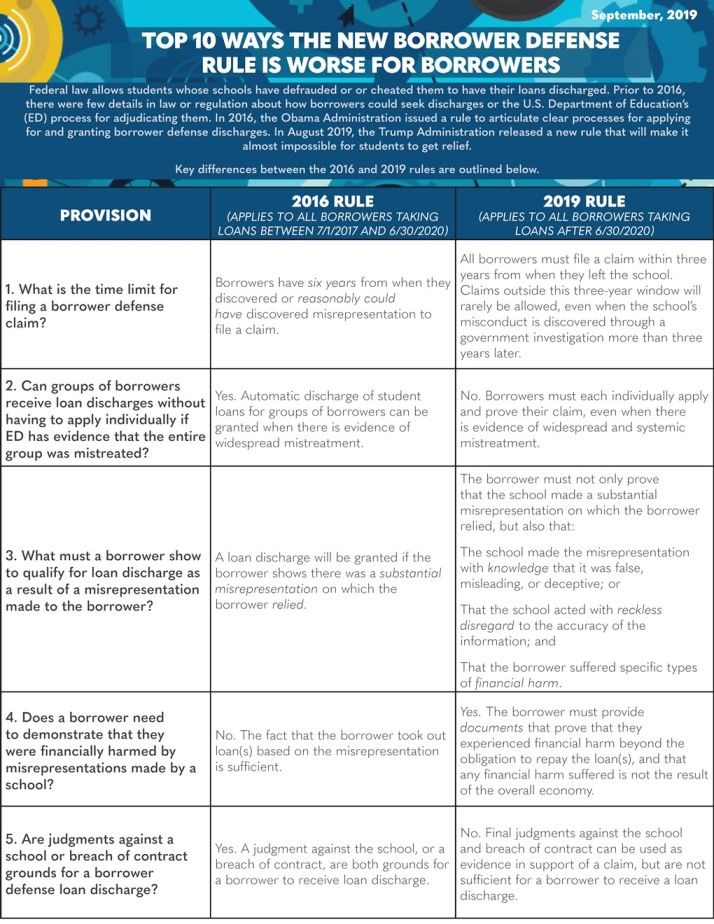
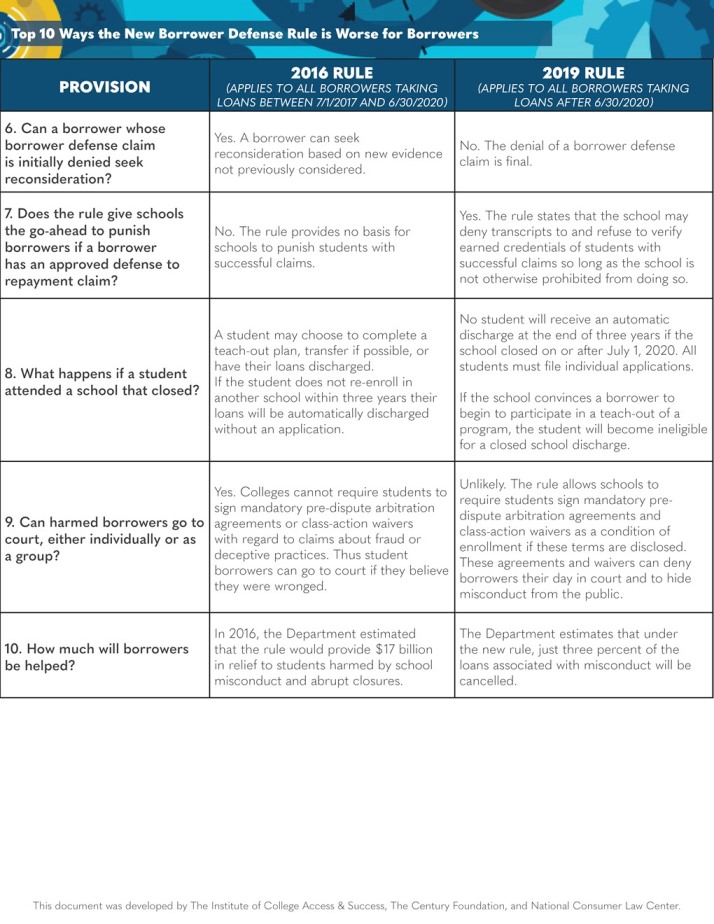
                  Today, the U.S. Department of Education officially published new rules  stripping away protections put in place by the Obama administration in what is often called the “borrower defense rule.” As a result, students who were harmed by school misconduct or closures will have a harder time getting relief from their federal student loans or holding schools accountable for illegal conduct. The 2016 borrower defense rule was designed to rein in predatory school conduct and to ensure that student borrowers have a fair shot at holding their schools accountable and getting relief they are entitled to by law.

                  The Department of Education predicts that these rollbacks will mean that student loan borrowers hurt by school closures, fraud, and misleading recruiting practices will receive $512.5 million less in student loan relief per year. This is unconscionable.

                  Student loan debt is at crisis levels, and the students suffering the most include those who went to schools that closed abruptly, used questionable recruiting practices to convince people to enroll, or both. This rule, if it goes into effect (we expect legal challenges), will encourage schools to double down on risky and illegal practices. And it will make it much less likely that student borrowers will get the loan relief they need and deserve.

                  The new, less student-friendly rules are scheduled to go into effect July 1, 2020. Most of the changes to student relief rights will only apply to new loans first disbursed on or after that date, and so most current borrowers will not be impacted.  Information for current borrowers on getting loan relief based on school misconduct or closure is available on our website.

                  But some changes will kick in sooner and may hurt current student borrowers. For example, current borrowers attending a school that closes after July 1, 2020 will be stuck with their loans unless they apply for a closed school discharge.  In contrast, many borrowers whose school closes between November 1, 2013 and June 30, 2020 will have their loans automatically cancelled.

                  To make the important differences between the 2016 borrower defense rules and the new rules clear, we’ve worked with The Institute for College Access & Success (TICAS) and The Century Foundation to create the chart below, listing the top 10 ways the new borrower defense rule is worse for student loan borrowers.

                  By: Kendra Cobb*

                  Last month marked the 25th anniversary of the first income-driven repayment (IDR) plan: the Income-Contingent Repayment Plan (ICR). This means that student loan borrowers who entered ICR in 1994 should begin receiving loan forgiveness for completing 25 years of qualifying payments. Borrowers enrolled in ICR who have not yet completed 25 years of payments can achieve forgiveness sooner or immediately by switching to another IDR plan with a shorter repayment period—and they may also reduce their monthly payments by switching.

                  Loan Forgiveness Under Income-Driven Repayment (IDR) Plans

                  The Department of Education offers multiple IDR plans to Direct Loan borrowers: Income-Based Repayment (IBR), Income-Contingent Repayment (ICR), Pay-As-You-Earn (PAYE), and Revised Pay-As-You-Earn (REPAYE). Borrowers can choose an IDR plan that allows them to pay a percentage of their discretionary income toward their student loans. These plans can help many borrowers afford their loan payments, avoid the severe consequences of default, and ultimately, receive loan forgiveness. Each plan forgives any remaining balance of the borrower’s loans after a period of 20 or 25 years of making qualifying payments. The amount forgiven is taxable, which means the borrower may pay income taxes as if they earned the forgiven balance as income.

                  Borrowers in ICR Can Achieve Forgiveness Sooner by Switching Plans

                  While ICR requires a 25-year repayment period for borrowers to achieve loan forgiveness, several other IDR plans require a 20-year repayment period. When switching IDR plans, borrowers generally keep credit for the number of qualifying payments already made under another IDR plan. This means that some borrowers can have their loans forgiven immediately or sooner by switching to an IDR plan with a shorter repayment period.

                  In particular, borrowers in ICR can switch to REPAYE and achieve immediate forgiveness if the borrower: 1) entered ICR prior to July 1999; 2) has made at least 20 years of qualifying payments; and 3) does not have loans for graduate school.

                  Borrowers in ICR with fewer than 20 years of qualifying payments may still be able to achieve forgiveness sooner by switching to one of the other IDR plans. A few things to keep in mind:

                  • If the borrower has loans for graduate school, then REPAYE requires a 25-year repayment period.
                  • The PAYE and 2014 IBR repayment plans also forgive loan balances after 20 years, but, unlike REPAYE, these plans are only available to borrowers who took out their first federal student loans much later than 1999.
                  • Borrowers who consolidated a Parent PLUS loan into a Direct Consolidation Loan are not eligible to repay that loan under REPAYE, PAYE, or IBR, even though they are eligible to pay under ICR.
                  • Think carefully before consolidating: Borrowers who consolidate their loans reset their qualifying payment count and lose credit for the number of qualifying payments made prior to consolidating.

                  Borrowers in ICR Can Reduce Payments by Switching Plans

                  Even for ICR borrowers who have not made twenty years of qualifying payments, there are still benefits to switching IDR plans. Not only can switching help borrowers achieve forgiveness sooner, but many borrowers would also see significant decreases in their monthly payments.

                  The ICR plan uses a different formula and a different definition of discretionary income than other IDR plans and as a result the payments are generally more expensive. ICR borrowers currently repay their student loans with the lesser of (A) 20% of their income in excess of 100% of the federal poverty guideline or (B) an amount based on payments under a 12 year plan. In contrast, borrowers in other IDR plans only repay 10% or 15% of their income in excess of 150% of the federal poverty guideline. These calculations can make a huge difference for borrowers. For example, a single borrower with two kids, an adjusted gross income of $50,000, and a $35,000 Direct Loan balance at 6% interest would have their monthly payments cut from $315 to $150 by switching from ICR to REPAYE.

                  Bottom line: ICR borrowers can switch IDR plans to achieve loan forgiveness faster or reduce their monthly payments.

                  Have you achieved loan forgiveness by switching IDR plans? Share your story!


                  *Kendra Cobb is an intern at the National Consumer Law Center and a rising third-year law student at Howard University School of Law who is passionate about financial services and economic empowerment.

                  About the author: National Consumer Law Center intern Kendra Cobb is a rising third-year law student at Howard University School of Law who is passionate about financial services and economic empowerment. She serves as Vice-President of the Business Law Society and has experience working with the U.S. Securities and Exchange Commission, an estate planning firm, and non-profits that focus on protecting consumers.

                  Celebrations are in order! This month is the 25th anniversary of the first income-driven repayment (IDR) plan, which means federal student loan borrowers may be eligible for forgiveness of their loans.

                  What is income-driven repayment (IDR)?

                  If not in default, borrowers can choose an IDR plan that allows them to pay a percentage of their income toward their student loans. These plans can help many borrowers afford their loan payments, avoid the severe consequences of default, and ultimately, receive loan forgiveness. Many borrowers know of loan forgiveness under the public student loan forgiveness program, but loan forgiveness can also be achieved through IDR plans. In fact, the first group of borrowers to enter and remain in the original IDR plan—income-contingent repayment —since 1994 will be eligible for forgiveness this month.

                  Each IDR plan has different eligibility requirements that depend on the type of loan, when the loan was taken out, and if the borrower has a partial financial hardship. Each plan also forgives any remaining balance of the borrower’s loans after a period of time of making qualifying payments.

                  What is a qualifying payment?

                  Understanding what a qualifying payment is can be tricky, but generally the payment needs to be the right amount and made in the right type of repayment plan.

                  Borrowers can count the time in the following scenarios toward forgiveness:

                  • When a borrower is enrolled in any of the IDR plans and makes monthly payments based on their income. This includes payments that are set at $0.00.
                  • For borrowers in income based repayment or Pay As You Earn plans who no longer have a partial financial hardship and make the required payments in the same amount as the ten-year standard monthly payment plan.
                  • When a borrower is enrolled in another plan and the monthly payments are equal to or more than the payments required under the standard ten-year plan.
                  • When a borrower receives an economic hardship deferment, which is limited to three years of qualifying payments (e. 36 monthly payments).

                  Fortunately, qualifying payments are cumulative and not consecutive. This means that borrowers can stop and then restart payments without losing the number of qualifying payments already made. However, borrowers who consolidate their loans while in an IDR plan will reset the count and will lose the number of qualifying payments already made.

                  Furthermore, the repayment period must end before the borrower is eligible for forgiveness. Borrowers can overpay or prepay their payments, but cannot qualify for forgiveness faster by doing so. For example, Borrower A has a $25 monthly payment under an IDR plan and four months remaining in their repayment period. If Borrower A prepays $100, then she will get credit for four payments. However, her loans will not be forgiven until those four months have passed.

                   What is the borrower’s lender or servicer responsible for?

                  Six months before a borrower meets the requirements for IDR loan forgiveness, the lender or servicer must send the borrower a written notice. The notice must: 1) explain that the borrower is approaching their date to receive loan forgiveness; 2) remind the borrower to make their remaining monthly payments; and 3) explain how the forgiven amount will be taxed.

                  After the lender or servicer determines that a borrower has satisfied the loan forgiveness requirements under an IDR plan, it forgives the remaining balance and accrued interest on that loan. However, the amount forgiven is taxable, which means the borrower may pay income taxes as if they earned the forgiven balance as income. There are some exceptions to taxation that may apply, such as insolvency—where a borrower’s debts exceed their assets.  At a minimum, borrowers should seek advice about potential tax problems and begin saving for any future costs.

                  What can borrowers do to make sure they receive loan forgiveness? 

                  Forgiveness under an IDR plan is supposed to happen automatically. However, borrowers must be aware and persistent. Borrowers who want to make certain they remain eligible for loan forgiveness under IDR plans should check for the following:

                  • Confirm that you are in the right repayment plan. This includes knowing what type of loans you have (this can be found in the National Student Loan Data System) and knowing the circumstances of your financial hardship.
                  • Recertify your income annually and on time. If you fail to submit the recertification request on time, then you risk being switched from your current IDR plan to the standard ten-year repayment plan and could face substantially higher monthly payments. Also, your servicer may be required to capitalize interest on the loan.
                  • Know what a qualifying payment is and do not rely on your student loan servicer to track the payments properly. Keep a paper trail of all qualifying payments, annual recertifications, and any other communications with your servicer.

                  By following these practices now, borrowers will be in much better shape and much more likely to receive forgiveness under IDR plans in the future.

                  Are you approaching forgiveness under an IDR plan? Share your story!

                  It was a big week in the fight for student loan justice, including a new lawsuit and a court victory.

                  The lawsuit:

                  Defrauded former for-profit college students filed a lawsuit this week against the U.S. Department of Education and Education Secretary Betsy DeVos seeking to force the agency to follow existing law and issue the debt relief to which the former students are entitled. The named plaintiffs are suing on behalf of a class of more than 158,000 former students who have filed applications for borrower defense to repayment.

                  With this lawsuit (Sweet v. DeVos), the plaintiffs are demanding that the Department do its job and start adjudicating their borrower defenses immediately.

                  If you are a student who was cheated by a for-profit college and you are waiting for  the Department of Education to make a decision on your borrower defense claim, you can support the litigation by submitting written testimony to the court about how you have been hurt by the for-profit college industry and the Department, and the impact this debt is having on your life.

                  The court victory:

                  The National Student Legal Defense Network (NSLDN) issued a statement after the 7th Circuit Court of Appeals ruled that student loan servicers can be held accountable under state consumer protection laws.

                  “This decision is a victory for student loan borrowers and a powerful rebuke to the attempts by Betsy DeVos to shield student loan servicers from oversight,” said NSLDN Vice President and Chief Counsel Dan Zibel, who argued the case before the 7th Circuit.  Zibel also said that the ruling “…ensures that the courtroom doors will remain open to student loan borrowers and state attorneys general fighting on their behalf.”

                  The Student Borrower Protection Center has more information about existing and proposed state efforts to rein in student loan servicing abuses.

                  This post originally appeared on https://protectborrowers.org/qualifying-payments/

                  This year, we’ve seen lawmakers in states across the country demand accountability from the private-sector student loan companies that handle loans for more than 44 million Americans. These breakdowns include lost paperwork and shoddy record-keeping when loans are transferred between companies—a process that has affected more than 10 million student loan borrowers over the past decade.

                  In California, we are working with lawmakers and advocates to advance legislation that includes strong new standards to protect borrowers when loans are transferred between companies, ensuring breakdowns no longer damage borrowers’ credit, increase interest charges, and jeopardize progress toward and eligibility for a range of loan forgiveness and debt cancellation options.

                  The Trump Administration has raised the stakes for tens of millions of borrowers, pulling down planned consumer protections while advancing a sweeping new proposal that will cause more than 37 million borrowers’ loans to change companies in the coming years. The following guest post from Persis Yu, Director of the Student Loan Borrower Assistance Project at the National Consumer Law Center, illustrates how loan transfers can lead to serious problems for borrowers pursuing loan forgiveness under an income-driven repayment plan or Public Service Loan Forgiveness—just one example of the problems hurting consumers across the student loan system every day.

                  ———————————————————————————————————-

                  By now you’ve probably heard about the problems with the Public Service Loan Forgiveness program. I addressed this issue in an October 2018 blog post, 96 Out of 28,000 Borrowers Approved for Public Service Loan Forgiveness … What Does This Mean for Everyone Else? In April, the New York Times highlighted one of the problems keeping borrowers from accessing loan forgiveness: errors in the count of their qualifying payments.

                  One might think, if it’s just counting, how hard could this be?

                  This is where the complicated program features come in. To be eligible for loan forgiveness under PSLF, borrowers need to make 120 qualifying payments. This means that the payment needs to be the right amount, made at the right time, and in the right type of repayment plan. (PSLF also requires that these qualifying payments need be made simultaneously while working the right number of hours in the right kind of job.)

                  So the month in which you made the payment a couple weeks late does not count. Or if you made payments when your servicer put you in an administrative forbearance to renew your income driven repayment (IDR) plan, those don’t count either. Or if the customer service representative suggested that you switch to the extended repayment plan for a year because you could make a lower payment, all those payments don’t qualify.

                  So how do you know which payments qualify? Well if you kept meticulous records for over a decade, you might be able to piece that information together. Maybe. But what if you mailed payments? How would you know when the servicer received and applied the payment? Your servicer may have placed your account in an administrative forbearance for a short period of time to resolve a paperwork issue and you might not have documentation of it.

                  Importantly, borrowers cannot rely on their servicers to get this count right. For example, we’ve heard from a number of borrowers who have challenged FedLoan Servicing, which is one of the Direct Loan servicers and is the specialty servicer for PSLF, on its PSLF count and gotten the count corrected.

                  In order to verify the number of qualifying payments and to ensure that servicers are counting payments properly, borrowers need to have access to a full and complete payment history. Sadly though, borrowers do not currently have easy access to this information. Borrowers are able to get basic level information about their federal loans from the National Student Loan Data System, but it does not provide payment level data.

                  The student loan servicer that is servicing a particular loan should have payment records, but the extent to which they make this information available varies by servicer.  Unlike with mortgages where servicers are required to provide you with information within 30 days of a qualifying written request, there are no federal standards requiring a student loan servicer to give the borrower a payment history.

                  FedLoan’s website gives the borrower the option to download a payment history, but the spreadsheet it provides is far from complete.

                  As you can see, while it does have the payment amount and date, critically it doesn’t identify the borrower’s payment plan, which is necessary to know in order to determine whether the payment is a qualifying payment.

                  Here is an image of a payment history from Nelnet, one of the other Direct Loan servicers.

                  Although you cannot tell from the FedLoan payment history, that borrower is making payments in an IDR plan. The borrower with Nelnet, however, is in a deferment while making these payments.  Neither of these payment histories provides that level of detail, making it impossible to tell from these records which borrower is making qualifying payments or how many.

                  Notably, a payment history received from Direct Loan servicer, MOHELA, shows not only the dates and amounts of the borrower’s payments, but also the borrower’s payment plan (not shown).

                  Critically, however, none of these payment histories provides any information prior to the loan being transferred to its current servicer. A lot of the counting problems stem from payments made prior to a transfer. According to the New York Times, FedLoan is telling borrowers seeking PSLF that it will take more than a year to get accurate histories of their payments that occurred prior to the transfer to FedLoan.

                  Until 2009, all Direct Loans were serviced by a single Direct Loan servicer, ACS (Xerox). In 2009, as it was moving to a system under which nearly all student loans were originated directly by the federal government through the Direct Loan Program, the Department of Education entered into new servicing contracts with four companies, Great Lakes Educational Loan Services, Nelnet, FedLoan Servicing (PHEAA), and Sallie Mae (now Navient). Loans were transferred from ACS to the new servicers between the years 2009 and 2013. The Department also contracts with a number of non-profit student loan servicers, including Cornerstone, Granite State, HESC/EdFinancial, MOHELA, and OSLA.

                  For almost all borrowers who are now seeking to have their loans cancelled through PSLF, servicing of their loans started with ACS and was then transferred to one of the new servicers between 2009 and 2013.  This means that the problem of obtaining a complete payment history when servicing was transferred from one servicer to another is impacting nearly everyone applying for PSLF.

                  PSLF is not the only forgiveness program that requires counting months. For borrowers seeking forgiveness under an income driven repayment plan, these problems are just going to be magnified. Instead of keeping track of 120 payments, these borrowers (and their servicers) will need to keep track of 240 or 300 payments (20 or 25 years depending on the plan). And any Direct Loan borrower who will be expecting forgiveness in the next decade will have transferred servicers.

                  Critically, IDR forgiveness is supposed to happen automatically. If servicers are miscounting IDR payments, borrowers will be overpaying on their loans. Borrowers need assurance that their loan payments are being counted properly. Without access to an adequate payment history, keeping track of these payments and holding servicers accountable will be nearly impossible.

                  Have you tried to get your payment history? What was your experience? Share your story.

                  You might think that struggling student loan borrowers face enough stress and pain from the government’s extreme student loan collection powers. This is sadly not the case. Many states have compounded borrowers’ pain by suspending or revoking professional licenses of borrowers in default on student loans. Even that is not enough. Schools often pile on by withholding academic transcripts from students seeking to move on with their educations.

                  As attorney Rebecca Maurer writes on the Student Borrower Protection Center web site, harm to struggling borrowers all too often extends beyond student loans. Many schools aggressively pursue students and former students for “accounts receivables”; that is, debts allegedly owed to the schools for fees, parking tickets, library fines etc..

                  Attorney Maurer (also a Student Loan Justice Fellow fellow with the Student Borrower Protection Center) writes about the ways in which schools destroy students’ efforts to move on and complete their educations by holding academic transcripts hostage until students resolve their accounts. These students end up trapped, needing the transcript to complete the degree and get a higher paying job, but without the higher paying job, lacking the income needed to pay off the school account and get the transcript released. 

                  The article, reprinted below, is a call to action to states to regulate transcript withholding. 

                  —————————————————————————————————-

                  Accounts Receivable & Withheld Transcripts: The Quiet Higher Ed Crisis That States Could be Tackling

                  By Rebecca Maurer | March 29, 2019

                  We are used to thinking of the higher education financing crisis through the lens of a singular issue: student loans. But recent court settlements at for-profit colleges have shed light on a less traditional type of student debt: past-due financial accounts, otherwise known as accounts receivable.

                  While defaulted student loans can lead to long-term problems like bad credit and wage garnishment, accounts receivable have a much more immediate effect: a school can decide to withhold a student’s transcript, preventing that student from transferring credits or obtaining a higher-paying job. Indeed, a withheld transcript puts a student in a Catch-22. She may need the transcript to complete her degree to get a higher paying job. But without the higher paying job, she cannot get the extra income to pay off her debt and have her transcript released.

                  Unlike much of student loan law, transcript withholding is well within the purview of state regulators since it is tied to state-level property rights. This means that as states increasingly step into the role of protecting student borrowers, they should consider regulating transcript withholding as part of their work.

                  It’s worth backing up to get the larger picture. How did we get here and how large of a problem are accounts receivable and withheld transcripts?

                  At most institutions of higher education, students can carry an open financial account with the school. In other words, the school can charge fees that are not covered by federal student loans, Pell Grants, scholarships or other sources of income. The debts are open balances owed due directly to the school.

                  At many schools, these accounts are low balances that consist of things like library fines, parking tickets, and lab fees. But at other schools, students rack up large amounts of tuition debt owed directly to the school.

                  Recent case studies show that there may be large numbers of these receivables on the books of many colleges, especially for-profit colleges.

                  As part of their bankruptcy representation, the Harvard Project on Predatory Student Lending helped to resolve more than $600 million in receivable accounts owed directly to ITT Tech by 750,000 students—amounting to an average of $800 per student.

                  A group of 49 attorneys general recently settled claims against Career Education Corporation (CEC)—the parent company of for-profit schools like Sanford Brown Institutes, Le Cordon Bleu, and Colorado Technical University. The settlement demonstrated that CEC was carrying $493 million in institutional receivables—an average of $2,750 per student.

                  A review of SEC filings for other for-profit schools show examples of millions in accounts receivables tied to students. For instance, Bridgepoint Education, which runs for-profit schools Ashford University and University of the Rockies, reported almost $50 million in accounts receivable in their most recent 10-Q to the SEC, a 10% increase from the year before. It is hard to determine exactly how many open accounts receivable the school has, but with an average student enrollment around 40,000, there is more than $1000 in open accounts receivable for every enrolled student.

                  While the problem may be particularly acute at for-profit schools, it certainly is not limited to them. My research into collections practices at Ohio schools revealed that the Ohio Attorney General currently has almost 400,000 open collection accounts tied to the state’s public universities—enough for 1-in-every-30 people in Ohio.

                  How do we know about the link between accounts receivable and withheld transcripts? I made a public records request to every public university in Ohio, and each one that replied had a policy saying that transcripts would be withheld for any past-due balanced owed directly to the school. In other words, each of those 400,000 accounts likely represents a withheld transcript. That is an immense amount of economic potential locked up by past-due school fees.

                  The CFPB’s 2015 case against ITT Technical Institute demonstrates an even darker side of this connection between past-due accounts and transcript withholding. The Bureau alleged that, “ITT leveraged the threat of withholding transcripts” if students failed to cover the balance of their tuition.[1]The Court agreed that “the threat of withholding vital educational assets like transcripts and class credit is not only likely but appears calculated to produce considerable leverage over ITT students, and that under certain circumstances the deployment of such leverage could fairly be termed ‘coercive.’”[2]

                  Despite the apparent wide-spread use of transcript withholding, there is almost no legal literature on the topic of accounts receivable and transcript withholding. In fact, the few courts that have taken up the question have differed wildly on whether a student even has a fundamental property right to their transcript.[3]

                  In the absence of a legal consensus, the opportunity has arisen for misconduct by schools, as we see in the case of ITT Tech. But the relatively open regulatory space—as well as intersection of transcript withholding with state property law—means there is an opportunity for states to address the issue.

                  We are already seeing the rise of states that are stepping up to protect student borrowers in the absence of leadership from Washington. Policy issues around transcript withholding should be on the table as well. For instance, a state could prohibit transcript withholding overall, or alternately, a state could explicitly give students a property interest in their official transcript for the completed course they have paid for in full. This property right would give students the ability to access most of their transcript, even if they end up with a past-due account for their final classes.

                  Even without regulatory changes, state attorneys general should investigate the practice of transcript withholding to look for misconduct. In Ohio, there are certain schools that seem to have a far higher number of open accounts per enrolled student than others, raising the question of whether the school policies and practices are encouraging students to get trapped into yet another debt cycle.

                  Transcript withholding tied to accounts receivable is a quiet higher education financing crisis.  All the numbers point to the conclusion that there are millions of Americans with economic potential locked up in their transcript. These citizens cannot get the jobs they are qualified for or are discouraged from finishing their degree because they cannot get the credits they have already completed.

                  Addressing the practice of transcript withholding needs to be part of the conversation of how we protect students. And in California, Assembly Member Luz Rivas has already taken the step to address this in AB 1313, which was sponsored by California Attorney General Xavier Becerra and seeks to prohibit schools from refusing to provide transcripts to current or former students due to an unpaid debt. Other states can look to legislation like this as a model for how to better protect students from abuses that disrupt lives, and derail the pursuit of a higher education.

                  ###

                  Rebecca Maurer is an attorney practicing in Cleveland, Ohio and a SBPC Student Loan Justice Fellow. She consults and writes on a variety of student loan, consumer debt, and housing issues. You can read more about her work here. 

                  [1] Consumer Fin. Protection Bureau v. ITT Educ. Servs., 219 F. Supp. 3d 878, 917 (S.D. Ind. 2015).

                  [2] Id. at 915.

                  [3]  Compare Juras v. Aman Collection Serv., Inc., 829 F.2d 739, 742 (9th Cir. 1987) (finding it “unlikely” that the transcript belongs to the student), Ball St. U. v. Irons, 27 N.E.3d 717, 723 (Ind. 2015) (finding that the transcript was, in fact, the property of the student), and In re Kuehn, 563 F.3d 289, 294 (7th Cir. 2009) (finding that “the students and colleges [were] to be joint owners” of the transcripts).


                  Since you must work for 10 years in a qualifying job to get public service loan forgiveness and the program only started in late 2007, borrowers have only recently become eligible for relief. Unfortunately, so far, more than 99 out of every 100 public service workers who applied for loan forgiveness were rejected. Among other actions and investigations, the Student Borrower Protection Center and American Federation of Teachers have launched an investigation into problems with administration of  public service loan forgiveness (PSLF).

                  In an effort to help borrowers who got bad advice about eligibility or experience other problems, Congress passed legislation in 2018 that provides limited, additional conditions under which a borrower may become eligible for public service loan forgiveness if some or all of the payments the borrower made on a Direct Loan were under a nonqualifying repayment plan. The Department is calling this new program the Temporary Expanded Public Service Loan Forgiveness (TEPSLF) opportunity.

                  You might want to consider consulting with a trustworthy attorney if you have questions about your eligibility.  To help get you started, we present an excerpt below from the blog of Boston student loan attorney Adam Minsky.  He shares his thoughts about what to expect from the temporary public service loan forgiveness program and why he thinks the Department may have created yet another program that is difficult for borrowers to navigate and obtain relief.

                  ———————————————————————————————————-

                  From Adam Minsky’s May 24, 2018 post, “New Details on Expanded Student Loan Forgiveness”:

                  First, a recap of PSLF. To get your student loans forgiven under the program, a borrower must make 120 “qualifying payments.” A “qualifying payment” is one that is made (1) on the right type of federal student loan, which is a Direct loan; (2) under the right type of repayment plan – which is either an income-driven repayment plan or the 10-year Standard plan; while (3) working in qualifying employment. 

                  Millions of student loan borrowers belatedly found out that they made no progress towards loan forgiveness under the PSLF program because while they  met the first and third criteria, they didn’t meet the second criteria because they were on the wrong repayment plan – like an Extended plan or a Graduated plan. So Congress passed a fix earlier this year – they are allowing these borrowers to petition the Dept. of Education to “count” these payments that otherwise should not have counted.

                  However, this fix is not full-proof, guaranteed, or permanent. Congress allocated $350 million to fund this expansion, but relief will be provided on a first-come / first-serve basis, and there are several other requirements as well (check out my overview of the expansion to get more details on the program’s requirements, and its limitations). So we were all left wondering – how exactly will this work?

                  [Last year] the Dept. of Education released an overview for what they are calling Temporary Expanded PSLF (or “TEPSLF”). Here’s how they say it will work:

                  • Borrowers must first apply to have their loans forgiven under the PSLF program, and be denied because they haven’t made enough qualifying payments, even though they were making payments on their Direct federal loans while working in qualifying PSLF employment for 10 years.
                  • Borrowers must have accrued 120 payments that would qualify for loan forgiveness under the new requirements of the “TEPSLF” program.
                  • Borrowers can then request reconsideration of their denied PSLF application by sending an email to FedLoan Servicing, the servicer tasked with handling the PSLF program. The email address is TEPSLF@MyFedLoan.org.

                  I think this is a mess. Here’s why:

                  • There appears to be no mechanism for borrowers to get a preliminary count of qualifying payments under TEPSLF, and there seems to be no way for borrowers to do a cut-and-dry application for loan forgiveness under the expanded requirements. Instead, borrowers must first apply for PSLF, be denied, and then appeal. That’s not exactly what I’d call efficient.
                  • FedLoan Servicing, which handles the PSLF program, already causes widespread delays and errors when processing qualifying PSLF payments. I do not expect their processing of the TEPSLF program to be any better.

                  Ultimately, I think the Dept. of Education is intentionally setting up the procedure in this manner to make it difficult for borrowers to obtain a benefit that they are entitled to under federal law. Borrowers who are on track for PSLF – and particularly those borrowers who may qualify under TEPSLF – should keep meticulous records of their student loan payments and related correspondence, and should be prepared for a tedious months-long process of applications and appeals.


                  We have more information about PSLF and other federal loan cancellation programs on this site.

                  Last week, Senator Lamar Alexander, the Chair of the U.S. Senate Committee on Health, Education, Labor and Pensions, proposed a program that would require student loan borrowers to repay their loans through mandatory automatic deductions from their paychecks. Yesterday, the National Consumer Law Center released a policy brief, The Dark Side of Payroll Withholding to Repay Student Loans, explaining why forcing borrowers to pay their student loans through their employers will harm many of the very borrowers these programs are hoping to help.

                  For many borrowers, including those who lack stable employment or work in the gig economy, forced automatic payroll withholding may mean diverting money away from rent, heat or food in order to pay their student loans. It could also mean that they would have to give their employers a lot of information about their families (potentially including a spouse’s income) and their student loan debt in order to calculate the student loan payment amount.

                  Some borrowers already experience a form of mandatory payroll withholding to repay their student loans, administrative wage garnishment, which can happen if a borrower falls behind on loan payments and defaults. Many borrowers have told us that wage garnishment makes it harder to pay the rent or other bills, or buy school supplies for their kids.

                  Have you experienced wage garnishment? How has it impacted you and your family? Share your story.

                  Also, did you know that you may be able to challenge or reduce a federal student loan garnishment? The most common reason is that the garnishment would cause financial hardship to you and your dependents. Click here to see more on how wage garnishments are calculated and the defenses you can raise.

                  By Margaret Mattes

                  Tens of thousands of student borrowers unable to complete their educations at the approximately 1473 postsecondary schools or campuses that closed between November 2013 and November 2015 nationwide are now entitled to have their federal student loans immediately discharged—i.e., cancelled. As of October 16, 2018, the U.S. Department of Education is legally required to discharge federal student loans of eligible students impacted by closures during that time period without requiring the student to apply for relief.

                  But the Department has failed to do so. In a complaint filed in November, the National Student Legal Defense Network (NSLDN), on behalf of Housing and Economic Rights Advocates, claims that the Department has “unabashedly and intentionally” refused to implement rules requiring it to automatically discharge certain student loans. Despite the requirement that the Department “must grant automatic discharges to students whose schools closed on or after November 1, 2013, and who do not re-enroll at another Title IV-eligible institution within three years of their school’s closure date,” the complaint alleges that the Department continues to collect on these loans. The lawsuit asks the court to order the Department to implement the rules requiring automatic closed school discharges immediately. NSLDN estimates that if the automatic closed school discharge rule were implemented, $250 million in student loan debt would be immediately canceled.

                  The current administration’s opposition to providing automatic relief to students impacted by school closures is no secret. It has repeatedly delayed implementing the automatic closed school discharge regulation. But a federal court held earlier this year that these delays were illegal and ordered the Department to put the regulations into effect.

                  Who is eligible for an automatic closed school discharge? 

                  Federal student loan borrowers are eligible for an automatic closed school discharge if:

                  • they were enrolled at a school or campus that closed after November 1, 2013 at the time of closure or withdrew within 120* days of the date the school closed, and
                  • they did not complete their educational program, and
                  • they did not re-enroll in another school that participates in the federal student loan program within three years of their schools’ closure date.

                  Students in schools that closed after November 2015 are thus not yet eligible for automatic debt relief.

                  Massachusetts Closed Schools Whose Students May Now Be Eligible For Automatic Loan Discharges

                  This chart represents a partial list of schools or campuses in Massachusetts that closed between November 2013 and November 2015. If you attended one of these institutions within 120 days of the date the school closed and did not complete your educational program, you may be eligible to have your federal student loans canceled.

                  School Name Location(s) Date of Closure
                  Altierus Career Education Chelsea May 15, 2015
                  Central Mass School Of Massage And Therapy Spencer December 24, 2014
                  Empire Beauty School Hyannis, Lowell June 29, 2015
                  Everest Institute Brighton October 27, 2014
                  Kaplan Career Institute Boston November 14, 2013
                  Marian Court College Swampscott June 30, 2015
                  Portfolio Center Waltham December 31, 2014
                  Sanford-brown College Boston May 2, 2014
                  Sullivan And Cogliano Training Centers Brockton November 17, 2014

                  Source: Federal Student Aid, U.S. Dep’t of Educ., “Closed School Weekly/Monthly Reports.”

                  Borrowers can still apply for a closed school discharge rather than waiting for automatic relief.

                  Whether or not a borrower is eligible for an automatic closed school discharge—ie, a discharge without applying—borrowers who were harmed by their school’s closure can still apply for a closed school discharge now rather than waiting for automatic relief from the government. And borrowers who apply for a discharge do not have to wait three years from their school closure to get it. Borrowers are generally eligible for discharge upon application if:

                  • they were enrolled at a school or campus that closed at the time of closure or if they withdrew within 120* days of the date the school closed, and
                  • they did not complete their educational program at their school, through a teach-out, or by transferring credits to another school.

                  More information about who is eligible for a closed school discharge and how to apply is available here as well as on the Department’s website.

                  Do you believe you are eligible for automatic forgiveness of your student loans because your school closed between November 2013 and November 2015? How has having student loans for a school that closed impacted you? Tell us your story.


                   *120 days is the general rule, but sometimes the Department recognizes “exceptional circumstances” for which it approves discharges for people who withdrew more than 120 days before closure.

                  This month, in a victory by and for student loan borrowers, a court ordered that the Department of Education had illegally delayed giving effect to an important rule from 2016 designed to protect student loan borrowers and taxpayers from school closures and misconduct.  The court’s order meant that the rule—often called the 2016 “Borrower Defense” Rule—went into effect on October 16, 2018.  This post describes how we got here and what the order means for student loan borrower rights.  A related article geared toward attorneys is available on NCLC’s Digital Library.

                  Secretary DeVos’s Attempts to Stop Borrower Defense Rule

                  Under the Obama Administration, the Department of Education published rules on November 1, 2016 that were scheduled to take effect on July 1, 2017.  But the administration changed before the July effective date, and the new Trump Administration and Secretary of Education DeVos said the rules made it too easy for borrowers to get student loan relief.  So, the Secretary tried to prevent the rules from going into effect using several delay notices while starting work on a replacement rule that would make it much harder for borrowers to get relief.

                  Court Agrees with Student Borrowers: Department’s Attempts to Stop Rule are Illegal

                  Student loan borrowers, as well as state attorneys general from 19 states plus Washington D.C. filed suit against Secretary DeVos challenging these delays as illegal.  The court agreed, holding that the delays were illegal and ordering that they be vacated (ended), effective October 16, 2018.

                  Department’s Efforts to Replace Rule with Terrible One Hit a Snag

                  While this court case has been going on, the Department has continued efforts to create a new rule to replace the 2016 Borrower Defense Rule.  It proposed a new rule on July 31, 2018.  The legal aid community analyzed the proposed new rule and concluded it would make it much harder to get relief for struggling borrowers whose school closed before they could graduate or lied to them to get them to enroll and take out loans.  The civil rights community and a broad coalition of organizations that represent the interests of students, veterans and borrowers agreed and also strongly condemned the proposal.

                  The Department received thousands of comments opposing the proposal and stated that it will not be able to respond to all the comments and finalize a new rule until after November 1, 2018.  This is important because it means that the soonest this proposed rule could go into effect and “replace” the 2016 rule is July 1, 2020, due to a “Master Calendar” law that governs timing of student loan rules.  The 2016 rules should likely be the law of the land until at least July 2020.

                  What the Rule Means for Student Borrower’s Rights

                  The now formally effective 2016 Borrower Defense Rule should clarify and strengthen student borrowers’ rights to discharge their student loans or to sue their school in court when it cheats them or closes before they can graduate.  The sections below highlight some of these changes to student loan borrowers’ rights under the now-effective rule.

                  But to make these rights real the Department will have to follow the law itself and also require the servicers, debt collectors, and schools that participate in the student loan program to comply with the law. Given the Department’s repeated attempts to delay, rewrite, and otherwise thwart the rule, we will be watching to see what the Department will actually do.  With over 100,000 borrower defense applicants waiting for decisions from the Department, it is past time for the Department to step up and do its job of providing relief to cheated borrowers.

                  Rule Clarifies Process to Raise School-Related Borrower Defenses to Loan Repayment

                  The law has long allowed students to raise-school related defenses to repayment of their federal student loans, often called “borrower defense” claims, but there has been little clarity on how students may do so and how their claims will be evaluated.  The now-effective rules are intended to clarify borrower defense procedures, and provide important borrower protections. The rules provide a process for individual borrowers to submit applications to have their Direct Loans fully or partially discharged based on school misconduct, and clarify that a Department official will evaluate the claim using a preponderance of the evidence standard and decide on relief.  The current application form is available on the Department of Education’s website (with separate applications for former students of Everest, Heald, and WyoTech); borrowers should check for any updates to the form in the coming months.

                  After applying, the borrower will have a number of rights—including rights related to evidentiary submission and review, written decisions, reconsideration and appeals, as well as rights to forbearance and suspension of collection of defaulted loans while borrowers’ applications are awaiting decision or being reconsidered.

                  The rules also provide a group process through which the Department may provide class-wide relief, without requiring individual applications, in cases of widespread school misconduct.  However, borrowers should not hold their breath waiting for group relief—only the Secretary of Education may initiate a group process under the rules, and the current Secretary DeVos has proposed eliminating this provision, making it appear unlikely that she’ll use it to provide relief to borrowers.

                  Rule Creates New Standards for When Borrower Defenses Should be Approved

                  For newly disbursed Direct Loans (including Direct Consolidation Loans), students will have a borrower defense if: (a) their school breached a contractual promise; (b) their school made a substantial misrepresentation that the borrower reasonably relied on to his or her detriment in deciding to attend, or to continue attending, or in deciding to take out a Direct Loan; or (c) there is a nondefault, contested court judgment against the school in the borrower’s favor.

                  For previously disbursed loans, the prior standard will remain—allowing borrowers to assert a borrower defense based on any act or omission of the school that violates state law and relates to the making of the Direct loan or the provision of educational services for which the loan was provided that would.  This could include state unfair and deceptive practices laws, false advertising laws, refund laws, and contract law.

                  Time Limits on Borrower Defenses

                  Unfortunately, the new rule imposes time limits on the recovery of amounts already paid or collected from the borrower. For newly disbursed loans, a six-year limitations period will apply to refunds if the borrower’s defense is based on a breach of contract or a substantial misrepresentation, with the limitations period for substantial misrepresentation claims running from the time the borrower discovered or could have reasonably discovered the information constituting the misrepresentation. There is no time limit for raising these borrower defenses to discharge of amounts that borrowers still owe, and no time limits apply if there is a relevant judgment against the school.

                  For previously disbursed loans, the Department will use the “limitation period under the law applicable to the claim on which relief was granted.” Although state law generally permits borrowers to raise defenses to offset outstanding amounts due on loans so long as the loan is collectable, the Department may interpret this new rule to allow it to limit refunds of amounts already paid on outstanding loans. Equity should counsel against penalizing current borrowers for not “timely” asserting borrower defenses before there was even a process to do so, and such equity-based arguments may be available under applicable state law.

                  Borrower Defense Provisions Apply Only to Direct Loans

                  The new borrower-defense rights apply to students and parents with Direct Loans. The rules state that borrowers with Federal Family Education Loans (FFELs) and Perkins Loans may apply through the Direct Loan borrower defense process if they agree to consolidate their loans into a new Direct Consolidation Loan (for those eligible to so consolidate), but they will not be able to recover amounts already paid on their FFEL and Perkins loans through this process. Borrowers with FFEL loans may alternatively assert a defense under existing FFEL borrower defense regulations and the terms of their promissory notes, but the rules do not clarify the process for FFEL borrowers to assert borrower defenses.

                  Rule Provides New Rights for Students Harmed by School Closures or False Aid Eligibility Certification

                  Students have a right to have their federal loans discharge if their school closed before the student completed their program or the school falsely certified the student’s eligibility for federal student loans. The newly effective 2016 rules strengthen these protections.

                  Most importantly, the rules require the Department to provide closed school discharges automatically—without requiring the student to apply—for certain eligible borrowers. The closed school discharge should automatically be provided to eligible borrowers whose schools closed before they could complete their program on or after November 1, 2013 and who did not re-enroll in another school within three years of their school’s closure.  This means that thousands of borrowers whose schools closed between November 1, 2013 and October 25, 2015 are already entitled to an automatic discharge of their student loans.

                  False certification discharges are also clarified, for example by making it clear that borrowers qualify for discharges where the school falsified the borrower’s high school graduation or diploma or referred the student to a third party to obtain a falsified high school diploma.

                  Rule Protects Students’ Right to Go to Court

                  Importantly, the rules also bar schools that rely on federal tax dollars from shutting off student access to the courthouse through forced arbitration clauses—at least when students are making claims about the type of school misconduct that the borrower defense rule covers (e.g., false advertising, deceptive recruiting, breaches of contract, etc.).  The rules do this by requiring schools that wish to participate in the Direct Loan program to agree not to use pre-dispute arbitration clauses and class action bans that cover these types of claims in agreements with students, and to agree not to rely on any existing pre-dispute agreements with current or former students to stop them from bringing these types of claims in court.

                  This should mean that student borrowers are now free to sue their schools and to bring class actions for misconduct that led them to take out burdensome student loans.  If students sue, their attorneys should seek amended agreements in writing from the school agreeing they will not attempt to rely on the arbitration clauses.

                  This change is very important for protecting the rights of student loan borrowers, who have been unfairly stopped from raising their claims against predatory schools due to the arbitration clauses that most for-profit schools slip into their student enrollment agreements. (In contrast, public and non-profit schools rarely require their students to waive their right to go to court).  It is also a win for future students and for taxpayers.  As NCLC has explained in urging the Department and other government actors to bar these clauses, forced arbitration silences legitimate complaints about illegal conduct, forcing complaints into secretive arbitration systems or suppressing cases before they’re even filed.  By bringing these complaints into the open and allowing students to band together in asserting classwide claims, school misconduct should be made public much earlier on—helping prospective students and the government to decide whether a school deserves their dollars.

                  It has been one year since student loan borrowers have been theoretically eligible to have their loans forgiven under the Public Service Loan Forgiveness (PSLF) program. And yet, out of the 28,000 borrowers who applied, only 96 have had their loans forgiven. That is less than 1 percent of applicants.

                  That number is shocking and speaks volumes about the failures of a billion-dollar servicing industry. How could this happen?  First, servicers have failed to inform borrowers who requested certification for PSLF when they needed to consolidate their loans or change their payment plan to be eligible. Indeed, the Government Accountability Office (GAO) last month reported that of the approximately 1.2 million people who have requested to have their employment and loans certified as eligible for PSLF forgiveness, over 150,000 did not have any eligible loans and over 370,000 never made a single qualifying payment. Many of these errors could have been prevented had borrowers been properly counseled.

                  But information alone is insufficient to ensure that borrowers access the programs they are entitled to. Marketwatch highlighted one borrower, Anne Tamar-Mattis, who successfully had her loans forgiven only after what she described as a “crusade” requiring “dozens of phone calls,” bad advice from her servicer, processing errors and delays, and perhaps her law degree.

                  As a lawsuit brought by members of the American Federal of Teachers earlier this week highlights, servicers are standing in the way of borrowers accessing critical programs. According to the suit, borrowers who would have otherwise been eligible for forgiveness did not qualify because Navient allegedly provided these public servants with wrong information, extending the amount of time they would need to wait before having their loans discharged under the program and causing them to spend money unnecessarily on their debts.

                  Critically, these problems are not limited to PSLF. Many of the issues complained about in this lawsuit also harm low-income borrowers who would benefit from income-driven repayment (IDR), which can give a borrower an affordable repayment option and forgiveness of any remaining balance after 20 or 25 years. Some of the plaintiffs, for example, complained that Navient steered them away from IDR and into forbearances. Many of our low-income clients have experienced this problem and the Consumer Financial Protection Bureau has even sued Navient for the same behavior.

                  Other plaintiffs complained about misinformation about federal loan consolidation, which allows Federal Family Education Loan (FFEL) borrowers to access Direct Loan programs like PSLF and the Revised Pay As You Earn plan. One plaintiff was advised to consolidate her loans to lower her payments, thus wiping out the 37 payments (more than three years’ worth) she made which would have counted towards her ten years of repayment. Another was never told that she would need to consolidate in order to access PSLF, resulting in her having loans that were ineligible for PSLF.

                  The net effect of all these violations is that student loan borrowers are paying more money for a longer period of time. Worse, some of these borrowers are unable to access affordable repayment options and wind up in default, having their tax refunds (including the Earned Income Tax Credit), wages, and federal benefits taken as a result.  Like many things, the people who are going to be hurt the most by these problems are those who have the least resources. As Ms. Tamar-Mattis aptly noted, “Not everybody has a lawyer to work for them, a lot of people are just counting on the system to work.”

                  By Higher Ed Not Debt

                  The Department of Education wants your opinion!

                  Under the “borrower defense” rule, the federal government will give you loan relief if you were misled or lied to by your college. The “gainful employment” rule is supposed to ensure that colleges do not leave graduates with very low earnings and high debt. If career programs do not serve students well, they must improve or lose student aid eligibility.

                  The Department is rewriting these rules to make it much harder to get loan relief and is weakening critical protections for students, and your voice matters! 

                  Click here to make your voice heard!

                  Below are some tips on how to write the most effective public comment possible if you choose to write your own.

                  Here are some tips on how to write the most effective public comment possible.

                  • Be specific: Why did you go to school? What sacrifices did you make? How large is your student loan? Did the college provide you a good education? Were you prepared by your school for a job in the field you studied? Were the promises that recruiters made to you true? Have you had an easy time finding a job in your field of study? Do employers respect the credential you received at the school?
                  • Talk about how your experience affected you: Comments are stronger if they describe in detail the harm that you experienced. Beyond how much debt you owe, or how your job prospects don’t match what you were promised, think about things like lost income, career opportunities passed up, making family sacrifices, and more.


                  Talk about the harmful changes the Education Department (ED) is proposing

                  • Do you have written evidence? The changes that ED is proposing to the Borrower Defense rule would make it extremely difficult for borrowers to have their claims approved. Do you have documents that prove that the school intended to harm you? Do you think it is right for ED to require such proof of students who have been harmed? Do you think you should have to prove that you were financially harmed?
                  • Did you know about borrower defense right away? When you found out that your school mistreated you did you know that you could apply for borrower defense? The new rule would limit the amount of time you have to apply for relief. Some borrowers would lose eligibility without ever even knowing they could apply for borrower defense.
                  • Should all wronged students get relief? If ED knows that a school mistreated a group of students, do you think that all of those students should get relief? The new rule would require every borrower to apply on their own to be eligible for relief, even borrowers that ED knows have been wronged.
                  • Should wronged students get full loan relief? Do you think it is fair to use the amount of money that you earn, or the amount of money that your classmates earn to justify forgiving only a part of your loans, or not forgiving your loans at all, even when you have clearly been harmed?


                  Here’s the link again to make your voice heard!


                  By the Project on Predatory Student Lending at the Legal Services Center of Harvard Law School, which is representing the plaintiffs in Calvillo Manriquez v. DeVos.

                  This post originally appeared on https://predatorystudentlending.org/updates/update-preliminary-injunction-granted-what-it-means-and-what-happens-next/.

                  On May 25, 2018, a federal court in San Francisco granted former Corinthian borrowers’ motion for a preliminary injunction in Calvillo Manriquez v. DeVos, ordering the Department of Education to stop using its “average rulings rule” immediately, and to stop collecting the loans of certain Corinthian borrowers. The judge found that the Department of Education had violated federal law by secretly and illegally using data from the Social Security Administration to partially deny individual borrower defense applications for thousands of Corinthian borrowers.

                  On June 19, 2018, the Court clarified that that the order stops all collection efforts on all Direct Loans that are infected with Corinthian’s fraud. The Order will last until the Department proposes, and the Court approves, a new policy for loan relief. If you are a former Everest, Heald, or Wyotech student, click here to see if and how the order impacts you.

                  The judge issued this Order after finding that the Department of Education had violated federal law by secretly and illegally using data from the Social Security Administration to partially deny individual borrower defense applications for thousands of Corinthian borrowers. The court also recognized the extraordinary harm that Corinthian borrowers are suffering at the hands of the government.

                  This preliminary injunction is a landmark decision, and it represents significant progress in the long fight to force the Department to recognize that it cannot continue to collect on predatory and fraudulent student loan debts. It also recognizes the extraordinarily lawlessness of the Department of Education, and finds that the Corinthian borrowers are likely to ultimately win their case that the Department of Education violated their rights in partially denying their claims. We hope that the Department will ultimately abandon its ill-advised policy of partial relief and return to the prior established policy that recognized that Corinthian loans are not valid obligations.

                  Read the decision here and the clarified order here. Read coverage of this case and this ruling here.

                  What is this case about?

                  Calvillo Manriquez v. DeVos is a class action filed in December 2017 challenging the Department of Education’s unexplained, irrational, and abrupt change of course with respected to former students of collapsed for-profit Corinthian Colleges. Under the Department of Education’s watch, Corinthian took in billions in taxpayer money and used boiler-room-style high-pressure tactics and racially-targeted advertising to build its business, all while producing outcomes for students so terrible that it had to lie about them. Corinthian filed bankruptcy and its debts disappeared, but the students it cheated were left thousands of dollars in debt for an education they never received.

                  After previously acknowledging that Corinthian’s widespread wrongdoing entitled at least some former students to complete cancellation of their federal student loans, the Department stopped granting any cancellation at all, and then used data from the Social Security Administration and announced that it would cancel only a portion of these bogus debts.

                  What is the average earnings rule?

                  In March, years after deciding that these Corinthian borrowers deserve complete loan cancellation, the Department started partially denying loan cancellation to former students because their “average earnings” were not less than half of the “average earnings” of some unspecified group of students who went to a different, non-Corinthian school. In coming up with its murky and convoluted calculation, the Department secretly and illegally gathered information about borrowers’ earnings from the Social Security Administration (SSA). Perversely, the Department got this information from SSA by using an information sharing agreement intended to protect the public from predatory companies like Corinthian by measuring and publishing “gainful employment” metrics.

                  To compare the earnings from Corinthian programs to “comparable” programs that had passing gainful employment scores, the Department grouped 61,717 former students who applied to have their loans cancelled by 79 Corinthian programs they attended. The Department submitted identifying information (names, dates of birth, Social Security Numbers) from their loan cancellation applications to the Social Security Administration to obtain the data regarding the earnings of those students. In return, the Social Security Administration provided the Department with the “mean and median incomes” for each program group, based on data from 2014. The Department compared these mean and median incomes to unidentified “comparable” programs that had passing gainful employment scores.

                  Borrowers in programs for which the average Corinthian applicants’ earnings were more than half of the “comparable” programs were denied complete loan relief. Between 10% and 50% of their loans were cancelled. Because their applications for loan cancellation were partially denied, the Department told them, they must now start repaying their bogus loans.

                  What is the Privacy Act?

                  The Privacy Act is a federal law from 1974 intended to protect people when the government collects and uses their information. It prohibits one government agency from sharing individuals’ information with other federal agencies without meeting procedural safeguards that the Department of Education undisputedly ignored. Moreover, federal agencies may not use data matching programs of the type the Department of Education undertook to make decisions concerning the “rights, benefits or privileges of specific individuals.” Here, the information the Department of Education disclosed to the Social Security Administration was used to make a determination about a specific individual – how much of the borrower’s loan the Department would forgive.

                  How does the Department’s average earnings rule violate the Privacy Act?

                  The court found that the Department had clearly violated the Privacy Act by gathering applicants’ information from the Social Security Administration and using it to partially deny Corinthian borrowers’ requests for loan discharge. The decision is a significant blow to the Department’s attempts to backtrack on the complete loan cancellation due to Corinthian borrowers.

                  Who are the plaintiffs in this case?

                  The proposed class in this case is Corinthian borrowers who are covered by Department of Education findings that Corinthian violated the law by lying to them about the chain’s job placement rates. As the Department already decided, because the company lied to get them to enroll, their loans are invalid and unenforceable. There are several named plaintiffs representing the class. Read about them here.

                  What is a preliminary injunction?

                  A preliminary injunction is a tool to stop an illegal action or condition while the lawsuit is litigated, instead of waiting for the end of the lawsuit to get relief. The plaintiffs had to show that they are likely to succeed on the merits of their claim, that they would suffer irreparable harm if the court did not stop the Department, and that an injunction is in the public interest.

                  The court rejected the Department’s arguments that the plaintiffs were not suffering from the Department’s actions, finding them “meaningless given the dire financial circumstances that Plaintiffs describe. Given their financial situations, any additional dollar they are required to repay takes away from basic need for food and shelter.”

                  The court also rejected the Department’s arguments that “the relief Plaintiffs seek will divert resources from other educational programs, and that there is a strong public interest in saving funds.” To the contrary, “there is a strong public interest in ensuring that agencies comply with the law in enacting rules and regulations. ” Moreover, in a clear rebuke, the court responded to the Department, “Saving money does not justify a violation of the law.”

                  What is enjoined, and what happens next?

                  The court ordered the Department of Education to stop all use of the Average Earnings Rule immediately. The court also ordered immediate cessation of all attempts to collect Plaintiffs’ debt.

                  The Court clarified that this order is not limited to the Named Plaintiffs, but applies to all Direct Loans that are infected by Corinthian’s fraud. The Court put the Department on a short leash, banning these collections until the Department presents and the Court approves a new procedure.

                  The Department has not indicated whether it will immediately appeal this decision. If the Department does appeal, Plaintiffs are confident that the Ninth Circuit will also find the Department’s unlawful data experiment illogical, and its continued attempts to harm Corinthian borrowers egregious.  The case will also now move forward to determine whether Plaintiffs can pursue the matter as a class action. A hearing on that motion will occur in San Francisco on September 17, 2018.


                  Today, the Department of Education announced that it does not plan to implement new rules designed to protect students in online degree programs from being taken advantage of by schools that load students up with debt but offer useless degrees. The “Program Integrity and Improvement” rules (also known as the “State Authorization of Distance Education” rules), were scheduled to go into effect this July and were designed to “protect more than 5.5 million distance education students at degree-granting institutions.”  But the Department is proposing to delay the rules and to start over with a new rulemaking, which would allow it to eliminate or rewrite the rules.

                  In its announcement, the Department said that it is taking this action “based on concerns recently raised by regulated parties”—i.e., the online education industry.  NCLC and other advocates for students, on the other hand, urged the Department to move forward with implementing the rules.

                  The rules were created to close a loophole. As the Department explained when it announced the rules in 2016, “State authorization is a longstanding requirement in the Higher Education Act that requires institutions to be authorized in the state in which they are located as a condition for eligibility to receive Title IV Federal student aid. While all higher education institutions must have state authorization in the states in which they are physically located, there are no federal regulations for distance education providers in states where the institutions are not located.”

                  Under the rules, the Department would be able to refuse to provide federal student loans to attend schools offering online education programs in states where they are not authorized to do so. Among other protections for students, the rules would have helped prevent schools from wasting online students’ precious time and money by enrolling students in job-specific programs, such as nursing or teaching, that will not actually qualify them for licensure in that job in their state.

                  The Department is once again focused on protecting industry at the expense of students.  This is the latest in a series of actions siding with industry against students:

                  Last summer, the Department announced that it similarly planned to delay and rewrite borrower defense and gainful employment.  Those rules were designed to protect students from predatory schools and to ensure that students are able to reap the benefit of their investment in education.  (We expect to see the Department’s proposed replacement rules soon, but based on its draft proposals over the winter, we are very concerned that the rules will significantly weaken student protections.)

                  In December, the Department announced that instead of cancelling the loans of students who were cheated by Corinthian Colleges, as the prior administration had done, it intended to only cancel a fraction of many borrowers’ loans—leaving borrowers on the hook for the remainder.

                  In April, the Department restored recognition of for-profit school accreditor ACICS, which the prior administration had terminated as a federal aid gatekeeper based on ACICS’s documented failures to set, monitor, or enforce standards at the schools it accredited, including the now-defunct Corinthian, ITT, and FastTrain.

                  And two weeks ago, the New York Times reported that the Department had “effectively killed investigations into possibly fraudulent activities at several large for-profit colleges where top hires of Betsy DeVos, the education secretary, had previously worked” by reassigning, marginalizing, or instructing its fraud investigators to focus on other matters. Investigations into possible misconduct by DeVry, Bridgepoint Education and Career Education Corporation have halted since former employees of these companies took on senior positions at the Department.  (The Daily Show ran a video segment on this problem.)

                  Leaders at the Department of Education seem to have forgotten, so we will continue to remind them: its job is to help students access education and achieve their dreams, not to help education companies make more money.


                  For student loan borrowers struggling to repay their loans, income-driven repayment plans are a lifeline that helps millions of people stay out of default. There are several income-driven repayment plans: Pay As You Earn – PAYE, Revised Pay As You Earn – REPAYE, Income-Based Repayment – IBR, Income-Contingent Repayment – ICR.  These programs let borrowers make payments based upon their income and family size. Borrowers who are in these plans for 20 or 25 years (depending on the plan) can get the remaining balance forgiven.

                  Unfortunately, a bill is moving through the U.S. House of Representatives that could weaken this critical lifeline for the lowest income student loan borrowers. This bill, named the PROSPER Act, would increase the minimum monthly payment from zero to $25. We think this would increase risk of default for the lowest income borrowers—including a disproportionate share of low-income students, women, people of color, and veterans—who would not be able to pay an additional $25 every month and meet their families’ basic needs.

                  The bill also eliminates the possibility of forgiveness after a set number of years. According to The Institute for College Access and Success (TICAS), by removing the promise of forgiveness after 20 or 25 years of payment, the lowest income borrowers would no longer see a light at the end of the tunnel. These borrowers may instead be stuck repaying their student loans for the rest of their lives. For example, under this plan, it could take a low-income borrower with $20,000 in student loan debt up to 92 years to repay their student loans.  And unfortunately, many borrowers owe even more than $20,000.  These borrowers would carry their student loan debt to the grave.

                  Do you want to help us keep student loan payments affordable and ensure there’s a light at the end of the tunnel? Tell us what income-driven repayment has meant to you.

                  Want to know more? Check out this great series of blog posts by TICAS on the PROSPER Act.

                  Student loan borrowers who apply to have their loans canceled due to their disability or the death of their child can worry about one less thing: possible tax consequences.

                  When a borrower dies or becomes permanently disabled before paying off student loans, the loans can be discharged, relieving the disabled borrower or surviving family members of the burden of paying off loans they often cannot afford. Parent PLUS loan borrowers are also eligible for the death discharge if the student for whom the PLUS loan was taken out dies. These discharge programs provide important relief to borrowers dealing with difficult circumstances. But the programs have come with a big catch: the possibility of a very large tax bill.

                  We here at NCLC have been arguing for years and years (and years!) that taxing disability and death discharges is grossly unfair to some of the most vulnerable student loan borrowers. Finally, after many years of advocacy, this tax has come to an end… for now (more on that later).  The tax bill passed at the end of 2017 does away with the tax on student loan discharges for death and disability.

                  This is generally good news for borrowers. But there are some complications for borrowers whose loans were already discharged or approved for discharge prior to 2018.

                  Sorting out tax consequences for loans already discharged or approved for discharge

                  This new law takes effect January 1, 2018. This means that any loans that were discharged in 2017 are still potentially taxable, and those borrowers should have received a 1099-C in January.  In determining whether the loans are taxable, the most important question to figure out is: when does discharge occur?

                  For loans discharged due to death or based upon a Veterans Administration’s disability determination, the answer is pretty simple. These loans are discharged when the discharge application is approved and the loans are forgiven. So borrowers who received these cancellations in 2017, unfortunately, still have to deal with the tax consequences. These borrowers should know that there are some exceptions to taxation that may apply, such as insolvency – where a borrower’s debts exceed his or her assets.  Borrowers who receive a 1099-C should be sure to seek competent tax advice.

                  However, other disability discharges—those a borrower obtained by having a doctor certify the disability or based upon a Social Security Administration determination —are subject to a three-year monitoring period. In this monitoring period, borrowers must follow certain steps and meet certain income requirements, otherwise their loans are reinstated. For these borrowers, we have been told that the loan is not actually discharged for tax purposes until the three-year monitoring period has ended. Therefore, borrowers who had a disability discharge approved in 2015, 2016, or 2017 but who are still subject to the three-year monitoring period should not be taxed on this discharge, because the discharge will not formally occur until monitoring period ends in 2018, 2019, or 2020, respectively. Borrowers in these categories may wish to seek competent tax advice.

                  Complications for borrowers whose monitoring period ended in 2017

                  Borrowers whose monitoring period ended in 2017 will not benefit from the removal of this tax, since it only applies to discharges finalized beginning in 2018.  However, these borrowers may experience some complications due to a change in the Department’s policy regarding when to send 1099-C’s to borrowers approved for disability discharges.

                  Prior to tax year 2015, the Department’s policy was to send a 1099-C to the borrower at the time when the disability discharge was initially approved. Then, in January 2016 (tax year 2015), the Department changed its policy and decided to instead send the 1099-C after the three-year monitoring period had ended.  We were concerned about what would happen to borrowers whose disability discharges were initially approved in 2014—and who had received a 1099-C for tax year 2014 based on the Department’s old policy—when they completed their three-year monitoring period in 2017.  Would these borrowers receive yet another 1099-C in January 2018 for tax year 2017, based on the Department’s new policy?  According to sources inside the Department of Education, those borrowers should not receive a second 1099-C. But it is a good idea for borrowers in this circumstance to consult a tax professional for more information.

                  This tax relief is scheduled to expire at the end of 2025

                  It is important to note that this change in the tax code will expire on December 31, 2025. This means that because of the three-year monitoring period, borrowers who have their initial discharge approved after December 31, 2022 and complete the three years of monitoring could be subject to the tax. The hope is, of course, that this law will be extended or become permanent before then.

                  Defaulted student loan borrowers planning to file their taxes should know that any refund they were expecting will likely wind up at the Department of Education (ED) instead of their bank account. Tax refund offsets are one of the powerful tools the government uses to collect defaulted federal student loans.

                  For many struggling student loan borrowers, their tax refund includes the vital Earned Income Tax Credit (EITC).

                  The EITC is one of the most important anti-poverty programs available to low-income workers.  It is specifically intended to help raise working families with children out of poverty.  The Center on Budget and Policy Priorities (CBPP) has cited EITC expansion as the most important cause of employment growth among single mothers with children during the 1990s.  In 2015 alone, the program was credited with lifting about 6.6 million people out of poverty, including about 3.3 million children. By seizing EITC payments, ED is harming vulnerable borrowers and their children.

                  Many borrowers do not know that their tax refund will be taken until it is too late. The IRS provides a toll-free number, (800) 304-3107, to call for information about tax offsets. You can call this number, go through the automated prompts, and see if you have any offsets pending on your social security number. Most garnishments and offsets can be challenged on the basis of financial hardship, but for tax offsets, ED has stated that it rarely refunds a tax offset due to financial hardship and will only do so in the case of extreme hardship. It generally limits extreme hardship to imminent eviction or foreclosure. Borrowers may be able to stop a tax offset by getting out of default first, but the timing can be tricky.

                  The government should not be keep children in poverty in order to force borrowers to repay their student loans.

                  Has this happened to you? How were you planning on using your EITC refund? Tell us your story.


                  This blog post was originally published on March 7, 2016 and has been updated for accuracy and completeness. 

                  With nearly a quarter of federal student loan borrowers in default, borrowers need a system that will help them to successfully repay their loans. Unfortunately, the Department of Education continues to reward contractors that lie to borrowers and to incentivize programs that set borrowers up for failure.

                  InsideARM reports that over the weekend, the Department of Education assigned the accounts of 325,000 defaulted student loan borrowers to Pioneer Credit Recovery (owned by Sallie Mae/Navient) and Alltran (formerly known as Enterprise Recovery Systems). The Department had fired those two collection agencies in February 2015 for providing inaccurate information to borrowers about their options for removing their loans from default.

                  According to the press release at the time, the Department reviewed 22 private collection agencies to ensure that they were not engaging in unfair or deceptive practices and were complying with all applicable Federal and State laws. It found that these two companies, along with three others, “made materially inaccurate representations to borrowers about the loan rehabilitation program, which is an option that can create benefits to defaulted borrowers.” The Department explained that these companies “gave borrowers misleading information about the benefits to the borrowers’ credit report and about the waiver of certain collection fees” and did so “at unacceptably high rates.”

                  Those companies sued the Department and, after the Trump administration took over, the Department said it would reconsider assigning accounts to these same companies despite the 2015 audit against them. A court order that had prevented the Department from assigning new accounts to debt collectors has recently been lifted, and the Department has started assigning student loan borrowers to debt collectors—including Pioneer and Alltran—again.

                  Student loan borrowers deserve accurate information regarding their loans. When companies break the law and lie to student loan borrowers, the government should not be rewarding them with lucrative government contracts.

                  But the deeper problem lies with the debt collection contract itself. As we found in our 2014 report, Pounding Student Loan Borrowers, collection agencies steer borrowers into rehabilitation programs because doing so earns them higher commissions, even though the rehabilitation program leads to worse outcomes for borrowers. Recent Consumer Financial Protection Bureau (CFPB) data confirms that the volume of defaulted loans that are rehabilitated is growing but that rehabilitation is failing to set borrowers up for repayment success.

                  Rather than rushing to award this same contract, the Department should take this opportunity to create a system that actually helps student loan borrowers address their loans.

                  Have you had problems with a student loan debt collector? Please let us know.

                  By Jane Greengold Stevens and Danielle Tarantolo,
                  Co-Directors of Special Litigation Unit, New York Legal Assistance Group

                  This post originally appeared on
                  http://www.huffingtonpost.com/entry/59a870f5e4b0d0c16bb523c2
                  and
                  http://nylag.org/blog/2017/08/relief-in-sight-for-defrauded-student-borrowers.

                  Former students who attended the “Wilfred Beauty Academy” in the late 1980s and ‘90s should keep an eye on their mail. Guaranty agencies, servicers, and the U.S. Department of Education are beginning to notify this cohort of student loan borrowers that they may be eligible to have their loans canceled. In August, a federal court in Manhattan approved a historic settlement between the Department and student loan borrowers who attended the “Wilfred Beauty Academy” in the late 1980s and ‘90s. The settlement brings the possibility of millions of dollars of relief to the approximately 60,000 students who were victimized decades ago by Wilfred—and by the Department’s lax oversight of for-profit schools—and have been suffering ever since.

                  For-profit schools have exploited students for many years, and continue to do so today, but Wilfred was especially nefarious. It enticed vulnerable people, mostly young women, many with limited English abilities, to enroll in search of a better life, and then flagrantly lied to the Department of Education in order to draw student loan dollars to fund those individuals’ tuitions. Specifically, Wilfred falsely certified to the Department that these students met the eligibility requirements for the student loans, when they did not. (A recent New York Times article paints a stark portrait of the devastating and lasting impact of this fraud on just two of the school’s victims.)

                  Eventually, the Department wised up to these practices and, along with the Department of Justice, investigated Wilfred for its fraudulent acts. Outcry over rampant violations by schools like Wilfred led Congress in 1992 to enact a statutory remedy: full discharge, or forgiveness of their loans for students who had been “falsely certified.”

                  When the falsely certified students either graduated from Wilfred (or as often happened, dropped out in frustration), having obtained a useless so-called “education” and with no job prospects at all, they were saddled with debt.  Following Congress’s action, the majority of them were eligible to have their loans fully discharged, but there was a big problem: none of them had any idea this was possible. And the only body with the ability, and the obligation, to notify them—the Department of Education—didn’t. In fact, it did the opposite. Year after year, decade after decade, the Department, and Guaranty Agencies holding the loans, continued to collect on these loans from Wilfred borrowers, including forcibly, by intercepting income tax refunds and garnishing wages.

                  For years, the New York Legal Assistance Group, a non-profit organization that provides free legal assistance to New Yorkers who cannot afford a private attorney, has helped individual Wilfred borrowers apply for discharges of their loans. In 2013, as a result of a brief mention in a local TV spot, it received calls from 30 Wilfred students in a short period of time. On behalf of a group of borrowers, it formally demanded that the Department of Education fulfill its duty to notify these individuals of their rights, but the Department refused. It then brought Salazar v. Duncan (now called Salazar v. DeVos) in 2014 to prod the Department into action. After several years of hard-fought litigation, the Department has now agreed, through the settlement approved in August, to tell all Wilfred borrowers about the possibility of relief from these debts.

                  Over the next several months, thousands of letters and discharge applications will go out to these borrowers. At the time these letters are sent, collection on the loans for borrowers not in default will be suspended. If borrowers in default file applications for discharge within 60 days after receiving the letter, collection will be suspended for them too.  All suspensions will continue until the applications are adjudicated. By December 9, 2018, the loans of all applicants found eligible will have been discharged, and by June, 2019, all loan payments will have been refunded.

                  The value of this relief cannot be overstated, but it’s an after-the-fact fix.  The real work for the Department is still ahead. As we write this, scores of schools like Wilfred are continuing to defraud student borrowers and the taxpayers, by enticing vulnerable students to enroll and to take out federal student loans, incurring huge debt to pay for worthless educations that they are falsely promised will lead to jobs. Most of the for-profit schools are able to exist only because of the availability of federal student loans.

                  The Department has the tools to crack down on these abuses, yet does not exercise meaningful oversight—with the result that more and more students will find themselves in the same situation as the Wilfred borrowers: useless education, finances ruined, and unable to obtain relief from the government agency that was supposed to protect them.  We urge the Department of Education to fulfill its obligation to students and U.S. taxpayers by refusing to allow sham schools to participate in the federal student loan program, and establishing meaningful borrower protections when it lets bad schools slip through the cracks.

                  Many of the 44 million borrowers are struggling to repay their more than $1.4 trillion in student loan debt in the United States. The options for federal student loan borrowers can be good, but as the Consumer Financial Protection Bureau’s many reports and recent lawsuit against Navient demonstrate, accessing those options can be a confusing bureaucratic nightmare. These conditions create a fertile market for the “student loan debt relief” industry.

                  Unfortunately, many of these companies offer very expensive products that have very little value. Most of these companies are for-profit, although there are issues with a growing number of nonprofit organizations as well. In 2013, the National Consumer Law Center (NCLC) issued a report investigating this growing industry.

                  More than 4 years later, these companies are still going strong. On Friday, the Federal Trade Commission and the Attorneys General of 11 states and the District of Columbia announced a task force to tackle the ongoing problem. They also announced new cases and a judgment against a debt relief scammer. They alleged that, in total, those companies had obtained over $95 million from unsuspecting student loan borrowers. Many of these companies had used tactics that our secret shopper had identified in the 2013 report, such as claiming to be affiliated with the Department of Education.

                  Law enforcement actions, such as the ones taken by the FTC and the Attorneys General are critical. Borrowers rarely have the resources to take on these scammers on their own, and even if they did, often the borrower’s money is long gone. In many cases, only law enforcement can shut these companies down. This is why the FTC and AGs’ announcement is so important.

                  However, with millions of student loan borrowers in distress and thousands of debt relief companies looking to profit from their pain, this problem cannot be solved by law enforcement alone.

                  The United States government has responded to growing levels of student loan debt by creating an array of borrower assistance programs. Borrowers should be able to get this relief for free; however, it is rarely easy. Government programs are unnecessarily complex and borrowers too often confront an impenetrable bureaucracy that prevents them from accessing their rights. To compound these problems, there are few reliable resources borrowers can turn to if they need help. (Federal student loan borrowers can find their servicer or debt collector by going to the National Student Loan Data System and can go here for some additional resources.)

                  Only when borrowers can easily access the assistance they need from reliable sources will these companies go away. Until then, the ground is fertile for fraud and these scammers will thrive and grow.

                  Debt relief companies strategically use lead generation, social media, and credit bureau data to position themselves in front of the borrowers who need to help. Borrowers report receiving letters and phone calls by people who know their loan balances, and see ads promising loan forgiveness.

                  In addition to creating better options for borrowers to access their loan options, policy makers and the companies that enable these types of ads (e.g. social media and credit bureaus) need to find a way keep scammers from targeting desperate borrowers. NCLC is investigating how these companies target and rip off student loan borrowers. Have you received texts, calls, or mail advertising student loan debt relief services, or have ads appeared when you have gone on the internet or social media? Click here to fill out our quick survey and/or send us a picture!

                  If you think you may have been the victim of a debt relief scammer, you can complain to the Federal Trade Commission, Consumer Financial Protection Bureau, or your state Attorney General.

                  By Adam S. Minsky, Esq., Law Office of Adam S. Minsky, Boston, Massachusetts

                  This post originally appeared on http://bostonstudentloanlawyer.com/student-loan-management-disaster-strikes/.

                  It’s a scary time for millions of Americans right now. Much of eastern Texas has been declared a disaster area following Hurricane Harvey. Florida, Puerto Rico and the U.S. Virgin Islands have been declared disaster areas as well following Hurricane Irma. The last thing anyone in those areas is thinking about right now is student debt. But what happens to your student loans when a disaster strikes?

                  Payments Continue to Be Due

                  Your monthly payments will continue to be due on your student loans, and that’s unlikely to automatically change as a result of a disaster. That means that if you have set up auto-debit, the payments will continue to be withdrawn from your bank account automatically – whether or not you have the money. So if you anticipate being short on cash, you may want to cancel the auto-debit by contacting your servicer (you can always re-establish it later).

                  On the other hand, if you don’t have auto-debit, you’ll need to make your payments manually. This could be a problem if you lose power, internet, or cell phone service, or if mail delivery is down or delayed. So if you haven’t set up auto-debit or automatic payments on your student loans, it might be prudent to talk to your servicer about making the next monthly installment payment early (before the disaster strikes, assuming you have warning) to avoid late fees and negative credit reporting if you can’t pay on the due date.

                  Forbearance Might Be an Option

                  If you cannot afford your monthly payment because of a natural disaster, you may be able to temporarily postpone payments through a forbearance. For federal student loans, the U.S. Dept. of Education allows for a special kind of disaster forbearance for up to three months for areas that have been declared a federal disaster area. As of right now, that includes much of eastern Texas, all of Puerto Rico and the U.S. Virgin Islands, and much of Florida. Aside from exceptional events, the forbearance is not automatic, however, so you’ll need to talk to your federal student loan servicer. Make sure you specifically request a disaster-related administrative forbearance, rather than a general or economic hardship forbearance; you’ll also want to ask about whether any outstanding interest will be capitalized (added to the principal balance).

                  Private student loans, on the other hand, typically will have far fewer options, so only request a forbearance for your private loans if absolutely necessary. And remember – interest still accrues during the forbearance period for any student loan, so your balance will grow.

                  There may be additional relief available for borrowers in default on their federal student loans, including a temporary suspension of collections activities and additional flexibility for borrowers making voluntary payments.

                  Adjust Your Income-Driven Payments

                  If you are repaying your federal student loans under an income-driven repayment plan, remember that you can request an adjustment of your monthly payment at any time due to changed circumstances. So if you experience a drop in your income during or after a disaster, you can submit a request to your federal student loan servicer to have your monthly payment recalculated. If you have no income, your payment under any income-driven plan (ICR, IBR, PAYE, or REPAYE) may go down to as low as $0/month. This could be a better solution than a temporary forbearance, since the recalculated payment would last for a 12-month period (after which you would need to recertify by sending in new income information), and there is no interest capitalization as long as you remain in the same repayment plan.

                  However, keep in mind that it can sometimes take one to two billing cycles for your servicer to process your request. You could always request a brief forbearance to cover that gap, but just be aware of potential interest capitalization. And, as always, interest continues to accrue on your loans.

                  Get Financial Help

                  Depending on the severity of the disaster, you may be able to apply for state or federal financial assistance, which can help with all sorts of expenses. You can check out this government website to see if your area has been declared eligible for individual assistance, and you can start the application process. You can also call FEMA at 1-800-621-FEMA. You’ll also want to be sure to contact any insurance carrier you have (renter’s insurance, homeowner’s insurance, condo insurance, etc.) to start the process of filing a claim.

                  According to Politico, late Monday night, the Department of Education told a federal appeals court that a court order blocking its ability to send any newly defaulted student loan borrowers to its hired debt collectors has cost taxpayers more than $5 million in lost collections since March.

                  This lawsuit came about because private debt collection agencies that were not awarded the latest collection contract sued the Department of Education. After the judge overseeing the litigation issued an order preventing the Department from assigning new accounts to debt collectors, the Department announced a re-do of the contract and is now rushing to make a final award by the end of next week.

                  What the Department of Education failed to mention in its latest filing is that the debt collection contract is failing to serve borrowers or taxpayers. Rather than rushing to award this same contract, the Department should take this opportunity to create a system that actually helps student loan borrowers address their loans.

                  Objectively speaking, five million dollars is not a small amount of money. However, the Department pays its private collection agencies nearly a billion dollars annually. And most of that money is a total waste to taxpayers. According to a recent Bloomberg analysis, the Department pays its debt collectors nearly $40 for every $1 dollar they collect:  meaning that for the collection agencies to collect $5 million, taxpayers would likely shell out almost $200 million in commissions. That’s a bad deal for taxpayers.

                  Arguably, the commission amount could be a good investment if it was helping direct borrowers into programs that turned these into performing loans. Aside from repayment in full or a loan discharge, most borrowers can cure a default of their federal loans through one of two programs: rehabilitation or consolidation.  But as we found in our 2014 report, Pounding Student Loan Borrowers, which recent Consumer Financial Protection Bureau (CFPB) data confirms, collection agencies steer borrowers into rehabilitation programs because that program offers the highest commission rate to the debt collectors, despite leading to worse outcomes for borrowers.

                  According to the CFPB, the rehabilitation program, where borrowers make a series of payments in order to cure their defaulted loans, is not creating a sustainable path to student loan repayment. Over a third of borrowers who rehabilitate their loans will re-default within the first two years. In contrast, the vast majority (95 percent) of the reported student loan borrowers who chose to use federal loan consolidation to get out of default (taking out a new federal loan to pay off the defaulted one), are still in good standing a year out.

                  Nonetheless, under the contract that the Department is planning to award, it will continue to pay collection agencies $1,710 if they can get a borrower to complete a rehabilitation plan but only $150 if they work with a borrower to consolidate defaulted loans. This contract is bad for borrowers and should not be awarded.

                  The Department also claimed that as a result of the judge’s order, 463,000 borrowers are stuck in default limbo because they cannot get out of default by rehabilitating their loans, as that program is generally managed by the Department’s private collection agencies.

                  This claim belies the fact that the Higher Education Act provides student loan borrowers in default with a second way to get their loans back into good standing: consolidation. Although rehabilitation may not be readily available due to the court order, many of these borrowers could consolidate out of default. The Department’s brief fails to show why borrowers are unable to consolidate out of default. Moreover, according to the CFPB’s data discussed above, consolidation – which does not require collection agency involvement – has better results for borrowers.

                  The Department needs to find a way to help the 463,000 borrowers resolve their student loan defaults. However, entering into a long-term contract with the same old flawed incentive structure that harms taxpayers and borrowers is not the solution.

                  As recently as this April, we explained that Congress chose not to roll back the important protections for defrauded student loan borrowers provided by the Department of Education’s borrower defense rules. Unfortunately, the Department has not only delayed implementation of the bulk of the borrower defense and gainful employment rules, but has also announced that it intends to rewrite both sets of rules. Fortunately, the Department must go through a series of steps to get input about these rules before it proposes new versions of them. Written comments are due July 12th.

                  The Higher Education Act provides certain rights and protections to borrowers of federal student loans. It also imposes specific responsibilities on the Department of Education.  The borrower defense rules, finalized in fall 2016, and the gainful employment rules, finalized in fall 2014, explain the standards that schools must meet in order to continue to receive federal aid dollars, and the process by which students can vindicate their right to discharge their loans due to their school’s misconduct.  Together, these rules are designed to ensure that students who do (or would) borrow federal loans to pay for college reap the benefit of that investment.

                  These rules provide many important safeguards for borrowers, including empowering students who have disputes with their schools to have their day in court instead of allowing schools to shuffle them into secret arbitration proceedings.  The rules provide important information to prospective students about the employment and earnings outcomes of students who attended the schools they are now considering.  The rules require certain schools to set aside funds to reimburse students if the school closes or runs afoul of the law.  And these rules provide for automatic loan discharges for certain students whose schools shut down.  The list could go on, as these are simply highlights of the ways that the borrower defense and gainful employment rules protect students and other taxpayers.

                  What do the delays and rewrites mean for student loan borrowers? Importantly, neither the delay and nor the rewrite of the borrower defense rules alters the fact that borrowers have a right to raise their defenses.  During this time, borrowers can continue to ask the Department of Education to review their borrower defense claims. However, revising the rules creates considerable uncertainty.   Policymakers, student borrower advocates, and state attorneys general are concerned that Education Secretary Betsy DeVos’s decision to revisit these rules is another sign that she is siding with predatory for-profit schools instead of fighting for students.

                  Since the rulemaking process requires the Department to get input, now is the time to stand for strong rules—and with all of the other individuals and groups that support strong protections for students and other taxpayers, and against predatory schools.  Now is the time to act.

                  Take Action

                  Speak Up: Submit written comments to the Department of Education by Wednesday, July 12, 2017.  In addition, you can sign up to speak at a public hearing in Washington, DC, on Monday, July 10, 2017, or Dallas, Texas on Wednesday, July 12, 2017.

                  Tell the Department of Education what your rights and these rules mean to you:

                  • Urge the Department to continue to grant relief to the tens of thousands of students who have applied, but are still waiting for borrower defense relief.
                  • Ask the Department to stop giving federal loans and grants to schools that do not equip their graduates to succeed in their careers.
                  • Insist that the forced arbitration ban go into effect immediately, affirming that student loan borrowers have the right to go to court if their schools break the law or break their promises to them.

                  Earlier this week, over 150 Members of Congress sent a letter to Secretary of Education Betsy DeVos highlighting concerns surrounding the U.S. Department of Education’s (ED’s) decision to make changes to the student loan servicing contract procurement process. A month after withdrawing guidance intending to ensure greater consumer protections in the contracting process for student loan servicers, Secretary DeVos announced her replacement to Obama’s servicing plan.

                  Quality servicing is vitally important for student loan borrowers. Student loan servicers are the borrower’s primary point of contact. If the servicer is competent and efficient, many financially distressed borrowers will be able to avoid default. The main problem with the current system is that student loan borrowers do not receive consistent quality service. Unfortunately, the new plan is unlikely to make things any better.

                  Despite the Secretary’s claim that her modifications would “ensure the best outcome for federal student loan borrowers,” we found that for nearly all the choices the Secretary made, where there was an option to make things easier for borrowers or harder, the Secretary chose harder. Here are some examples of useful items that Secretary DeVos eliminated:

                  • “High touch servicing” which would ensure that vulnerable borrowers and borrowers at risk of defaulting get extra help in order to stay out of default.
                  • The Payback Playbook – this was a form created by the CFPB to help borrowers make sense of their options.
                  • Materials available in Spanish.
                  • The requirement that borrowers are routed to well-trained representatives after selecting a specific topic during a call.
                  • The requirement that servicers provide borrowers information about “Income Driven Repayment,” and “Delinquency Resolution/Alternate Repayment Options,” when borrowers call the main number.
                  • Notification to borrowers who send payments to incorrect locations.
                  • Annual user testing of notices.
                  • The requirement that servicers present options to borrowers who can only make partial payments or want to pay extra.

                  Secretary DeVos’s plan also eliminated the system of using multiple servicers and subcontractors, and replaced it with a single servicer to handle the loans for approximately 36 million student loan borrowers. This idea is nearly universally hated. Lawmakers raised concerns about this idea in their letter to DeVos. The Association of Community College Trustees (ACCT) has expressed “significant reservations” about relying on a sole servicer.

                  Even the servicing industry hates the idea. Education Finance Council (EFC), the national trade association representing nonprofit and state-based higher education finance organizations, including all the not-for-profit (NFP) Federal Direct Loan servicers, has raised concerns that ED’s plan would create a monopolistic environment with little to no incentive to ensure the single servicer provides the highest quality of customer service to student loan borrowers.  InsideARM—the industry trade publication—stated:

                  It’s unclear exactly how giving one firm a monopoly over such a massive contract will provide customer protection, although on its face it may seem easier for ED to oversee a process at only one company. It is interesting that businessperson Donald Trump and the administration created by President Donald Trump do not seem consistent.  Few true business people would propose a single vendor for a significant contract. The true businessperson would deem concentration risk too high.  Additionally, leverage for price negotiation and creation of a competitive performance dynamic would disappear. It is shocking that ED would ignore those elements and suggest a single servicer.

                  On first blush, the plan to switch to a single servicer resembles recommendations by consumer advocates for a single platform. However, consumer advocates have never recommended that ED hire just one company. Rather they have recommended a single, ED-branded website and portal for loan servicing that is accessible on multiple technology platforms, but with multiple companies handling the various servicing functions.

                  Historically, having a single servicer has not worked well for ED. All Direct Loans used to be serviced by ACS, a subsidiary of Xerox. As ACCT highlights in its letter, ED eventually pulled ACS’ contract due to poor performance.  It took ED as long as three years to extract and redistribute the student loan accounts in ACS’s portfolio to other servicers. Since that time, ED’s portfolio of loans has grown significantly, so it would be even harder to extract and redistribute student loan accounts to another servicer if it became necessary to replace the single servicer.  There would be a great risk of leaving millions of borrowers vulnerable to poor quality servicing. This is especially concerning given that ED plans to lessen the weight it gives to companies’ past performance when it selects its single servicer.

                  Secretary DeVos’s proposal cuts corners at the expense of helping borrowers access the programs and services they need to stay current on their loans. There is no doubt that student loan servicing needs to improve, but DeVos’s plan is the wrong plan to get that done.

                  Last Thursday, President Trump announced his budget plan, which includes some dramatic changes for student loan borrowers. One of these big changes is to income-driven repayment. The budget proposes to eliminate the multiple existing income-driven repayment plans and replace them with a single income-driven repayment plan. The proposed plan offers some pros and cons. However, the plan would not be available to parents who take out parent PLUS loans after July 1, 2018.

                  PLUS loans are an important option for some families when the Stafford loan limits are insufficient to cover the cost of their child’s education. However, as we’ve written before, with no loan limits and no ability-to-pay standard, PLUS loans can have serious consequences for borrowers who ultimately cannot afford them. If they default, parent PLUS borrowers face the full range of draconian government collection powers.

                  At present, parent PLUS borrowers already have fewer income-driven repayment options than other federal student loan borrowers. They are not eligible for the more generous Income-Based Repayment (IBR) or Revised Pay As You Earn (REPAYE) plans. Nonetheless, they can consolidate their PLUS loans and apply for Income Contingent Repayment (ICR). ICR usually requires higher payments than IBR or REPAYE, but is still based upon income. This option is complicated and too few borrowers know how to access it. However, for those who do, it is a valuable lifeline.

                  Under the administration proposed budget, student loan borrowers (other than parent Plus borrowers) who took out loans after July 1, 2018, could choose an income-driven plan that makes their monthly payments equal to 12.5% of their discretionary income.  It would forgive the remaining loan balance after 15 years of repayment for borrowers with only undergraduate debt, and after 30 years for borrowers with any amount of graduate-level debt. Parent PLUS borrowers would not be eligible for this plan at all.

                  We regularly hear from financially distressed parent PLUS loan borrowers. Because they have fewer options than other federal loan borrowers, too many end up in default in many cases. One parent borrower wrote to NCLC about her son, “… a high school student with a promising future (so we thought). His father became permanently disabled just prior to our son starting High school. At this time, we also had a first-born disabled son and a second son who became a father during his high school years.” According to this parent, “I believed that our son would graduate and assume all loan debt that I acquired for him since he couldn’t, so I took out Parent Plus loans so he could attend college. Our income had dropped due to my husband’s permanent disability, but I kept my faith and believed all would work out. After all, I thought if only our son could attend four year college, he would be like all our friends kids and grow to be responsible and independent and everything would be great. Our son had his first of two back surgeries (one attending college) summer after his freshman year. Finally, chronic pain and mental health illness caused him to withdraw from College after his third year. He did have a second back surgery and also became 100% permanently disabled. In the recent years, I also had a back surgery related to a work injury…I am unable to work full-time hours.”

                  These parent PLUS borrowers need access to an affordable repayment option.

                  Have you taken out Parent PLUS loans to help pay for your child’s education? Are you struggling to make payments? Tell us your story.

                  By Diane Cheng, Associate Research Director, the Institute for College Access & Success (TICAS)

                  This post originally appeared on www.ticas.org/blog.

                  20 million students complete the FAFSA every year to apply for financial aid from the federal government, states, and colleges. More than six million federal student loan borrowers are currently enrolled in income-driven repayment (IDR) plans to help keep their payments affordable and avoid default. For years, these students and borrowers have been able to use the IRS Data Retrieval Tool (DRT) to easily transfer their tax information into the online FAFSA and the online application for IDR plans. The DRT was abruptly taken down a month ago due to security concerns, and the Department of Education recently announced that it is expected to be offline until the next FAFSA season begins in October 2017.

                  The DRT is not just a “convenience” (as the IRS has described it), but the centerpiece of major improvements in simplifying essential financial aid processes. It has greatly increased efficiency and accuracy for consumers, colleges, and loan servicers. And its outage will have profound impacts on millions of students and borrowers who still need to apply for aid, complete verification, and submit IDR forms this year. We urge the Department of Education and IRS to work together to restore secure access to the DRT as soon as possible, and to do so in a way that avoids creating barriers to access for low-income students, such as requiring complicated financial or personal information.

                  TICAS blogged a couple weeks ago about a number of things the Department of Education should be doing to mitigate the effects of the DRT outage. Meanwhile, as long as the DRT is down, students and borrowers are facing a more complicated, daunting, and time-consuming process to apply for aid and keep their student loan payments affordable. Each additional hurdle makes it less likely that people will get all the way through the process and be able to meet crucial deadlines.

                  How many students and borrowers will be affected by the DRT outage between now and October?

                  • More than 8 million students (40% of all aid applicants) applied for aid between April 1 and September 30 in recent years. Many of these applicants used the DRT, and a greater share were expected to use it in 2017-18 due to recent improvements to the FAFSA timeline.
                  • 3.4 million federal student loan borrowers applied for IDR or updated their income information electronically and had access to the DRT in the most recent year.*


                  How will students and borrowers be affected by the DRT outage?

                  For the FAFSA:

                  • Instead of using the DRT to quickly transfer their tax information and pre-populate the answers to up to 20 high-stakes questions, students will have to get a copy of their 2015 tax return and manually input their data into the FAFSA (both the 2016-17 and 2017-18 FAFSAs require 2015 tax data). If they don’t have a tax return on hand, they can try to retrieve information from their tax software or tax preparer if they used one, or request a tax transcript from the IRS, but getting an official tax transcript can take up to 10 days by mail. It is possible but more difficult to quickly get an electronic transcript: you first need to have a mobile phone under your own name plus a personal credit card, mortgage, home equity loan, or car loan – hurdles that make that process inaccessible for many, particularly low-income families.
                  • After submitting the FAFSA, students who don’t use the DRT may be more likely to be selected for an additional process called “verification” and required to get an official tax transcript to confirm their FAFSA information before they can receive their aid. For example, Purdue University reported that the share of aid applications flagged for verification doubled from 10% to 20% after the DRT was taken offline. The Department of Education has touted the DRT as “the fastest, easiest, and most secure method of meeting verification requirements.” Without it, students have to request official tax transcripts, with the hurdles discussed above. TICAS, along with a bipartisan group of 43 lawmakers and national associations of financial aid professionals, college admissions counselors, and college access professionals have asked the Department to also accept signed tax returns while the DRT is not available.
                  • The additional delays in getting the necessary documentation to apply for aid or complete verification will affect whether students receive their financial aid in time to enroll in college. Many states and colleges require the FAFSA for their own aid programs, many of which are first-come, first-served. For example, a Buzzfeed article reports that Texas state grants for needy students have already run out for this year, so students backlogged in verification are losing out on $5,000 of grant money. Additionally, more than half of financial aid administrators surveyed said that verification sometimes, often, or almost always results in students being unable to enroll on time. Without the DRT, the delays caused by verification will be even worse.


                  For IDR plans:

                  • Borrowers with taxable income cannot complete the process of applying for IDR or updating their income online at studentaid.gov, which took an average of just 10 minutes when the DRT was available. The online application will create a PDF that borrowers will need to send into their loan servicer, along with a copy of their most recent tax return. Depending on their servicer, borrowers may be able to upload the required documents onto the servicer’s website or will need to mail or fax everything.
                  • The additional hurdles for documenting income without the DRT affect not only borrowers who are applying for IDR, but also borrowers who are already in IDR. They are required to update their income documentation every year, and borrowers who miss those annual deadlines can face unaffordable spikes in monthly payment amounts that increase their risk of delinquency and default, as well as interest capitalization that can add substantial costs. As mentioned in our earlier blog post, TICAS urges loan servicers to give borrowers in IDR more time to submit their updated income documentation while the DRT is down.


                  * There are no publicly available data on how many electronic IDR applications were previously submitted between April and October (each borrower is on his or her own timeline), or how many borrowers specifically used the DRT.


                  Advocates for student loan borrowers breathed a sigh of relief on March 30, when the deadline passed for Congress to introduce a resolution to roll back the new “borrower defense” rules.  These rules are designed to protect students and taxpayers from harm by predatory schools.  After rumblings from Washington that these rules would be in Congressional crosshairs, NCLC and many student loan borrowers and organizations representing veterans, students, borrowers, and others, as well as twenty state attorneys general, let Congress know how important these rules are.  It looks like all of our voices were heard:  Congress did not introduce a resolution to repeal the rules by the deadline, so these important student protections live another day.

                  We described the borrower defense rules in detail when they were finalized last fall and in a recent issue brief.  The rules help protect student loan borrowers and taxpayers by:

                  • Creating a long-overdue process for federal student loan borrowers to apply for loan forgiveness they are entitled to seek under the Higher Education Act;
                  • Restricting schools that participate in the federal student loan program from using abusive arbitration clauses (also known as “rip-off clauses”) and class action bans to silence students’ complaints, force students to “go it alone” with any claims they have against their school, and keep students’ fraud claims against schools out of court;
                  • Ensuring that students whose schools closed before they could complete their program get relief by automatically forgiving their federal student loans if they do not go back to school within three years; and
                  • Protecting students and taxpayers by requiring the riskiest schools to warn students and to put money aside to cover the cost if their students’ loans are forgiven.


                  Most parts of the borrower defense rules are scheduled to go into effect on July 1, 2017.  (Some parts of the rules, including automatic loan forgiveness for students whose schools closed on them and who did not go to another school within three years, may go into effect sooner).  But defrauded borrowers do not have to wait until July to seek relief:  the Department has already created an application form and process for borrowers to request cancellation of their loans based on their schools’ misconduct.  Given how much work has already been done to set up this process and the importance of these rules, there is no good reason to delay implementation.  Defrauded borrowers have already waited too long for relief.

                  NCLC will also be watching closely to see how the Department of Education implements these rules.  As we previously noted, the rules give the Department authority to better protect students and taxpayers against school fraud and to provide relief to defrauded student loan borrowers.  But they also give the Department some discretion in deciding when and whether to use that authority.  For the rules to truly serve borrowers, the Department will need to seize on its authority and act to protect and provide relief to student loan borrowers swiftly when schools close or engage in misconduct.  Borrowers and their advocates can’t sit back now: we must continue to remind our government that the federal student loan program exists to support students’ opportunities for a better future, not to enable school fraud.

                  According to the IRS, if you went to a Corinthian school and had your loans canceled under the borrower defense rule, you should not owe taxes on the canceled amount. Unfortunately, we have learned that the Department of Education and its servicers sent IRS forms 1099-C to Corinthian students whose loans were canceled in 2016.

                  This has caused a lot of confusion for these borrowers. Few taxpayers know how to handle a 1099-C even when it is properly issued but it is even harder when it is not. To make matters worse, most free tax sites will not help with 1099-C issues. As we blogged about last month, a forgiven student loan is usually treated as income for tax purposes. However, there are a number of exceptions to this rule.

                  Fortunately the IRS instructed the Department of Education not to send the 1099-Cs for these types of borrowers next year.  In particular, the IRS officially stated that former Corinthian students whose loans are discharged through a borrower defense to repayment WILL NOT owe taxes as a result.

                  In the meantime, we have heard that the Department has submitted a list of impacted borrowers to the IRS. The IRS has said that these borrowers will not be audited for failing to include the 1099-C amount when they file their taxes. We hope that the Department will send guidance to affected borrowers, but have not yet seen it. .

                  Bottom line for former Corinthian students:

                  • If you received a 1099-C from your student loan servicer as a result of a discharge of student loans taken to attend a Corinthian school AND have NOT yet filed your taxes, the IRS has told us that it is safe to ignore the 1099-C. Keep it in your records but you do not need to include it in your tax filing. If you use a tax professional, make sure that they are aware of the IRS’s position on this debt.
                  • If you do for some reason get a letter from the IRS about your taxes, DO NOT ignore it. Contact a tax professional. There are low-income tax clinics that may be able to help in these circumstances. Be prepared to explain the situation in order to prevent an audit.
                  • Unfortunately, people who have already filed and included the 1099-C amount as income will likely need to file an amended return to avoid being improperly taxed on that amount.


                  A better solution is needed:  Although the most recent IRS guidance should help in the future, it is limited to discharged loans for attendance at just two school chains—Corinthian (including Everest, Heald, and Wyotech programs) and American Career Institutes (“ACI”). The Department of Education has received borrower defense applications from borrowers who attended many other schools. Under the disputed debt doctrine, it is unlikely that the debt that is forgiven as a result of any successful borrower defense claim should be taxable. But again, few borrowers will have the resources to sort that out. A better, long-term solution is needed.

                  It is a little known fact that a forgiven student loan is usually treated as income for tax purposes. While some types of student loan cancellations (e.g. Public Service Loan Forgiveness, closed-school, etc.) are exempt from taxation, forgiveness of the debt due to disability and death is not exempt. There are limited exceptions to taxation that may apply–such as insolvency, where a borrower’s debts exceed his or her assets—but they can be very complicated.

                  Last month, borrowers who had their student loans forgiven due to their disability or the death of a child (for whom they had taken out the loan) received IRS 1099-C forms in the mail. Many learned then—for the first time—that the canceled student loans could be treated as taxable income. As a result, they may get a surprise tax bill for the forgiven loan amounts. For these borrowers, many of whom are older or veterans with service-connected disabilities, receiving the 1099-C is like salt in the wound. Could this terrible practice finally be coming to an end?

                  Earlier today, Senators Coons (D-DE), King (I-ME), and Portman (R-OH) reintroduced the Stop Taxing Death and Disability Act. This bipartisan bill would exempt from income tax federal and private student loans that are canceled due to the death of the student or the total and permanent disability of the borrower. A companion bill is expected in the House. This bill was originally introduced last year with strong bipartisan and bicameral support.  The Senate bill (S. 2800) had 17 cosponsors—a mix of Democrats and Republicans. Reps. Roskam (R-IL-6th) and Ron Kind (D-WI-3rd) led the House companion bill, which was unanimously approved by the Ways and Means Committee.

                  NCLC has been arguing for years that taxing these discharges is grossly unfair to some of the most vulnerable student loan borrowers.  In order to qualify for a disability discharge, borrowers must be able to show that they are no longer able to engage in “substantial gainful activity.”  In other words, they must show that their disability prevents them from being able to support themselves financially.  Yet, despite showing this, and despite the government’s decision that it makes sense to provide these borrowers with financial relief, under current law the IRS can levy a potentially devastating tax burden on these borrowers.

                  Parent PLUS loan borrowers are also eligible for a death discharge if the student for whom the PLUS loan was taken out is deceased.  Again, the current tax rules mean that parents reeling from the death of their child could also face an enormous, unexpected tax bill at the same time.  The proposed bill would address that unfairness and provide real financial relief to disabled borrowers and to grieving parents.

                  For now, borrowers who receive a 1099-C should be sure to seek competent tax advice.  Unfortunately, free tax preparation resources are woefully lacking for these low-income borrowers.  The IRS has indicated that cancellation of debt issues for student loan debt are beyond the scope of its Volunteer Income Tax Assistance (VITA) programs.  In some circumstances, however, low-income borrowers may be able to seek assistance from Low Income Tax Clinics.

                  Did you recently get a 1099-C after your student loans were forgiven due to death of the student or your disability? Tell us your story.

                  In case you missed it, there has been a flurry of interest in issues that impact older student loan borrowers. Right before the holidays, the Government Accountability Office (“GAO”) released a report documenting the harsh consequences that the Department of the Treasury’s practice of garnishing Americans’ social security payments has on vulnerable student loan borrowers in default. Then earlier this month, the Consumer Financial Protection Bureau (“CFPB”) released a Snapshot report describing the increasing student loan debt that older consumers are carrying, as well as how the increased debt burden is impacting borrowers’ later life financial security. The takeaway from both of these reports is that student loans are threatening the financial security of an increasing number of older Americans.

                  According to the CFPB, the number of consumers age 60 and older with student loan debt has quadrupled over the last decade. Nearly 40 percent of federal student loan borrowers age 65 and older are in default. Older borrowers who carry student debt later into their lives often struggle to repay or have defaulted on their loans.  Unfortunately, as complaints to the CFPB from older consumers show, trouble accessing income-driven repayment plans leads too many older borrowers to default, just as it does for younger borrowers.

                  Older borrowers with defaulted federal loans are often subject to having a portion of their Social Security benefits taken to repay their student loans. Although there are rules designed to protect a portion of the recipient’s benefits, the dollar amount protected has not changed since 1996, which leaves a borrower with only $750 a month ($9,000 per year) to live on.

                  The CFPB found that a large portion of older student loan borrowers struggle to afford basic needs. Older borrowers are more likely than those without outstanding student loans to report that they have skipped necessary health care needs such as prescription medicines, doctors’ visits, and dental care because they could not afford it.

                  The GAO report found that for more than two-thirds of borrowers whose monthly benefit was below the poverty line, the money deducted from their Social Security benefits was enough only to pay fees and interest, so the amount of the debt was not even reduced. This means that these borrowers could have their benefits offset indefinitely and might never finish paying off their loans.

                  For more than a decade, National Consumer Law Center advocates have highlighted the need for Congress to better protect Social Security recipients. At a minimum, NCLC advocates have called for Congress to index the $9,000 exemption to cost of living or inflation increases and to apply a ten-year limit to Social Security offsets.

                  Are you over 60 and struggling to repay your student loan debt? Tell us your story.

                  There are no easy answers for former ITT Tech students struggling with student loan debt, but there are a number of actions these students can consider to try to get rid of any unfair debt.

                  Closed School Discharge, Borrower Defenses, State Tuition Recovery Funds

                  In previous posts, we discussed the key options for the tens of thousands of students who were unable to complete their program at ITT Tech because of the school’s closure in September.  These students may be eligible to have their federal student loan debt cancelled though the closed school discharge program.  Key considerations and frequently asked questions about this option are covered here and here.

                  Many former ITT students are not eligible for closed school discharges because they completed or withdrew from ITT earlier on, or have private debt that is not covered by the federal discharge programs.  Their path to relief is less clear.  As noted in our earlier posts, borrowers who believe ITT lied to them to get them to enroll or otherwise violated the law may consider applying for a discharge of their federal loans by asserting a borrower defense to repayment.  They may also look into whether they are eligible for relief through a state student tuition recovery fund.

                  Student Claims in the ITT Bankruptcy Proceedings

                  Another action that ITT students who feel they were defrauded might consider is to pursue or support student claims in the ITT bankruptcy proceeding.  The deadline to file a claim in the bankruptcy proceeding is January 30, 2017. 

                  ITT Tech filed for bankruptcy in September 2016.  The bankruptcy court will decide who has valid claims against ITT and how ITT’s remaining money and assets should be divided among those with valid claims.  Importantly, one of ITT’s bigger remaining assets is the right to collect on loans owed it by former students.  A number of financial firms that lent ITT money, as well as federal regulators and state attorneys general that have sued ITT, have asserted claims in the bankruptcy proceeding and are asking for a cut of what’s left of the school’s assets.

                  Yesterday, a group of former ITT students asked the bankruptcy court to also consider what ITT owes its former students.  These students allege that ITT broke consumer protection laws and its contracts with students by using unfair and deceptive practices to recruit students to enroll and sign up for loans, and that the school unfairly profited from them.  The students and their lawyers from the Project on Predatory Student Lending at the Harvard Law School Legal Services Center submitted testimony from hundreds of former ITT students in support of their claims.

                  The students are asking the bankruptcy court for several things, including:

                  1. To find that ITT broke the law and violated the rights of its former students by engaging in widespread unfair and deceptive practices to recruit, enroll, and sign students up for loans.
                  2. To find that ITT owes former students for violating their rights and to award them money through the bankruptcy proceeding.
                  3. To order that ITT and certain private lenders stop collecting on some private ITT student loans.
                  4. To treat their claim as on behalf of all ITT students who attended the school since 2006. This way all ITT students from the past 10 years could potentially benefit from the bankruptcy proceeding.

                  What the Bankruptcy Filing Means for ITT Students and What Students Can Do

                  We do not know whether the bankruptcy court will allow the students to proceed with their claims on behalf of all ITT students since 2006.  And we do not know whether the court will find that ITT broke the law and that students are entitled to relief, or how much relief they would get.

                  But the former ITT students have submitted a lot of testimony to support their claims that the school misled students at locations across the country to get them to enroll and sign up for loans.  And they make a good argument that the voices of ITT students should be considered when deciding how to divide up ITT’s assets and how to deal with its right to collect on student loans.  Additionally, if the bankruptcy court finds that ITT violated its former students’ rights under consumer protection or contract law, that could help make students eligible for federal student loan discharge through the borrower defense to repayment process.

                  Former ITT students who believe they have a claim against ITT may want to file individual “proofs of claim” in the bankruptcy court.  Filing an individual proof of claim would help students to ensure that their claims are properly before the bankruptcy court even if the court decides not to allow the students who filed yesterday to bring their claim on behalf of all former ITT students since 2006.  Students may file proofs of claim here.  The deadline to file is January 30, 2017.

                  Former ITT students can find instructions about how to submit a proof of claim and how to receive updates from the ITT students’ lawyers at the Project on Predatory Student Lending here.  Additionally, anyone with information that may be relevant to the students’ claims can submit information about ITT to the ITT students’ lawyers  by email at tips@inside4profit.org or voicemail at 617-390-252.

                  Former ITT students can also submit complaints and information about ITT to the Department of Education here and can submit complaints about ITT student loans to the Consumer Financial Protection Bureau here.

                  Since the election of Donald Trump for President, we have heard from many people asking us, “what does this mean for student loan borrowers.” The honest answer is that we do not yet know. We have very little actual information about what the next administration plans, and it is still too early to speculate.  The President-elect has indicated that he supports some type of income-driven repayment plan, but without the details, it is hard to say how this will impact student loan borrowers, especially low-income borrowers.

                  Importantly, some things will not change—at least not in the short term. There is still roughly $1.3 trillion in outstanding student loan debt, and 1 in 4 borrowers are behind. In the past several years, we have made some good gains for low-income student loan borrowers both in access to income-driven repayment options as well as in improvements to consumer protections for borrowers.  While, in many instances, the solutions have not gone far enough, we are prepared to defend these gains.

                  It remains critical that borrowers have access to clear and competent loan servicing that connects borrowers with the options for managing and getting relief from their loans that they are entitled to.  As the most recent CFPB report shows, too many borrowers are steered by private collection agencies hired by the Department of Education into programs that may not be right for those borrowers.  For example, agencies often steer borrowers into rehabilitation rather than consolidation, but nearly one third of borrowers who rehabilitate their loans redefault within 2 years of getting out of default.  Given the draconian consequences of default, the results can be catastrophic for borrowers. This result is unacceptable and we will continue to speak out against incentives to government contractors that do not protect borrowers’ interests.

                  It also remains critical that companies that violate the law in order to make more profits for Wall Street and wealthy investors are held accountable —especially when their profits primarily come from defrauding students seeking job training in order to better themselves and provide for their families.  Trump campaigned on a platform of increasing jobs and fighting systems that were rigged, so we hope he will keep important protections in place ensuring that when schools rig the game and use students to line their pockets with federal student aid, students and taxpayers aren’t left holding the bag.

                  Regardless of who is in office, there is plenty of work to be done to protect the interests of low-income student loan borrowers. We will continue to do our best to hold whoever is in office accountable for ensuring that the student loan system works for borrowers.

                  On Friday, the U.S. Department of Education announced final regulations to protect federal student loan borrowers and taxpayers against closures and misconduct by predatory schools like we saw with the now closed Corinthian Colleges. The regulations, most of which are scheduled to go into effect July 1, 2017, include significant amendments to the rules governing borrower defenses to repayment of federal loans based on school misconduct and discharges for students who could not graduate due to their school’s closure, as well as important new restrictions on abusive mandatory arbitration clauses that schools have used to silence complaints and keep students’ claims out of court.  Below we discuss the likely impact of some of the key provisions on borrowers who have been harmed by school misconduct.

                  Borrower Defense to Repayment

                  The new regulations create a much-needed—and long-overdue—process for borrowers who have been taken advantage of through illegal conduct by predatory schools to get the loan relief they are entitled to under the Higher Education Act.  Although the final rules do not contain a number of the protections NCLC and others pushed for to improve accountability and access to relief for the borrowers who need it most, they do provide more clarity about how borrowers can get loan relief in situations of school misconduct.  Specifically, they set out in broad terms how borrowers can apply individually for relief, how the Department may pursue groupwide relief for groups of borrowers who attended the same school, and what process and standards the Department will apply in considering borrowers’ eligibility for and the amount of relief.  Downsides to the rule include that the bases for relief are relatively narrow compared to what is available under many state consumer protection laws, that the Department will apply time limits to restrict refunds to borrowers who have already paid down some of their debt, and that the amount of relief to students found to have been defrauded will be dependent on the Department’s discretion.

                  What we’ll be watching now is implementation.  In particular, the rules leave to the Department’s discretion whether and when to pursue providing relief to groups of students who attended the same school based on findings of widespread fraud by the school.  While NCLC has long pushed for a group relief process and welcomes the inclusion of a group process in the rule, this group relief provision will only have an impact if the Department commits to using its authority to investigate widespread fraud and provide group relief.  If the Department does not make this commitment, the rules will do little to ensure that borrowers receive the relief they are legally entitled to.  Experience has shown that the vast majority of students who are defrauded do not know about their right to student loan discharge or the evidence showing the fraud, and will not navigate the process for attaining relief on their own. In fact, less than one third of Corinthian borrowers who are presumptively eligible for relief under the Department’s streamlined process have applied to have their loans canceled. Even worse, as Senator Warren recently highlighted in her letter to the Department, many of these borrowers are losing their social security benefits, having a portion of their wages taken every month, and losing tax refunds – including their Earned Income Tax Credits (EITC) to pay for a debt that is likely invalid.

                  The Department in fact already has discretion to provide automatic, group-wide relief to borrowers who were subject to the same fraudulent conduct—including those the Department has found were misled by Corinthian’s advertised false job placement numbers.  The Department has yet to use this discretion.  We reiterate our call that the Department halt collection of these Corinthian borrowers’ federal student loans and discharge the debts.

                  Additionally, as indicated in the first report on work of the new Borrower Defense Unit, the Department is applying time limits to curtail claims for relief by borrowers the Department has found were defrauded.  It is outrageous that the Department would penalize these borrowers for not submitting their borrower defense claims sooner, when they couldn’t submit sooner because the Department has only now created a submission process 20 years after the right to the borrower defense was established.  If the Department finds that borrowers with outstanding loans were defrauded, and is only now accepting applications for relief, it should not limit relief based on how long it took to set up a process for applying for relief.  The Department should reconsider the fairness of that approach and the efficiency of researching the statute of limitations applicable to every claim and defense in every state, and to instead exercise its authority to simply provide full relief to borrowers it finds were defrauded.

                  Protecting Students’ Right to Go to Court

                  Importantly, the rules also bar schools that rely on federal tax dollars from shutting off student access to the courthouse through forced arbitration clauses.  This is a big win for student loan borrowers, who have been unfairly stopped from raising their claims against predatory schools due to the arbitration clauses that most for-profit schools slip into their student enrollment agreements. (In contrast, public and non-profit schools rarely require their students to waive their right to go to court).  It is also a win for future students and for taxpayers.  As NCLC has explained in urging the Department and other government actors to bar these clauses, forced arbitration silences legitimate complaints about illegal conduct, forcing complaints into secretive arbitration systems or suppressing cases before they’re even filed.  By bringing these complaints into the open and allowing students to band together in asserting classwide claims, we expect school misconduct will be made public much earlier on—helping prospective students and the government to decide whether a school deserves their dollars.

                  Critically, the final arbitration rules close major loopholes that NCLC and other consumer advocates identified in the proposed rules, by barring use of any pre-dispute arbitration agreements to bar students from accessing the courts, even if signing the arbitration terms is not a formal “condition of enrollment” or contains a so-called “opt-out” provision.  These were loopholes that threatened to swallow the rule, and we commend the Department for closing them.  The arbitration ban should help ensure that schools that rely on federal tax dollars cannot gag student complaints or bar students from vindicating their rights in court.

                  Improved Relief for Students Whose Schools Closed on Them

                  Students who took out federal loans but could not complete their degree because their school closed will also get important relief under these rules and other announcements made by the Department on Friday.  First, the new rules provide for automatic loan discharge if students do not re-enroll at another school within three years of the school closure.  NCLC, along other legal services advocates, successfully pushed the Department to add closed school discharges to the rulemaking agenda, and we applaud the Department for adopting our suggestion to make closed school discharges automatic for eligible borrowers.  While the Department did not adopt all of the changes we recommended, including making the discharge automatic after one instead of three years, this change will nonetheless have a real impact on borrowers harmed by the increasing number of for-profit schools that are closing.

                  The Department plans to implement this provision as soon as possible.  Automatic closed school discharge relief will apply to eligible students who attended Corinthian and the many other schools that have closed since November 2013, including ITT.  There are thousands, if not tens of thousands, of students entitled to discharge of their federal student loans because their school closed on them, and this rule will help ensure they get this relief.

                  Second, the Department announced that it plans to restore Pell Grant eligibility to students who attended closed schools.  Students are limited to 12 semesters of Pell Grants, and so borrowers who attended a school for 3 years and used 6 semesters of Pell Grants before the school closed would otherwise not have access to Pell Grants for their full college education if they chose to discharge their debts and start over again on a four-year degree at a quality school.  Although students whose schools close on them will never get back all the time they invested in the school, this will ensure that they can at least get back their student aid to start anew.

                  Restoring Pell Grant eligibility to students harmed by closed schools is an important step in the right direction.  Regrettably, the Department failed to restore Pell eligibility to borrowers found harmed by other school misconduct, including those with valid claims to a borrower defense to repayment or to discharge based on their school’s false certification of eligibility for financial aid.


                  The Consumer Financial Protection Bureau (CFPB) Student Loan Ombudsman released a report today estimating that over a third of borrowers who rehabilitate their loans will re-default within the first two years. It further highlighted industry estimates that re-default rates could be as high as 75% over the entire life of the loans. This confirms one of our greatest fears – that programs designed to help student loan borrowers may actually put them in a worse position.

                  Loan rehabilitation is a program by which a federal student loan borrower is able to cure a loan default by making nine reasonable and affordable payments in a ten-month period. After making these payments, the borrower is able to access flexible repayment options, such as income-based repayment, which include potential loan forgiveness. The catch is that, since 2008, borrowers are only able to rehabilitate their loans once. This means that borrowers who rehabilitate and then re-default are no longer eligible to get their loans out of default through rehabilitation. Though borrowers are also able to consolidate some loans out of default, consolidation is similarly limited to generally one chance.  Therefore, borrowers who re-default will often be stuck in default indefinitely—with no further chance to get back on track and in good standing. These borrowers will experience the draconian consequences of default, such as wage garnishment, seizure of their tax refunds (including their Earned Income Tax Credit), and offset of their Social Security benefits, potentially for the rest of their lives. This harsh “two strikes and you’re out” policy denies borrowers the opportunity to take control of their student loan debt after early struggles.

                  Based upon consumer complaints, the CFPB attributes this high level of re-default to ineffective loan servicing and inadequate counseling by debt collectors. Ineffective servicing has been a hot topic this year and this administration has paid a lot of attention to the problems borrowers face enrolling and staying in one of the income-driven repayment plans. Unfortunately, debt collection has not received the same level of scrutiny.

                  Debt collectors working for the Department of Education are paid a lot of money. Under the current contract, they are paid $1710 per successful loan rehabilitation. To put that into context, they are paid only $150 to help a borrower complete a disability discharge application or consolidate into an income-driven repayment plan. As we wrote in our 2014 report, Pounding Student Loan Borrowers, the Department’s compensation system rewards debt collectors for maximizing the dollars collected and for loan rehabilitations. We documented how this compensation system leads to violations of borrowers’ rights. In fact, when the Department fired five of its debt collectors last year for lying to student loan borrowers, it was precisely because of those debt collectors’ exaggerated claims about the benefits of loan rehabilitation.

                  Borrowers can rehabilitate their loans for as little as $5 per month, based upon their income, and the CFPB estimated that nearly 80% of rehabilitating borrowers are eligible to make a payment that low. Most of those borrowers would qualify for $0 payments in an income-driven repayment plan. The fact that they are not getting into those plans or not staying in them shows a major failure in the system. The CFPB estimates that failure to be extremely costly for borrowers, adding an unnecessary $125 million in interest charges alone.

                  Debt collectors are required to counsel borrowers about income-driven plans while rehabilitating their loans. Unfortunately, we do not have any data about the success rate of that counseling, nor will the Department of Education release an unredacted version of the Private Collection Agency Manual so that we can see how it has instructed its debt collectors. Nonetheless, the CFPB’s data show that the Department is paying over $1 billion to put a lot of borrowers in a worse position then when they started. That seems like a bad deal for the American taxpayer.

                  The CFPB also questions whether loan rehabilitation even makes sense anymore. This is an important question. The report observes that “legacy requirements in the rehabilitation program place increased burden on borrowers, increase costs for taxpayers, create unnecessary barriers to repayment success, and fail to consider the significant changes that have occurred in higher education finance market in the past decade.”

                  In our experience working with clients, very few choose loan rehabilitation as a method for getting out of default once they are given an accurate presentation of their options. (See here for a comparison of rehabilitation versus consolidation.) Most of the borrowers we work with choose the option of consolidating directly into an income-driven repayment plan. In the report of its debt collection pilot, the Treasury Department also showed more borrowers consolidating than rehabilitating.

                  Federal student loans are complicated and borrowers in default have many different options. Student loans have no statute of limitations – they can even be collected from Social Security retirement benefits. And there can be serious long term consequences if a borrower makes the wrong choice. The goal of working with student loan borrowers in default should be to inform and counsel borrowers about the full range of available options, and to facilitate getting the borrower into the right program for the long term based upon that borrower’s circumstances, not just to collect the most money in the short run or shoehorn everyone into the same program.

                  In light of this data, we renew our call on the Department of Education to eliminate the use of private collection agencies and move toward a comprehensive and individualized counseling model for student loan borrowers in default.  At a minimum, the Department should reform the collection incentive structure so that payment is based upon borrowers’ long-term success.

                  This week, the National Consumer Law Center updated its policy brief highlighting the need to end the seizure of Earned Income Tax Credits (“EITC”) from defaulted federal student loan borrowers.

                  As we have said in previous blog posts (here and here), seizing EITC payments is a counterproductive policy.  The EITC is extremely important to working families and is effective not only in alleviating existing poverty, but also in lifting future generations out of poverty. Moreover, systemic obstacles, a lack of effective support, and abusive practices often precede a borrower’s default. Taking these funds from low-income borrowers, who in many cases were denied the promised benefits of education, compounds these harms and injures borrowers’ children in meaningful and potentially long-lasting ways.

                  The effect of the government’s EITC seizures is also punitive. While defaulted low-income borrowers may face EITC seizures of thousands of dollars in a single year, borrowers in good standing with the same amount of debt have notably lower payment obligations, potentially as low as $0 a month. The seizures even penalize borrowers who are actively utilizing programs designed to get their loans out of default and into good standing, impeding their ability to do so.

                  In light of the EITC’s intended purpose of helping to lift working families out of poverty and the harms caused by the seizure of borrowers’ EITC payments, this practice must stop. The policy brief highlights opportunities for Congress to put an end to EITC seizures.

                  We also highlight measures that the Department of Education can take in the meantime. Currently, the Department reimburses a borrower’s tax refund offset if the borrower is experiencing extreme hardship, generally limited to cases of imminent eviction or foreclosure where the borrower provides a court order indicating that the foreclosure or eviction has been approved. As the stories borrowers have shared show, this standard ignores the ways that borrowers experience extreme financial hardship and needs to be relaxed.

                  We thank all of you who have taken the time to tell us how seizure of the EITC has impacted your family. We continue to receive more stories than we can respond to, but we read all of them and they help us in our fight to end this harmful practice. Has this happened to you? How were you planning on using your EITC refund? Share your story to help us put an end to this practice.

                  The rules around closed school discharges can be confusing—for students and for those trying to assist them—and good information can unfortunately be hard to find.  We have heard that a lot of incorrect information is circulating on message boards.  It’s important to know the facts before making a decision about transferring credits or applying for a closed school discharge, or before advising a borrower on these decisions.

                  We covered the basic rules about eligibility, relief, and how to apply for closed school discharges, as well as factors students should consider when thinking about whether to apply, in last week’s blog post.  Below are answers to questions we have gotten about how the closed school discharge works and what students need to know.

                  Q:  How quickly do former ITT students have to decide whether to transfer to complete their program at a new school versus applying for a closed school discharge?

                  A:  Students can take their time making this decision.  There is no deadline to apply for a closed school discharge, and for federal loans, students generally have a 6-month grace period after their enrollment ends before repayment starts.  Moreover, if a school or recruiter is hurrying a student to sign up to transfer credits or enroll right away, that’s a red flag that the school may be more interested in boosting its enrollment numbers than the best interests of students.

                  That said, it is a good idea for students to get a copy of their ITT transcript as quickly as possible, as there may be delays or it may be harder to access transcripts later on.  The Department of Education has information about how to request ITT transcripts here at number 6.  It is also a good idea for students to figure out how much federal student loan debt they have before making a decision.  Students should contact their servicer for information about their total student loan balances.  (More tips on accessing federal student loan information are here.)

                  Q:  If a former ITT student enrolls in a completely different program at a new school, would transferring general education credits from ITT to the new school make her ineligible for the closed school discharge?

                  A:  No, the Department of Education has stated that transferring ITT credits to a new school only makes a student ineligible for a closed school discharge if the credits are used to complete a program that is the same or comparable to the one the student was unable to complete at ITT.  (The Department addresses this here at number 10.)  There is not a lot of guidance as to what programs are “similar” or “comparable,” but sometimes it should be reasonably clear.  For example, a student who was working on completing a nursing associate degree program at ITT would be ineligible for a closed school discharge if she transferred her ITT credits to another school and completed a nursing associate degree program there.  But if the student studying nursing at ITT had instead transferred credits to another school to complete a business administration degree, that program would likely be considered different—and so the student would still be eligible for a discharge of the loans she took out to attend ITT.

                  If you look at the closed school discharge application, you’ll see that question 13 asks if the student completed or is in the process of completing the “same or a comparable program.”  If the student transferred credits to a completely different program, she should answer “no” to that question to preserve her eligibility for a closed school discharge.

                  Q:  If a former ITT student transfers some but not all ITT credits to complete a program at another school, is the value of those credits deducted from the total discharge the student can get? For example, if a student is able to transfer 10 of her 20 ITT credits into a program at a new school, is the student eligible to cancel half of her ITT loans?

                  A:  No, the closed school discharge is “all or nothing”—the borrower is either eligible for a complete discharge of all of her federal loans taken out to attend ITT or she is ineligible for any closed school discharge.  The number or portion of credits transferred does not matter and does not change the amount of loans that can be cancelled.

                  But remember, eligibility for the discharge depends on whether the program at the new school is the “same or comparable” to the ITT program (see above).  So if a student transfers any ITT credits to another school and completes the same or a comparable program at that school, then she will be completely ineligible for a closed school discharge.  (Borrowers who do not qualify for a closed school discharge because they transfer some of their credits to complete their program at a new school may want to seek full or partial loan cancellation through another discharge program, such as by asserting a borrower defense to repayment, but the criteria for that discharge are much less clear and relief would be uncertain.)  If an otherwise eligible student transfers some ITT credits—such as general education credits—to complete a different, non-comparable program at a new school, then the borrower is still eligible to have all of her federal student loans taken out to attend ITT discharged.

                  More answers to questions about closed school discharges are available here.

                  This morning, U.S. Senator Elizabeth Warren sent a scathing letter to the U.S. Department of Education highlighting some troubling data about the way that the Department  treated Corinthian Colleges borrowers eligible for fast track relief. The Department announced that these borrowers were eligible for relief after finding that nearly 100 Corinthian campuses (operating as WyoTech, Everest, and Heald) had committed fraud in order to induce students to enroll.

                  Senator Warren’s staff found that roughly 80,000 defrauded borrowers who are eligible to have their loans canceled are still in some form of collection. Even worse, 30,000 of these borrowers are in an “Administrative Offset.” This means that they may be losing their social security benefits, having a portion of their wages taken every month, and losing tax refunds – including their Earned Income Tax Credits (EITC).

                  For many years, NCLC has written about the draconian consequences the Department of Education imposes on borrowers in distress (see here, here and here). Knowingly imposing these punitive measures on vulnerable borrowers who were the victim of fraud is unconscionable. As Senator Warren highlights, the Department has seized benefits, including EITC payments from this group of borrowers. Seizing the EITC has a devastating impact on families and children. In May, we shared some of the stories we heard in our brief calling for an end to the seizure of the EITC.

                  Because the Department of Education is taking money designed to keep children out of poverty in order to repay a debt that should not exist underscores both why (1) the government needs to stop seizing EITC benefits and (2) that the Department needs to provide immediate and full relief to all of the borrowers defrauded by Corinthian Colleges.

                  We thank the Senator for taking a strong stand to protect student loan borrowers. On behalf of our low-income clients, we join her in demanding that the Department halt collection of Corinthian borrowers’ debt and discharge their loans.

                  On September 6, 2016, ITT announced that it was closing its campus doors, leaving tens of thousands of students across the country in the lurch.  ITT students everywhere are figuring out what to do next.

                  Although students will have a lot of individual considerations, there are two basic options for students who were unable to complete their program at ITT due to its closure:

                  – First, students who want to wipe out their federal student loan debt and either make a fresh start at a new school or focus on a job may be eligible to have their federal student loans taken out to attend ITT cancelled.  They can do this through the “closed school discharge” program:

                  • A closed school discharge wipes away any federal student loan debt taken out to attend ITT.  This discharge relieves students of what might otherwise be very expensive financial obligations for an education at ITT they were unable to complete.
                  • The downside is that students cannot get back the time they put into their education at ITT, and starting over may not be practical for all students.
                  • More details about eligibility, relief, and how to apply for closed school discharges is below.


                  – Alternately, students who want to keep going and complete their program at a different school may be eligible to transfer credits to another school.  Whether a school will accept ITT credits—and which credits and how many—depends on the school.  Additionally, there’s no guarantee that all or even some ITT credits will transfer to a good school that would be worthwhile to get a degree from (and that isn’t also at risk of closing!), or would in fact reduce the cost or time to complete the degree at a new school.

                  • The benefit of this option is that the student can keep momentum towards a degree and keep closer to his or her planned education timeline.  This may be especially valuable to students who were only a few credits away from graduating.
                  • The downside is that the student will be ineligible for a closed school discharge of their ITT loans.
                  • Additionally, transferring credits may not actually save time or money.  For students considering this option, it is important to be sure that the transfer of credits will actually save money, time, or both in the individual student’s situation, and that the total investment of time and money in completing the education program will pay off.  Students looking at their transfer options may want to start with their local community colleges and state schools.  The Department of Education also has a College Scorecard website that students can use to find schools offering comparable programs.  Students can then inquire with those schools about credit transfers, costs, and timeline to complete a degree.


                  Students trying to decide between these two options should try to get two pieces of information early on.  First, they should find out exactly how much federal student loan debt they have from their time at ITT, and get a sense of what their monthly payments on that amount would be.  Students should contact their servicer for information about their total student loan balances (more tips on accessing federal student loan information are here).  Second, they should get a copy of their ITT transcript, which they may need to show schools to find out which credits will transfer.  The Department of Education has information about how to request ITT transcripts.  These records will help students assess their options.


                  Summary of the Closed School Discharge Option for ITT Students:

                  • Eligibility: Students who were enrolled at ITT when it closed on September 6, 2016 (including those on an approved leave of absence), or who withdrew any time after May 6, 2016 (or earlier in extenuating circumstances), and who did not complete their ITT program due to the school’s closure, may apply for a closed school discharge.  Such students are eligible for a closed school discharge unless they are completing or have completed a comparable educational program at another school by transferring ITT credits or hours to the school or through a teach-out agreement between ITT and the school or other similar means.
                  • Relief: An approved closed school discharge will cancel the borrower’s federal student loans taken out to attend ITT, including any Direct Loans, Federal Family Education Loan (FFEL) Program loans, or Federal Perkins Loans.  This means the student will no longer owe these debts.  Additionally, any payments the student has already made on the debts should be refunded and any negative credit history associated with the loans should be removed.
                  • How to apply: Students must complete an application and send it to their student loan servicer.  A copy of the application and more information about how to apply is available here.


                  The closed school discharge only applies to federal student loans.  Students who also have private student loans (see here for tips on how to tell if your loans are federal or private), or who paid tuition or fees out of pocket, may also be able to get relief on those expenses through a state tuition recovery fund.  But this varies from state to state, so students will have to check if their state has a relief program and whether they are eligible (more information available here).  The terms of the private student loan contract may also allow for relief in the event of a school closure.

                  Last week, the Consumer Financial Protection Bureau’s (“CFPB”) Student Loan Ombudsman released its midyear report analyzing complaints submitted directly by consumers about their student loans. Importantly, the CFPB’s Student Loan Ombudsman announced that it is now officially accepting complaints about federal student loans. Although it has actually been accepting federal student loan complaints for a few months now, this is the first time it is openly soliciting these complaints.

                  As this report shows, complaining can actually make a difference. The CFPB uses these complaints to inform its policy recommendations, supervision of student loan servicers and debt collectors, and enforcement actions. If you have applied for an income-driven repayment (“IDR”) plan in the past year, you may be familiar with some of the problems discussed in the report (and now you know you are not alone). The CFPB documented problems with delays in processing IDR applications and annual renewals. It also documented complaints about servicers rejecting complaints without giving borrowers an opportunity to fix mistakes or update documentation. These problems can be costly for borrowers. For example, if an error causes the borrower to miss an important deadline, any outstanding interest will be capitalized (meaning its added to the principle balance) resulting in the borrower paying more interest over time. In the worst case, processing problems can effectively prevent borrowers from accessing an affordable repayment option.

                  The CFPB’s report highlighted some key steps that the Department of Education (“ED”) and servicers can take immediately to improve servicing for borrowers. The CFPB urged servicers to engage with borrowers when there are problems in their IDR application instead of denying the application without explanation, and to improve communication more generally. The CFPB also created a form that servicers can use to communicate with borrowers who have problems with the IDR application to help remedy the problems.

                  Complaining can have some practical benefits for borrowers as well. After a complaint is submitted, the CFPB transmits the complaint to the servicer or collection agency and those companies have 15 days to respond and are expected to resolve complaints in 60 days. However, there is no guarantee that this will actually solve the issue. Borrowers looking for help resolving issues with their federal student loans can also now complain directly to ED with its new complaint system.

                  While we encourage everyone with a problem to complain to the CFPB or ED, there are many reasons why some of the most vulnerable and desperate borrowers may be the most likely to have problems, but the least likely to complain (such as limited internet access, lack of information their rights, or dealing with more urgent needs). This is why, in addition to taking complaints, it is vital that these regulators be proactive and not rely solely on complaints to identify and address problems.

                  Yesterday, NCLC and 39 others sent a letter to Secretary John King demanding that the Department of Education look at its loan data to determine the impact that student loan defaults have on student loan borrowers of color.

                  In our letter, we asked the Department to collect and release the data necessary to ensure that student loans are a tool for economic advancement and not economic devastation for borrowers of color.  Just as the collection of race-coded mortgage data through the Home Mortgage Disclosure Act (HMDA) enabled regulators and citizens to better assess whether mortgage providers were affirmatively furthering fair housing, data collection is needed in the higher education context to clarify how student loan servicers and collectors can affirmatively further the Department’s racial justice goals.

                  An Education Sector report from 2007 found that, ten years after graduation, the default rate for African American students was more than five times higher than the default rate for white students, and the default rate for Hispanic students was more than twice the rate for white students. It has been  nearly a decade since that report came out. We want to know if things have improved (research suggests that it hasn’t), we want to know what policies have worked, and we want to know what policies have hurt borrowers of color. But in response to a FOIA request filed by NCLC and the ACLU, the Department’s Federal Student Aid office acknowledged that it has no policies in place to monitor the racial impacts of its collection practices, nor does it keep any data that would allow it to monitor how African American or Latino borrowers are faring.

                  As NCLC has said on many occasions (see here, here, and here), there are extraordinary penalties for borrowers who go into default.  When a borrower has a defaulted federal student loan (a loan that is more than 270 days past due), the government can seize certain income and assets from the borrower without a court order. The borrower is also charged exorbitant collection fees. This means that defaulting on a federal loan is also very costly.

                  Many borrowers in default are required to pay more per month than similarly situated borrowers in good standing. For example, a single borrower making $25,000 per year with two children would have a $0 payment each month if in good standing on an income-driven repayment plan. That same borrower in default would likely have approximately $250 garnished from her wages. Additionally, that borrower would likely have her tax refund intercepted, losing approximately $4000 in Earned Income Tax credits. By one calculation, default increases lifetime payments on an average loan by 250% over standard repayment. As a result of these collection costs and practices, borrowers of color could disproportionately be paying more for their student loans than their white peers, both in the short term and over the life of the loan.

                  In the past year, the Department has announced improvements both to its servicing of federal student loans and to protecting students from abusive school practices. It also announced the new REPAYE repayment plan which will help make student loan payments more affordable.  While these policies are an important step, having data examining race is critical to ensure that the benefits of these polices are felt by all borrowers.

                  On a quiet Friday afternoon, just prior to the Fourth of July weekend, the U.S. Treasury Department released the first report on its student loan debt collection pilot program. Treasury launched this pilot program last year with the U.S. Department of Education (ED) to learn more about the way the government collects on defaulted student loans. To do this, ED referred a small sample of loans from its outstanding defaulted loan portfolio to Treasury for collection.

                  On first blush, the data doesn’t look good for the pilot. Treasury rehabilitated fewer loans out of default status (8 v. 126) than the control group whose loans were placed with a traditional private collection agency. The private collectors also collected more money — mostly through wage garnishments which can leave the borrower with as little as $217.50 per week. But rehabilitation is not necessarily a long term solution and can actually hurt some borrowers. The amount of money collected in the short run also doesn’t tell the whole story. Overall, Treasury resolved only slightly fewer loans and appears to have done more to help borrowers consolidate their loans out of default status or access loan cancellation programs to which students may be entitled. It is also worth noting that Treasury began its program slowly and may have been hampered by the lack of consistent Department of Education branding. In order to determine whether the Treasury pilot program was a success, we need more information.

                  Federal student loans are complicated and borrowers in default have many different options. Student loans have no statute of limitations – they can even be taken out of Social Security payments – and there can be serious long term consequences if a borrower makes the wrong choice. The goal of working with student loan borrowers in default should be to inform and counsel borrowers about the full range of available options, and to facilitate getting the borrower into the right program for the long term based upon that borrower’s circumstances, not just to collect the most money in the short run or shoehorn everyone into the same program.

                  Treasury took a different approach from the control debt collection agency, it only called the borrower once per week and it did not impose wage garnishments until 11 months into the pilot. This has led some to claim that “if we are interested in rehabilitating borrowers, the answer is not to be more gentle.”  But should the goal of the pilot be to “rehabilitate” all borrowers?  You can browbeat people into doing just about anything. But that doesn’t mean that it is the best result for borrowers – or even for the government, if borrowers later redefault.

                  While loan rehabilitation is an important option, it is not right for every borrower.  In fact, in our experience working with clients, very few choose loan rehabilitation as a method for getting out of default. Treasury’s report acknowledged this fact, stating:

                  It is critical… that borrowers who pursue rehabilitation understand that it can only be successfully completed once and, as such, may not be the most suitable option for borrowers who may not be able to continue to meet their monthly payment obligations once they return to current status.[1]

                  As NCLC wrote in our 2014 report, Pounding Student Loan Borrowers, ED’s compensation system rewards debt collectors for maximizing the dollars collected and for loan rehabilitations. In fact, when ED fired five of its debt collectors last year for lying to student loan borrowers, it was precisely because those debt collectors’ exaggerated claims about the benefits of loan rehabilitation. Therefore, it should not be surprising that the Treasury pilot resulted in fewer loan rehabilitations.

                  Overall, Treasury resolved the loans of 237 borrowers (or 4.14 percent of borrowers). This is less than the control group placed with a traditional debt collector resolved (313 borrowers or 5.46 percent); however, the difference is not nearly as dramatic as it is for rehabilitations or dollars collected.  Therefore, more of these borrowers resolved their loans in some other way.

                  Treasury notes that there are three ways to resolve student loan default: “(i) an installment payment agreement of up to 240 months, (ii) consolidation (if loan(s) have not previously been consolidated) and (iii) a loan rehabilitation (if loan(s) have not previously been rehabilitated).”[2] (There are actually more than three ways to resolve student loan default, such as through one of the statutory loan cancellation programs, e.g., disability discharges.)

                  The Treasury report indicated that 73 borrowers in the pilot consolidated their loans out of default status and 17 borrowers received “administrative resolutions” – which includes loan cancellations, but the report does not provide data about the number of loans either consolidated or canceled by the control group. Presumably, the pilot numbers must be proportionally higher than the control group in order to make the math work. (The other remaining borrowers’ loans were resolved through involuntary collection methods such as tax refund offsets. If the pilot and control groups are truly comparable, that number should be roughly the same for each group.) Finally (and most importantly), we do not have any data about what program is best in the long term for the borrowers who were served throughout this pilot program.

                  It is yet to be seen what we will learn from the Treasury pilot. However, any assessment needs to be based on more than just the number of loans rehabilitated and the dollar amount collected.

                  [1] U.S. Dep’t of Treasury, Report on Initial Observations from the Fiscal-Federal Student Aid Pilot for Servicing Defaulted Student Loan Debt 6 (July 1, 2016).

                  [2] Id. at 2.

                  Guest Post by Deanne Loonin (Attorney and advocate for low-income student loan borrowers)

                  Programs to help struggling student loan borrowers will only succeed if servicers effectively do their jobs and provide high quality information and assistance.

                  Servicers are a borrower’s primary point of contact.  Ideally, they should provide borrowers with accurate and comprehensive information about their options and help them get relief.  The reality of the current servicing system, unfortunately, is far from this ideal.

                  Quality, borrower-centric servicing is essential, but often overlooked in policy debates.  The Obama Administration has started to pay attention, recognizing the flaws in the current system and announcing plans to create a new “state of the art” student loan servicing system.

                  Even though borrowers and their advocates must keep pushing to make sure borrower interests come first in this process, it is important to give the Department a chance to follow its words with meaningful actions.

                  Instead, some policymakers are opposing the proposal based on fears that a new system will lead to lost business for existing contractors.  Not surprisingly, they are trying to “protect” businesses in their own districts even if those companies have not done their jobs, wasted taxpayer money and ruined borrowers’ lives.  These reflexive objections based on provincial interests can block potentially meaningful reform.

                  A well developed and administered system could do a lot to help borrowers especially if the Department follows through on promises to create borrower rights that are:

                  • Accurate and actionable;
                  • Consistent; and
                  • Transparent.


                  The Department also promises to hold contractors accountable.

                  The success of these proposals depends first on whether the Department will consider borrower concerns BEFORE creating a final system.  The Department has announced plans to provide opportunities for public input, but no details.  The later public input occurs, the more likely it will be little more than symbolic.

                  Borrowers and their advocates have many other questions.  For example, the Department talks about awarding a single contract for servicing, but then possibly hiring additional contractors to provide other services to borrowers.  It is unclear how this will work and also unclear if the Department intends to place most (or all) of the responsibility and power in one private entity.  There were enough problems in the past when the Department relied on a single Direct Loan servicer to raise huge alarm bells.

                  There are other essential elements to a borrower-centric servicing system that have yet to be publicly discussed, including whether there will be:

                  1. Rights to consistent, quality service that is enforceable by borrowers themselves.
                  2. Financial incentives for high quality service and positive borrower outcomes.


                  We know from experience that servicers tend to act according to financial incentives, but as far as we know the Department has said nothing public about how it will incentivize contractors to comply with borrower-focused standards.

                  1. Rigorous tracking of borrower-based outcomes and public access to data.
                  2. Exclusion of companies tainted by past scandals and investigations.


                  For example, Senator Elizabeth Warren noted in a May press release that one of the current Department servicers Navient (formerly Sallie Mae) has not yet repaid the $22.3 million it still owes the federal government for overcharging for student loan subsidies.  There are other companies that still owe past fines or are under investigation or companies such as the Pennsylvania Higher Education Assistance Agency (PHEAA), taking a very aggressive stance in court that it is immune from liability for violating federal laws.

                  The Department should heed Senator Warren’s reminder to “…keep the interests of students and their families….first and foremost as you make important contracting decisions regarding Navient and other student loan servicers.”

                  The government should also understand that while servicing is critical, it will not solve all that ails the current student aid system.  There is much more to be done to prevent borrowers from taking on so much debt in the first place, to cut off access to federal funds by deceptive for-profit schools, and to ensure borrower justice and government efficiency.   Further, some relief programs should be administered through group processes that eliminate the need for case-by-case, time-intensive evidentiary process.   But it all starts with servicers who know what they’re doing and are held accountable when they harm borrowers and waste taxpayer funds.

                  Credit reporting is a confusing topic for all types of debt, but it is especially confusing for student loans.  This is largely because there are so many different types of student loans and they are governed by so many different rules.  For example, there are multiple types of federal student loans, as well as private loans, and state loans that fall somewhere in the middle.  Some student loans do not have statute of limitations but others do; some federal loans have repayment plans that can result in forgiveness but others do not; some of them can be rehabilitated but others do not.

                  In many ways, reporting student loans on a credit report is a lot like fitting a square peg in a round hole. The Departments of Education and Treasury, and the Consumer Financial Protection Bureau recently announced that they were going to work with the credit reporting industry to try to fix that hole, so to speak.

                  It is great that these agencies are paying this much attention to student loan credit reporting.  As we stated in our comments submitted to the CFPB, they should improve student loan credit reporting practices based on best practices.  We also urge the CFPB, Education Department, and Treasury to seek borrower input throughout the process.  Borrowers are a key constituency in this process, and these agencies need to hear how credit reporting decisions impact borrowers.

                  In the meantime, we get a lot of questions about how student loans are reported and what that will mean for student loan borrowers applying for credit (or any of the other uses of credit reports). Here is a quick rundown of some of the questions we get asked the most:

                  How long can student loans be reported on a credit report?

                  This is the question I get asked more than any other and there is a lot of misinformation about how long student loans can be reported. Even though the federal government can collect federal student loans forever, negative information (such as missed payments, collection accounts) must be removed after seven years. The only exception is Perkins loans, which can stay on the credit report until the loan is repaid.

                  Positive information can stay on your credit report so long as it is accurate (this is true of student loans or any other type of debt).

                  How are the income driven repayment plans reported?

                  Generally, a credit report does not indicate the borrower’s repayment plan. However, the report does indicate the borrower’s repayment period.  For example, the credit report of a borrower in a standard plan with a ten year repayment period will indicate that the borrower’s repayment period is 120 months.  The credit report of a borrower in Income Based Repayment whose remaining balance will be forgiven after 25 years will indicate that the borrower’s repayment period is 300 months even though that borrower may repay the loan in full before the end of the 25 years.  Likewise, the credit report of a borrower who is in a 25 year extended repayment plan will indicate that the borrower’s repayment period is 300 months.  The credit report will also indicate the borrower’s monthly repayment amount in either repayment plan.

                  Whether being in an income driven repayment plan is good for your credit depends on the circumstances. Making payments in an income driven repayment plan builds a positive payment history which is generally good for one’s credit score.  There are some lenders, however, that are looking at the payment amount and the amount of principle paid.  These lenders may not view borrowers with very low payments as favorably as someone who is making larger payments.  It is important to remember, however, that being in an income driven repayment plan is always preferable to being in default.

                  Is it a federal loan or a private loan?

                  A credit report will not indicate whether a loan is a federal loan or a private loan.  However, there may be some items on the report that can indicate whether the loan is federal or private. For example, loans held by the Department of Education will often say both “DEPT OF ED” and the servicer name. However, FFEL loans (which are a type of federal loans) and private loans made by lenders who also made FFEL loans can be hard to distinguish.  If you are trying to figure out what kind of loans you have, you should check the National Student Loan Data System for a list of your federal loans.

                  Will rehabilitation of a defaulted loan help my credit score?

                   Yes, but maybe not by much.  Upon successful completion of a rehabilitation plan, the default notation should be removed from your credit record. In most cases, however, the other negative history will remain until it gets too old to report.  The other way to get out of default is to consolidate.  When you consolidate, the default notation and other negative history for the old loan will remain on your report until it gets too old, but your report will show you as current on the new consolidation loan.  The total impact to your credit score will ultimately depend on what else is on your credit report.

                   What questions do you have about credit reporting? Let us know!

                  It has been one month since tax season came to an end. By now, many student loan borrowers have learned the hard way that the federal government will take their tax refund, including Earned Income Tax Credits (EITC), if they are in default on a federal loan.  A couple of months ago, we shared a blog post warning people about this collection tactic.  We asked people who had this happen to them to share their stories and to tell us what they planned to do with their tax credit.

                  The stories were heartbreaking and show the devastating impact of taking these funds from low-income working families. Here are some excerpts from the stories:

                  • I was planning on using my EITC to get dental work for me and my children.
                  • I am a single mother of 4 small children and had undergone major emergency life threatening surgery and medical issues and have been unable to work since July 2015, I needed that money to keep a roof over our heads and to pay back utilities landlord etc.
                  • I planned to get an apartment, a car, pay bills and take care of what was important. I work only weekends and have no other income or help. I work at a rate of 8.50 & can’t afford daycare to even get more hours.

                  We received more stories than we could respond to, but we read all of them and they moved us to take further action.  Today, the National Consumer Law Center released a policy brief calling on the U.S. Departments of Education and Treasury and the White House to work together to end this terrible practice.

                  The EITC is incredibly important to working families and is effective not only in alleviating existing poverty, but also in lifting future generations out of poverty. Seizing EITC payments is a counterproductive policy which compounds the harms borne by low-income borrowers, who in many cases were denied the promised benefits of education, and injures borrowers’ children in meaningful and potentially long-lasting ways.  In light of the EITC’s intended purpose of helping to lift working families out of poverty and the harms caused by the seizure of borrowers’ EITC payments, this practice must stop.

                  Has this happened to you? How were you planning on using your EITC refund? Share your story to help us put an end to this practice.

                  Student loan borrowers should be aware of a proposed rule by the Federal Communications Commission (FCC) issued on May 6, 2016.  It implements a new law that allows robocalls and texts to be made to a cell phone without the consumer’s consent “to collect a debt owed to or guaranteed by the United States.” This law, which amends the Telephone Consumer Protection Act, was proposed by the Obama Administration and jammed through Congress as part of the Bipartisan Budget Act of 2015 (Section 301, signed 10/2/15). The exemption would permit these robocalls and texts by debt collectors of federal debt—primarily student loan borrowers that are delinquent on federal student loans, as well as taxpayers pursued by private collectors—subject to the regulations implemented by the FCC.

                  Fortunately, the proposed rules contain strong consumer protections.  While student loan servicers and debt collectors will now be allowed to autodial a borrower on his or her cell phone (and send texts and deliver prerecorded messages) without permission if the borrower is behind on a student loan, there are limits on those calls. The FCC has proposed to limit those calls to three calls per month and would require that callers obey consumers’ requests to stop calling them. NCLC and other consumer advocates have applauded the FCC’s proposal and have previously highlighted the importance of having strong protections.

                  Unfortunately, the FCC is facing resistance and if industry groups get their way, these strong consumer protections may not make it into the final rule. It is really important that the FCC hears from consumers who have been harmed by robocalls. You can provide your own story of abusive calls from debt collectors by filing your own comments with the FCC.

                  Additionally, as it currently stands the proposed consumer protections are not in the text of the rule itself, but only in the language accompanying the rule, which makes it much more difficult for consumers to determine their rights. We are recommending that the FCC include the protections in the rule itself.

                  Please also consider commenting on the FCC’s proposals to:

                  1. Limit calls/texts to cell phones to three per month, as a way of reducing harassment of student loan debtors.
                  2. Give consumers the right to request that robocalls stop, and require callers to notify consumers of this right.
                  3. Consumer protections should be in the actual rule so that consumers can easily look up the law and know their rights.


                  The FCC is accepting comments on the proposed rule until June 6, 2016, and reply comments through June 21, 2016. Student loan borrowers and others can file comments with the FCC electronically by going to the FCC website.  The Proceeding Number is 02-278.

                  Last week was full of announcements about student loans. The U.S. Department of Education (ED), along with the Consumer Financial Protection Bureau and the U.S. Department of Treasury, announced last week that it plans to take steps to improve consumer protections and enhance the student loan borrower experience. ED’s announcement focused on four areas: helping borrowers get accurate and actionable information, providing consistent service, requiring servicers to be accountable, and providing transparency. Many of the action items in ED’s fact sheet seem intuitive but have sadly been problems for borrowers, including getting payments applied in the manner that the borrowers direct; providing borrowers with a full and accurate payment history; and ensuring that borrowers are not harmed by a servicer’s delay, lost paperwork, or bad information.

                  This announcement builds on ED’s plan to overhaul the way it does student loan servicing and it is encouraging to see ED highlight the need for consumer protection standards in the servicing contracts.  However, it is vital that ED make all of these changes in the light of day with input from consumers and student loan borrowers. While ED has promised transparency, it has not yet made it known how it will take feedback on its servicers’ new contracts.

                  It is also vitally important that any borrower rights ED recognizes are actually clear and enforceable by borrowers. As Americans for Financial Reform stated in its open letter to Secretary John King today, “[u]nlike other consumer credit areas such as credit cards and mortgages, federal student loans lack clearly defined and privately enforceable borrower protections.  This glaring gap in borrower protection prevents student loan borrowers from receiving information and assistance and impedes effective oversight and accountability.”

                  As NCLC has noted for years (here, here, and here), the current system is failing too many borrowers. ED’s plan for reform has the potential to benefit many student loan borrowers, but only if it is done through a truly open and transparent process and results in servicing contracts that include strong, enforceable borrower protections.

                  Last week the U.S. Department of Education launched a new, mobile-friendly website StudentLoans.gov/Repay to help student loan borrowers identify good repayment options for their circumstances.  The new website is easy to use on a smartphone – a great feature for those borrowers whose primary access to the internet is through their phones.  And with just five clicks, it seems easy to figure out a borrower’s best course of action  – whether that means getting out of default, reducing monthly payments through an income-driven plan like REPAYE, or accessing the Public Service Loan Forgiveness program.

                  It is great that the Department is working on new ways to provide borrowers with accessible guidance on repayment options, including mobile-friendly options like this.  Unfortunately, the frustrating complexity of the student loan repayment system prevents this tool from being as simple and straightforward as it initially appears.

                  First, the seeming simplicity of the “five steps” to identifying a good repayment plan fades when you then click to “see all steps” to sign up for the recommended plan.  You may find yourself then scrolling through as many as 15 steps to actually implement the plan.  Additionally, these steps may include long waits (e.g., waiting for up to 24 hours for a FSA ID); significant decisions (e.g., “Decide whether you want to rehabilitate or consolidate your loans”), and lots of legwork that the Department should streamline (e.g., tracking down contact information for your servicer(s), and figuring out how to rehabilitate defaulted loans).  Borrowers may find they need help in navigating these steps, and they should receive that help from their servicers – which are paid by the Department to provide exactly this sort of help.  Unfortunately, the new website does not provide a phone number to call if a borrower has questions or wants guidance.

                  Second, the recommendations will not be appropriate or complete options for some borrowers.  For example, there are no questions about having attended a closed school or having a disability – circumstances that would indicate the borrower should look into loan discharges.  Perhaps more troublingly, for some borrowers the actions recommended will not be possible or could lead borrowers to lose valuable rights.  For example:

                  • The website recommends that borrowers with older loans consolidate to access income-driven repayment plans, but fails to warn borrowers with Parent PLUS loans that they should not consolidate those PLUS loans with other loans because their resulting Direct Consolidation loan will actually be ineligible for the best income-driven repayment programs. See here for more information about how to handle consolidation if you have Parent PLUS loans and other federal student loans loans.
                  • The website appears to recommend that all borrowers with loans from prior to 2011 consolidate their loans – even borrowers who are current on their loans and are not looking for ways to reduce their loan payments (i.e., borrowers who seem to be doing fine!). But consolidating does not make sense for all borrowers with older loans.  Downsides of consolidating may include losing the option to consolidate later to get out of default, losing credit for IBR payments made towards loan forgiveness, and the previously mentioned risk of consolidating Parent PLUS loans with other loans.  See here for other “pros” and “cons” of consolidation.

                  Ultimately, the Department’s new repayment website is easy to use, but it cannot fully untangle the complexity of the current student loan landscape.  Borrowers who use the new website to get started may therefore still want to use other resources like those on studentloanborrowerassistance.org and studentaid.ed.gov to find more information about their repayment options and how to implement them, and also to explore whether they are eligible to cancel their loans based on circumstances like disability, a school’s closure, or school misconduct.

                  Today the National Consumer Law Center and the ACLU’s Racial Justice Program filed a lawsuit against the Department of Education seeking the release of student loan debt collection information and race data.  We sent a Freedom of Information Act (FOIA) request in May 2015, requesting that the Department release documents both about its debt collection policies and practices (including those of the private debt collection agencies it contracts with), as well as any analysis or data it has on racial disparities. Despite numerous studies showing racial disparities in student debt, the Office of Federal Student Aid says it has no protocols for examining collections by race.  Further, in lieu of disclosing requested information concerning the practices and oversight of its private collection agencies, the Department provided heavily redacted materials.

                  NCLC settled a FOIA lawsuit against the Department last year after requesting documents related to the financial incentives and oversight of the 22 private collection agencies that collect federal student loans.

                  Today the Department of Education’s Special Master, Joseph A. Smith, released his long awaited third report on the status of providing relief to defrauded federal student loan borrowers.  While we are encouraged to see that the Department has approved slightly over 2,000 borrowers for discharge of their student loans based on misrepresentations about job placement rates at certain Corinthian programs at Heald, Everest, and Wyotech campuses, we continue to believe that these numbers are far too low and that the process is taking too long.

                  Unfortunately, in the ten months since the appointment of the Special Master, the Department has yet to review and act on any of the applications of the many borrowers who are not covered by the Department’s current findings of school misconduct.  This includes many borrowers who reported that they took out loans after being lied to about job placements, cost of attendance, qualifications for job licensure, and other important aspects of school programs.  The Department has also failed to act on or explain how it will treat applications from the many harmed borrowers with FFEL loans.  While we appreciate that the Department needs to establish an appropriate process for evaluating these applications (and we’ve previously written about our recommendations for the process), struggling borrowers are waiting for the relief to which they are entitled.

                  The report also indicates that most borrowers who are covered by the existing findings of misconduct are not yet getting relief.  For example, the Department has identified over 54,000 Heald borrowers who should be eligible for relief under its findings of misconduct, yet fewer than 2,000 such borrowers have had their loans discharged through the borrower defense process.  While the Department has stepped up its outreach, these efforts are falling short of meeting the goal of providing relief to all defrauded borrowers. The Department’s plan of coordinating with servicers to advise borrowers of their eligibility for relief would be an important step in the right direction, but we need more information about what it is planning and recommend the following:

                  • Because many borrowers are being inundated with deceptive emails from scam debt relief companies and may not trust emails about discharge, loan servicers should include written information about debt relief options in the monthly payment statements to all former Corinthian borrowers.
                  • The Department’s collection agencies should inform borrowers in default of their eligibility for discharge, including with all written demands for payment.
                  • The Department should identify all borrowers potentially covered by the Department’s recent findings and require servicers and collection agencies to include the applicable attestation form with monthly statements or demands for payment sent to these borrowers.
                  • The Department should ensure that borrowers who speak with loan servicers or debt collectors by phone are informed about debt relief options and how to apply. Right now, we are hearing that Corinthian borrowers who tell their servicers that they believe they were defrauded are not receiving this information.

                  Additionally, the Department should commit to halting involuntary collection of the loans it has already determined are eligible for discharge.  When the Department knows a loan is dischargeable based on school misconduct, seizing the victims’ tax refunds or garnishing their wages or benefits is unnecessary and unjust.

                  Ultimately, if the Department knows that a borrower took out a loan to attend a school that was lying about key aspects of the program, and that the borrower is eligible for relief, the Department should simply discharge the loan.

                  Chapter 13 is a type of bankruptcy case that gives consumers a chance to restructure their debt.  There are many reasons why consumers file Chapter 13 bankruptcy cases.  Often it is to stop a home foreclosure or auto repossession, deal with tax obligations, or repay burdensome debt under more favorable terms.  Like many consumers, these Chapter 13 filers also have student loan debt.  Because students loans are not dischargeable in bankruptcy except when the borrower can prove undue hardship, many Chapter 13 filers want to stay in their repayment plans (including the income-driven repayment) while they are in bankruptcy.

                  Payment of student loans in Chapter 13 is a win-win outcome for borrowers, the Department of Education, and taxpayers.  So why are borrowers struggling to stay in repayment while in Chapter 13?

                  Is repayment allowed under bankruptcy law?  In many cases, the answer is yes.  Consumers in Chapter 13 cases submit a plan to the court that sets out how their creditors will be paid.  Many bankruptcy courts approve Chapter 13 plans that let consumers continue to make their regular monthly payments (which could be IDR payments) to student loan creditors while they are in bankruptcy.  These courts find that the same law that permits similar treatment for other long-term debts such as home mortgages also applies to student loans.  Some courts, however, will approve this separate treatment of student loan creditors only if the plan does not unfairly treat other similar creditors.  Borrowers should check with their bankruptcy attorney about what is possible in their area.

                  Do the Department’s regulations allow repayment?  Unfortunately the answer to this question is not clear.  There is a Department regulation that places student loans in forbearance when they file for Chapter 7 and lasts until the bankruptcy is concluded.  Perhaps because the Department has not issued a regulation or public guidance that specifically addresses the Chapter 13 situation, student loan servicers treat Chapter 13 filers as if they have filed a Chapter 7 and place their loans in forbearance.  This prevents borrowers from staying on IDR plans and getting the benefit of payments towards loan forgiveness during their Chapter 13 case.  Student loans are effectively “put on a shelf” during the case.  Even worse, borrowers can emerge from Chapter 13 further in debt because interest continues to accrue on their loans during the bankruptcy.

                  Advocates at NCLC and the National Association of Consumer Bankruptcy Attorneys have asked the Department to address this problem.  There has been some progress.  In a few individual cases, consumer attorneys have been able to negotiate terms of Chapter 13 plans with the Department that allow borrowers to enroll and participate in IDR plans.  This is a good first step but more than an ad hoc, case-by-case approach to this issue is needed.  Most borrowers and their attorneys still expect that the Department and its servicers will treat student loans in Chapter 13 as if they are in forbearance.  The Department should issue clear public guidance on student loan servicing for borrowers in bankruptcy so that all participants (consumers, attorneys, servicers, trustees, and bankruptcy courts) know what repayment options are possible during a Chapter 13 case.

                  Why hasn’t the Department addressed this issue?  We suspect that the Department has not adopted clear guidance on the servicing of loans in Chapter 13 out of concern that student loan servicers will somehow violate bankruptcy law, namely the automatic stay.  This protection for consumers from collection actions when they are in bankruptcy does not prevent creditors from accepting payments, providing monthly statements, or processing IDR applications.  Concerns about violating bankruptcy law had been used by mortgage servicers for many years as an excuse for inadequate servicing of mortgage loans in Chapter 13 cases.  While not all mortgage servicing problems have been resolved, the servicing industry and regulators have come to recognize that normal servicing protocols can be adapted to conform to bankruptcy law.  Recently proposed regulations from the Consumer Financial Protection Bureau on providing monthly billing statements to mortgage borrowers when they are in bankruptcy also provide an excellent analysis of bankruptcy loan servicing issues and should serve as a template for any guidance developed by the Department.

                  The numbers are in and the results are depressing. No, I’m not talking about Super Tuesday.

                  You may have noticed, at the bottom of our home page, we survey student loan borrowers.  The last survey ended on February 29 and produced the mostly stark results we have seen thus far. We asked people who have student loan debt when they expect to pay off their loans.  We had a total of 581 people respond to the survey and this is how they responded:

                  • 9 people (1.5%) voted: I’m hopeful I will pay if off in 2016
                  • 60 people (10.3%) voted: I need at least another 5 years to pay off my loans
                  • 512 people (88.1%) voted: I don’t think I will ever be able to pay off my loans

                  With roughly $1.3 trillion outstanding student loan debt, seeing 88% of student loan borrowers feeling that they will never pay back their loans is heartbreaking.  It is also deeply troubling, because borrowers who default on their federal loans may lose key benefits that provide a safety net and foster economic mobility, as the government can seize the earned income tax credit, garnish wages, and even offset social security benefits — and with no statute of limitations, this debt can dog borrowers forever.

                  For over a year, the National Consumer Law Center and other borrower advocates have been calling on the Department of Education to relieve the heavy debt burdens of students harmed by the deceptive and illegal practices of for-profit schools. It appeared that the Department was poised to do so when it decided to convene a negotiated rulemaking session to revise the procedures to be used for a borrower to establish a defense to repayment (DTR) claim process.

                  The Department’s draft of the proposed regulations, released Friday, leaves us deeply disappointed. Here are some of the key problems with the proposal:

                  • Unfair Time Limit for Borrower Claims: While the Department may use draconian collection tools without any time limit, it proposes to allow borrowers only 2 years to submit a DTR claim in most circumstances. This is unjust and arbitrary. Borrowers harmed by for-profit schools are often unaware of their rights and are likely to miss this short time-window, while the Department may collect on their loans for decades. It’s straightforward: if a school defrauds borrowers, the Department should not deny relief simply because some of those borrowers learned of their rights too late.
                  • No Relief for State Law Violations Absent Court Judgment: State laws are the primary laws that protect borrowers from abusive recruitment and other predatory practices, and the current borrower defense regulations recognize this by allowing for defenses based on state law violations. Yet, the Department proposes to deny relief to borrowers who are harmed by state law violations unless there has been a court judgment in the borrower’s favor. Because court judgments on these issues are exceedingly rare (in part because of mandatory arbitration provisions predatory schools use to bar students from going to court), this would have the effect of removing relief for victims of state law violations.
                  • Process Pits Students Against Wealthy For-Profit Schools: The Department’s proposal would create a complicated trial-like process allowing schools to defend against borrowers’ claims and requiring individualized proof of injury. This “David and Goliath” process would pit borrowers who do not have access to attorneys against wealthy schools and their attorneys in a process that favors the party with more experience with the process and better access to evidence and legal knowledge.
                  • No Group Relief: The proposal’s individualized proof requirements would effectively preclude group discharges and dramatically reduce the number of borrowers who will actually get relief. Providing group relief for students subject to common misconduct would be far more efficient and fair to similarly situated borrowers.
                  • Lack of Protections for Current Borrowers: The Department’s proposal is largely inapplicable to loans originated before 2017. There are millions of borrowers currently affected by the deceptive and illegal practices of Corinthian and other predatory schools who urgently need relief.


                  The proposal represents a disappointing attempt by the Department to pin the cost of its own lack of oversight on the backs of harmed low-income students. It makes it as hard as possible for students to get out of debt, while many of the schools that fraudulently obtained billions in student loans from federal taxpayers will never have to pay it back.  This is an unfair and unjust way for the Department to recoup its losses.

                  Former Secretary Arne Duncan stated: “We are determined to protect students who have been victims of these unethical companies, by ensuring they get every penny of the debt relief they are entitled to, through a streamlined and straightforward process. We’re going to make that as simple as we legally can . . . .” While the Department’s proposal would do the opposite, there is still time for the Department to reconsider and retailor its proposal through the rulemaking process in a manner that honors its stated commitment to protecting students.

                  The National Consumer Law Center’s proposal for a fair process can be found here.

                  The President released his proposed budget yesterday, which included a number of items related to student loans.  We are pleased to see that for the first time, the President’s budget proposes to eliminate the taxation of all loans forgiven or canceled due to a Department of Education program, including disability and death discharges.  (See page 124 of the “Green Book.”)  The National Consumer Law Center has been writing on behalf of its low-income clients about the wrongheadedness of taxing disability discharges for many years (see here, here, and here). These borrowers deserve relief from this ridiculous tax burden imposed on individuals who have already demonstrated that their disability prevents them from supporting themselves economically. While this is far from a sure thing, it is great to see the administration give this issue the attention it deserves.  Now it is time for Congress to fix this problem once and for all.

                  Borrowers who had their student loans canceled due to death or disability in 2015 should look out for a 1099-C in the mail this week.

                  With a few exceptions, canceled debt is treated as income. Federal student loan borrowers are eligible for the cancellation of their loans if they are totally and permanently disabled or due to death.  Parent PLUS loan borrowers are also eligible for the death discharge if the student for whom the PLUS loan was taken out is deceased.  While some types of student loan cancellations (e.g. Public Service Loan Forgiveness, closed-school, etc.) are exempt from taxation, cancellation of debt due to disability and death are not.

                  NCLC has been arguing for years that taxing these discharges is grossly unfair to some of the most vulnerable student loan borrowers.  In order to qualify for a disability discharge, borrowers must be able to show that they are no longer able to engage in substantial gainful activity.  In other words, they must show that their disability prevents them from being able to support themselves.  Yet, despite showing this, the IRS can levy a potentially devastating tax burden on the borrower.  While there have been efforts to address the tax consequences of some of the other types of student loan cancellations, death and disability are often left out.

                  Depending on the borrower’s circumstances, dealing with cancellation of debt issues can be very complicated. There are some exceptions to taxation that may apply, such as insolvency – where a borrower’s debts exceed his or her assets.  Borrowers who receive a 1099-C should be sure to seek competent tax advice.  Unfortunately, resources are woefully lacking for low-income borrowers.  The IRS has indicated that cancellation of debt issues for student loan debt are out of the scope of their Volunteer Income Tax Assistance (VITA) programs.  In some circumstances, low-income borrowers may be able to seek assistance from Low Income Tax Clinics.

                  Today the Department of Education made the newest income-driven student loan repayment plan, the Revised Pay As You Earn (“REPAYE”) plan, available for borrowers to request through its online income-driven repayment plan application.  Now all Direct Loan student borrowers (though not Parent Plus borrowers) will be able to cap their monthly payments at 10% of their discretionary income, regardless of when they borrowed.  This is great news for the Direct loan borrowers who are ineligible for the 10% payment rate available to only recent borrowers under the Pay As You Earn (“PAYE”) and Income-Based Repayment (“IBR”) plans.  The Department of Education estimates this will allow roughly 5 million more borrowers to reduce their payments to 10% of their income.

                  The expansion of eligibility for the 10% payment rate is a welcome change that will help more borrowers struggling with their student loan debt.  However, it also adds further complexity to an already complicated set of repayment options for borrowers (and their advocates and advisors) to consider.  It also continues to leave struggling Parent PLUS borrowers without an option for repaying such loans at the 10% payment rate; the best income-driven option for Parent PLUS borrowers remains to consolidate and repay at a capped 20% rate under the older Income Contingent Repayment (“ICR”) plan. Finally, borrowers must know about their income-driven options (and how to stay in them) to benefit from them—this means the servicers who are borrowers direct point of contact must understand and convey effectively these options and how to access and remain in the plans.

                  Below is background on REPAYE and a look at some key trade-offs and considerations for borrowers eligible for multiple income-driven repayment plans choosing a repayment plan.  Information about REPAYE is also available on the Student Loan Borrower Assistance website and on the FSA website, and borrowers may log-in to use the repayment calculator at studentaid.gov.  For practitioners looking for more details on REPAYE and other repayment plans, Chapter 3 of the online version of NCLC’s Student Loan treatise has been updated to address extensively the details of the new REPAYE plan alongside the other repayment plans.

                  REPAYE Background and Eligibility

                  On October 30, the Department of Education published its final rules establishing the REPAYE plan.  These regulations implement President Obama’s June 2014 directive to extend to all Direct loan student borrowers the ability to cap their monthly payments at 10% of their “discretionary income,” defined as adjusted gross income above 150% of the applicable poverty guideline divided by twelve.  Previously, this rate was only available through the amended IBR plan to persons who were new borrowers on or after July 1, 2014 and through the PAYE plan to  persons who received student loan disbursements on or after October 1, 2011 and who were “new borrowers” as of October 1, 2007.  In contrast, REPAYE is available to all Direct student loan borrowers regardless of their loan origination dates.  Borrowers in REPAYE whose only eligible Direct loan debt is for undergraduate education will have any outstanding balance forgiven after 20 years of repayment, and borrowers with eligible Direct loan debt received for any graduate or professional education will have their balance forgiven after 25 years.

                  Notably, the regulations do not expand access to the 10% rate simply by omitting the eligibility restrictions applicable to the existing PAYE plan, but by creating a fourth new income-driven repayment plan.  The previously established income-driven repayment plans have not been removed or scheduled to phase out.

                  Considerations for Borrowers Eligible to Choose Among REPAYE, PAYE, and IBR

                  The income-based application now includes four different income-driven repayment plans:  REPAYE, PAYE, and IBR (which itself is effectively two plans, generally offering a 10% payment rate and 20 year repayment period for new borrowers since July 2014, and a 15% payment rate and 25 year repayment period for less recent borrowers), as well as the older and generally less favorable ICR plan.  REPAYE, PAYE, and IBR each have slightly different terms and eligibility restrictions.  Many borrowers will be eligible for multiple income-driven repayment plans and will thus have a choice to make.

                  For example, new Direct student loan borrowers since July 2014 who have a “partial financial hardship” (meaning the amount due on eligible loans under a 10-year standard repayment plan exceeds 10% of discretionary income) are eligible for the 10% rate under REPAYE, PAYE, and IBR.  For these borrowers, PAYE and the IBR offer very similar terms, though PAYE is slightly more borrower-friendly for two reasons: (1) if a borrower no longer has a partial financial hardship, all outstanding interest is capitalized under IBR but the amount of interest capitalized is capped under PAYE; (2) borrowers in IBR who wish to change to another repayment plan must jump through a procedural hoop of spending at least one month in the standard repayment plan before switching to their desired plan, and borrowers in PAYE face no such switching hurdle.

                  There are more significant differences between PAYE and REPAYE, and the optimal plan for borrowers will be based on individual circumstances and concerns.  The biggest drawback of REPAYE relative to PAYE is for borrowers with any Direct loans obtained for graduate or professional school—such borrowers face a 25-year repayment period under REPAYE, five years longer than the 20-year PAYE period.  Another downside to REPAYE is that spousal income is generally included in calculating “discretionary income” and monthly payment amounts even for married borrowers who file their taxes separately (in PAYE and IBR spousal income is only included for joint tax filers), so married borrowers who file taxes separately may face higher monthly payments in REPAYE.  Additionally, REPAYE does not cap monthly payments at the “standard” repayment amount, as under PAYE and IBR—so as borrowers’ income rises some may face higher monthly payments under REPAYE than PAYE.  However, REPAYE has its own advantages.  Most significantly, it offers more protections against snowballing interest: under REPAYE, borrowers whose payments are insufficient to cover the interest accrued during the month will only be charged for up to 50% of the unpaid interest, and interest is not capitalized if the borrower no longer has a partial financial hardship.  Borrowers who would face negative amortization (i.e., those whose payments are not enough to pay off their monthly accrued interest) can thus save on interest under REPAYE.

                  Borrowers with older Direct loans may face a choice between REPAYE and the pre-July 2014 IBR formulation.  Most will do better under REPAYE because their IBR payment would be higher (15% of discretionary income vs 10%) and, if they have only undergraduate loans, their IBR repayment period will be longer (25 years vs. 20).  However, REPAYE’s barriers to excluding spousal income, along with REPAYE’s lack of a payment “cap” at the amount a borrower would pay under the standard repayment plan, may nonetheless make IBR a better option for some married borrowers—especially those with graduate school debt who face a 25-year repayment period under either plan.

                  Finally, given this complexity, borrowers may also “choose to not choose” by simply requesting to be placed “on the plan with the lowest monthly payment.”  This is an essential option for borrowers who may not know which plans they are eligible for or which will offer the lowest payment.  However, the automatic process for then placing the borrower into a plan will not take into account all of the considerations that may matter to borrowers, especially for married borrowers and over the long haul.  Rather, the borrower will simply be placed in the first plan the borrower qualifies for in the following ordered list: (1) REPAYE (if the borrower qualifies for the 20 year repayment period), (2) PAYE, (3) REPAYE (if the borrower would have a 25 year repayment period), (4) IBR, (5) ICR.


                  We have been calling on the government for years to stop offsetting Social Security benefits of disabled student loan borrowers.  Recipients of Social Security Disability (SSDI) payments generally qualify for disability discharges.  Yet most do not know about the discharge program and do not know that applying for a discharge stops offsets and cancels loans.

                  As part of the March 2015 Presidential Student Aid Bill of Rights Memorandum, President Obama required by July 1, 2015 that the Secretary of Education and the Director of the Office of Management and Budget, in consultation with the Commissioner of Social Security,  develop a plan to identify Federal student loan borrowers who receive Social Security Disability Insurance (SSDI) and determine which beneficiaries qualify for a total and permanent disability discharge of their student loans.   The agencies were required to specify a process for the Secretary of Education to stop collection on qualified borrowers in order to ensure that SSDI benefits are not reduced to repay student loans that are eligible for discharge.  In addition, the Obama Administration required the agencies to identify the best way to communicate with other SSDI recipients who hold student loans about their repayment options, including income-driven plans, and assist them in entering those plans.

                  Although this component of the memorandum may have received less attention, it is critically important in ensuring that disabled borrowers get relief.  To keep the process moving, the Department provided notice in November of a new computer matching program between the Department of Education and the Social Security Administration.  This program is intended to make sure that the Department can figure out which student loan borrowers are receiving SSDI and inform them of the disability discharge process.

                  There are three ways for federal student loan borrowers to meet the Department of Education disability discharge standard:

                  1.  Veterans who have been determined by the Secretary of Veterans Affairs to be unemployable due to a service-connected condition qualify for this discharge without having to provide additional documentation from a doctor, or

                  2.  If you are receiving Social Security Disability Insurance (SSDI) or Supplemental Security Income (SSI) benefits, you can submit a Social Security Administration (SSA) notice of award for SSDI or SSI benefits stating that your next scheduled disability review will be within 5 to 7 years from the date of your most recent SSA disability determination, or

                  3.  You can submit certification from a doctor that you are totally and permanently disabled.

                  The new matching program is intended to help SSDI recipients apply for this relief.  It does not change the application or approval process.  Rather, it is an important way to make sure that SSDI recipients know about the disability discharge program and can stop offsets of the payments they need to survive.

                  Borrowers should be advised that a successful disability discharge application will cancel a federal student loan, but that is not the end of the process. The Department will continue to evaluate borrowers for three years and can reinstate the loan in certain circumstances.  In addition, the amounts discharged due to disability may be taxable income.  The Department says that it is required to report to the I.R.S. the discharge of any debt greater than $600 as income in the year that the loan was discharged, not at the end of the three year monitoring period.  However, borrowers may not have to pay taxes.  For example, borrowers may be able to claim insolvency status using I.R.S. Form 982.    We continue to urge Congress and the Department to eliminate this tax penalty.  

                  There are many other developments that student loan borrowers should know about.  We will post more information soon, including help understanding the new Revised Pay As You Earn plan that will be “open for business” in a few weeks.


                  Today, the Department of Education released a new report outlining a series of statutory, regulatory, and administrative recommendations in response to President Obama’s Student Aid Bill of Rights.  There are some good recommendations for borrowers (e.g. see the recommendation to increase the amount of Social Security benefits that should be protected from offset).  The Department also called for changes to the tax code to ensure that borrowers in an income driven repayment plan and who have a defense to repayment are not stuck with a large tax bill when their loans are cancelled.

                  Unfortunately, the Department left out two very important categories of borrowers in its tax recommendations: borrowers with disabilities and survivors of those who receive death discharges.

                  1)  Borrowers who get their loans discharged due to disability are some of the most vulnerable borrowers.  In order to qualify for a disability discharge, borrowers must be able to show that they are no longer able to engage in substantial gainful activity.  In other words, they must show that their disability prevents them from being able to support themselves.  Yet, despite showing this, the IRS can levy a potentially devastating tax burden on the borrower.  See our policy brief on this issue from 2013.

                  2) Student loans forgiven due to death are also treated as taxable income.  In addition to the estate of deceased borrowers, parents who took out PLUS loans for their kids also face tax consequences in the unimaginable circumstance that their child dies.  Their stories are heartbreaking.

                  In the report, the Department outlined some important steps to streamline the process for Veterans and Social Security recipients to access disability discharges.  Yet it failed to acknowledge the tax consequences for these borrowers once the cancellation occurs.

                  Exempting federal student loans discharged because of death or total and permanent disability from cancellation of debt income would ensure fairer tax treatment for some of the most vulnerable student loan borrowers. It is unacceptable to exclude these categories when considering other important changes to the tax code.

                  It has been busy lately in the student loan servicing arena.  State and federal regulators have begun to wake up to the rampant problems caused by sloppy, inaccurate, and incompetent servicers and the heavy costs for borrowers.  We have been writing about these issues for some time.

                  The stakes are high.  Student loan servicers are the borrower’s primary point of contact.  If the servicer is competent and efficient, many financially distressed borrowers will be able to avoid default.  The main problem with the current system is that student loan borrowers do not receive consistent quality service.  Combined with lax oversight and no clear way for borrowers to enforce their rights, too many borrowers never obtain options that could relieve their debt burdens and help them make fresh starts in life. For too long, the Department of Education has used an opaque contract system, repeatedly hiring the same old players to administer servicing contracts with little or no accountability.

                  This sad story keeps going… with more and more reports of systemic failure.  The Department of Education Inspector General reported on problems with the servicing contracts a few years ago.  More recently, the GAO issued a comprehensive report on servicing failures, including low levels of participation of eligible borrowers in the income driven and public service loan forgiveness programs.  There are serious problems as well with borrowers seeking to recertify income driven repayment plans.  In 2015 rulemaking sessions, the Department provided data showing that over half of all borrowers in an income driven plan do not recertify. This indicates critical problems with the ways in which servicers interact with borrowers and their failures to provide accurate and comprehensive counseling and service.

                  The CFPB has been sounding the alarm for some time.  Just yesterday, the Bureau released a comprehensive report detailing repayment roadblocks borrowers encounter when working to repay their student loans. Specifically, this report discusses comments from student loan borrowers and other stakeholders, who reported:

                  • A wide range of sloppy, patchwork practices by servicers that create obstacles to repayment, raise costs, cause distress, and contribute to driving struggling borrowers to default.
                  • A lack of assistance for struggling borrowers that can lead to loss of critical student loan benefits and protections, borrowers being victims of debt relief scams, and ultimately default, and
                  • The need for market-wide student loan servicing reforms to stop harmful practices and protect borrowers.


                  Additionally, the Bureau, the Department of Education, and the Department of the Treasury published a shared set of principles on student loan servicing, echoing many of the same recommendations included in the Bureau’s report and proposing a framework to reform student loan servicing and expand consumer protections.

                  It is good news that other agencies, such as the Department of Treasury, are pushing for market reform.  Deputy Secretary Sarah Bloom Raskin spoke a few days ago about her “acute focus” on student loan issues since arriving at the Treasury Department.  She noted concerns she has heard about the lack of consistent quality servicing and discussed the need for market reform.

                  The question is what will happen next.  The CFPB said in issuing its report that it has made it a priority to take action against companies that are engaging in illegal servicing practices. We know, for example, that Sallie Mae/Navient has reported that the CFPB is considering litigation.  The company has also reported a multistate investigation led by Illinois.

                  But how can we get system-wide reform that will include all of the following??

                  • Consistent servicing standards that borrowers can enforce,
                  • Contracts that incentivize servicers to provide comprehensive service and inform borrowers of all possible options, including discharges,  AND
                  • Real consequences when servicers violate the law, including loss of contracts, sanctions, and public and private enforcement.  (To get to real consequences, we need real investigations…not              the shoddy types of investigations, for example, the Department recently announced in absolving servicers of violating servicemember relief act rules).


                  The Department of Education has said that it intends to “re-compete” the Direct Loan contracts next year.  This is an opportunity to reach out beyond the same old players.  We know the Department has a lot on its plate, but the political window could be closing. It is past time to send these contracts out for open bid and open up the process to the light of day.  In the meantime, the Department must engage in rigorous oversight of the existing servicers and make sure that borrowers can access rights they are entitled to.  When they do investigate their contractors, the government must do so honestly and accurately and let the public know what is really going on.

                  The CFPB says that it also intends to explore potential industry-wide rules to increase borrower protections.  We support this effort, but again, there must be a sense of urgency to develop strong borrower protections and standards.

                  It is good news that the regulators are waking up, but borrowers have known about these problems for years.  Let’s get moving with servicing reform.


                  We wrote in a previous post about our coalition letter to the Department of Education’s “Special Master”, urging him to create a fair and accessible “defense to repayment” process for borrowers.  While the special master Joseph Smith works on this project, the Department also announced that it will be holding hearings and creating a negotiated rulemaking committee to develop proposed regulations for determining which acts or omissions of an institution of higher education (“institution”) a borrower may assert as a defense to repayment of a Direct loan and the consequences for borrowers, institutions, and the government.

                  The “defense to repayment” process will be most relevant if you have a legitimate complaint about your school, but are not eligible for one of the other discharge programs.  In this case, you may still be able to raise a school-related claim as a defense to collection.  These defenses may be raised even if you are current on the loan and there are no collection actions.  If you are in default and facing collection, the defenses may be raised in response to all types of collection actions, not just lawsuits.   If your school violated state or federal law, you may claim that you are not obligated to pay it back.  You may also seek a refund for amounts you already paid.  But it is not clear how this process will work.  This is why the public hearings and new rulemaking process are so important.  The Department will be deciding who is eligible for this relief and how the process will work.

                  The Department will first hold two public hearings to gather information.    The public hearings will be held:

                  • September 10, 2015, at the U.S. Department of Education, 1990 K Street NW., Eighth Floor Conference Center, Washington, DC 20006.
                  • September 16, 2015, at the Courtyard San Francisco Downtown, 299 2nd Street, Rincon Hill Room, San Francisco, CA 94105.

                  The public hearings will be held from 9:00 a.m. to 4:00 p.m., local time.  The Department will also accept written comments through September 16.

                  This is a critical time for borrowers and their advocates to get involved and make sure that the Department puts borrower needs first.  As we have written previously, we are concerned that the Department’s primary focus is protecting the federal government’s investment, rather than protecting the people who are least responsible for this situation – the students.  The Department has started to provide some clarification about relief for Corinthian school students, but much more needs to be done to make sure that Corinthian students and students from other predatory schools can get the relief they are entitled to by law.

                  United States Senators Blumenthal, Murray and Warren sent a letter to the Department of Education in May requesting information about the Department’s reviews of servicers’ compliance with the Servicemembers Civil Relief Act (SCRA).  In announcing the review last year, Secretary of Education Duncan said that every option would be on the table with regard to the contract status of Navient (formerly Sallie Mae) and the other servicers.  When the Department finally released the results of its investigation in May 2015, officials stated that borrowers were incorrectly denied the required SCRA interest rate cap in less than 1 percent of cases.

                  The Senators decided to dig deeper, producing a detailed analysis of the Department’s reviews.  In this analysis released last week, the Senators raise serious doubts about whether the Department adequately reported the results of the reviews.  Among other issues, the Department reviews included only a small subset of the types of SCRA violations identified in the Department of Justice and FDIC enforcement actions.  According to the Senators, “The Department of Education based its conclusion on an examination of a tiny fraction of the relevant cases.”

                  In addition, the Senators raised questions about how the Department characterized its findings.   Department reviews identified high error rates in the small number of cases included in the reviews.  This is contrary to the Department’s conclusions of minimal error rates.  According to the Senators, the Department’s public description of its findings did not fully describe the experiences of servicemembers who applied for the rate caps.  The Senators state in conclusion that “These problems indicate that ED has failed to effectively assess, act on, or report on potential problems with administration of the SCRA program by student loan servicers.

                  This is serious business.  Navient’s servicing contract alone is worth more than $100 million.  Yet despite long track records of problems, the Department keeps hiring the same companies to administer these lucrative contracts.  And when it did engage in oversight, in this case, the Senators found serious flaws in the investigation and in the conclusions.

                  These disturbing findings highlight the need for a complete overhaul of the student loan servicing system.  The stakes are high.  Student loan servicers are the borrower’s primary point of contact.  If the servicer is competent and efficient, many financially distressed borrowers will be able to avoid default.  The main problem with the current system is that student loan borrowers do not receive consistent quality service.  Combined with lax oversight and no clear way for borrowers to enforce their rights, too many borrowers never obtain options that could relieve their debt burdens and help them make fresh starts in life.

                  For too long, the Department has used an opaque contract system, repeatedly hiring the same old players to administer servicing contracts with little or no accountability.  It is time to send these contracts out for open bid and open up the process to the light of day.  In the meantime, the Department must engage in rigorous oversight of the existing servicers and make sure that borrowers can access rights they are entitled to.  When they do investigate their contractors, the governmentmust do so honestly and accurately and let the public know what is really going on.

                  The Senators provided a huge public service in looking behind the numbers.  Having an empiricist like Senator Warren in Congress, according to a post by Professor Katie Porter, means that “…you can expect someone reading your report, not accepting the conclusions….Our servicemembers deserve a hard look at whether their legal rights are being protected, while they are protecting our rights.”

                  We look forward to hearing more from the Department about the flaws uncovered in the Senators’ report and about future actions to hold servicers accountable.

                  Over a year after the National Consumer Law Center and other borrower advocates first began calling on the Department of Education to relieve the heavy debt burdens of students harmed by the deceptive and illegal practices of Corinthian Colleges, the Department has taken a first step towards doing so. Last month, the Department appointed Special Master Joseph Smith to create a process allowing federal student loan borrowers to assert their schools’ illegal practices as a defense to repayment (DTR) of their federal loans.

                  Last week, we and a group of non-profit organizations that provide free legal services to low-income borrowers sent a letter urging Mr. Smith to establish a fair, efficient, transparent and accessible DTR process. The letter identifies criteria that are essential to a fair and just process for borrowers:

                  1. A uniform process for asserting defenses to all federal loans, including FFEL and Direct loans, consolidation and PLUS loans.
                  2. A DTR application that allows borrowers to easily assert violations of state and federal law, with the most common violations provided as checkboxes on a paper form or as pull-down boxes on an electronic form. Borrowers should be able to submit DTR applications without an attorney and without knowledge of consumer protection law, contract law, tort law, or other relevant law.
                  3. No supporting documentation requirements. Because borrowers will be asked to sign applications under oath, they will provide competent evidence of their enrollment and related facts.
                  4. Evaluation of all DTR applications within 90 days by a neutral arbiter.
                  5. Written determinations that explain all evidence relied upon, reasons any evidence presented was insufficient or disregarded, and the specific legal bases for the determination.
                  6. A requirement that the Department consult all available sources of information within its possession, including prior DTR claims and student complaints, as well as sources of information held by accrediting agencies and state or other federal agencies.
                  7. An easily accessible and searchable public database that includes the allegations and outcomes of all DTR claims that have been adjudicated.
                  8. A borrower right to seek reconsideration or appeal, as well as the right to reapply and submit additional information.
                  9. No procedural barriers that may have been implicated if a borrower were bringing an affirmative case in court, such as arbitration clauses and statutes of limitation.
                  10. The allowance of both state and federal law violations as bases for DTR claims. For the federal standards, an application should be granted if the school engaged in conduct that constituted a federal UDAAP violation (unfair, deceptive or abusive act or practice, 12 U.S.C. § 5531(a)), a violation of the Higher Education Act or regulations, or a violation of the Federal Trade Commission Guides for Vocational Schools.
                  11. The option of forbearance for borrowers with non-defaulted or defaulted loans, from the time the application is submitted through the final determination.
                  12. The liberal use of automatic discharges based on Department, state agency, or other federal agency findings and evidence that a school has violated state or federal law. When other state or federal agencies are involved, the Department should work with those agencies to identify the cohorts of borrowers entitled to relief.
                  13. A requirement that the Department initiate an investigation whenever it has evidence suggesting that a group of borrowers may be entitled to DTR relief. It should notify borrowers of its investigation and grant automatic discharges where appropriate.
                  14. Full loan discharges to all borrowers covered by a group process or who establish a defense to repayment, including a refund of any amounts paid on the loans and removal of all information regarding the loans from credit reports.


                  We hope that Mr. Smith will take our recommendations seriously and implement a process that truly implements Secretary Arne Duncan’s stated intention: “We are determined to protect students who have been victims of these unethical companies, by ensuring they get every penny of the debt relief they are entitled to, through a streamlined and straightforward process. We’re going to make that as simple as we legally can . . . .”

                  The Consumer Financial Protection Bureau (CFPB) asked for comments on student loan servicing a few months ago.  Thousands of borrowers and their advocates responded before yesterday’s deadline, highlighting again and again that the current system does not work well for borrowers and is not created to ensure that borrowers have enforceable rights to quality service and accessible relief.

                  We filed extensive comments with numerous examples of breakdowns in the current servicing system.  The second part of the comments focus on servicing of home mortgages.  We emphasized that servicing rules and protocols are more developed for mortgages than for student loans. Unfortunately, enforcement of the rules and protocols in mortgage servicing has been largely missing. This failure of enforcement should signal an area of concern for anyone developing a system for oversight of student loan servicing.

                  We also filed separate comments with the National Association of Consumer Bankruptcy Attorneys (NACBA) focusing on servicing problems faced by borrowers filing for bankruptcy.

                  We urge the Bureau, Department of Education and other agencies to carefully review these comments and recognize the harm caused by inferior servicing.   Student loan servicers are the borrower’s primary point of contact.  If the servicer is competent and efficient, many financially distressed borrowers will be able to avoid default.  The main problem with the current system is that student loan borrowers do not receive consistent quality service.  Combined with lax oversight and no clear way for borrowers to enforce their rights, too many borrowers never obtain options that could relieve their debt burdens and help them make fresh starts in life.

                  Unfortunately, the servicing system has become so confusing that an entire industry of for-profit “debt relief” companies has sprung up to supposedly provide the services that the free government servicers are failing to provide.  Borrowers run the risk not only of paying exorbitant fees to these companies, but also of losing important rights.

                  There is an urgent need to improve student loan servicing to help avoid default and ease the burdens of student loan debt.


                  The Obama Administration announced a number of relief options for borrowers this week, including new ways to help disabled borrowers.  This has been overshadowed by other news on student loans this week, but it is criticially important.  We have been calling on the Administration for some time to stop collecting from Social Security Disability Insurance (SSDI) recipients and instead help them figure out eligibility for disability discharge.

                  The Administration announced that beginning in 2016, the Department of Education and the Social Security Administration will conduct regular data matches to identify federal student loan borrowers who may be eligible for a disability discharge.  Once identified, the Department will take steps to stop collection actions “…to ensure that that borrower’s Social Security disability insurance benefits are not reduced to repay the student loans.”  The announcement says that the Department and SSA are working on ways to identity these borrowers.

                  We urge the agencies to work quickly on this data match project.  It should not be too difficult for the Social Security Administration to provide information about people who are receiving payments from them.  This should be a straightforward matter:  SSA will identify people who are receiving SSI or SSDI and alert the Department of Education and Treasury if necessary to stop offsetting SSDI and make sure borrowers get the relief they are entitled to.  A simple concept, but one that the government is not currently doing.  It is even more straightforward to do this now that the Department of Education accepts many SSDI determinations as presumptive proof of eligibility for disability discharge.  (Note that there should be no offsets of Supplemental Security Income (SSI) payments).

                  The Administration and Congress must also act to ensure that disabled borrowers that do get discharges are not then hit with potentially devastating tax bills.  Unfortunately, under current policy,  the amounts written off through disability discharge are potentially taxable income.

                  Stay tuned for more news and don’t forget that Monday July 13 is the deadline to send comments to the Consumer Financial Protection Bureau about student loan servicing.  NCLC will post our comments on Monday.

                  The Consumer Financial Protection Bureau (CFPB) has launched a public inquiry into student loan servicing practices.  The issues that the Bureau is seeking information on include: industry practices that create repayment challenges, hurdles for distressed borrowers, and the economic incentives that may affect the quality of service. The CFPB is also re-launching an enhanced version of its Repay Student Debt online tool to help borrowers figure out their options for affordable repayment.   The full request for information lists other key questions.

                  Student loan servicing is critical.  Servicers are the borrower’s primary point of contact.  If the servicer is competent and efficient, many financially distressed borrowers will be able to avoid default.  Quality servicing is also critical for current borrowers to ensure proper application of payments, provide accurate and timely information about accounts and other assistance.

                  This is a great opportunity for borrowers to be heard, but you must submit your comments by July 13.  You can send them electronically, by email or regular mail.

                  • Electronic: http://www.regulations.gov. Follow the instructions for submitting comments.
                  • Email: FederalRegisterComments@cfpb.gov. Include Docket No. CFPB-2015-0021 in the subject line of the message.
                  • Mail: Monica Jackson, Office of the Executive Secretary, Consumer Financial Protection Bureau, 1700 G Street NW., Washington, DC 20552.
                  • Hand Delivery/Courier: Monica Jackson, Office of the Executive Secretary, Consumer Financial Protection Bureau, 1275 First Street NE., Washington, DC 20002.


                  This is an example of just one of many comments submitted by consumers so far:

                  “I took out my first federal student loan in 1994 to attend the University of my dreams. Since then I have earned over $10,000 in student loan debt. I knew I would have to pay it back, but I thought I was paying it back to the bank. I did not know that my loans would be handed over to the company Sallie Mae. Since being out of school, I have worked part-time, full-time, and have been out of work. During those times I always made payments on my loans. After making payments for 10 years, I still owe over $8,000 in student loan debt. The interest rate on my loan makes it nearly impossible to catch up and see my balance go down. The last time I looked at my repayment calculator, it stated I wouldn’t have my loans paid off until 2022. That is the year my son will be graduating from high school and preparing to attend college. Last year there was a shake up in the student loan borrower world, Sallie Mae was handing some loans over to Navient. I knew this was happening about two months before the final transfer. Literally the week before this transfer was to be official, SallieMae contacted me stating that I owed them a payment. Not only had I already made a payment for that month, I was attending school and carrying 6 units for the semester. My loans had been in deferment until all of a sudden SallieMae said they weren’t. I contacted SallieMae and they told me that my school failed to report me as attending. I contacted my school and they said it was SallieMae’s error. While trying to get that cleared my loan transferred to Navient, and SallieMae had nothing else to say. Approximately two months after my loan being moved to Navient and making two payments, I receive a letter from a company called Nelnet. This letter informs me that they now have my student loan and to send payments to them. I checked their FaceBook page and I was not the only person that thought it was a scam. Now my loans have changed hands for a fourth time, and I had no say in any of it. Nelnet sent me a notice in April 2015 stating that I was no longer in school and owed them a payment. Keep in mind I have been making payments the whole time I have been in school. I contacted them to tell them I am carrying 6 units for the Spring semester. Again, I have the company telling me that my school reported I was not attending. I have not defaulted on my loans. I have always made my payments, even when my loans are in deferment. Twice I have had the companies tell me I am not in school when I am. Once I had tried to get a temporary disability deferment, and was told I could not because I had taken my loan out after 1994. I was unable to work, how could I pay my loan off? The most devastating part to a student loan, isn’t just paying it back. The interest rate on student loans are far to high. After ten years of payments my loan balance would be at least $2,000 less what it is, if my interest rate mirrored my credit card interest rate. The interest rates for student loans needs to change and be lowered. Another thing that needs to happen is to make sure those going into school know about the companies that take over their loans when they leave school. I was never given that information.”

                  We have previously posted comments about the need to create student loan servicing standards for both federal and private student loan borrowers.

                  We also want to affirm our support for the CFPB’s efforts to protect student loan borrowers.  In particular, we honor and support the commitment of the CFPB’s “student loan watchdog” Rohit Chopra who announced this week that he is leaving his post.

                  In an earlier post, we noted a  Wall Street Journal  article highlighting the work of Mr. Chopra and the CFPB.  Apparently, according to the article, Mr. Chopra’s work did not always “sit well with the industry.”  We noted that “this is a good sign for borrowers that the CFPB is doing its job to make consumer financial products and services work for Americans.  As we have written in prior posts, the CFPB exists largely because the lending industry (including many current private student lenders) engaged in widespread predatory practices that buried many consumers in debt.  These lenders now do everything they can to  change the conversation.  They talk about these loans from the past as ancient history.  Sometimes they make excuses and move on.  The problem is that they left so much destruction along the way.  It is not ancient history for our clients and others like them with ruined credit histories and shattered dreams.  The companies must not be allowed to move on without doing their part to help troubled borrowers.”

                  Mr. Chopra and others at CFPB have repeatedly warned that without proper regulation, student lenders could repeat past mistakes.   CFPB staff have repeatedly raised the need to provide relief for borrowers.  Perhaps this is why, the Wall Street Journal quoted  Richard Hunt, president of the Consumers Bankers Association, saying that there is more tension between banks and those in the CFPB’s student lending division than in all other areas of the CFPB combined.  Well done Mr. Chopra.  We expect to hear your voice again in the future to help bring fairness to the consumer marketplace and to consumers.


                  NCLC Advocates Applaud Department of Education’s Step Towards Granting Widespread Student Debt Relief to Corinthian Borrowers

                  Over the past year, the National Consumer Law Center has called on the U.S. Department of Education to cancel the student loans of all borrowers harmed by the predatory and illegal practices of Corinthian Colleges.  NCLC advocates applaud today’s announcement from the Department as a step in the right direction.

                  The Department has announced that it will:

                  • Extend closed school loan discharge eligibility to Corinthian borrowers who withdrew from a closed school on or after June 20, 2014.
                  • Grant loan cancellations and refunds to borrowers who enrolled in a Heald College campus and program for the time frames. Borrowers, however, must use an application to apply for relief.
                  • Provide loan forbearance and suspend collection on loans for Corinthian borrowers who have applied for relief based on their schools’ state law violations (called “Defense to Repayment”) or who intend on applying for this relief within 12 months. To request forbearance, students may call (855) 279-6207 or submit an online request.
                  • For borrowers not included in the above groups, appoint a Special Master to develop a system that will allow borrowers to assert a Defense to Repayment, including non-Corinthian borrowers. For Corinthian borrowers, this will include a “simple” application form and possible relief for groups of borrowers based on the evidence of “appropriate authorities.”


                  While we praise the Department’s first step, we continue to have a number of questions and concerns, including:

                  Lack of Automatic Relief:  Although the Department could identify and grant automatic relief to all Heald College and closed school borrowers, it has instead decided to require that borrowers apply.  This is disappointing. The Department has acknowledged that historically only 6% of eligible borrowers contact the Department about closed school loan discharges.  How will the Department ensure students know about their eligibility and apply?

                  Need for Accurate Borrower Assistance: While encouraging volunteers to provide assistance is important, they must be well-trained and have access to experts who can help them answer complicated student loan questions.  In addition, both of the following are essential for ensuring that all eligible Corinthian borrowers are able to obtain relief:

                  1)  Adequately funded legal assistance: The options now available to Corinthian students are complex.  The eligibility requirements, closed school discharge forms, documentation requirements, and possible pitfalls remain both daunting and confusing.  This highlights the need for accurate legal advice and guidance for thousands of Corinthian borrowers throughout the country.

                  2)  Clear guidance and oversight of loan servicers: Loan servicers will be the first call for most borrowers and will continue to receive loan discharge and Defense to Repayment applications. As we previously described in a letter to the Department, in some cases loan servicers are providing incorrect information to borrowers. The Department must improve its oversight of loan servicers and ensure that they are providing accurate information, presenting borrowers with all of their options and properly evaluating loan relief applications.

                  Heald College Relief Limited to Post July 1, 2010:  This leaves borrowers who enrolled in the short window between November 2009, when Corinthian bought Heald Colleges, and July 1, 2010, on the hook for their federal loans.  Does the Department have any intention of providing similar relief to these borrowers?

                  No Answers for Remaining Borrowers:  We continue to urge the Department to provide widespread debt relief to all harmed Corinthian borrowers through a fair and efficient system, which will be created by the Special Master.  At a minimum this system must provide automatic group relief for borrowers covered by government agency findings of state law violations.  For other borrowers, the system must be accessible and simple, without any burdensome individualized evidentiary requirements.

                  Given that other large for-profit school chains may close in the near future, we hope the Department will move quickly to appoint a Special Master, create a fair Defense to Repayment process, improve its oversight of and provide more guidance to loan servicers, and provide sufficient funds for widespread legal assistance for eligible borrowers.

                  As of May 10, the new federal student aid ID (FSA ID) has replaced the old PIN system. The Department of Education says it created this new system to improve security and the customer experience.  This system is very important for borrowers.  You must have an FSA ID to get access to personal information (such as loan balances) and to sign federal student aid documents, including the application for federal aid (FAFSA).

                  There are likely to be some growing pains as borrowers get used to the new system. The new FSA ID requires users to select a username and password, which replaces the old PIN as the process to authenticate identity and access federal student aid information.

                  Here are the main steps to create an ID:

                  Step 1: When logging in to fafsa.gov, the National Student Loan Data System, studentaid.gov, or other secure websites, click the link to create an FSA ID.
                  Step 2: Create a username and password, and enter your email address.
                  Step 3: Enter your name, date of birth, Social Security number, contact information, and challenge questions and answers.
                  Step 4: If you have a PIN, you will be able to enter it, and link it to your FSA ID. You can still create an FSA ID if you have forgotten or do not have a PIN.
                  Step 5: Review your information, and read and accept the terms and conditions.
                  Step 6: Confirm your email address using the secure code, which will be sent to the email address you entered when you created your ID. Once you verify your email address, you can use it instead of your username to log into the websites.

                  You can use your your FSA ID to sign a FAFSA (application for federal student aid) right away. Once the Social Security Administration verifies your information, or you if you linked your PIN to your FSA ID, you’ll be able to use your ID to access the Department’s secure websites.

                  Students, parents, and borrowers who have general questions about creating an FSA ID, or who are having difficulty logging in with their FSA ID, should contact the Federal Student Aid Information Center (FSAIC) at 1-800-4-FED-AID (1-800-433-3243). Web chat is also available from the FAFSA.gov “Help” page under “Contact Us.”

                  The Department says that even though the number of inquiries has been low relative to the number of successful FSA ID registrations and authentications, some of the inquiries have taken longer than predicted to resolve. As a result, customers have experienced longer-than-normal wait times to reach a customer service representative. The Department says it is working to reduce this wait time.


                  On May 5, 2015, the National Consumer Law Center submitted a letter to U.S. Secretary of Education Arne Duncan urging him to provide federal student loan cancellations to Corinthian borrowers without requiring them to individually prove Corinthian state law violations.  Given the abundant government evidence that Corinthian engaged in systemic fraud, it makes no sense for the Department to require each borrower find an attorney so he or she can re-prove Corinthian’s fraud.  We once again asked the Secretary to use his clear statutory authority to compromise debts to grant automatic loan cancellations to Corinthian borrowers.

                  We must keep the pressure on the Department to do right by the thousands of harmed Corinthian students. Please join us in this demand by signing our Petition now.  Sign-ons are due by Tuesday, May 12. 

                  We also asked the Secretary to accurately inform borrowers who attended unscrupulous schools about their potential eligibility for different types of federal debt relief.  We attached a response (see Attachment B in our letter) from the Department to an individual student’s “defense to repayment” claim.  In this response, the Department incorrectly claimed that it does not have authority to cancel loans for borrowers who attend schools that engage in violations of the law, stating that its role is to “evaluate only whether a school is capable of administering the Department’s student aid programs.”

                  This is incorrect. This response also highlights the Department’s wrong view that it has no duty to protect students or taxpayers from for-profit school fraud.  As we state in our Petition, this is the viewpoint that led the Department to neglect its clear consumer protection role under the Higher Education Act (HEA) leading to the harm of many thousands of Corinthian students.

                  Our letter also included an example of similar misinformation from a loan servicer, Navient, in response to a request for relief from another borrower.  Navient’s response (also included in Attachment B of our letter) also incorrectly stated that the HEA does not provide for discharges of borrowers harmed by school fraud.

                  These responses raise important questions.  Because loan servicers are the only source of information for most borrowers, the Department must ensure that the servicers provide accurate and unbiased information about borrowers’ rights.  Otherwise, how will the vast majority of borrowers without attorneys find out about the different options for loan relief?  This misinformation is likely preventing many harmed borrowers from accessing desperately needed loan relief to which they are entitled by law.

                  In addition, if the Department imposes an individual case-by-case defense to repayment process on students, will the Department and its loan servicers administer this process in a fair, efficient, and unbiased manner?  So far, the few responses we have seen indicate that the answer is no.

                  These examples provide additional justification to our demand that the Department provide automatic debt cancellations to Corinthian borrowers. Anything less is unacceptable.

                  After many years of targeting low-income students through predatory and illegal recruiting practices, Corinthian Colleges is closing its remaining 28 campuses. Despite evidence of Corinthian’s widespread fraud, the U.S. Department of Education allowed Corinthian to enroll new students until just a few days ago. As a result, thousands of students throughout the country were deceived into taking on enormous student debt for a worthless education, through no fault of their own.

                  The Corinthian students affected by campus closures, including those on approved leaves of absence, are eligible for the full discharge of their federal loans. In addition, students who withdrew 120 days before their campus or online program closed will also be entitled to federal loan discharges. The Department may extend this period based on “extenuating circumstances.” Students may show extenuating circumstances by showing that the quality of the education deteriorated before they withdrew. State student protection funds in many states, including California, will also pay off eligible students’ private student loans.

                  Undersecretary Ted Mitchell recently stated that in the past, only 6 percent of students reached out to the Department about having their loans discharged. It is therefore critical that the Department immediately notify all students regarding their right to closed school discharges, as is required by federal regulations.

                  Over 10,000 students will need help understanding their options and completing discharge and student protection fund applications. We urge the Department and Corinthian to fund free legal services for students who are affected by the campus closures.

                  The Department could have prevented the harm to the thousands of Corinthian students. In the future, the Department must take swift and aggressive action to stop the flow of federal funds whenever it has reason to believe a school is engaging in illegal practices that harm students and taxpayers. It should also provide widespread debt cancellations for Corinthian students. Please send this message to the Department by signing NCLC’s petition and sharing the addresses with your friends, colleagues, and family:

                  Resources for Students:

                  For California students: The California Attorney General has a webpage dedicated to helping students identify whether they are eligible for closed school discharges of federal loans, Student Tuition Recovery Fund reimbursements of private loans, and available legal clinics in students’ geographic areas.

                  For non-California students:

                  Arizona, Ohio, Oregon and New York have similar student protection funds. Students may contact these states’ agencies to find out whether they qualify for reimbursement of their private loans.

                  In addition, we have posted contact information for free legal assistance.

                  Higher Education Not Debt has posted a closed school student loan discharge self-help packet.

                  Senator Warren and Congressman Cummings recently held a “Tackling Student Debt” hearing in Boston as part of their middle class prosperity project.

                  NCLC’s statement at the hearing highlighted concerns about government profits in the student loan programs.  The bottom line is that Congress did not create federal student loans to generate profits for the federal government.  We strongly agree with Senator Warren and five other U.S. Senators signing a recent letter that: “It is not the job of the Department of Education to maximize profits for the government at the cost of squeezing students who are struggling to get an education.”

                  NCLC’s testimony highlighted the following key recommendations to improve the student loan system and put borrower needs first:

                  1. Create a government agency that clearly puts students first
                  2. Establish clear student loan borrower standards and protections
                  3. Ensure that student loan borrowers have access to relief and an opportunity to enforce their rights
                  4. Engage in rigorous public enforcement and oversight and hold the government and its contractors accountable, and
                  5. Provide public information and study what works.


                  Here is just one example of how improper servicing harms borrowers:

                  My client Juanita is 36 years old and is a single mother with four children.  Due to disabilities, she is currently unable to work.  Her only income is about $850 in monthly Social Security Disability payments.  She attended a for-profit school years ago and has been unable to make a dent in repaying that debt. Although she completed the program at the school, she was never able to work in the field she was allegedly trained for.  The current loan balance is around $15,000.  She tried to go back to a different for-profit school a few years ago and dropped out right away when she sensed that it was an inferior school.  However, that school is still coming after her for money she supposedly owes to the school.

                  Juanita has had a difficult time, most recently having to leave an abusive domestic situation and move to Massachusetts.  She was unable to address the student loan delinquency so that by the time we met this week, she was on the cusp of default (353 days delinquent).  Fortunately, the loan was not yet in default.  This should have opened up the full range of pre-default relief options.  Instead, when she called, the servicer representative (a government contractor) aggressively first demanded to know why Juanita was so far behind on her payments.  This “blame the victim” aggressive start to the conversation was not only completely out of line, but irrelevant.

                  The representative then went on inaccurately to say that Juanita had to pay the entire amount due.  When Juanita said she couldn’t possibly pay $15,000, the representative said that she had to make large payments to get the loan current.  The representative did not even mention income driven repayment until Juanita said that she wanted to get her attorney involved in the conversation.

                  Juanita should be ok with her student loans, at least for now.  She is working to apply for income based repayment and consider disability discharge as well.  However, sadly, this is not because of anything she heard from her servicer.

                  Regardless of recent changes to servicer incentives to encourage default prevention,  we repeatedly meet with clients who are not informed of the full range of relief options.  To make matters worse, they too often receive hostile and inappropriate treatment even though they are contacting their servicers to figure out solutions.

                  Relying on a proprietary contract system hidden from the public and from borrowers is not appropriate in the federal student loan context.  Federal student lending is not a typical marketplace.  Federal student loans are government products and borrowers are entitled to various relief options by law.  All borrowers should have the same access to these programs.  It makes no sense that due to the vagaries of competition; only some borrowers have access to relief and comprehensive counseling.

                  Congress created federal aid programs to help students and their families seeking to better their lives through education.  Yet time and time again, the government has failed to fully implement the relief options enacted by Congress.  As the senators recently summarized in their February letter, “Congress has also acted to grant more authority to the Department of Education to ensure that borrowers who need relief can, inappropriate circumstances, receive the assistance they need…Instead of implementing more policies designed to maximize federal profits on the backs of our kids, the Department should take further steps to implement the directives it has been given by Congress to ensure that our most vulnerable young people struggling with the burden of student loan debt have meaningful opportunity to build a strong future for themselves and their families.”

                  NCLC lays out reform proposals in greater detail in this response to the Department of Education’s request for information and in this policy brief.

                  The changes to the contract incentives are a good start, but not enough.  Private contracts may be part of the solution, but only if combined with clear enforceable borrower rights and rigorous government oversight.  The stakes are high.  Servicers are the borrower’s primary point of contact.  If the servicer is competent and efficient, many financially distressed borrowers will be able to avoid default.

                  Our higher education system and economic productivity depend on how we resolve these issues.  Access to higher education is key to help struggling families remain in the middle class and help those lower on the economic ladder to get ahead.


                  This week, 14 former Corinthian Colleges students met with the Department of Education, the Consumer Financial Protection Bureau, and the Department of Treasury. Echoing the allegations of many state and federal government agencies, they described how Corinthian induced them to take out thousands of dollars in student loans by making false promises of a first-rate education and high-paying jobs upon graduation.

                  At great risk to their own financial well-being, these students have brought attention to the unjust circumstances of thousands of former Corinthian students.  They enrolled based on false assurances that a Corinthian education would lead to better lives for themselves and their families.  Although these students worked hard for credentials they later discovered were worthless, the Department continues to mercilessly pursue them for repayment of their student loans.  At the same time, the Department has allowed Corinthian, which defrauded taxpayers and students, “to get out of its financial obligations.” Low-income students are essentially being forced to pay for Corinthian’s legal violations and the Department’s failure to enforce the law.

                  Although the group delivered 257 Corinthian students’ applications for debt relief to the Department, it called on the Department to grant automatic and widespread debt cancellations, rather than requiring each individual student to prepare and submit his/her own application.  We have previously urged the Departmentto do this and strongly support this request.  The Department has clear authority to automatically cancel the debts of large classes of students who were subjected to deceptive practices under a number of provisions including:

                  • Defense to Repayment: Under provisions of federal loan promissory notes and regulations, the Department is obligated to grant loan relief when a student provides evidence that the school has violated a state or federal law.
                  • Compromise or Settlement: The Department may also cancel harmed students’ loans pursuant to its broad discretion to compromise and settle claims under the Higher Education Act and the Federal Claims Collection Act.
                  • Loan Discharges: The Higher Education Act also obligates the Department to cancel student loans when a school closes or has falsely certified a student’s eligibility for financial aid.


                  At the meeting, the Department agreed to consider the Corinthian students’ request.  We hope the Department will take this opportunity to finally provide widespread relief to Corinthian students. For Corinthian students, we urge the Department to:

                  • Immediately cease collection of all Corinthian students’ loans.
                  • Work with state attorneys general, accreditors, and other federal agencies to identify groups of current and past Corinthian students who will receive automatic and full loan cancellations, including refunds of amounts already paid.
                  • Set up a streamlined process through which other Corinthian students may seek loan cancellation, for example by sending all students simple forms and granting full cancellations to students who state they were misled by Corinthian.

                  With respect to students from other schools, we also urge the Department to set up a process to grant class-wide loan cancellations whenever the Department, state attorneys general or other government agencies determine that a school has committed systemic legal violations.  It should also develop a simple and non-burdensome process through which students who were deceived may seek debt relief.

                  This week, the Consumer Financial Protection Bureau (CFPB) issued its latest supervision report highlighting legal violations uncovered by the Bureau’s examiners.  In this report, it announced that it found that at least one of the Department of Education’s private collection agencies systematically made false and misleading representations to federal student loan borrowers.  The collection agency exaggerated the benefits of the loan rehabilitation program which allows borrowers to get out of default by making 9 reasonable and affordable payments in a 10 month period.  Debt collectors also told borrowers they had to make electronic payments when no such requirement exists.  Not surprisingly, collection agencies get paid the highest commission rate when borrowers rehabilitate their loans which has led to a number of abuses.

                  The CFPB is the latest in a string of government agencies to find that private collection agencies working for the Department of Education break the law.  Just two weeks before, the Department of Education announced that it was cancelling the contract of five of its private collection agencies for making “materially inaccurate representations to borrowers” at “unacceptably high rates.”

                  The day before the CFPB’s release, the White House, while not specifically naming any illegal action on the part of ED’s debt collectors, also announced that it plans to improve the debt collection process focusing on creating a fair and transparent process that charges reasonable fees and effectively assists borrowers.

                  In 2014, separate reports by the Government Accountability Office (GAO) and the Department’s Office of the Inspector General (OIG) found that Department of Education oversight of its collection agencies was woefully insufficient.  The OIG report specifically stated that the Department “did not effectively ensure that the PCAs are abiding by the Federal debt collection laws and the related terms of their contractual agreements.”

                  While attention on federal student debt collectors is new, the problems are not.  Advocates for student loan borrowers have been complaining of abuses by the ED’s debt collectors for years, especially around rehabilitation.  Most recently, NCLC detailed many of the problems in its 2014 report: Pounding Student Loan Borrowers.

                  Clearly the system for collected defaulted federal student loans is broken.  The Department of Education should end the use of private collection agencies and replace it with a system that puts borrowers first.  In the meantime, the Department and the CFPB should continue to aggressively pursue these violations and require immediate corrective measures.

                  There is a lot of good news for borrowers in the President’s Student Aid Bill of Rights memorandum.   Combined with the recent cancellation of a number of government debt collection agency contracts, the President is showing that his Administration is serious about helping struggling student loan borrowers.  The reforms announced today are a positive step for borrowers, but there is still much more to be done.   Among other things, we need a lot more information about many of the action items announced today.   In some cases, the Administration is setting deadlines far into the future for actions that the Department of Education should already be doing.  We hope that the Department of Education and other federal agencies understand this sense of urgency and will move quickly (more quickly than the extended deadlines in the memo), particularly to implement the most important reforms for borrowers in financial distress.

                  The highlights of the President’s memo are summarized in this fact sheet.  Key requirements include:

                  1.  New complaint system.  The Secretary of Education is required to develop and implement a simple process for borrowers to file complaints by July 1, 2016.  The Department will be required to provide data from the complaint system to other enforcement agencies and by October 1, 2017, publish a report summarizing and analyzing the system, including resolution of complaints.

                  As we wrote in our reports about problems with the debt collection agency complaint system, a responsive and transparent complaint system cannot eliminate all the problems in the current collection system, but it is an important step in restoring the balance between borrower rights and a draconian collection system.

                  2.  Higher standards for servicing.  The required actions in the memo mainly relate to better disclosures.  However, the memo also refers to strengthened consumer protections.  We are eager to hear more about this. As we have repeatedly said, the government must move beyond focusing exclusively on contract incentives and create a clear and enforceable set of borrower rights AND engage in oversight so that servicers that do not comply with their responsibilities face real consequences.  Enforceable rights mean both public and private enforcement.   We call this “putting some teeth” in student loan servicing reform.  We want to hear more about the teeth in this new announcement.

                  3.  Process for raising defenses to repayment.  By October 1, 2015, the Secretary of Education in consultation with the Secretary of Treasury and the Director of the CFPB, must issue a report on whether changes are needed to current law allowing borrowers to raise defenses to repayment.  This too is a positive step, but this provision has been on the books for years and we urge the Department to act quickly to describe and implement this process.  Further, the Department should use all of its tools (including loan cancellations) to provide relief for borrowers, particularly those harmed by abusive for-profit school practices.

                  4. Streamline income-driven repayment.  Reforms include a required report due by October 1, 2015 about the feasibility of developing a system to give borrowers the opportunity to authorize the I.R.S. to release income information for multiple years to automatically determine income driven repayment plan payments.  This is critical and among other things should help borrowers as they face annual income-driven repayment plan certification.

                  5.  Improve communication with borrowers.  The Department is required to find new and better ways to communicate with borrowers (by January 1, 2016), particularly borrowers in late stage delinquency.

                  6.  Single portal for loan information.  As soon as practicable, the Department must create a central location (or portal)  that borrowers can use to get information regardless of the specific servicer.  We have repeatedly called for this change and believe it will help reduce borrower confusion.  We strongly support the Administration for making this a priority.

                  7.  Improve the debt collection process.  By July 1, 2015, the Department must implement actions to improve the debt collection process focusing on creating a fair and transparent process that charges reasonable fees and effectively assists borrowers.    By January 1, 2015, the Secretary is also required to publish a quarterly performance report on debt collection agency contractors including data separated by contractor.

                  We urge the Department to use this opportunity to evaluate the entire debt collection system, particularly the ways in which private debt collectors are incentivized to violate borrower rights and ignore the law.  While it is essential to ensure that collectors are complying with existing laws, we still have serious concerns about the Department’s use of private debt collectors.  As we wrote in a 2010 New America post calling for the elimination of private debt collection agency involvement in collecting federal student loans,  the use of private debt collectors “,,,, has been a disaster for financially distressed borrowers who are desperate for help. Dispute resolution is, obviously, not the primary mission of loan collection agencies. Debt collectors are not adequately trained to understand and administer the complex borrower rights available under the Higher Education Act, and the government does not provide sufficient oversight of their activities.”  We call on the Department to ultimately eliminate the use of private collection agencies.

                  8.  Protect Social Security Benefits for Borrowers with Disabilities.  The Department is required to specify a process to stop collection against borrowers receiving SSDI so that these borrowers may be referred to the disability discharge process.  This is a critical change for some of the most vulnerable borrowers and should be implemented immediately.  We have been calling for this reform for some time.

                  9.  Debt Collection Pilot Program.  By July 1, 2016, the Secretary of Treasury in consultation with the Secretary of Education is required to report on the intial findings of an ongoing pilot program to test ways to improve the debt collection process.  The new pilot program at the Department of Treasury is a great opportunity to test different models with the goal of understanding how to collect money when appropriate AND inform and counsel borrowers about the full range of available options.

                  10.  Provide clarity on the rights of borrowers in bankruptcy.  The Department is required to issue information by July 1, 2015 highlighting factors courts have used in determining undue hardship in bankruptcy.  We need a lot more information on this item.  At a minimum, we urge the Department to take simple, but necessary, steps to prohibit its bankruptcy contractor from using the current over-the-top hardball tactics.

                  It is clear from the action today and other recent actions that the Administration cares deeply about student loan borrowers and the burdens of student loan debt, but there is much more work to do.  We urge the Administration to take this opportunity to affirm that as Senator Elizabeth Warren recently wrote, “It is not the job of the Department of Education to maximize profits for the government at the cost of squeezing students who are struggling to get an education.”  We look forward to seeing more announcements and reforms and change…The time is now.

                  The Department of Education announced late in the day on Friday that following a review of 22 private collection agencies, the Department will “wind down” contacts with five agencies that were “…providing inaccurate information to borrowers.”  The five companies are:  Coast Professional, Enterprise Recovery Systems, National Recoveries, Pioneer Credit Recovery (owned by Sallie Mae/Navient), and West Asset Management.

                  We applaud this long overdue action.  We couldn’t agree more with this statement from Department of Education Under Secretary Ted Mitchell:  “Every company that works for the Department must keep consumers’ best interests at the heart of their business practices by giving borrowers clear and accurate guidance.  It is our responsibility-and our commitment-to uphold the highest standards of service for America’s student borrowers and consumers.”  The CFPB supported the Department’s action, stating tht:   “Student loan debt collectors that mislead and harm consumers must be held accountable….consumers need clarity, not confusion.”

                  Unfortunately,  we were not surprised that the Department found widespread problems with the collection agencies, including inaccurate representations to borrowers about loan rehabilitation. We have been sending examples of these inaccuracies and other legal violations to the Department and other agencies for years.    We also documented many of these problems in our 2014 report, Pounding Student Loan Borrowers.  What is surprising is that the Department is taking action, “walking the walk” and starting to stand up to the powerful collection industry.

                  This should not be the end, but rather the beginning, of increased oversight and attention to borrower needs. This is great news, but there is much more to be done to stop collectors from gouging student loan borrowers on the taxpayer dime.

                  While it is essential to ensure that collectors are complying with existing laws, we still have serious concerns about the Department’s use of private debt collectors.   As we wrote in a 2010 New America post calling for the elimination of private debt collection agency involvement in collecting federal student loans,  the use of private debt collectors “,,,, has been a disaster for financially distressed borrowers who are desperate for help. Dispute resolution is, obviously, not the primary mission of loan collection agencies. Debt collectors are not adequately trained to understand and administer the complex borrower rights available under the Higher Education Act, and the government does not provide sufficient oversight of their activities.”

                  We call on the Department to ultimately eliminate the use of private collection agencies.  The new pilot program at the Department of Treasury is a great opportunity to test different models with the goal of understanding how to collect money when appropriate AND inform and counsel borrowers about the full range of available options.  In the meantime, the Department should keep engaging in aggressive oversight.  This should include a focus on how the collectors are explaining and implementing the new rehabilitation program.

                  The Department also announced that it will issue enhanced guidance to the remaining agencies, increase internal training, enhance the private collection agency manual, expand monitoring for these types of issues, and refine the internal escalation process.  We strongly support these actions, but we need more public information as the Department engages in these reforms.  As we wrote in this December letter to Secretary Arne Duncan, among other actions, the Department must once again make the collection agency handbook available to the public.  “Borrowers are entitled to programs such as rehabilitation”, we wrote, “The programs exist to help borrowers succeed.  It is a huge disservice to borrowers to ‘hide the ball’ regarding the details of these programs.  Further, it indicates to us that the Department is more concerned about collecting from borrowers in default than informing them about relief programs.”

                  Finally, we urge the Department to explain what this long overdue action means for borrowers.   It is essential to provide relief to borrowers harmed by abusive collection agency practices.

                  Stay tuned, there is much more to be done, but  for now, we applaud and support the Department for taking action and protecting borrowers.

                  Nearly two years after our initial request, we are finally able to close the file on our Freedom of Information Act (FOIA) lawsuit against the U.S. Department of Education.

                  Back in March of 2013, we sent a FOIA request to the Department requesting documents related to the financial incentives and oversight of the 22 private collection agencies that collect federal student loans. In response, we received no useful information.  Of the 25 pages we received, 17 were completely black, and 8 pages had all but the debt collectors’ names redacted. Finally, after months of getting no response to our appeal, NCLC filed a lawsuit in federal district court against the Department of Education.

                  Under the terms of our settlement, the Department agreed to provide us with an uncensored version of all of those documents.

                  The documents show that the Department paid approximately $22 million in bonuses to 11 debt collectors in Fiscal Year 2012.  One such company was NCO Group, Inc. whose parent company settled charges with the FTC for $3.2 million just one year later.  The documents also showed that the service quality category was omitted from the calculation of the collection agency’s performance scores.  This is a huge problem.  As we discussed in our 2014 report, service quality is the only performance category that incorporates borrower experience. A recent audit by the Department’s Inspector General confirmed that the Department does not actually use this category in calculating the performance scores.

                  The obstacles we faced in getting this information are unfortunately business as usual for the Department.  The Department routinely uses a stonewalling strategy by failing to respond to FOIA requests or providing useless information.  While increased transparency will not solve all student debt problems, improvement in these areas can help restore the balance between borrower rights and extraordinary government collection powers. The government has nearly unlimited power to collect student loans. At a minimum, the government must be accountable to the public about how it uses this power and how much it costs all of us in the long run.  FOIA requests are one way to get this information (or try to get it), but most of this information should be publicly available to anyone on the Department’s web site.

                  Here’s hoping that 2015 will bring in a new era of transparency and accountability at the Department of Education.

                  The Department of Education’s latest round of negotiated rulemaking begins tomorrow.  The Department has set out a limited, but important agenda, focusing on income-driven repayment and benefits for military service members. Specifically, the Department has said that the agenda will be to:  (1) prepare proposed regulations to establish a new Pay as You Earn repayment plan for those not covered by the existing Pay as You Earn Repayment Plan in the Federal Direct Loan Program, and (2) establish procedures for Federal Family Education Loan (FFEL) Program loan holders to use to identify U.S. military servicemembers who may be eligible for a lower interest rate on their FFEL Program loans under the Servicemembers Civil Relief Act (SCRA).

                  The first issue relates to President Obama’s commitment, announced in June 2014, to make student loans more affordable for borrowers.  The President stated a goal of allowing borrowers to cap their income-driven payments at 10% of disposable income.  Eligible new borrowers already have this benefit through the Pay As You Earn (PAYE) plan.  The idea is to expand this standard to all borrowers.  One key question is whether the negotiators will try to make changes to the program’s eligibility criteria.  For example, they may want to more closely target the program benefits to lower income borrowers.  This remains to be seen, but there is a lot at stake as this process gets going tomorrow.

                  The proposed changes for service members currently on the agenda mainly involve formalizing the practice already occurring in the Direct Loan program of requiring loan servicers to affirmatively identify servicemembers who may be eligible for lower interest rates under the Servicemembers Civil Relief Act.

                  Another key question is whether the Department will agree to add other items to the agenda or stick with focusing on income-driven repayment and SCRA.  Stay tuned to find out how this goes.

                  The process can unfold in different ways, but the Department’s goal is to try to get the negotiators to agree to a consensus on all agenda items over the course of three multi-day meetings.  If the negotiators reach a consensus, they agree not to comment unfavorably on the results.  The negotiators cannot bind all of their members to the consensus (if they are organizations with members) but they can agree that their own organizations will not comment unfavorably.  Other groups and the public are free to offer comments during the meetings (there is a public comment period for those attending in person) and afterwards when the Department publishes a notice requesting comments.  If there is no consensus reached, the Department can publish a proposal that may or may not reflect the discussion during the meetings.  This proposal will be open to comments from everyone.  This is likely to occur on a tight time table as President Obama said he wanted to make the new income-driven plan available by December 2015.


                  Last week, the Department of Education announced the final sale of 53 Corinthian campuses to ECMC. In its announcement, however, there is no mention of any debt relief for former and most current students. By failing to provide broad debt relief for Corinthian students, this Administration is continuing the Department’s decades long practice of relentlessly pursuing borrowers, even when there is voluminous evidence that unscrupulous school operators engaged in widespread illegal recruitment practices.

                  The Department clearly has the legal authority to provide comprehensive debt relief. In 1991, a U.S. Senate Subcommittee issued a report finding that “hundreds of thousands of young people [had been] [v]ictimized by . . . fraudulent schools” because of the Department’s “neglect in carrying out its regulatory oversight functions . . .” and “abdicat[ion] [of] its responsibility to the students.” Based on this report, Congress mandated that the Department cancel the loans of students who attended schools that closed or engaged in certain illegal practices. Since that time, Congress expanded the Department’s authority to provide debt relief by allowing it to determine when a borrower may assert a school’s “acts or omissions” as a defense to repayment.

                  Now, over 20 years after the 1991 report, the Department continues to neglect its duty to protect students. The Department’s own evidence and the investigations of other federal agencies and over 20 state attorneys general demonstrate that thousands of former students were subjected to Corinthian’s illegal sales techniques and inflated placement rates. Although it should have taken action long before it did, the Department has gone out of its way to keep Corinthian afloat and prevent students from obtaining closed school discharges. The Department even proposes to share in the future profits generated by ECMC, while refusing to provide comprehensive debt relief.

                  This is not just about Corinthian. This is also about the thousands of students at a wide range of government-supervised schools who have been cheated by for-profit schools over the past 30 years. In 2013, the New York Legal Assistance Group (NYLAG) asked the Department to notify students who attended one of 60 schools operated by Wilfred American Education Corp. of their potential eligibility for federal loan discharges. This request was based on the Department’s own evidence that Wilfred committed widespread fraud, targeted vulnerable individuals and falsely certified loans for students who did not have a high school diploma. The overwhelming evidence led to criminal convictions of Wilfred’s management, as well as the Office of Inspector General’s recommendation that the Department grant all Wilfred students’ loan discharge applications.

                  In response to NYLAG’s request, the Department agreed only to notify students from one Wilfred campus of their potential loan discharge eligibility. Even after NYLAG filed a lawsuit, the Department decided to expend its resources fighting, rather than mailing notices to the remaining 40,000 Wilfred students. The Department should not be proud that it convinced the court to dismiss the lawsuit.

                  It is high time the Department started to use its authority to cancel loans on a broader basis and grant amnesty to the thousands of students who have attended for-profit schools that engaged in widespread legal violations. We urge the Secretary to start by discharging the loans of former Corinthian students and offering current Corinthian students a loan discharge option. We also ask that the Secretary notify all former Wilfred students of their potential eligibility for loan discharges.

                  Last summer, we raised concerns regarding the proposed sale of Corinthian Colleges to ECMC, urged the Department to provide federal debt relief for current and past Corinthian students, and provided information about student rights and options.  Yesterday, the Department announced that it had approved the sale of 53 of 56 Corinthian campuses to ECMC. We continue to have serious concerns.

                  Where does this sale leave Corinthian students harmed by Corinthian’s illegal practices? Here are some answers – and more questions.

                  Little in Federal Student Loan Relief: The sale terms provide some consumer protections for future students, including a ban on mandatory arbitration clauses. But the deal provides too little federal loan relief for current and past students:

                  • Past Students: So far, the Department has not agreed to cancel any federal loans for former students.
                  • Current Students: ECMC will offer approximately 40% of students enrolled in certain programs a choice between finishing their programs, receiving a voucher, or opting for a full refund. ECMC (through its new education subsidiary Zenith), however, will present these options to students, leaving them vulnerable to being pressured into the option that is most beneficial to ECMC.
                  • Current Students: The other 60% of students at the sale schools must finish out their programs. Although they may choose to withdraw, these students may or may not be entitled to a refund.
                  • Students at Closing Schools: ECMC plans on teaching out 12 schools by the end of August 2015. These students will not qualify for closed school discharges of their federal loans.
                  • California and Heald Students: These campuses are still for sale.


                  $480 Million in Private Student Loan Relief: We applaud the Consumer Financial Protection Bureau’s decision to stand by students who may have been harmed by Corinthian’s alleged predatory lending scheme. The CFPB has secured $480 million in debt relief for students who borrowed private loans from Corinthian (called Genesis Loans) as follows:

                  • Borrowers will receive a 40% reduction on their principal balances. The CFPB states that loan servicers will notify borrowers who qualify for this relief.
                  • ECMC has agreed to ensure that borrowers will not be sued or threatened with legal action if they fail to repay their Genesis Loans.
                  • All current negative information concerning Genesis Loans will be deleted from borrowers’ credit histories. However, the CFPB warns that borrowers must make on-time payments towards the remaining balances, otherwise negative credit information is likely to be reported in the future.


                  Although this relief is good news for borrowers, we still have concerns and ask that, in light of its stated commitment to transparency, ECMC provide additional details. Will these borrowers, many of whom have viable state law causes of action against Corinthian for illegal practices, be granted a 100% debt reduction? Or, will the current Genesis Loan holders demand that borrowers make steep and unaffordable monthly payments?

                  While it is important to examine the details of this sale, we must not forget the bigger picture. Our system of for-profit school oversight is broken. Students are at the mercy of unscrupulous for-profit schools like Corinthian because the Department and state oversight agencies have turned a blind eye to their predatory practices. As it stands now, when a large school like Corinthian implodes, it is the students who pay. This is unacceptable.

                  Unlike other federal student loans, there is a “credit check” requirement for both parent and graduate/professional PLUS loans.  The “credit check” basically requires that  PLUS loan borrowers show that they do not have adverse credit histories.

                  There has been considerable controversy about how to define an “adverse credit history.”  After a lot of back and forth, the Department made changes to this definition in 2014 and recently announced that those changes will go into effect earlier than expected–March 29, 2015.

                  The recent changes came about after the Department decided in 2011 to tighten the PLUS loan credit standards without new regulations.  PLUS loan denials increased dramatically at certain schools after the Department tightened the adverse credit category, including at many historically black colleges and universities (HBCUs).  The HBCUs and their allies fought the change.  This public push by the HBCUs obscured the fact that the for-profit education sector was hit hardest by the changes.

                  The Department’s actions in 2011 appeared to stem from understandable concern about PLUS loan borrowing and delinquency rates.  The reality is that PLUS loans can be dangerous products, with higher interest rates than other federal student loans and fewer flexible repayment options.  New America issued a report in 2014 focusing on the “parent PLUS loan crisis.”

                  Despite these dangers, the Department ultimately made only modest changes to the credit check rules.  The Department recently announced that these new rules will go into effect early—on March 29, 2015.

                  Under current rules, “adverse credit history” means that as of the date of the credit report, the PLUS loan applicant–

                  (1) Is 90 or more days delinquent on any debt; or

                  (2) Has been the subject of a default determination, bankruptcy discharge, foreclosure, repossession, tax lien, wage garnishment, or write-off of a debt under title IV of the Act during the five years preceding the date of the credit report.

                  Under the new rules effective March 29, in determining whether there is an adverse credit history, the Department will  consider whether the applicant has one or more debts with a total outstanding balance greater than $2,085, debts that are 90 or more days delinquent as of the date of the credit report, or that have been placed in collection or charged off as defined in the regulations during the two year preceding the date of the credit report, OR if the applicant has been the subject of a default determination, bankruptcy discharge, foreclosure, repossession, tax lien, wage garnishment, or write-off of a federal student loan debt during the five years preceding the date of the credit report.  This last category is the same as the current regulation.

                  The absence of any credit history cannot be considered an indication of an adverse credit history and is not to be used as a reason for denial. In addition, borrowers should know that under both the existing and new rules,  they may still qualify for PLUS loans even if they have adverse credit histories if they obtain an endorser who does not have an adverse credit history or document to the Department’s satisfaction that extenuating circumstances exist.


                  We thought last year was a busy year in the student loan world (and it was) but this year was even busier.  As The Institute for College Access and Success  (TICAS)  and others have reported, student debt burdens continue to increase.  The Obama Administration announced a commitment this year to expand options for borrowers and to provide better outreach about relief programs.  This was an important step, but there is still a long way to go in terms of providing real relief for struggling borrowers.

                  We started the year at the Student Loan Borrower Assistance Project with a January report on Sallie Mae, “A Government Created, Student Debt Fueled Profit Machine.”   The report highlighted a number of themes that continued throughout the year including:

                  The need for servicing reform:   Our November policy brief focuses on the need for reform in three key areas:  1)  Incentives:  The government should reward servicers that do the right thing for borrowers, 2) Borrower Relief:  The government should ensure that there is real relief for borrowers (including the opportunity to switch servicers), and  3) Enforcement:  The government should punish bad actors.   So far, the Department of Education has focused mainly on  financial incentives, making some positive changes, but there is still a long way to go.  (Ben Miller of New America wrote a helpful summary on the key changes from September).   The bottom line is that the servicing experience is still not consistently high quality for student loan borrowers as Bob Shireman wrote  in a recent article.

                  The need to impose real sanctions when government contractors violate the law.  We know a lot more about the government’s lack of oversight than we did a year ago. Among others, the Department’s Inspector General, the  GAO and CFPB have issued audits and reports about problems with government and private student loan servicers, collectors and others.  Just last week, the Department’s Inspector General issued this report about the ad hoc nature of the Department’s default prevention work and lack of overall structure or planning.  The GAO’s March report was especially enlightening (and depressing for borrowers) about mismanagement in the Department’s collection process.

                  We know a lot more, but the key question is when this will translate into rigorous enforcement and punishment of bad actors.   The Huffington Post staff has written numerous articles this year on this topic, including this article noting that the Department’s investigation of the government servicers may not amount to much.   Other groups such as Jobs with Justice have also pushed hard, particularly focusing on Sallie Mae.

                  The growth of abusive actors taking advantage of problems in student loan servicing.  The problems with servicing have unfortunately helped pave the way for an abusive student loan debt relief industry.   Since we issued a report on this industry in 2013, the number of companies has grown and their tactics have become even more aggressive.  The good news is that regulators are paying attention with the CFPB and Florida Attorney General taking enforcement action this month as well as Illinois Attorney General Lisa Madigan earlier this year.

                  The need for more information, data and study of student loan borrowing, debt burdens, servicer and collector performance.  The Department has made more data available this year, particularly about servicing.  This is good news, but as we wrote in a recent letter to Secretary Duncan, we still need a lot more public information to properly evaluate the government loan programs and contractor performance.  Among other important data, we asked for:

                  1. Information and data about why borrowers default and incidence of re-default
                  2. Information about the Department’s commission and compensation system for servicers and collectors and performance evaluation metrics
                  3. Copies of guidance to servicers and collectors other than the publicly available contracts
                  4. More information about servicer performance 
                  5. Information about collection and servicer complaint systems and
                  6. Information about referrals to Treasury offset.

                  We co-sponsored a symposium with Suffolk Law School in April focusing on the need to gather more data and research on key student loan issues.  We need to know so much more!  On that theme, Senators McCaskill and Warren and other U.S. senators sent a letter to the Department in July asking for in-depth information about servicers and collectors.  Where is the response?

                  Senator Elizabeth Warren has helped shed light on the  lack of government accountability and the harm caused to borrowers.   Senator Warren highlighted this problem when she questioned Federal Student Aid Chief Business Operations Officer William Leith in September.   Among other statements by Senator Warren that day:  “Let me get this straight: You break the law. You don’t follow the rules. You treat the borrowers badly…and you all just renegotiated the contracts to make sure that across the portfolio [loan servicers] are going to make a little more money if nothing changes?”

                  The CFPB has also taken a lead in protecting consumers. Among other actions, the Bureau has called on private lenders to step up and provide relief to financially distressed borrowers.  It remains to be seen whether the private loan modification programs announced so far will help many borrowers.

                  Deputy Treasury Secretary Sarah Bloom Raskin has added her powerful voice to the debate, focusing on the need for inter-agency cooperation to make sure that student loan borrowers know about their options and how to use them.  We look forward to hearing more about a new in-house student loan debt collection pilot program set to begin next year at Department of Treasury.

                  Our March report No Lost Causes included ideas from former students, teachers, advocates and school officials about how to help low-income borrowers succeed.  The borrowers profiled in the report overcame tremendous obstacles to make it through school and manage debt.  Most of them, however, continue to struggle as do so many others.

                  Unfortunately, policymakers and regulators did not do nearly enough this year to help student loan borrowers get a fresh start if they default on their loans. The draconian collection system persists, as we documented in our September report Pounding Student Loan Borrowers.  We also testified on this topic, calling for an end to the “collection agency experiment” at a Senate hearing in April.

                  There have been some improvements this year for borrowers, including new regulations for the loan rehabilitation program and greater outreach by the Department of Education to inform borrowers about income-based options.  Yet the main goal of federal student aid–to foster equal access to higher education—is as elusive as ever. Among other concerns, racial disparities persist  in higher educational attainment.    (Much of this is connected to persistent racial inequalities in other areas, including early education and employment).

                  Perhaps some of these disparities will decrease as the abusive for-profit higher education industry continues to face greater scrutiny.  We have seen a lot of new developments this year, including many major school chains closing or facing severe financial distress.  Ultimately, the bad practices in this sector began to catch up with them, but give credit to the push from the federal government, state Attorney General offices, borrowers and their advocates and others.  We issued this report in June with recommendations to improve state oversight of for-profit schools.

                  The biggest story at the moment is the demise of  Corinthian schools and pending sale to Education Credit Management Corp. (ECMC).  Yes, this is the same company that services and collects student loans AND is the government’s contractor using aggressive litigation tactics against student loan borrowers seeking bankruptcy relief.  We signed this letter (on behalf of our low income clients) along with more than 45 other borrower advocates, civil rights groups and others expressing grave concerns about this sale.   There are still a lot of unaswered questions, including whether the government will provide relief for borrowers stuck in the middle of this mess.  (Check out this on-line campaign from Higher Ed Not Debt to get full refunds for Corinthian students).

                  The new year is just around the corner.  There should be a new round of negotiated rulemaking beginning early in the year and of course a new Congress.   We hope there will be a more aggressive crack down on student loan “debt relief” companies as well as comprehensive servicing and collection reform.  We are taking a two week break here at Student Loan Borrower Assistance project and  invite you to stay tuned in the new year.  As always, keep sharing your experiences with us and Happy New Year.


                  We support today’s action taken by the CFPB and the Florida Attorney General to shut down College Education Services and in a separate CFPB action to file a lawsuit against Student Loan Processing.US, student loan “debt relief” businesses.

                  NCLC highlighted concerns about the student “debt relief” industry in its 2013 report Searching for Relief: Desperate Borrowers and the Growing Student Loan “Debt Relief” Industry. Since then we have unfortunately seen student loan debt relief business grow and engage in even more abusive practices.  Too many of these companies charge even higher fees for services that borrowers can get for free. The NCLC report documented how borrowers, including some of the most vulnerable borrowers, stand to lose a lot of money and important rights if they sign up with these companies.

                  We are alarmed at the proliferation of these companies, particularly the use of new and more aggressive marketing tactics.  The allegations in the CFPB and Florida Attorney General actions, as well as claims in the recent complaints filed by the office of Illinois Attorney General Lisa Madigan, demonstrate the broad reach of these companies and harm to consumers.

                  Here is an example from one company’s email to a borrower:

                  “I wanted to follow up with you just in case your current student loan servicer has reached out to you in an attempt to help you reduce your current loan payments and I want to say DON’T DO IT. The programs they can offer you are not nearly as beneficial to you as what the government has established for you, that’s what [name deleted] will get you an approval for. At [name deleted] we only enroll our clients into government approved programs run by the Department of Education that provide true debt forgiveness, these programs are complex but don’t worry we can help.”

                  This example is one of many counters to the industry’s arguments that borrowers are knowingly choosing to pay for services they can get for free, just like tax preparation. Perhaps the comparison might make some sense in an ideal world where the companies were providing quality service, accurately informing borrowers that they can contact their servicers and get into the same programs for free, informing borrowers that the “debt relief” companies have no special access and do not offer any special programs, and encouraging borrowers to check in with their servicers.  As demonstrated in these recent enforcement actions, the real world industry is much different than this ideal.

                  In its announcement, the CFPB focused on the connection between the growth of the debt relief industry and problems with student loan servicers.  On the federal loan side, the government contracts with a number of for-profit and non-profit companies to help borrowers manage their debt.  According to the CFPB, “As student loan borrowers run into roadblocks while trying to get help from their servicers, such as lost paperwork or payment processing problems, they may grow discouraged with their prospects of an alternative payment plan.”

                  We call on federal policymakers and regulators to make significant improvements in the student loan servicing system so that borrowers can get quality service and might be less likely to turn to these unfortunate “debt relief” alternatives.   NCLC’s Student Loan Borrower Assistance Project created principles to improve federal student loan servicing, which include the following actions:

                  • Incentivize quality servicing and create real competition
                  • Provide relief for borrowers and information about relief options, and
                  • Punish the bad actors.

                  Since our blog post of last July, our request that the U.S. Department of Education provide significant debt relief to Corinthian students has gone unheeded. Instead, despite its own finding that Corinthian deceived students by falsifying placement rates, the Department has kept this unscrupulous company on financial life support.  It allowed Corinthian to continue to recruit and enroll new students, but did not require Corinthian to correct its placement rates or cease the deceptive practices revealed by the Consumer Financial Protection Bureau and the California, Massachusetts and Wisconsin attorneys general. Now the Department is supporting the proposed acquisition of 56 Corinthian campuses by ECMC Group, a company known for its “ruthless” federal student loan debt collection tactics.

                  This sale is a risky experiment that could cost current and future students, as well as taxpayers, millions if it fails. ECMC has no experience operating an educational institution. How can it possibly turn around a failing institution offering substandard programs to over 40,000 students? Are these programs even worth saving?  Would it not be in the best interest of students, their communities, and taxpayers to allow students to discharge their loans and start over at schools better suited to provide a quality education?  Is this the precedent the Department wants to set for large failing for-profit institutions that have engaged in fraud?

                  The proposed sale to ECMC provides for very little student debt relief.  If the sale happens:

                  bulletCorinthian will pay off only $3.8 million in the predatory institutional loans it made to students (called Genesis loans). This amount is tiny in comparison to the more than $500 million of loans still owed by borrowers who are likely to experience aggressive debt collection tactics for years to come, even though many of them have defenses to repayment based on Corinthian’s misconduct.

                  bulletOnly a limited number of students in certain business, criminal justice, and paralegal programs will have the option to withdraw and receive a full refund. The vast majority of Corinthian’s students may withdraw, but do not have any refund rights beyond the limited rights already provided by law.

                  bulletStudents will not be eligible for a closed school discharge of their federal loans, even if ECMC discontinues their programs.

                  Fortunately, this is not yet a done deal.  The Department can still provide relief to Corinthian students who received inflated placement rates or who were subjected to other illegal recruitment practices.  The Higher Education Act provides the Department with the authority to specify “acts or omissions of an institution of higher education a borrower may assert as a defense to repayment of a loan.”  We urge the Department to use this authority to:

                  bulletIn the states where the attorneys general have evidence that Corinthian violated state laws, cancel the loans for students who enrolled during the periods covered by the evidence; and

                  bulletCreate a simple process by which other students may submit claims to cancel their loans, without imposing difficult evidentiary burdens on students.

                  Students may learn more about their options from the California Attorney General’s interactive website.

                  The Wall Street Journal reported last week on the Consumer Financial Protection Bureau’s focus on problems in the student loan market.  The article highlighted the work of Rohit Chopra, “the nation’s student-loan watchdog.”

                  Apparently, Mr. Chopra’s work is not “sitting well with the industry.” This is a good sign for borrowers that the CFPB is doing its job to make consumer financial products and services work for Americans.  As we have written in prior posts, the CFPB exists largely because the lending industry (including many current private student lenders) engaged in widespread predatory practices that buried many consumers in debt.  These lenders now do everything they can to  change the conversation.  They talk about these loans from the past as ancient history.  Sometimes they make excuses and move on.  The problem is that they left so much destruction along the way.  It is not ancient history for our clients and others like them with ruined credit histories and shattered dreams.  The companies must not be allowed to move on without doing their part to help troubled borrowers.

                  This is a major reason why the CFPB  is so important.  Mr. Chopra and others at CFPB have repeatedly warned that without proper regulation, student lenders could repeat past mistakes.   CFPB staff have repeatedly raised the need to provide relief for borrowers.  Perhaps this is why, according to Richard Hunt, president of the Consumers Bankers Association, there is more tension between banks and those in the CFPB’s student lending division than in all other areas of the CFPB combined.

                  The industry’s main defense is apparently that there are problems in the federal student loan side too.  The CFPB regulators know this and often point this out.  This is not an excuse in any case for private lenders to avoid providing relief for struggling borrowers.  Some companies have recently announced new modification programs.   For example, the Washington Post recently reported that Wells Fargo and Discover are offering new options.  This seems encouraging, but we need more information about who can apply for these modifications and the type of relief offered.

                  While modifications are critical for many borrowers, they are not a substitute for bankruptcy relief.  Too many borrowers are still stuck with predatory loans from the past, These predatory loans were unsustainable and unaffordable for a vast number of vulnerable borrowers.  “Unsustainable” in human terms means individuals who pursue their dreams of upward mobility, only to find that these dreams are shattered due to unaffordable debt loads that they will never be able to repay.  These borrowers should have access to bankruptcy to get a true fresh start.

                  In the meantime, borrowers are fortunate to have Mr. Chopra and the CFPB fighting for fairness and transparency in student lending.

                  The National Consumer Law Center’s annual conference wrapped up this weekend.  We were honored to have a number of top federal student aid regulators at our conference this year.  We wrote about Treasury Deputy Secretary Sarah Bloom Raskin’s speech in a separate post.  We were also honored to hear from Department of Education Deputy Under Secretary Jeff Appel and Consumer Financial Protection Bureau Assistant Director and Student Loan Ombudsman Rohit Chopra.  Participants ranged from legal aid advocates, private attorneys, and representatives from other state and federal agencies.

                  At the session on student loan servicing, Student Loan Borrower Assistance Project Director Deanne Loonin highlighted the need to look beyond incentives as the exclusive way to improve servicing.

                  This is not to say that incentives don’t matter.  They do.  We know this from the collection agency experience where the Department of Education’s change in commission structure (and subsequent regulatory changes) has led collection agencies to finally do a better (although far from perfect) job of following the law, at least with respect to the loan rehabilitation program.

                  Deputy Secretary Raskin focused on the recent improvements in servicing incentives in her speech.  We agree that the provisions in the renegotiated contracts should better incentivize servicers to offer the full range of options to borrowers.  The goal is to help prevent defaults.   There is still much more to be done to strengthen these incentives.  In any case, incentives alone are not enough.  The government must also create a clear and enforceable set of borrower rights AND engage in oversight so that servicers that do not comply with their responsibilities face real consequences.

                  Enforceable rights mean both public and private enforcement.  Take this hypothetical example:  A borrower calls his servicer and asks for income-based repayment.  The representative replies that it’s too much work and she doesn’t feel like explaining the IBR process.  What can the borrower do?  The Department of Education directs borrowers with complaints to talk to their servicers (hmm…isn’t that the agency that just told the borrower that they don’t feel like helping) or call the ombudsman.  The Department describes this latter option as a “last resort.”  Contacting the ombudsman can certainly be helpful in many cases, but the ombudsman’s office is set up as a “neutral” mediator, not a borrower advocate.  Perhaps the borrower can do what most other consumers do and select a different servicer.   Think again.  Unfortunately, the government left out this typical component of competition when it created the servicing system.  Borrowers are not allowed to switch servicers, with the limited exception of a new program allowing borrowers to select one of the four main servicers as part of the consolidation process.  (We’ve written previously about our concerns about this new system).

                  How about private enforcement in court?  This is possible, but very difficult because courts have said that there is no private right to enforce the Higher Education Act.  There are ways around this, but courts have been finding all sorts of contorted ways to shut the door on private enforcement.  The borrower in the example above could literally be stuck in a never ending Kafkaesque nightmare where he escalates his complaint and is continually sent back to complain to the same people that started the whole problem.

                  In addition to incentives and private enforcement, the government must aggressively oversee these contracts for legal compliance.  This too is a missing piece of the puzzle.  We have seen a company like Sallie Mae (now Navient), for example, continuing to get lucrative contracts and renewals despite repeated problems and enforcement actions against them.  Senator Elizabeth Warren highlighted this problem when she questioned Federal Student Aid Chief Business Operations Officer William Leith in September.   Among other statements by Senator Warren that day:  “Let me get this straight: You break the law. You don’t follow the rules. You treat the borrowers badly…and you all just renegotiated the contracts to make sure that across the portfolio [loan servicers] are going to make a little more money if nothing changes?”

                  That’s not right.

                  Again, we were encouraged to hear from so many top regulators at our conference this year.  This shows that the government is paying attention.  Now is the time to add some teeth to this renewed interest.


                  The National Consumer Law Center had the honor yesterday of hearing U.S. Treasury Deputy Secretary Sarah Bloom Raskin speak about the critical importance of student loan servicing and collection.  Specifically, Deputy Secretary Raskin stated: “From our experience in the mortgage market, we know the importance of servicers informing borrowers and guiding them through the process of identifying the best repayment options.  Yet we also know that absent proper supervision, enforcement, and well-structured incentives, servicers can fall short of this responsibility.  We can recall the problems in mortgage servicing, so when we hear of problems with student loan servicing and debt collection, we are unlikely to prematurely dismiss them.”

                  Deputy Secretary Raskin also said: “The structural incentives under which the servicers operate must be aligned with the interests of student loan borrowers and the public mission.”

                  Hear, hear.  Deputy Secretary Raskin’s remarks are another sign that the federal government is waking up and taking seriously the issues we have raised for years about problems with student loan servicing, particularly in the federal student loan area where borrowers have a relatively long delinquency period and many options to help them avoid the draconian consequences of default.

                  The Department of Treasury, along with the Department of Education, Consumer Financial Protection Bureau, other federal and state regulators all have important roles  and it is critical that the regulators coordinate as much as possible.  The Department of Treasury, for example, is the agency that administers the Treasury Offset program.  We have advocated in testimony and other statements that among other actions, the Departments of Treasury and Education should coordinate to ensure not only that the offset process provides borrowers with due process, but also that borrowers are aware of rights such as disability discharges, that could terminate Social Security offsets.

                  Deputy Secretary Raskin cited recent improvements in the Department of Education servicing contracts to more effectively incentivize servicers to prevent defaults. We have written previously about these improvements.  We agree that the renegotiated contracts include significant improvements, but there is still much work to do to strengthen these incentives AND to create borrower protections.  Financial incentives are an important piece of the puzzle, but are not enough to protect borrowers.  We need to know where borrowers can go to get relief when servicers fail to comply with their duties.

                  We were very encouraged by Deputy Secretary Raskin’s speech and her commitment to protecting consumers and urge the Department of Treasury, along with Department of Education, CFPB and other regulators to keep engaging  with borrowers and their advocates.


                  Since we wrote our report on the student loan “debt relief” industry in 2013, we have unfortunately seen this industry grow and engage in even more abusive practices. We summarized our concerns in this presentation that Deanne Loonin gave by skype to the Association for Student Loan Relief’s Las Vegas conference this past week.

                  In this case, we do not believe that what happens in Vegas should stay in Vegas! We are alarmed at the proliferation of these companies, particularly the use of new and more aggressive marketing tactics. Among other concerns, some of the companies appear to be actively steering borrowers away from contacting their federal loan servicers.

                  Here is an example from one company’s email to a borrower:

                  “I wanted to follow up with you just in case your current student loan servicer has reached out to you in an attempt to help you reduce your current loan payments and I want to say DON’T DO IT. The programs they can offer you are not nearly as beneficial to you as what the government has established for you, that’s what [name deleted] will get you an approval for. At [name deleted] we only enroll our clients into government approved programs run by the Department of Education that provide true debt forgiveness, these programs are complex but don’t worry we can help.”

                  This example is one of many counters to the industry’s arguments that borrowers are knowingly choosing to pay for services they can get for free, just like tax preparation. Perhaps the comparison might make some sense in an ideal world where the companies were providing quality service, accurately informing borrowers that they can contact their servicers and get into the same programs for free, informing borrowers that the “debt relief:” companies have no special access and do not offer any special programs, and encouraging borrowers to check in with their servicers. But just read the complaints filed by the office of Illinois Attorney General Lisa Madigan to see how far off the real world practices can be from the ideal.

                  Borrowers stand to lose a lot of money if they sign up with these companies. Perhaps even worse, they may lose important rights. There are many existing federal and state laws that apply to these companies, but regulators have to step up just as Attorney General Madigan has done.

                  We know there are serious problems with the federal student loan servicers. We understand why borrowers get frustrated dealing with servicers. We advocate for systemic reform. This is key, but the demand for quality servicing cannot be an excuse to rip off consumers.

                  Last month, the Department of Education announced new contract terms for its largest student loan servicers.  The Department made some important changes, but much more needs to be done.

                  As Ben Miller of New America summarized, the changes address only the finances, not the structure of student loan servicing.  We agree that financial incentives matter and the changes should help protect borrowers.  The new incentives aim to prevent delinquencies as well as defaults and to create disincentives for servicers to steer borrowers to less optimal options such as forbearance.

                  These are positive developments, but relying on financial incentives to protect borrowers is not enough.  Even assuming that servicers always act rationally and follow financial incentives, they still make mistakes.  When this happens, regardless of financial incentives, the borrowers have no formal way to force the servicers to get it right.

                  Borrowers are not parties to the contracts between the government and the servicers, so they can’t directly enforce the contracts.  In any case, so much of the contracting process happens behind the scenes that borrowers rarely even know what their rights are.  For example, the new contracts state generally that servicers must provide good customer service, receive customer complaints, and have a system to escalate when customers are unhappy, but what happens when they don’t do this? The unfortunate answer is that borrowers are generally stuck waiting for the government to do something.

                  Even if the government acts, so far, this has usually been just a slap on the servicer’s wrists.  More important for borrowers, even if a servicer is penalized for violating the law, this does nothing to resolve an individual borrower’s complaint.

                  We can’t rely solely on the Department of Education to provide rigorous oversight. To get an idea of how weak the oversight is, read this July 2014 report from the Inspector General regarding the dismal state of collection agency oversight.  (We highlighted these issues in our recent report on student loan debt collection).  The CFPB has oversight over servicers as well and should prioritize borrower rights when conducting examinations and aggressively enforce those rights.

                  This is all critical, but ultimately, public enforcement will not be enough.  There must also be ways for borrowers to privately enforce their rights.  This requires legislation and regulations to prescribe servicing rights for borrowers with private remedies.  We need structural reform.

                  In the meantime, the Department should combine its positive (and hopefully ongoing) changes to financial incentives with substantive changes to the contracts including:

                  1.  Allowing borrowers to switch servicers (the best way of all to spur competition)

                  2.  Moving toward a single portal so that borrowers know when they are dealing with the government and are not subjected to improper marketing by servicers.

                  3.  Developing a survey that tests not only borrower satisfaction (what does this really mean anyway), but also actual results.

                  4.  Providing more data about how servicers are performing.  (As a start, did the Department respond to U.S. Senators’ request for information about servicing that we wrote about?)

                  5.  Creating clear ways for borrowers to complain about servicers and to get relief when servicers make mistakes.

                  6.  Opening up competition beyond the same old players.

                  7.  Investigating servicer performance and applying real penalties for violations.  e.g.  The Department has existing authority to terminate the contracts, take away existing accounts, or choose not to assign new accounts.  Use those tools.

                  8.  Providing information about the servicer choice system.  What have the results been so far?  What information do borrowers have to select servicers?

                  Pounding Student Loan Borrowers: The Heavy Cost of the Government’s Partnership with Debt Collection Agencies, a report produced by the National Consumer Law Center’s Student Loan Borrower Assistance Project, finds that the U.S. Department of Education heavily favors high pressure student loan collection and debt collector profits to the detriment of millions of financially distressed borrowers seeking help.

                  Key Findings

                  The Collection Agency Contractor System Costs Taxpayers Billions and Sets Up Conflicts
                  The Department of Education estimates that in 2014, taxpayers and student loan borrowers will pay over $1 billion in commissions to private student loan debt collectors, growing to over $2 billion by 2016. Low-income borrowers are especially harmed because the government often seizes benefits, such as the Earned Income Tax Credit, that are aimed at promoting economic mobility. Additionally, the Department hires debt collectors not only to collect on student loan debt, but also to communicate with borrowers about options to help borrowers address and resolve the debt, creating a conflict of interest.

                  Government Incentives Drive Collection Agency Behavior
                  Changes made to the compensation system in July 2012 demonstrate that the options collection agencies offer to borrowers are driven by the fees the government pays, not by the law. Loan “rehabilitation” is an important way for a student loan borrower to get out of default. Before July 2012, the government paid a much higher fee to a collection agency that arranged for a loan rehabilitation that required payments that did not take the borrower’s income into account than for one that did. Even though borrowers have long been entitled to more affordable rehabilitation payments based on the borrower’s financial circumstances the government’s collection agencies almost never arranged them until the government equalized the fee structure in July 2012.

                  Bottom line: money, not the law, drives collection agency behavior.

                  Government’s Private Collection Agency Evaluation System Harms Borrowers
                  The Department rewards collection agencies based on the total amount of money collected from student loan borrowers, regardless of the harm caused to borrowers and regardless of legal compliance. Ironically, this same system, which lets collection agencies break the law without consequence, imposes severe consequences on borrowers when they get into trouble and fall behind on their payments. The Department evaluates its collection agencies with a metric called the Competitive Performance and Continuous Surveillance (CPCS) score. The Department uses the CPCS score to determine the allocation of new accounts, instilling fierce competition among contractors for hundreds of millions of dollars in commissions. The three contractors with the highest score receive additional performance compensation which can add up to several million dollars a year for the top contractor. NCLC found the following problems with the Department’s evaluation system:

                  • There is no relationship between the Department’s scores and the volume of borrower complaints about a collection agency’s tactics;
                  • The Department has never deducted points from a collection agency for complaints;
                  • The Department failed to use the performance category that incorporates borrowers’ experiences; and
                  • The Department has given collection agency NCO Group, Inc. the highest rank several times in recent years, despite NCO’s legal troubles with federal and state regulators


                  Oversight of Debt Collectors Is Inadequate and Violation of Federal Law Is Widespread
                  In 2014, separate reports by the U.S. Government Accountability Office (GAO) and the Department’s Office of the Inspector General found that Department of Education oversight of its collection agencies was insufficient. Specifically, the Inspector General found that the Department’s Federal Student Aid office failed to monitor borrower complaints against its collection agencies and it neglected to take corrective action against those agencies when they did not improve. As a result of its inadequate supervision, the Department of Education’s Federal Student Aid office failed to ensure its collection agencies abided by federal debt collection laws and the terms of their contractual agreements. The government’s use of private collection agencies is also incompatible with the equal access goals of the Higher Education Act and the goal of giving borrowers fresh starts.

                  Key Recommendations

                  1. Eliminate the use of private collection agencies and move toward a comprehensive and individualized counseling model. In deciding how to work with borrowers in default, the Department should study alternatives and create pilot projects with empirical research to test these options. The goal of this model should be to match the borrower with the right program based upon his or her circumstances, not just to collect the most money for the Department.
                  2. Reform the debt collection agency evaluation system so that performance is about more than dollars collected. The evaluation system should ensure that government contractors follow the law and act in the best interest of student loan borrowers.
                  3. Congress and the President should improve the Department of Education’s oversight of collection agencies and require the Department to make public information about how performance is tracked and the results. The Department’s Office of the Inspector General and the Government Accountability Office (along with Congress and the general public) should continue to monitor the Department’s oversight.
                  4. Improve transparency and provide public information about the private debt collectors’ performance, including complaints and any investigations or disciplinary actions taken against private debt collectors and the cost of outsourcing to them.
                  5. Improve the complaint system so that student loan borrowers can easily file complaints about collection agencies. The Department should follow the lead of federal agencies, such as the Consumer Financial Protection Bureau, and create user‐friendly complaint systems with easy to find instructions and contact information.

                  We wrote in our March 2014 report about the critical importance of giving students more than one chance to succeed in college.  The reality is that most students do not follow a straight line from high school to a four-year college to graduation.  Many stumble along the way.   Yet federal aid policies and practices hammer students who do not succeed the first time around.  Draconian collection and default policies prevent individuals from getting a fresh start.

                  Congress has steadily eroded fresh start opportunities over the years, including the change in 2008 that limited borrowers to one opportunity to rehabilitate their loans.  This is short-sighted policy that Senator Harkin proposes to change in his HEA discussion draft.   The proposal is to eliminate the one-time limit and ensure that borrowers have more than one chance to rehabilitate their loans.  There are other needed reforms to the rehabilitation system in the proposal, including codifying  a borrower’s right to a reasonable and affordable rehabilitation payment using an income-based repayment formula.  (This is now required in the regulations).

                  Giving borrowers more than one chance to rehabilitate their loans and tying the reasonable and affordable payment to the IBR formula are the top two recommendations in our “Provide Full Rehabilitation Relief” policy brief.    Our other key recommendations are to:

                  1.  Eliminate the requirement that guaranty agencies must sell loans in order to complete a rehabilitation (this is for FFEL loans only).

                  2.  Ensure that collectors are counseling borrowers on the full range of options to get out of default, and

                  3.  Provide full credit reporting benefits.

                  Providing a fresh start recognizes the reality that everyone makes mistakes and that not everyone succeeds the first time around.  The main difference for low-income individuals is that one slip can be the end of the educational journey.  There is little or no margin for error or cushion when they fall.

                  Giving borrowers another chance is critical not only in their individual lives, but also for society.  The extreme collection powers that kick in after student loan default impede economic productivity by preventing many students from returning to school, succeeding, repaying their loans, and entering the labor force.


                  Senator Harkin released draft proposals for Higher Education Act reauthorization in June.   As part of this process, Senator Harkin created an email address to receive feedback by August 29.  This was intended to facilitate the submisssion of feedback and suggestions from “interested stakeholders.”

                  Over the next month or so, we will be highlighting ideas in Senator Harkin’s proposals that could really help financially distressed student loan borrowers.  (The full proposal is long, but includes many ideas that will help student loan borrowers)

                  We are starting with the proposal to require private student lenders to cancel loans due to a borrower’s death or disability.  As we have written before, it is particularly difficult for private loan borrowers to get relief.  It is extremely difficult (but not impossible) to discharge student loans, including private student loans, in bankruptcy.  The lenders and others in the industry lobbied to make bankruptcy inaccessible for borrowers, but they have not stepped up to offer much in the way of other types of relief.   Borrowers are stuck waiting for lenders to voluntary offer help because there is no comprehensive federal law, as there is for government loans, requiring these lenders to offer cancellations, flexible repayment or other options.  (We filed comments with the CFPB last year focusing on the lack of relief and presenting recommendations for reform).

                  One key idea in Senator Harkin’s proposal would require school certification of all private loans made to students attending schools eligible for federal aid.  Many lenders do this already, but this would be a new mandate.  And as part of the certification process, schools would be required to vet the loans to make sure that among other provisions, the lenders offer death and disability cancellations.

                  This proposal is not perfect.  It would not cover everyone and it would only apply prospectively.  This is particularly difficult for borrowers stuck with the worst of the predatory student loans that private lenders irresponsibly pushed on borrowers up until the financial crash. This is why the bankruptcy relief provisions in Senator Harkin’s bill are just as critical.  Combining the new mandatory certification provisions with expanded bankruptcy relief would go a long way to helping private loan borrowers get out from under crushing debt.

                  We wrote an open letter last year to private student lenders urging them to stop making excuses and start helping borrowers.   Unfortunately, not much has changed.

                  There have been improvements for newer borrowers. Most new private loan products are better, but let’s not get carried away congratulating the lenders.  The predatory loans they made for years helped crash the economy.  During the boom years, the focus was on quick profits.  Over time, however, the defects in these expensive, unsustainable products became clear and the loans began to fail.  The industry hit a wall, exposing the risks of making unsecured, expensive loans to borrowers with little or no ability to repay.

                  Most subprime private student lenders have either left the business since the credit crisis or moved on and created new products.  Although these lenders may have moved on from the worst hits to their bottom lines, most borrowers continue to face collection long after the loans are charged off.  Each charge-off represents an individual who cannot repay a debt and who may be facing aggressive collection tactics.  These student borrowers generally face numerous collection calls, lawsuits, and negative entries on their credit reports that can last for extended periods of time.

                  We see and hear the human toll from the low-income borrowers we represent.  Some are so traumatized by collection calls and skyrocketing debt loads that they vow never to go back to school.  These choices not only impact these individuals and their families, but also harm our society.

                  Senator Elizabeth Warren expressed her outrage about the continuing harm to borrowers in a Senate hearing last week.  She called attention to a recent CNN article highlighting the plight of parents who co-signed their daughter’s student loan.  When their daughter tragically died, the parents were stuck with a $200,000 debt (the loans were originally $100,000 according to the article).  In a series of questions to Consumer Bankers Association President and CEO Richard Hunt, Senator Warren first described how banks lobbied to make it nearly impossible for borrowers to discharge private student loans in bankruptcy and then asked, “”What can these borrowers do?”  Mr. Hunt replied with a few examples of lender relief programs, including death and disability cancellations.   These programs are helpful, but  too few and far between and offered only on a case by case basis.

                  Financially distressed borrowers stuck with unaffordable, toxic loans need more comprehensive relief.  Senator Warren also noted that the federal regulators have specifically stated that private student lenders have flexibilty to modify loans.  In fact, the  agencies encouraged lenders to work with private student loan borrowers in July 2013.  Why isn’t this happening on a larger scale?

                  First and foremost, Congress must restore bankruptcy rights for all student loan borrowers.  Beyond that, as a starting place for reform, it’s important to review the Consumer Financial Protection Bureau’s summary of responses to  its request for comments about relief for existing student loan borrowers.  These options are taken from the more than 28,000 comments the agency received.  Policymakers should pay close attention to the CFPB report with its focus on the potential impact of student debt burdens and ways to spur affordable loan repayment options.  NCLC provided our perspectives in these comments.  We believe that much more must be done to provide assistance for struggling borrowers.  The guiding principles of these policies should be:

                  1.  Affordability for borrowers.

                  2.  Preservation of borrower protections.

                  3.  Enforceability.

                  4.  Efficiency and Scale.  The program must be designed to reach as many as possible of the borrowers in or at risk of default, and

                  5.  Fairness.  The program must not be a bailout or giveaway to lenders.

                  In the meantime, not much is happening to create real relief and the lenders keep suing financially distressed borrowers.  To really close the books on these toxic loans, the lenders should create an amnesty program and provide full relief for these borrowers.  The lenders have moved on, it’s time to let struggling borrowers move on as well.


                  In the wake of the collapse of Corinthian Colleges (parent company to Everest, Wyotech and Heald brand schools), Corinthian students will have a hard time getting straight answers about their rights and options.  Unfortunately, under the agreement between Corinthian and the Department of Education, the Department has ceded responsibility for explaining students’ rights and options to Corinthian.  More troubling, Corinthian will be in the position to decide whether students who enrolled before June 23, 2014, will receive a refund or be required to complete their programs. Where else may Corinthian students go for advice?  Although some legal services organizations may be able to provide help, many have recently experienced severe federal budget cuts. The Department, however, did not require Corinthian to provide any funding for student legal assistance.

                  Below, we provide some answers for students about their options under the Corinthian/Department agreement and federal student loan cancellation rights.  Students should be aware that they may also have rights with respect to private student loans or state student protection funds.  These rights depend on state law and the terms of the private loan contracts.

                  Information for Closing (Teach-Out) School Students

                  • We focus here on your eligibility for a closed school discharge of your federal loans. But, even if you aren’t eligible for a closed school discharge, you should look into whether you qualify for relief from other federal loan discharge programs or state student protection programs.
                  • What are Teach-Outs?  Teach-outs are arrangements through which either Corinthian or another school provides ongoing instruction so that students are able to complete their programs.  Teach-outs may not be appropriate for all students.
                  • Meeting with Director of Education: 
                    • Every closing school student will be required to meet with the Director of Education at his/her campus to discuss whether the student will participate in a teach-out or receive a refund of all amounts paid directly to Corinthian.
                    • This refund will not include amounts borrowed to pay for living expenses, transportation expenses, or other non-educational expenses. For students who borrowed to cover these types of expenses, Corinthian will not provide complete student loan refunds.  Corinthian will only refund tuition, fees, and other education-related expenses paid directly to Corinthian.
                    • The Director is not required to inform students about their potential right to the cancellation of their federal loans (this is called a closed school discharge).
                  • Options for Students Enrolled After June 23:
                    • These students will have the right to choose a refund or to participate in a teach-out.
                    • If a Director pressures these students to participate in a teach-out, they should file a complaint with their state attorney general and state oversight agency.
                  • Options for Students Enrolled Before June 23: 
                    • These students will have no choice.  Corinthian will decide whether they will receive a refund or be expected to participate in a teach-out.
                  • Teach-Outs and Closed School Discharges:
                    • If Corinthian itself provides the teach-out, students will not have a right to a discharge of their federal loans.
                    • If another school provides the teach-out, students should have the right to opt out of the teach-out and instead seek a full discharge of their federal loans.
                    •  Students who participate in the teach-outs will not receive a refund from Corinthian.  They may, however, withdraw for any reason before completing the teach-out, and still qualify for a full discharge of their federal student loans.  Student who withdraw before completing should do so in writing and keep a copy to include with their discharge application.
                  • Credit Transfers and Closed School Discharges:  Finally, students who opt-out or withdraw from the teach-out, but transfer any credits and complete a comparable program at another school, will not qualify for a discharge of their federal loans.


                  Some Information for Sale School Students

                  • No Refund or Discharge Rights:  If Corinthian sells a school, students at that school will not have a right to a refund under the agreement or to a closed school discharge.
                  • No Refund or Discharge If New Owner Discontinues a Program:  New owners may discontinue programs before students are able to complete them, unless the Department prohibits this.  If a new owner terminates a program, students who are unable to complete will not be entitled to a discharge of their federal loans or any refund from Corinthian.
                  • If Corinthian Cannot Sell a School:
                    • If Corinthian is not able to sell a school and the school closes, students who are unable to complete their program due to the school closure may  be eligible for a discharge of their federal loans (see conditions listed above).
                    • In addition, students who withdraw 120 days before a school closure will qualify for a closed school discharge.  The Department may extend this 120-day period for “exceptional circumstances.”  To extend this period, students must provide evidence that the quality of the education deteriorated before withdrew.


                  Information for All Corinthian Students

                  • New students should think twice about enrolling at Corinthian.  It is unlikely that Corinthian will be able to follow through on its promises to provide quality educations at this time.
                  • Students should document any deterioration in the quality of instruction or student services at any campus or online programs.  Examples include instructors failing to show up for class, unrepaired instructional equipment, days when the campus is unexpectedly closed, or any other unusual circumstances.  This means writing down observations with dates and the names of Corinthian employees and student witnesses.
                  • Students should compile a list of other students and their contact information.  What each of them experience can often serve as evidence to support each others’ closed school discharge applications or other types of claims.
                  • Students should file a complaint with their state attorney general and state oversight agency if they believe that Corinthian is engaging in any improper or questionable conduct.


                  We issued a policy brief in June on student loan servicing.  We urged the Department of Education not to renew the current servicing contracts.  We said that borrowers and taxpayers deserve better than five more years of the same old system.  We are sorry to report that the Department went ahead and renewed the contracts.  But there is still hope and the Department claims that all options are still on the table.

                  The timing was confusing.  First, President Obama announced that the Administration planned to renegotiate the federal student loan servicing contracts.  Eventually, the word also got out that the Department had already renewed the existing contracts.  They had previously said they intended to renew the contracts, but could have changed their minds and developed contingency plans.   Meanwhile, the Department says it is currently investigating Sallie Mae, focusing on allegations in the recent settlement between Sallie Mae, the Department of Justice and FDIC for violations of the service member relief law and other laws AND it says that the contracts should and will be renegotiated.  But in the meantime, the Department went ahead and renewed the contracts.

                  In a July 8 letter, Senator Claire McCaskill, Chairman of the U.S. Senate Subcommittee on Financial and Contracting Oversight, Senator Elizabeth Warren of MA and Senators Tammy Baldwin, Richard Blumenthal, Sherrod Brown, Richard Durbin, Patty Murray, Jack Reed, and Jon Tester expressed concern that renewing the contracts will undermine the President’s efforts to renegotiate the terms of the contracts.  The Senators highlighted particular concerns about continuing to contract with Navient (formerly Sallie Mae) without adequately considering current investigations into the company’s loan practices.

                  In the letter, the Senators request a list of essential information to understand the current state of the contracts, including:

                  1)  A list of all contractors involved in the administration of student loans;

                  2)  All audits of contractors;

                  3)  Final contracts and modifications;

                  4)  Independent cost estimates;

                  5)  Payment histories and invoice histories;

                  6)  Reports regarding performance;

                  7)  Information about planning for future loan servicing contracts, including information on expanding the pool of potential bidders and

                  8)  Performance metrics and evaluations and information about how performance is measured.

                  The Senators requested a response no later than July 29, 2014 and also requested a briefing no later than August 8.

                  We applaud and support these Senator’s efforts to shed light on the servicing system.  The servicers hold the keys to borrowers’ futures.  Yet too often, they are unwilling or unable to counsel borrowers properly on the range of options available to prevent student loan distress.  We will write more in future posts with examples of problems our clients and other borrowers encounter and recommendations to improve the servicing system.  In the meantime, as the Senators realize, we need more information about what is going on behind the scenes in order to protect borrowers and taxpayers and provide realistic and comprehensive ideas for reform.  We also need to know that the Department is actually listening to the voices of borrowers in this process.  We are very concerned about the secrecy surrounding the servicing negotiations.  We fear that the Department of Education is moving toward a model in which it justifies withholding basic information about private servicers because of supposed proprietary contract arrangements.  This may work well to avoid accountability, but it does not work best for borrowers and taxpayers.

                  In our experience, Department staff have been more willing lately to provide information and respond to requests, but there is much more to be done in terms of transparency and reform.  The July 8 letter sprearheaded by Senators McCaskill and Warren is a critical first step. We urge  the Department to not only respond to Congress, but to also respond publicly.

                  Department staff say that renewing the contracts does not tie their hands in any way.  They claim that all options remain on the table, including full performance evaluations, possible termination or other sanctions against the existing servicers, and opening up bids for new servicers.  We believe more should have been done before renewing, but it’s too late for that. It is not, however, too late to consider all of the other options and restore integrity to the servicing system.


                  The Department has long known that Corinthian Colleges posed a grave risk to its students and to taxpayers. In November 2012, the Department determined that Corinthian failed to earn a minimum financial responsibility score.  In addition, since 2007 Corinthian has been the target of a number of state attorneys general investigations and actions involving alleged deceptive recruitment practices. Although we supported the Department’s decision to impose a 21-day federal financial aid hold on Corinthian, we believe the Department and state oversight agencies could have done much more, much sooner, to protect Corinthian students. Their failure to do so has led to the current situation that could impact over 72,000 students.

                  We are dismayed by the Department’s subsequent decision to allow Corinthian to draw down 16 million dollars.  We are concerned that the Department’s primary focus is protecting the federal government’s investment, rather than protecting the people who are least responsible for this situation – the students.

                  The Department, for example, has allowed Corinthian to continue enrolling students without requiring that Corinthian provide any notice to those students about potential school closures or buy-outs.  It is outrageous that investors have received notice, while students have not.  We applaud California Attorney General Kamala Harris’ recent decision to put students first by seeking an injunction requiring Corinthian to provide students with this information.

                  Today we sent a letter to Secretary Arne Duncan , urging him to put students’ needs first.  Students should not have to pay for the mistakes of Corinthian, the Department or state for-profit school regulators.  We asked the Secretary to implement ten specific measures in order to protect students in the event of school  and program closures, teach-outs, and buy-outs.  We requested that the Department be cautious about approving teach-outs or buy-outs, as these may lead to Corinthian students being harmed by a second for-profit school.  We also asked the Department to provide full federal loan discharges for distance education and brick-and-mortar students whose programs are discontinued by new owners.  In addition, because students whose schools are sold should not be forced to complete their programs with new owners, we asked the Department to grant them the option of full federal loan discharges.

                  We also requested that the Department require Corinthian to fund legal services for impacted students, cease enrolling new students, provide information regarding the likelihood of buy-outs and closures to current students, and cancel or pay-off closed school students’ private student loans.  Finally, we asked the Department to ensure that no Corinthian executives receive compensation before students and taxpayers are fully compensated for their losses.  Any other agreement would be unacceptable.

                  We wrote earlier about a number of important changes to the federal student loan program. It took a long time, but it’s now almost July 1, the date when the new rules become effective.

                  There are a number of important changes, including very significant improvements to the loan rehabilitation program.

                  These new rehabilitation rules are for both FFEL and Direct Loans.  The Department’s Direct Loan collection agencies were already implementing these changes to some extent, but the “roll out” has been inconsistent. We hope the situation will improve as of July 1 once the new rules are officially effective.

                  There are a number of important changes, including:

                  1.  Direct Loan rehabilitation now requires a written agreement (this was true of FFEL before, but not Direct Loans)

                  2.  There is a specified method for calculating reasonable and affordable payments using the 15% income based repayment (IBR) formula.

                  Here is how this should work:  Once you request rehabilitation, the collector should then ask you for your most recent adjusted gross income (AGI) or other income (e.g. public assistance).  The collection agency will use the IBR calculator (based on the 15% IBR formula) to come up with a preliminary rehabilitation payment.  If you agree to this amount, you will then need to submit documentation either of AGI or alternative documentation of income.

                  You can object to this amount, but then you must provide documentation of your income and expenses using a new form.  However, be advised that your payment will likely increase after the rehabilitation period if you choose this route.  At that point, you can request deferment if you qualify or forbearance if you cannot afford the regular IBR payments, but these are time limited options.  You should think carefully about whether it is a good time to rehabilitate if you don’t think you will be able to afford IBR payments after the rehabilitation is completed.

                  Under the new system, despite what the collection agencies may say, you do not have to be eligible for IBR in order to make the 15% IBR calculated payments during the rehabilitation period.  Collectors will be using the 15% IBR formula (and the IBR calculator) as a proxy to determine reasonable and affordable payments.  It is important to understand that this is not the same as applying for the IBR program.  And if you have a parent PLUS loan or are otherwise not eligible for IBR, you should understand that even though the collector will use the 15% IBR formula to determine your payments during your rehabilitation, your payments will likely go up after rehabilitation is completed.

                  The loan holder may tell you that you have to make a “good faith” payment while they are waiting for you to submit documentation of your income. This is your choice.  You do not have to make this payment.  However, you may want to do this so that you can get started with the nine month rehabilitation period.  Be advised that these payments will count toward the nine months only as long as the final rehabilitation payment amount is not higher than the amount you are paying as  a “good faith” payment.

                  If you are having your wages garnished, you have a one time right to have the garnishment suspended if you make five required rehabilitation payments

                  Once the payment is established, the collection agency sends a written rehabilitation letter and the rehabilitation plan begins.  You still have to make nine payments within a ten month period in order to complete the rehabilitation period and get out of default.

                  The new rules and new commission system should help address the common problem of collectors claiming that higher payments are required in order to rehabilitate.   This is wrong. The law has always said that borrowers only have to pay reasonable and affordable amounts.  There is no minimum amount that the loan holder must charge.  Too often, the collectors have simply ignored the law in order to maximize their profits. The new rules should be an improvement.


                  Last week we issued a report highlighting the urgent need for stronger state oversight of for-profit colleges, Ensuring Educational Integrity: Ten Steps to Improve State Oversight of For-profit Schools.

                  On the heels of this report, Corinthian Colleges announced that the Department of Education has imposed a 21-day hold on federal financial aid payments.  Why?  Because Corinthian failed to provide information about its possible falsification of graduate job placement data. The Department’s concerns echo those of two state attorneys general, who recently filed actions alleging that Corinthian inflated job placement rates, among a number of other alleged deceptive practices.

                  Now Corinthian is in danger of closing some or all of its campuses.  This could impact over 72,000 students nationwide. Fortunately, students whose campuses close should qualify for the cancellation of their federal student loans. This, however, is not complete relief.  Low-income students will not be entitled to renewed eligibility for Pell grants. Veteran students will not be entitled to renewed eligibility for G.I. Bill funds.  Although some students may apply to state student protection funds for the pay-off of their private loans, many live in states that do not maintain such funds.  Nor do the loan cancellations account for the lost time and effort so many students put into their Corinthian studies.  For the majority of these students, the credits earned will be non-transferable and worthless.

                  But these aren’t the only people harmed.  Taxpayers may ultimately lose millions of dollars in cancelled student loans. Students who enrolled because they believed that a Corinthian credential would lead to high paying employment, who graduated, and who never found employment in the occupation for which they trained will also be harmed. These students will not qualify for any type of student loan cancellation.

                  In light of the serious allegations leveled at Corinthian, the Department’s decision to impose the 21-day hold should be commended.  But this decision comes far too late. Had there been active regulators on the beat, the extraordinary losses now facing taxpayers and students might have been avoided.  The Department knew that Corinthian was having financial problems back in November 2012 when Corinthian’s financial responsibility score fell below the required minimum. Yet the Department waited over a year and a half before taking any action.  State oversight agencies should have been aware of Corinthian’s low financial responsibility score, as well as the two state AG actions and eight pending state AG and federal agency investigations, one of which was initiated as early as 2011. (See Appendix A of NCLC’s report).  Yet it does not appear that a single state oversight agency took steps to audit Corinthian’s placement rates, to investigate Corinthian’s financial health, to investigate other potential abuses, or to take some action to protect students and taxpayers. The result? Corinthian was allowed to enroll thousands of students unimpeded, despite so many warning signs.  And now it is likely the students and taxpayers will have to pay.

                  This is a wake-up call.  State regulators and the Department must start actively monitoring for-profit schools and taking action to protect students and taxpayers as soon as there is any evidence that a for-profit school is violating the law or failing minimum standards.

                  President Obama announced new executive actions last week to address rising student loan debt burdens.

                  The proposed changes to income-based repayment received the most attention.   The current Pay As You Earn plan has the most favorable terms for borrowers, but is only available to new borrowers (meaning borrowers taking out loans as of July 2014) and a limited number of borrowers with older loans.  Under the Pay as You Earn plan, borrowers are required to pay 10% of disposable income toward federal student loans compared to 15% under “regular” income-based repayment.  And Pay as You Earn borrowers can obtain loan forgiveness after 20 years compared to 25 years under “regular” income based repayment.  In the announcement last week, President Obama proposed to extend the more favorable Pay as You Earn terms to all borrowers with older loans.

                  The President’s announcement does not include any changes to the way income-based repayment works. Congress could make those types of changes.  In the meantime, the changes announced last week are about the President taking action without having to wait for Congress.  This means that the mechanics of income-based repayment, including eligibility criteria, will remain the same.

                  Most important, borrowers need to understand that President Obama is PROPOSING to extend the more favorable terms to more borrowers.  This will not happen overnight.  It will only happen if the Department of Education successfully amends the regulations.  The timing is not clear.  President Obama said that his goal is to make the new plan available to all borrowers by December 2015.

                  In the meantime, borrowers that do not qualify for the better income-based terms can still obtain affordable repayment plans under “regular” income-based repayment.  You should contact your loan servicer to discuss these options.

                  President Obama also announced that he is planning to strengthen incentives for loan contractors to serve students well.  The Administration did not give much detail about what this means other than the President’s statement that the Department of Education will be renegotiating the contracts with the current servicers.

                  As we discuss in this new policy brief on loan servicing, we need to know a lot more about the government’s student loan servicing plans.  When they say they are going to renegotiate the contracts, does that mean they are going to wait to renew the contracts?  Or have they already renewed the contracts and are now renegotiating?  How will the new “stronger” incentives differ from the current performance metrics?  And is the Department seeking input from borrowers and their advocates as part of this process?  We asked many of these questions in our May 2014 letter to Secretary Duncan, but we haven’t heard back yet.

                  We are very concerned about the secrecy surrounding the servicing negotiations.  We fear that the Department of Education is moving toward a model in which it justifies withholding basic information about private servicers because of supposed proprietary contract arrangements.  This may work well for Department employees seeking to avoid accountability, but it does not work best for borrowers and taxpayers.

                  The goal of the system should be to provide quality service to borrowers.


                  We wrote earlier about potential problems with the Department of Education’s new “servicer choice” consolidation application system.  At that point, most, but not all borrowers were required to use the new system in order to consolidate with the Direct Loan program.  The Department continues to plow ahead, announcing last week that they implemented the second phase of the system and that all borrowers, including those in default, must now use the new system to consolidate.

                  We are so concerned about potential abuse in this program that we sent a letter in March to CFPB Assistant Director and Student Loan Ombudsman Rohit Chopra and to the Federal Student Aid COO James Runcie highlighting our concerns.  More than two months have passed and we have received no response at all to our letter.  We have no idea if the Department is taking the concerns about potential abuse seriously.  All we know is that they have gone ahead and expanded the program.

                  If you are a borrower, the main thing you need to know is that you must use the new process if you want to consolidate your federal student loans.  Only applications submitted before May 18 will continue to be processed under the old system.  The new system is an electronic application on Studentaid.gov and it requires you to choose your loan servicer.  (Note that you should be able to download and print a paper application if you  prefer that method).

                  We are still very concerned about how this servicer choice process will work. Although we agree generally with enhanced borrower freedom to choose servicers (and certainly to switch servicers), we are very concerned about the potential for abuse with the new consolidation system.  This could occur in a number of ways, including:

                  1. Collection agency referrals:  Phase Two includes borrowers in default.  These borrowers are almost always dealing with a collection agency.  Although borrowers should be able to bypass collection agencies and consolidate on their own, our experience is that the collection agencies pressure borrowers to allow the agencies to process the consolidation applications.  Under the new system, we fear that these agencies will make servicer choices without consulting the borrowers.  There is very serious potential for abuse.  Kickback arrangements are one possibility.  Even more directly, one of the servicers on the list, Sallie Mae, owns collection agencies.
                  2. For-Profit Debt Relief Companies.  Our 2013 report Searching for Relief focused on abuses in the for-profit student loan “debt relief” industry.  The service most of these companies perform, if they perform any service at all, is processing government loan consolidation applications on behalf of borrowers.  This appears to be yet another area of potential abuse if these companies seek compensation to steer borrowers to particular servicers.  Our investigation found that these companies generally do not provide reliable information to consumers.  Therefore it would not be surprising if they selected servicers on behalf of borrowers without informing the borrowers about their right to choose servicers.  Most of these companies seek powers of attorney to act on behalf of borrowers.

                  We are also concerned about the lack of information available to consumers to help them make servicer choices.  The only information we know of showing servicer performance is the quarterly survey information that is generally available only on the Department’s Information for Financial Aid Professionals (IFAP) web site.  The Department recently posted the latest performance surveys.   While imperfect, this information gives borrowers some sense of servicer performance.  However, it is hidden on a site that consumers rarely visit or even know about.

                  Please let us know your experiences with the new consolidation application system.  You can also help us get information from the Department of Education by asking them why they haven’t responded to our letter. Why won’t the Department provide us this information?  Don’t you think that borrowers and taxpayers should know how the federal aid system works, what it costs, and how private contractors benefit?

                  Comments on the Department of Education’s proposed “gainful employment” regulation are due next Tuesday May 27.   This is the Department’s second attempt to define what it means for career education programs at public, nonprofit and for-profit colleges to prepare students for gainful employment in a recognized occupation.  According to the Department of Education, a shocking 72% of the for-profit college programs subject to the proposed regulation had graduates who on average earned less than high school dropouts.

                  The gainful employment requirement has been part of the Higher Education Act for years, but there has never been a rule defining it.  Creating a standard definition is essential to enforce the law and protect students and taxpayers.

                  The Department of Education’s efforts to crack down on worthless programs are critical, but the proposed regulations should be stronger.  Among other changes, the Department must require schools to immediately improve weak programs AND provide real relief to borrowers harmed by attending programs that fail to meet the gainful employment standards.  Borrowers, students, and taxpayers have an opportunity to tell the Department about why the rule is so important and how it can be stronger.  You must send your comments on or before Tues. May 27.

                  The Institute for College Access and Success (TICAS)’s analysis of the Department’s data found that of the 4,420 programs in the Department’s dataset with complete data, there were 114 programs that had more defaulters than graduates.  As TICAS higlights, this means that “students receiving federal aid to attend these programs are more likely to find themselves unable to repay their debt than they are to complete the credential they sought.”    And this is an understatement of the problem given the limits of the default data.  All of these 114 programs were at for-profit schools and most were associate degree programs.  There are seven programs where the number of defaulters exceeded the number of completers by more than 1,000.  All seven of these programs were at the University of Phoenix.

                  TICAS accurately calls these “parasitic programs.”  The stakes for both student borrowers and taxpayers are huge, especially given the draconian government collection powers faced by borrowers in default.

                  The proposed rule is the government’s effort to address this waste of borrowers’ lives and taxpayer dollars, but it must be stronger.  Now is the time for you to weigh in and share your comments with the Department of Education.

                  Share your story, and let the Department know it needs to improve the rule to protect students and taxpayers from wasteful career education programs

                  The  Consumer Financial Protection Bureau’s (CFPB) April 2014 update on student loan complaints highlights a particularly insidious problem in the private student loan industry—the practice of “auto default” in which borrowers in good standing are immediately placed in default on their loans after the death or bankruptcy filing of a co-signer.  This occurs even when borrowers are current and in good standing on their loans.  Many are suddenly in default after making payments for years.

                  Since about 90% of private student loans have co-signers, these practices impact nearly all private student loan borrowers.  Borrowers not only face the death of a family member in many cases, but also threats from collectors to place liens on property or other assets if they do not immediately pay the loan in full.   Most lenders also report the default to credit bureaus, seriously damaging a borrower’s credit score.  Again, these are borrowers who are current and in good standing on their loans, suddenly in default in some cases after making payments for years.

                  This document gives some examples of the clauses the lenders rely on to trigger default in these circumstances.

                  The first document, a private Discover student loan from 2008 states in the “Whole Loan Due” clause (see box) that the entire outstanding balance on the loan will be due immediately at the lender’s option without any prior notice to the borrower and without any right to cure, except where required by law.  Default can occur, among other reasons, immediately upon the death of the student or cosigner.

                  The second document, a Sallie Mae Signature loan from 2003 with Citizens Bank as the lender has a similar clause.  Although little consolation, Sallie Mae at least agrees to give the borrower notice of default if the borrower OR co-borrower dies.  There is also a “universal default” clause in this document starting that the entire private loan will become due if the borrower is in default on any other loans she may have with Sallie Mae, or “…on any loans I may have with you in the future.”  Further, the document states that a failure to receive a statement does not relieve the borrower of the obligation to make payments.

                  The third document from Key Bank also requires notice to be given, but allows the lender to declare the loan in default if the borrower dies or becomes insolvent or in the lender’s judgment, there is a “significant lessening of my ability to repay any Loan subject to the terms of this Note. “  This is an extremely subjective standard, as we discussed in detail in our 2008 report on predatory private student loans.

                  It is unclear why a lender would engage in these practices.  Accelerating a loan when a borrower is current cuts off the lender’s revenue stream.  The CFPB report includes some possible reasons, including that some lenders rely on third parties to conduct document searches of death and bankruptcy records.  In these cases, the lenders tend to automatically accelerate the loans without even looking into the individual borrower’s circumstances.

                  The report lists some alternative actions lenders could take.  At a minimum, lenders should consider individual circumstances before automatically declaring defaults.  According to the CFPB, lenders might also give borrowers an opportunity to obtain a new co-signer.  This CFPB advisory provides information to borrowers about avoiding these potential problems.  Borrowers should look into what’s called a “co-signer release.”  This option can avoid surprise default and both borrowers and co-borrowers can benefit.  Since many lenders do not tell borrowers when they are eligible to have a co-signer released, the CFPB provides information about how to ask your lender for this release.

                  We share the CFPB’s concern about these private lender practices that compound the pain for borrowers.  This certainly warrants further review, as the CFPB concludes.   Closing the door on borrowers in good standing is yet another way that private student lenders fail to do the right thing for borrowers.  Too often, the lenders feel empowered to act in these harmful ways and fail to provide relief because they know that it is so difficult for borrowers to get bankruptcy relief.  In addition to tackling the “automatic default” problem head-on, Congress must also act to restore bankruptcy relief for student loan borrowers.

                  It can be confusing to figure out interest rates on student loans because the rates keep changing.  Congress passed a law last year tying the federal student loan interest rates to the financial markets.  This led to lower interest rates last year.  The question many new borrowers are asking is what about this year?

                  We are starting to get some answers.  The Consumer Financial Protection Bureau (CFPB) posted information indicating that interest rates on new federal student loans are expected to jump this July.  These rates are not set in stone yet, so borrowers should stay tuned, but the CFPB  estimates that rates for undergraduate Stafford loans will increase from 3.86% this past year to 5.09% starting on July 1, 2014.   The rates for graduate Stafford loans will likely increase from 5.41% to 6.64%.  Rates for PLUS loans, according to the CFPB estimates, are likely to increase from 6.41% this past year to 7.64% for new loans on July 1, 2014.

                  The CFPB also provided information about how higher rates translate into higher payments for borrowers.  You can get more information based on your own circumstances using the CFPB Paying for College tool.

                  We will post more information once the final rates for next year are available.  There will be a Treasury bond auction next month and that rate will set the new federal student loan interest rates.

                  These are the estimates for federal student loan interest rates.  Rates for private student loans are not set by law.  Instead, the lenders set rates for private loans and unlike federal loans, these are often variable rates.

                  The U.S. Senate Health Education Labor & Pensions Committee (HELP) held a very important hearing a few weeks ago on federal student loan issues.  This was part of a series of hearings to collect ideas for the reauthorization of the Higher Education Act.

                  The hearing began with testimony from James Runcie, COO of the Department of Education’s Office of Federal Student Aid (FSA).  As occurred at the earlier House hearing, Mr. Runcie defended FSA in this case even after Senator Elizabeth Warren pressed him on the agency’s oversight of private contractors.  We urge you to review this part of the hearing and judge what you think of Mr. Runcie’s response to Senator Warren’s questions about why the agency has renewed contracts with companies such as Sallie Mae despite evidence of pervasive problems.  (We have written about the history of conflicts of interest and sweetheart deals Sallie Mae has enjoyed over the years and the harm caused to borrowers).

                  In response to Senator Warren’s questions, Mr. Runcie acknowledged that the profits from the federal student loan programs end up in the general treasury—the funds are not returned to students in the form or grants or other assistance.  Senator Warren spoke about this “obscene” profit generating system at a symposium last weekend NCLC co-sponsored with Suffolk University in Boston.  She focused mainly on charging less at the front end through lower interest rates and allowing current borrowers to refinance their loans.  We urge Congress to view the profit system even more broadly.  A major reason why the program is so profitable is because of the extraordinarily high government collection rates.  The collection rates are so high because of the draconian collection powers that allow the government to hammer borrowers until they die.  As we emphasized in our testimony, IT DOESN’T HAVE TO BE THIS WAY AND IT HASN’T ALWAYS BEEN THIS WAY.  The government has not always had the power to seize portions of Social Security, for example.  This began in 1996 when Congress passed the Debt Collection Improvement Act.

                  The Department of Education has not always relied so heavily on private debt collectors.  (See the Government Accountability Office’s recent report on lack of government oversight of private debt collectors).  Unfortunately for borrowers and taxpayers, there has been a steady increase in borrowing by the lowest income borrowers, a steady increase in the cost of college, and a steady increase in government powers to collect.  The countervailing positive trend for federal student loan borrowers is the growth of affordable repayment and other options.  Borrowers should learn about these programs and be persistent as they apply and navigate the system.  At the same time, the government contractors administering these programs must do a better job and they must be evaluated, among other metrics, on compliance with consumer protection laws and customer service.  There is way too much mystery surrounding the current servicer and collector evaluation system.  We need to know how this money is being spent, how contracts are awarded and how the private contractors keep getting these contracts despite repeated problems.

                  Student Loan Borrower Assistance Project Director Deanne Loonin testified at the Senate hearing, focusing on giving borrowers more than once chance to succeed.  Other key points:

                  1.  Student borrowers take on too much of the risk under the current system.  Schools may be profiting as tuition continues to increase, private servicers and collectors may be profiting due to borrower distress and even the government appears to be profiting, but it’s on the backs of students who are asked to take on nearly all of the risk.

                  2.  Schools must be held more accountable because the best way to prevent defaults is to help students succeed in school.

                  3.  The use of private contractors for servicing and collection plays out in that the contractors too often steer borrowers to the easiest options instead of providing holistic counseling.  Some competition may be healthy, but the system should be about putting borrowers first, not ensuring that private companies get every opportunity to promote their brands and make large profits.

                  4.  Eliminate private debt collectors.  In our experience, collection agencies routinely violate consumer protection laws and prioritize profits over borrower rights.  It’s time to end this experiment.

                  5.  Restore a safety net for vulnerable student loan borrowers, including restoring bankruptcy rights.

                  6.  The Administration was able to mobilize and implement the transition to full direct lending a few years ago.  Now the government must put this same level of commitment to fixing the servicing and collection system.  The Department of Education should stop hiding behind proprietary contracts and be transparent, including about performance and evaluation.

                  7.  The Department of Education should work with other agencies, including those with clear consumer protection roles such as the Consumer Financial Protection Bureau.

                  Senators Harkin and Murray expressed concerns at the hearing about private collection agencies, including about the fees borrowers are required to pay even when services are minimal.  Senator Baldwin raised concerns about the disability discharge system, highlighting the very critical problem that amounts written off due to disability discharge are currently considered taxable income. 

                  Senator Warren reported on a recent letter she received from Sallie Mae in response to her request for information.  On the positive side, Sallie Mae provided some data about servicer performance, but it was full of holes.  It seems that the company self-selected data that looked best for them.  For example, the company  has been touting its default prevention data. Yet these numbers are not exactly what they seem to be.  The Department’s “default prevention” category simply measures the number of borrowers in repayment who went into default during the particular quarter.  It does not probe further to determine how a borrower avoided default. This is troubling given the widespread practice of steering borrowers into options, such as forbearance that are easier for servicers and collectors but not best for borrowers.

                  In our experience representing low-income borrowers, we consistently see examples of Sallie Mae and other servicers pushing borrowers into the quickest options, such as forbearance, rather than explaining and assisting borrowers to obtain more favorable long-term solutions, such as income-based repayment.  Forbearances can be costly for borrowers because interest accrues during forbearance periods and because they must be renewed more frequently than most other options.

                  We applaud Senator Harkin and the committee for holding this important hearing and urge Congress to keep pushing to give students the best chance to succeed.  Our higher education system should be about opportunity and access, not about government and private profits.


                  The U.S. House Committee on Education and the Workforce held a hearing this past week examining mismanagement in the federal student loan rehabilitation process.  The hearing coincided with a damning report from the General Accountability Office (GAO), Better Oversight Could Improve Defaulted Loan Rehabilitation.  Department of Education Inspector General Kathleen Tighe testified at the hearing about the seriousness of the problems uncovered in the GAO report.

                  Unfortunately, these operational breakdowns are not news to borrowers.  We have been writing for years about problems not only in the loan rehabilitation program, but throughout the federal student loan program.  Better late than never, the GAO’s report is hopefully a first step in fixing these widespread problems.

                  We hope that the Administration’s key takeaway is to act aggressively to fix not just loan rehabilitation, but the entire federal loan servicing and collection system.  The Administration has been able to tackle other difficult projects.  Why not this?  As Federal Student Aid Chief Operating Officer James Runcie noted, the Administration was able to mobilize and implement the transition to full direct lending a few years ago.  This was impressive and for the most part, it appears that the direct loan origination system works well.  As the Inspector General pointed out, the Department of Education is one of the largest financial institutions in the country.

                  Now the government must put this same level of commitment to fixing the servicing and collection system.   We will know it is working better if servicers and collectors start complying with existing laws and learn to explain these laws without bias to borrowers.  The government must measure success on this basis instead of focusing only on higher collection levels.  COO Runcie, for example, proudly noted his Department’s record overall collection totals in both FY 2012 and 2013.  Collections grew from $3.4 billion in FY 2011 to $3.7 billion in FY 2012 and $8.5 billion in 2013, he said.  In contrast, the GAO concluded that the Department lacks data to prove progress in other areas, including providing superior service, information to borrowers, and safeguarding taxpayer interests.  In addition, the GAO report concluded that there are key weaknesses in the Department’s ability to effectively monitor their performance related to loan rehabilitation and other collection activities.

                  The government must balance the need to collect student loans and the need to assist borrowers.  The current system heavily favors high pressure collection and collector profits, to the detriment of financially distressed borrowers seeking the help they so desperately need.

                  Contractors are too often rewarded based on the amounts collected without regard to borrower rights. There is no better example than the GAO findings that the Department documented instances where collection agency representatives provided false or misleading information to borrowers.  What did the Department do when they found these problems?  According to the GAO report, the Department provided feedback.  GAO concluded that the Department generally does not ensure that the agencies take corrective actions.  The GAO didn’t even ask why the Department didn’t immediately refer these legal violations to federal regulators such as the Consumer Financial Protection Bureau.

                  The tender treatment of collection agencies breaking the law is in sharp contract to the way borrowers are hounded forever when they run into financial distress.

                  Ultimately, the GAO report and House hearing should be about finding ways to improve the direct loan program, not about returning to the past guaranteed loan program.  Memories are short and too many have forgotten the rampant abuses in the guaranteed loan program.  As a refresher, check out this post from New America about the 9.5% scandal where taxpayers took the hit when private lenders in the guaranteed loan program put their own profits above the law.  Taxpayers are still not made whole from just that one scandal.  For example, media reports show that the Department has not yet recovered over $20 million in allegedly improper payments to Sallie Mae despite a 2009 recommendation to do so from the Inspector General.

                  The GAO report is so rich with important information that we wll follow this post with a series of posts focusing on different findings, including:

                  1.  The need for data to measure default prevention programs such as rehabilitation. 

                  It is also important to remember that rehabilitation is not the only program available to borrowers in default.  The GAO report focused on rehabilitation, but the GAO, Inspector General and others should continue to review administration of other programs, including the new disability discharge system.  There is such a focus on rehabilitation that even the GAO report is incomplete in describing other ways to get out of default.  The report states that the way to get out of default through consolidation requires a borrower to make at least three on-time monthly payments.  In fact, these borrowers may also consolidate right away without making the three payments as long as they select an income-driven repayment plan.  (Check out this information sheet comparing rehabilitation vs. consolidation as ways out of student loan default).

                  2.  Collection of complaint statistics.

                  Do borrowers even know where to go to lodge complaints?

                  3.  Consequences when collection agencies violate the law.  Do such consequences even exist?  What about Department personnel, particularly at FSA, who botched the administration of the contract discussed in detail in the GAO report?

                  4.  The costs to taxpayers of the government’s failure to provide rigorous oversight of contractors..

                  5.  What about restitution for borrowers harmed by the Department’s errors?

                  6.  The lack of public information about the servicing and collection contracts.

                  The ultimate fix is not just increased loan rehabilitations.  The government must create a system that allows borrowers to get holistic, unbiased information to address student loan problems.

                  We sent a letter last week to CFPB Assistant Director and Student Loan Ombudsman Rohit Chopra and Department of Education Chief Operating Officer James Runcie outlining our concerns about the new Direct Loan Consolidation application system.

                  Although we agree generally with enhanced borrower freedom to choose servicers, we are very concerned about the potential for abuse with this new consolidation system.  This could occur in a number of ways, including:

                  1. Collection agency referrals:  Phase one does not include borrowers with loans in default.  However, the current plan is to require these borrowers to use the new system once phase two is implemented.  These borrowers are almost always dealing with a collection agency.  Although borrowers should be able to bypass collection agencies and consolidate on their own, our experience is that the collection agencies pressure borrowers to allow the agencies to process the consolidation applications.  Under the new system, we fear that these agencies will make servicer choices without consulting the borrowers.  There is very serious potential for abuse.  Kickback arrangements are one possibility.  Even more directly, one of the servicers on the list, Sallie Mae, owns collection agencies.
                  2. For-Profit Debt Relief Companies.  Our 2013 report Searching for Relief focused on abuses in the for-profit student loan “debt relief” industry.  The service most of these companies perform, if they perform any service at all, is processing government loan consolidation applications on behalf of borrowers.  This appears to be yet another area of potential abuse if these companies seek compensation to steer borrowers to particular servicers.  Our investigation found that these companies generally do not provide reliable information to consumers.  Therefore it would not be surprising if they selected servicers on behalf of borrowers without informing the borrowers about their right to choose servicers.  Most of these companies seek powers of attorney to act on behalf of borrowers.


                  We are also concerned about the lack of information available to consumers to help them make servicer choices.  The only information we know of showing servicer performance is the quarterly servicer survey information that is generally available only on the Department’s Information for Financial Aid Professionals (IFAP) web site.  While imperfect, this information gives borrowers some sense of servicer performance.  However, it is hidden on a site that consumers rarely visit or even know about.  Further, we have noticed that the most recent information has not been posted.  We have not seen an update since August 2013.  There are media reports that the Department is making adjustments to some of the data categories.  However, we do not understand why this would preclude the Department from continuing to release updated information in the other categories.

                  The stakes are high for borrowers.  This program allows them to choose a servicer.  Once they choose, they cannot switch.  It is unclear how borrowers should make this decision.  The Direct loan consolidation product is the same for everyone and ultimately, servicing should be the same too.  Why would there be wide variations in service?  And if this is the case, shouldn’t borrowers know about it?  Perhaps most important, consistently inferior service should have consequences for servicers.  So far, this doesn’t appear to be the case.

                  We asked the agencies to send information about any and all information that is publicly available for consumers to learn about servicer performance.  In addition, we requested information about any precautions the Department or other agencies have taken to avoid potential abuses and to provide information so that consumers can truly shop for servicers.  Stay tuned for more information.

                  Let us know your experiences with your student loan servicer.  What do you think is the best system for federal student loan borrowers?

                  low-income studentsLack of financial resources and the growing costs of college have a clear impact on college success rates, yet there are social trends at work that also provide significant challenges.  Our new report addresses the root causes of poverty and social isolation while also presenting practical ideas to help low-income students succeed. The ideas are from a diverse group of student loan borrowers, teachers, administrators, and advocates.

                  No Lost Causes:  Practical Ideas to Help Low-Income Student Succeed in College  brings the voices of those directly involved in higher education to the debate about college success. The ideas presented in the report focus on lowering the barriers that go hand in hand with poverty, including:

                  • Providing multiple opportunities for nontraditional students to succeed,
                  • The critical importance of mentors,
                  • Additional support that colleges can provide,
                  • The need for potential students to receive better information on financial aid,
                  • Addressing root causes that impede college completion, and
                  • Seriously considering alternatives to colleges


                  “Taxpayers have spent years and millions of dollars on student assistance, but the completion gap for low-income students has barely budged,” says Deanne Loonin, director of the National Consumer Law Center’s Student Loan Borrower Assistance Project and editor of the report. In describing the ideas presented in the report, Loonin said, “These ideas can begin as small pilot projects or nationwide policy reforms.  Now is the time to try new ideas.”

                  The Consumer Financial Protection Bureau’s (CFPB) announced yesterday that it filed a lawsuit against the for-profit school ITT Educational Services based on allegations of predatory lending and other unfair, deceptive, or abusive practices.   According to CFPB Director Richard Cordray, “ITT marketed itself as improving consumers’ lives but it was really just improving its bottom line…We believe ITT used high-pressure tactics to push many consumers into expensive loans destined to default. Today’s action should serve as a warning to the for-profit college industry that we will be vigilant about protecting students against predatory lending tactics.”

                  The Chronicle of Higher Education reported that four state attorneys general were on the conference call announcing the CFPB action.  The AGs are part of a multistate group that is investigating ITT and three other publicly traded for-profit higher-education companies: Corinthian Colleges, the Education Management Corporation, and the Career Education Corporation.  One of the attorneys general, New Mexico’s Gary King, has announced that his office is suing ITT over alleged misrepresentations made to nursing students.

                  Among other violations, the CFPB lawsuit focuses on ITT’s institutional lending program. We documented many of the problems with these institutional loans made by for-profit schools in our 2011 report, Piling It On: The Growth of Proprietary School Loans and the Consequences for Students. The schools have continued to push these loans despite shockingly high default rates, using the loans to keep the federal dollars flowing. The schools are reaping profits, but vulnerable students trying to get ahead through education are left with lifetimes of devastating debt and damaged credit ratings. The complaint includes other allegations that are unfortunately all too typical in the for-profit higher education sector, including misrepresentations about transferability of credits and about job prospects.

                  The CFPB and Attorney General actions are critically important in seeking relief for vulnerable borrowers and to alert the for-profit school industry that business as usual will no longer be tolerated. Putting profits above education quality and student success is just not acceptable.

                  We also urge the CFPB and state Attorneys General to prioritize relief for student borrowers as they pursue these critical actions. Borrowers should review the existing options for loan relief.  For example, there are limited cancellation programs currently available to eligible borrowers.

                  Our June 2013 report “Searching for Relief” highlighted abuses in the for-profit student loan “debt relief” industry.  We wrote since then to debunk the argument that these companies are just like tax preparers.

                  The CFPB echoed these warnings in this July 2013 advisory.  More recently, New York’s Department of Financial Services issued subpoenas to 13 companies that offer debt relief and consolidation for student loans.  In announcing the first official action of his Student Protection Unit, New York Governor Andrew M. Cuomo said, “The rising tide of student loan debt has made it more important than ever that we put in place strong consumer protections for New York’s students.”  Governor Cuomo went on to say, “Any company trying to sell students a raw deal using misleading or deceptive practices should know that we’ll continue to work vigilantly to root out consumer abuse.”

                  We received an e-mail from a student loan borrower that further illuminates why these companies are so deceptive.  The consumer said:

                  “I recently heard a commercial on the radio offering assistance for people that had past due student loans.  When I called the number, I was told I qualified for a 10 year payment plan based upon my income and that after the 10 years any funds I still owed would be forgiven.  The individual I was speaking to then indicated there would be a six month fee of $99 per month to set up this plan.”

                  What’s wrong with this picture?   Let us count the ways:

                  1.  Deception:  The ten year forgiveness plan is not a unique product that the company offers, but rather a government program for certain borrowers.  The companies don’t want to tell consumers that these are government programs because they are trying to sell their “special expertise.”

                  2.  Inaccurate Information.  The ten year program the company is talking about is most likely the public service loan forgiveness program.  The company failed to explain that this program is not for everyone.  It is only, as the name suggests, for borrowers working in public service jobs.  They must also be working full-time to qualify.  This consumer did not meet these qualifying conditions and therefore would not be eligible to get loan forgiveness after ten years.

                  3.  A lot of money for a free program.  Six hundred dollars is a lot of money to pay someone to do something that you can do for free. (Some companies charge even higher fees!)  It’s theoretically possible that some informed consumers might want to pay these huge sums, but if the companies provided accurate disclosures, it’s hard to imagine this business model as a growth industry.  An informed consumer would know that they are not paying for a special product, but are simply hiring someone who may or may not have any particular expertise to help them apply for something that they may or may not be qualified for and in any case, something that they can get for free.

                  Why don’t the companies explain this up-front?  We assume that providing this information would not get them a lot of customers.  This is how scams evolve.   We applaud Governor Cuomo’s leadership in taking on these companies and hope that other regulators will follow their lead.

                  We have written previously about the problems with parent PLUS loans.  This new issue brief summarizes the ways in which parent PLUS loans can be very dangerous products for borrowers and reasons why schools have incentives to push these loans.

                  Parent PLUS loans can be very dangerous products for borrowers because:

                  • The current PLUS loan interest rate is 6.41%. And this is historically low.   Most older PLUS loans have interest rates of 7.9%.  In comparison, the current Stafford loan interest rate is 3.86% for undergraduates. 
                  • PLUS loans currently have origination fees of 4.2% compared to NO FEES for other federal loans.
                  • Unlike all other federal student loans, there are no explicit borrowing limits for parent PLUS loans.  Parents may borrow up to the full cost of attendance, which is determined by the institution, not the government, and includes books, travel and living expenses.
                  • There are no ability-to-repay standards for PLUS loans.  There are only minimal credit standards that most borrowers are able to meet initially or on appeal. 
                  • Parent PLUS loan borrowers are not eligible for income-based repayment (IBR) and therefore have fewer options for avoiding default and its consequences.  
                  • A parent PLUS loan consolidated with other loans taints the entire consolidation loan so that the borrower cannot repay using IBR. 
                  • Similar to other federal student loans, parent PLUS loans are nearly impossible to discharge in bankruptcy.
                  • Parent PLUS loan borrowers in default face the full range of draconian government collection powers, including wage garnishment, Social Security offsets and tax refund offsets.  There is no time limit on government collection. 


                  New America released a policy brief this month providing even more detail on the dangers of parent PLUS loans.  New America’s “The Parent Trap” not only highlights the dangers of parent PLUS loans, but also explains the real consequences of the Department of Education’s decision in 2011 to tighten credit standards for PLUS loans.  Most of the publicity about the changes has focused on the revenue and enrollment losses at historically black colleges (HBCUs).  In fact, according to New America, since the change in the credit standard went into effect, for-profit colleges have lost about $790 million more in PLUS loan disbursements than HBCUs.  HBCUs only make up a small share of volume in the parent PLUS loan program.  About 2% of all undergraduates are in HBCUs and these institutions represent between 3 and 4 percent of PLUS borrowers.  In contrast, from 2006 to 2011, the share of for-profit undergraduate enrollments was about 10%, but accounted for 16 to 18 percent of total parent PLUS loan recipients. (This is particularly significant since for-profit schools have been viewed as focusing on the needs of adult students who do not qualify for parent PLUS loans).  In addition, since the Department’s policy change, over 72% of the institutions that lost the largest number of PLUS loan recipients and 87% that lost the largest amount of disbursements are from the for-profit sector.  The rest of the schools are high-priced nonprofit colleges and public universities.

                  It is unfortunate that this issue has been framed as an anti-HBCU issue instead of a pro-borrower issue.  Getting the facts straight is particularly important in light of the upcoming negotiated rulemaking sessions.  These meetings are scheduled to begin on February 19 and the issue of PLUS loan credit standards is on the agenda.  This is likely to be one of the more contentious issues at the table.  We urge the Department to take this opportunity to review the existing standards and seek input.  It may be a good time to consider new standards, but there must be strong standards to protect borrowers, including ways to measure a borrower’s ability to pay.

                  We regularly hear from financially distressed parent PLUS loan borrowers.  Too many end up in default in many cases because they  have fewer options than other federal loan borrowers.


                  We urge you to read our new report: The Sallie Mae Saga:  A Government-Created, Student Debt Fueled Profit Machine.   

                  Report: How Sallie Mae Became the Largest Student Loan Industry Player at Borrower and Taxpayer Expense

                  There are nearly 39 million borrowers in the U.S. carrying over $1 trillion in federal student loan debt. About $120 billion of federal student loan debt was delinquent in 2012—a 30.5% increase from fiscal year 2011. This burden on borrowers has also created business opportunities for servicers, collectors, and other private companies. A new report from the National Consumer Law Center (NCLC) provides insight into the dangers of the federal government relying on a for-profit publicly traded company to protect borrowers and taxpayers and offers recommendations for reform. The Sallie Mae Saga: A Government-Created, Student Debt Fueled Profit Machine reviews the biggest player of all, with connections to every aspect of the student loan industry.

                   In 1972, President Nixon created the Student Loan Marketing Association, or “Sallie Mae” — a government-sponsored enterprise (GSE) empowered by the government to use U.S. Treasury money to buy government-backed student loans from banks. Sallie Mae benefited for more than 30 years from its close government connections and became a fully private company in 2004, growing into the dominant force in the student loan world. The business has been extraordinarily profitable.  Given a for-profit company’s imperative to do what is best for its investors, it is especially critical that the government conduct rigorous oversight of its private contractors. Unfortunately, the growing number of government investigations and consumer complaints show that government supervision has been lax.

                  “We need the U.S. government to prioritize borrower success rather than ensuring  that companies like Sallie Mae continue to profit,” said Deanne Loonin, director of the National Consumer Law Center’s Student Loan Borrower Assistance Project and author of the report.

                  NCLC’s analysis provides insight into the dangers of relying on a for-profit publicly traded company to protect borrowers and taxpayers and offers the following recommendations.

                  Key Recommendations:

                  • Federal and state agencies must Coordinate and Engage in Rigorous Oversight and Enforcement
                  • Improve Evaluation of Servicers and Collectors. On the servicing side, we recommend, at a minimum, measuring “default prevention” not just on the numbers of borrowers avoiding default, but also on the ways in which they avoided default.  Also recommended: sending a sampling of anonymous servicer files to neutral analysts to evaluate on a range of criteria, including whether the borrower achieved an effective long-term solution, if available.
                  • Hold Servicers and Collectors Accountable for Poor Performance and Legal Violations. The government should not reward servicers and collectors with poor track records by continually renewing contracts, and also act immediately to recover overpayments and penalties already assessed.  For example, the U.S. Department of Education has not yet recovered over $20 million in allegedly improper payments to Sallie Mae despite a 2009 recommendation to do so from the Inspector General.
                  • Provide Relief for Financially Distressed Private Student Loan Borrowers.

                  There are limited legal resources to assist student loan borrowers, but some options do exist.  There are organizations in every state and most communities which provide free legal help to people whose incomes fall below certain amounts.

                  The government can seize tax refunds, wages, and even certain federal benefits like Social Security, all without first getting a judgment in court. In some states they can revoke professional licenses. More info.

                  Yes, but it is much more difficult than discharging other types of unsecured debt like credit cards. You have to prove “undue hardship.”

                  Yes, in limited circumstances. In some cases, you can cancel a loan due to serious problems with the school you attended.  Other cancellations are available if you work for a certain period of time in a public service job.  This includes military service members.  Another category is for borrowers with serious disabilities or after a borrower dies so that the debt is not passed on to the borrower’s estate.

                  Delinquency means that you are behind on payments. Once you are delinquent for a certain period of time (usually nine months for federal loans), your lender will declare the loan to be in default. The entire loan balance will become due at that time.

                  There are a number of income-driven repayment plans to choose from depending on the type of loan you have and when it was disbursed.

                  It’s been a very busy year in the student loan world.  The media, policymakers and regulators have started to wake up to the scope of student loan debt and the consequences for borrowers, their families and the economy.

                  We will be taking a short break at Student Loan Borrower Assistance Project.  Before we go, here are a few highlights from 2013:

                  The Institute for College Access and Success (TICAS) recently issued a report on student debt and the class of 2012.  Other important data collections and summaries include information from the College Board Trends reports and a number of reports released by the Consumer Financial Protection Bureau (CFPB).  CFPB Assistant Director and Student Loan Ombudsman Rohit Chopra analyzed the impact of growing student loan debt on the American economy in this presentation to the Federal Reserve Bank of St. Louis in November.

                  We continued to focus on problems with student loan debt collection and servicing.  Our March 2013 report highlighted ongoing problems with the Department of Education’s private collection agency complaint system.  We also noted some areas of improvement.  In addition, we issued a report in June about the growing student loan “debt relief” industry.  The industry is often deceptive, claiming to offer services that federal student loan borrowers can get for free.  Unfortunately, many borrowers turn to these services because of problems navigating the Department of Education bureaucracy.  These hurdles were the subject of many of the reports issued through the Gates Foundation’s Reimagining Aid Design and Delivery (RADD) project.  Inside Higher Ed summarized the various RADD reports while the Chronicle of Higher Education highlighted the growing influence of the Gates Foundation in student aid work and higher education policy (“The Gates Effect.”).

                  New America’s analysis of problems with merit aid focused on the ways in which colleges compete for higher income students and leave lower income students behind.  Media reports, including this article in the Atlantic picked up on this trend, asking if colleges are becoming a force for inequality.  Persistent gaps remain in college access and success based on class status and race.  There have, however, been some improvements in college graduation rates for some minority groups, as the Education Trust wrote about in July.

                  Unfortunately, for-profit school abuses did not end this year, but the industry did lose some steam.  In addition to ongoing problems for current students, there are still many borrowers who attended unscrupulous schools in the past and remain mired in debt.  (See articles in the Cleveland Plain Dealer and the New York Times describing the pain that borrowers feel long after predatory schools close).    As Chadwick Matlin wrote in The Atlantic.com, “If you care about understanding the country’s student loan situation, the best place to start is with for-profit colleges.”

                  The Department of Education is trying again this year to develop a gainful employment rule to hold schools accountable for inferior programs. The latest round of rulemaking just ended in December and the outcome is unclear.   (See this analysis by New America’s Ben Miller about some of the for-profit school industry’s particularly misleading arguments against the gainful employment rule).  David Halperin of RepublicReport.org wrote about the intensive industry lobbying efforts that may once again end up gutting the Department’s efforts.

                  The next round of rulemaking in early 2014 will include a number of critical issues including determination of the credit criteria for parent PLUS loans.  New America highlighted the  dangers of propping up schools through PLUS loan borrowing.

                  Federal student loan defaults increased yet again this year, but there was still no action in Congress to provide relief for existing borrowers.  The human toll of student loan defaults continued to mount while government collection powers were left unchecked.  NCLC wrote in October about the ways in which debt collectors push families into poverty.  The situation is particularly bleak for student loan borrowers who face the government’s draconian collection powers.  We urge policymakers to consider our recommendations to give borrowers an opportunity for a fresh start.  As we approach the holiday season and the start of a new year, we hope that these recommendations will become reality in 2014.  As always, stay tuned!

                  Our June 2013 report Searching for Relief highlights problems with the emerging student loan “debt relief” industry.  Since then, the CFPB issued an advisory reminding borrowers that they do not have to pay money to get assistance with student loans.  Senators Boxer and Harkin and 21 of their colleagues wrote a letter in July calling on federal officials to investigate these companies.

                  More recently, a new sheriff rode into town…from within the industry.  The new student loan debt relief trade association, the Association for Student Loan Relief claims to be the leading association of professionals “…associated with the sole purpose of assisting Americans burdened with student loan debt.”  But who are they really and will the industry really regulate itself?   It can certainly help for an industry to set voluntary guidelines and standards, but it was never enough in the foreclosure rescue or credit card debt settlement industries and it won’t be enough this time either.

                  The new organization’s officers claim to be open to government regulation and sensitive to the issues we raised in our report.   If so, here’s our main message to AFSLR–If you sincerely want to be transparent, start with your own web site! You should make clear that the “services” you list are all available for free from the government.

                  The services section of the AFSLR web site lists products such as consolidation, loan forgiveness, deferral and cancellation.  These are all options that are available for free and that qualified borrowers are entitled to by law, but it doesn’t say that on the web site.  In addition, if the member companies have special expertise to help borrowers obtain these options, they should say so.  But this is far from clear.   Only the cancellation category on the web site refers to the federal government, stating that there are a number of programs offered by the federal government which can lead to the cancellation of certain loans.  How does this fit in with the services the members claim to offer?  This isn’t clear.  Why not refer borrowers to the government web site or to neutral web sites like ours for more information?  Most important, the association and its members must disclose prominently that the programs they claim to specialize in are actually federal government programs that an individual can access on her own at no cost.

                  We will be keeping a close eye on this association and we urge borrowers (and regulators) to do so as well.

                  The Consumer Financial Protection Bureau (CFPB) issued a rule this week that will allow the Bureau to supervise certain nonbank student loan servicers for the first time.  This important move should invigorate oversight of student loan servicing.  The CFPB’s supervisory authority covers any nonbank student loan servicer that handles more than one million borrower accounts.  This should include the seven largest student loan servicers of both federal and private student loans.  These servicers are responsible for more than 70% of the activity in the nonbank student loan servicing market.  (Note that regardless of size, nonbank student loan servicers are still subject to the CFPB’s enforcement jurisdiction).

                  The CFPB describes its supervisory focus as including these steps:

                  1.  Gathering reports from and conducting examinations of supervised entities,

                  2.  Making sure that all relevant federal consumer financial laws are being followed, and

                  3.  Ensuring that banks and nonbanks are following the same rules.

                  The CFPB has previously released reports highlighting serious problems in the student loan servicing market, including issues with improper payment applications, account transfers, and failure to provide adequate relief options.

                  The CFPB can help fill the gaps caused by a long history of lax federal oversight.  The Department of Education in particular has been mostly asleep at the wheel.  For example, the Department apparently plans to renew its servicing contract with Sallie Mae despite outstanding government investigations of the company and high levels of borrower complaints.  This move reinforces the need for government transparency on servicer performance and quality.

                  The hope is that the CFPB and Department of Education will work together to ensure that servicers are doing their jobs properly.  The Department of Education will continue to have an important role in ensuring that the servicers comply with relevant laws and otherwise meet their contractual obligations.  As SLBA Director Deanne Loonin discusses in this interview, the servicer role is particularly critical because if done properly, federal servicers can prevent many borrowers from going into default on their loans.

                  Unfortunately, our experience is that most servicers steer borrowers into the options that are easiest for the servicers such as deferments and forbearances. These options work in some cases, but there are better choices for many borrowers.  In a July earnings call, Sallie Mae CEO John Remondi described servicing federal loans as very expensive work.  He cited the example of enrolling a borrower into income-based repayment, noting that the company does not get paid for outperformance in “that side of the equation.”  Mr. Remondi claims that his company still does this work properly, but his statement highlights the problems with the current commission system.  The current system incentivizes servicers to push easy solutions rather than  taking the time necessary to do what’s best for borrowers.

                  Given the high stakes for borrowers and the devastating consequences if they default, CFPB oversight of servicers is a welcome development for consumers.  Borrowers having trouble with their servicers should submit complaints to the Bureau.  The CFPB has also asked borrowers to share their experiences about the processing of student loans and has asked several servicers to voluntarily provide information about their policies.

                  To find out what type of federal government loan you have, visit the National Student Loan Data System (NSLDS). NSLDS is now found on the Department’s StudentAid.gov site. You can also click here to help you tell the difference between government and private loans.

                  Federal Agency Student Loan News

                  November 2013

                  Department of Education

                  The Department announced a number of important new changes and programs in November, including:

                  1.  Another round of negotiated rulemaking.  The Department announced its intention to establish a negotiated rulemaking committee to address federal aid program integrity and improvement issues.  Nominations for negotiators are due December 20, 2013 and the meetings are scheduled to begin in February.  Tentative topics include:  Cash management of federal aid funds (see NCLC comments and PIRG report on this topic); State authorization for programs offered through distance or correspondence education and for foreign locations (see NCLC report on state regulation of for-profit schools); clock to credit hour conversion; and the definition of “adverse credit” for PLUS loan borrowers (see our prior post on this topic).

                  2.  Outreach on Income-Driven Repayment Plans.  The Department announced that it has started contacting borrowers to inform them about the income-driven repayment plans.

                  3.  Information about New Direct Consolidation Loan Process.  The Department has terminated its contract with ACS (Xerox) and is in the process of transferring services previously performed by ACS, including the Direct Loan consolidation process.  The Department has created a new direct consolidation loan system that will be phased in starting in January 2014.  The new system will include an electronic five-step application.  Stay tuned!

                  Consumer Financial Protection Bureau

                  1.  The CFPB asked student loan servicers to provide information about their policies for handling extra payments.  (Copy of CFPB letter to servicers).

                  2.  CFPB Assistant Director and Student Loan Ombudsman Rohit Chopra’s Presentation at Federal Reserve Bank of St. Louis.  The presentation includes updated numbers on student debt levels.  The Bureau estimates that there is about $ 1,200,000,000,000 in student loan debt owed by around 40,000,000 Americans.  Mr. Chopra focused on the wide ranging impact on rising student loan debt levels in other areas of the economy and also highlighted parallels to the mortgage market.  In addition, he noted problems with student loan servicing in both the federal and private student loan markets.  (The CFPB released its annual ombudsman report in October).

                  We will post new developments in future posts.  You can also stay up to date by checking out the Department’s Information for Financial Aid Professionals web site  and the CFPB’s Students and Young Americans web site.

                  William D. Ford Direct loans are made directly from the Department of Education to students, without the involvement of a private lender.   Prior to July 2010, there was also a federal Family Education Loan Program (FFEL), also known as the guaranteed loan program.  These loans were made by private lenders and guaranteed by the government.  Many of the terms and conditions for the FFEL and Direct loan programs are the same.  However there are some differences in repayment options.  There are still many FFEL loans in the system, but as of July 2010, no new FFEL loans are being made.

                  The discussion about student loan defaults too often assumes that it is acceptable and typical to use the full force of the government to collect from defaulted borrowers.  In fact, there is nothing typical about the government’s draconian student loan collection powers.  A recent Wall Street Journal article highlights the extraordinary nature of student loan collection by describing the Department of Agriculture’s (USDA) sugar loan program.

                  The article explains that a glut of sugar production over the past year has sent sugar prices plummeting and has sparked a huge wave of defaults on USDA sugar loans.  According to the article, taxpayers are already stuck with a $280 million bill due to the loan defaults.

                  If the sugar processors (companies that turn raw beet and cane into sugar) were treated like student loan borrowers, it would be extremely unlikely that they would ever get government help again.  Their dreams of making it in the sugar business would be ruined and they would be prevented from getting a fresh start.  Instead, U.S. farm policy, according to the Journal article, requires that the government make new loans for the new season.  This includes loans to companies that defaulted in the past year.  According to the article, Minn-Dak Farmers Cooperative borrowed $18.1 million this year after failing to pay back $7.2 million due in August.  Another company, Amalgamated Sugar took out $18.8 million in new loans after defaulting on $17 million at the end of September.

                  Not surprisingly, the Journal reports that the government places few restrictions on sugar loans, allowing companies that default to immediately borrow again without penalty.  And what about loan limits similar to those for student loans?  It turns out that they don’t exist if you are a sugar processor.  They can take out as much as they want as long as they put up collateral.  The collateral in this case is, what else?….sugar.  The USDA is currently holding about 300,000 tons of sugar that it received as collateral.  It is apparently not so easy to get rid of these sugar reserves.  According to the Journal, the USDA often sells it at a discount of 80% or more or in some cases dumps it on nursing homes and prisons.

                  Admittedly, we do not know much about sugar processing, although we do know that sugar isn’t all that good for your health!  Regardless, it is quite clear that there aren’t many incentives for sugar processors to curb borrowing.  The contrast with student loan borrowers is almost laughable.  It isn’t so funny though, especially if you are a low-income student like one of our clients who sought higher education as the ticket to economic mobility.  Instead of giving them a helping hand as we do for sugar processors, the government hammers student loan borrowers relentlessly until they take hold of one of the limited ways to get out of default if one is available and if they know about it or if not, until they die.

                  Presumably the sugar processors have a stronger lobby in D.C. than low-income student loan borrowers.  That’s no excuse for making policies that make no sense.  The negative consequences reach far beyond borrowers and their families.  Eliminating the possibility of a fresh start to students who do not succeed the first time around prevents them from climbing the economic ladder and making productive contributions to our economy.

                  Yes, there are some limits. For example, in an administrative wage garnishment, the government can take no more than 15% of your disposable wages. No matter what, you get to keep an amount equal to 30 times the minimum wage (now $217.50/week). With Social Security offsets, the government cannot take SSI payments. They can take Social Security disability or retirement benefits, but no more than 15% of the total benefit. No matter what, the first $750/month cannot be taken.

                  Most student loans are not dischargeable in bankruptcy unless you can prove “undue hardship”, but there are a few exceptions to this rule. More info.

                  Yes. Some discharge options are only for certain federal loans. Some loan holders may cancel private loans in limited circumstances.

                  You are not eligible for new loans and grants. The government can also seize tax refunds, garnish wages without a court order, take a portion of Social Security payments, and charge very large collection fees.  Learn more.

                  Yes. Borrowers with Direct Loans may change plans at any time by notifying their servicers.  FFEL loan holders must allow you to switch at least once each year, but most will let you change more often if necessary.

                  Federal loans, whether through a bank/private lender or the Department of Education, are funded and tightly regulated by the federal government.  Private loans are not subsidized by the government, and therefore are not regulated as closely. Borrowers should generally maximize their federal loan options before resorting to private loans.

                  The Department of Education issued final regulations on November 1, 2013 making significant changes to a number of key student loan programs.  Many of the most important changes affect the loan rehabilitation program that borrowers may use to get out of default on federal student loans. The regulations are effective July 1, 2014 and apply to both FFEL (guaranteed) and Direct Loans.

                  There is a very important change regarding the calculation of reasonable and affordable payments in the rehabilitation program.   As of July 2014,  loan holders will be required to initially calculate the reasonable and affordable payment amount using the income-based repayment (IBR) formula.  This is not the same as placing defaulted borrowers into IBR plans.  Rather, loan holders will use the IBR formula to calculate the rehabilitation payment, but borrowers will only be able to officially be in an IBR repayment plan after they complete the rehabilitation process and get out of default.   Further, the formula will be the current IBR formula based on payments no higher than 15% of discretionary income even though some borrowers may now have IBR plans based on a 10% threshold.  The formula could result in a 0 payment, but the regulations state that the borrower must pay at least $5/month.   If a borrower objects to this amount, the loan holder must recalculate the payment based solely on information provided on an approved form.

                  These regulatory changes send a clear signal to collectors about how to administer the federal student loan rehabilitation program AND comply with the law.  Current law already requires collectors to offer reasonable and affordable payment plans.  Yet collectors routinely violate the law and tell borrowers that they must make payments beyond what they can afford.  In issuing proposed regulations in July 2013, the Department acknowledged that many collection agencies first try to get defaulted borrowers to pay the total amount of defaulted debts and then attempt to negotiate payments that are as close to the ten year standard payment amount as the borrower can pay.

                  This problem derives in part from a system established by the Department which provides compensation to collectors for setting up rehabilitation plans only if the plans require borrowers to make certain minimum payments.  In addition, the Department states in the 2009 Private Collection Agency manual that the payments must be reasonable and affordable based on the amount owed and on the borrower’s total financial circumstances.  The “amount owed” criteria is not in the current regulations.

                  There is some hope that these new regulations will have a greater impact because the Department not only issued new rules, but also changed the commission system. We do not know all of the details because the Department continues to refuse to publicly release the private collection agency handbook.  However, we have obtained enough information to conclude that the Department appears to be paying full commissions if the borrower’s rehabilitation payment is based upon the income-based repayment (IBR) formula or a minimum amount based upon the loan balance.

                  Because of the change in commissions, many collectors are already implementing the “IBR first” calculation system for rehabilitation even though the new regulations do not go into effect until July 2014. Industry insiders say that this means that rehabilitation payments will be lower than the “historical thresholds.”   In fact, borrowers have historically been entitled to pay no more than a reasonable and affordable amount.  There should be no dramatic shift based on what the law says.  The drama occurs because collectors are now more likely to tell borrowers the truth because they don’t have to sacrifice their own profits to do so.

                  It’s a good outcome if collectors are finally incentivized to follow the law, but there are still other ways in which the current commission system rewards collectors for steering borrowers into programs that may not be in their best interests.  In addition to the positive steps in these final rules, the Department must also make its contracting and commission system transparent and ensure that collectors are complying with all laws and regulations.  All borrowers should be able to get unbiased information from neutral counselors.  Unfortunately, this goal seems impossible to reach as long as the government puts private collection agencies in charge not only of collecting, but also in charge of “safeguarding” borrower rights.

                  The Consumer Financial Protection Bureau’s (CFPB) annual ombudsman report focuses on the problems many borrowers face trying to repay private student loans.  We applaud the CFPB report, especially since it is so difficult for borrowers to get relief from burdensome private student loan debt.  The agency also issued an advisory to help borrowers pay off their loans more quickly if they are trying to do so.

                  The CFPB reported that almost half of all of the complaints from private student loan borrowers were from consumers seeking loan modifications or other relief.  These results affirm the need for policymakers and regulators to come up with creative solutions to provide relief, especially for those borrowers stuck with predatory loans made by so many lenders prior to the credit crash.  It is also essential to restore bankruptcy rights for these borrowers.

                  The CFPB report is an important contribution to the growing evidence of dysfunction and breakdowns in the student loan servicing industry.  For example, the largest private student lender and servicer, Sallie Mae, announced recently that delinquency rates on its private student loans increased because of problems with the company’s servicing systems.  We need to hear from Sallie Mae about what it is doing to fix the problems AND to make sure that borrowers are made whole.  You should let the CFPB and your servicer know if you have experienced these types of problems.

                  The news is not much better on the federal loan side, but the Department of Education is trying to make improvements.  For example, the Department announced that it is working to make sure that all federal loan borrowers have just one servicer.  This “transfer initiative” will go on through March 2014.  The Department is reminding borrowers that loan servicers can help with all sorts of questions and problems, not just about repayment.  Servicers, they say, are “…there to ensure that you, as a federal student loan borrower, get the customer service and repayment support you need to successfully repay your student loan.”  In response to this reminder, a borrower asked whether he can do everything that a private “student loan debt relief” company can do without their $699 fee?  The Department has not yet responded, but we hope the answer is YES—Government loan serivcers should be able to help borrowers get loan consolidations or other programs, definitely for free.  Borrowers should get neutral counseling and should be able to make choices that work best for them.

                  Unfortunately, in our work with clients, we rarely encounter this level of service.  I was meeting with a financially distressed client last week, for example,  who was barely managing to stay current on an old guaranteed consolidation loan (FFEL loan).  She had been living in a domestic violence shelter for some time.  She is temporarily living with a friend while her son lives with other family members.  She is trying to get back on her feet and find work.  It is difficult and she is only earning about $5,000/year.  Yet when she called her federal loan servicer for help, they put her in a short-term forbearance.  For the last serveral years, they have placed her in forbearances and deferments.  She says that no one even mentioned income-based repayment (IBR).  She called the servicer while I was in the room and sure enough, the representative mentioned another forbearance.  The representative only mentioned IBR when I got on the phone and asked about it.  What is this about?  How hard is it to mention the range of options?  IBR is not for everyone, but it seems like a pretty good idea for a borrower earning about $5,000/year with mountains of credit card debt and a student loan balance of almost $15,000.  She hopes to improve her financial situation, but for now, her main goal is to stay out of default and avoid collection agency harassment and the draconian collection powers of the federal government.

                  It’s nice that the government is reminding borrowers to take advantage of the free counseling offered by servicers, but who is making sure that the counseling is comprehensive and accurate?  Among other things, we need to know more about how the government is paying the servicers.  If they are paid mainly by customer volume, we will have an important clue as to why they so often prefer the quicker forbearance and deferment options over the more time-consuming IBR process.  There is public information about the contracts, but we need more information.  Policymakers, regulators, taxpayers and borrowers all need to know if the servicers are complying with the law and serving borrowers.

                  What about the borrower who responded to the Departments’ reminder by asking about private “debt relief” companies?  Our June 2013 report highlights the many problems with these companies.  Unfortunately, consumers are often drawn to them when they don’t get what they need from the government servicers.  This should not be the case.  The debt relief companies charge (often a lot of money) for services that are available for free.  They are rarely up-front about what they are selling, claiming to offer “special deals” when in fact they are talking about government programs that are available for free.  To make matters worse, the private companies often lack the expertise to give accurate information.

                  There is a lot of work to do to improve student loan servicing, but not all solutions require new laws and regulations.  The first step is to make sure that the servicers have proper incentives to serve borrowers and that they know that there is rigorous oversight if they fail to do their jobs.

                  Yes. You have the right to request an administrative hearing. You may also be able to reduce or suspend collection if you can prove that collection will cause great hardship.

                  In addition to filing the regular bankruptcy petition in court, you also have to file a separate case, called an adversary proceeding. Learn more.

                  The government has developed forms for different types of discharge for you to fill out and send to your loan holder.

                  In most cases, you have to miss nine months of payments before you will be in default.

                  Your payment goes first to accrued late charges or collection costs, then to any outstanding interest, and finally to outstanding principal.  More info. for federal loans.

                  Anyone who is enrolled in a degree, certificate, or other approved program at an eligible school and is a U.S. citizen or eligible non-citizen. In addition, in most cases, borrowers must have a high school diploma or equivalency.  There are other criteria, including prohibitions on aid for most incarcerated students and a rule that students convicted under federal or state laws of sale or possession of illegal drugs cannot get federal student aid in certain cases.  Except for PLUS loans, there are no credit checks required as long as other eligibility conditions are met.

                  The government shut down has lasted over a week now.  This is having a big impact on higher education.  However, at least for now,  the Department of Education says that there should be minimal impact on schools, lenders and guaranty agency’s ability to administer the federal aid programs.

                  Most of the Department of Education employees are not working during the shutdown.  The main Department of Education web site is also not being updated.  However, the Department says that FAFSA on the web and the Federal Student Aid PIN web site are up and running as well as the Studentaid.gov web site.  The Department also says that it is continuing to process consolidation applications.  All federal student loan servicing and debt collection systems and related web sites should also be working.  (This includes the National Student Loan Data System).  The Department has issued detailed information about what is working and what is not.

                  Because Pell grants and student loans are financed through June 2014, they have not yet been affected by the shutdown.  However, if Congress fails to raise the debt ceiling, there could be far-reaching consequences for student aid.  There are many other uncertainties, including whether the Department of Veterans Affairs will have funds to pay G.I. benefits.

                  The Department of Education is posting information about the shutdown and its ripple effects on the Financial Aid Professionals web site.  We will also post updates as new developments arise.

                  Thanks to so many of you for responding to the new polling feature on our home page.  Your responses reveal some interesting and often surprising results.

                  In the first poll from this summer, we asked if you were having trouble with just federal student loans, just private loans, or both.  About one-third of the approximately 300 borrowers responding said that they were struggling with both federal and private loans.   “Just federal loans” came in second, followed not too far behind by “just private loans.”  Only a small percentage of respondents stated that they didn’t know what type of loan they had.

                  We would like to hear from all of you, but particularly those of you struggling with both federal and private loans.  For example, we want to know when you took out these private loans.  The private student loan market is not nearly as big as it was during the subprime credit heyday, but as this poll shows, there are still many borrowers (and co-signers) getting these loans and struggling to repay.  On the other hand, if you are struggling with federal loans, have you looked into some of the flexible repayment options?

                  In our second poll, we asked if those having trouble repaying student loans had completed their educations.  About three-quarters of almost 250 respondents said that they had completed their education, but were still struggling to repay loans.  We have previously written about how little research there is on why borrowers default.  However, the research that does exist consistently points to lack of completion as the major risk factor for default.  These results show a more complicated picture.  Most important, it is troubling to see how many borrowers that have completed their educations are also struggling.  On this same theme, in response to our third poll, about three-quarters of just over 250 respondents said that they were working full-time, but having trouble repaying student loans.  We know that borrowers with lower incomes and unemployed borrowers are often in severe financial distress, but it is sobering to see how many full-time workers are also having trouble repaying student loans.

                  Among other issues to consider, these results show how difficult it is to rely on college completion or even full employment to resolve student loan debt problems.  The results also highlight the disconnect between federal loan relief options such as unemployment deferments and income-based repayment and consumers.  We know from our experience representing low-income borrowers that very few know about these options.  It’s important for the government to do more outreach (once the government is open again) but this is not enough.  Many borrowers do not enroll in these programs because servicers and collectors give them inaccurate information or simply fail to tell them about the range of options.  Others enroll in programs like IBR, but lose the benefits somewhere along the way.

                  An important first step is to ensure that servicers sand collectors know what they’re doing, that the government engages in rigorous oversight, and that monetary incentives align with borrower interests.  To that end, we are asking in our fourth poll if you know who your servicer is?  So far, most of you have said that you do.  That’s great news.  We hope you will review the information on our web site and on the Department’s web site and communicate with your servicer to make sure that they are following the law and helping you stay out of financial distress.

                  No, but you may qualify for a school-related discharge if the school closed while you were there or if the school falsely certified your eligibility for a loan. You may have other remedies if you were dissatisfied with your school, including state student tuition recovery funds and raising defenses to repayment based on school-related legal violations.

                  No. Private loan lenders have less collection powers than the government.

                  You can reopen your bankruptcy case at any time to try to discharge the student loans. There should be no additional filing fee to reopen a case for this purpose.

                  Yes, in the Perkins loan program.  Full-time military service also counts toward public service forgiveness.  More info. on programs for military.

                  It depends on the grounds for default listed in the loan agreement. You can usually go into default on a private loan as soon as you miss a payment.

                  The best ways to repay out of default are through consolidation or rehabilitation.

                  Consolidation is used to reduce and simplify monthly payments by rolling multiple loans into one. However, it can also lengthen the period of repayment and therefore increase the total amount you will pay in interest over the life of the loan. In the past, many borrowers consolidated their federal student loans to save money on interest payments.  This “benefit” was not as great after 2006 when interest rates became fixed. You may lose some rights by consolidating. This is most clearly a problem if you consolidate federal loans into a private consolidation loan (you would lose the rights associated with federal loans).

                  PLUS loans are the only federal student loans that come with some “creditworthiness” requirements.  Basically, the government will deny an application if the parent is considered delinquent for 90 days or more on the repayment of a debt or has been the subject of a default determination, bankruptcy discharge, foreclosure, repossession, tax lien, wage garnishment, or write-off of a student loan in the past 5 years.  Parents can appeal denials based on extenuating circumstances.

                  In 2011, the Department tightened the credit standards for parent PLUS loans by deciding to go back five years instead of just 90 days in looking at a borrower’s delinquent accounts and charge-offs.  The decision stemmed at least in part from concerns about increased PLUS loan borrowing, very high PLUS loan acceptance rates and increased default rates. (We don’t really know the extent of PLUS loan defaults, however, because the Department does not include PLUS loan in the cohort default rate statistics).

                  The fact that so many PLUS loan borrowers are struggling should not be all that surprising given the rough economic conditions in our country, combined with the relatively high cost of PLUS loans and the limited number of repayment options. Most Direct PLUS loans have fixed interest rates of 7.9%.  Going forward, the new fixed rate (at least for now) is 6.41% with origination fees of just over 4%.  Most distressing of all, parent PLUS borrowers are not eligible to repay through the income-based repayment programs.

                  It is true that some parent PLUS borrowers can consolidate their PLUS loans and apply for ICR (which has higher payments than IBR), but even this option can be complicated.  (See the Department’s answer to Q12 explaining this option).  If the borrowers decide to separate their PLUS loans and non-PLUS loans and apply for IBR only for the non-PLUS loans, they will find that their often significant PLUS loan debt is not considered in determining the IBR payment because PLUS loans are not eligible loans.

                  The dangers of PLUS loans are very real to these borrowers.  If they default, parent PLUS borrowers face the full range of draconian government collection powers.  Yet the outcry from the Department’s rule changes centered on the harm to schools, not borrowers.   For example, PLUS loan denials increased by 50% for parents of students at historically black colleges and universities (HBCUs), costing the institutions about $50 million in enrollment revenue.  The Huffington Post even reported that at least some HBCUs were considering suing the Administration over the changes.

                  Affected schools and their allies pushed the Department to reconsider the restrictions.   The Department responded first by making some changes to the borrower appeals process and then in August 2013, agreeing to review the rules in upcoming negotiated rulemaking sessions and in the meantime taking steps to make it easier for parents who were initially denied PLUS loans to receive loans on appeal.

                  There is no question that the changes harmed many colleges’ bottom lines, which also harms students.  The real question is about a system of higher education that is dependent on parents taking out relatively expensive loans with limited flexible repayment options.

                  This doesn’t mean that the Department’s specific changes made sense.  Perhaps collection and write-off history are not the most relevant factors in assessing ability to pay. But shouldn’t the government be concerned about evaluating a parent borrower’s ability to repay before extending the credit?

                  To be fair, school officials have not only talked about their bottom lines, but have also raised legitimate concerns about the way the Department went about making these changes.  The Department did not publicize its decision very well ahead of time and apparently did not seek public input.  Many of the school officials testifying at recent Department of Education hearings made this point, urging the Department to consider PLUS loan credit standards in an open environment.

                  For the most part, however, the school officials talked about the devastating impact on enrollment at their schools.  This is understandable given their interest in keeping their doors open, but one would also expect the officials to at least mention the need for relief for struggling borrowers.  This didn’t happen much.  For example, only a few school officials raised concerns about the limited repayment options available to parent PLUS loan borrowers.

                  One school official, President Freeman of Albany State University, went even farther, talking about how institutions have been trying to move away from Stafford loans.  President Freeman testified:  “We know that the federal government monitors our default rate.  We certainly monitor our default rate, and this is one of those canaries in the mines, that if we do not return to provisions that allow for a credit formula that makes sense, we will, indeed, find an increase in the Stafford loan and the corresponding negative impacts that defaults will create.”   Negative impacts?  President Freeman appeared to be focused on the negative impacts on schools because Stafford loans are counted as part of default rate calculations, but PLUS loans are not.  What about the impact on borrowers?  Compared to PLUS loans, Stafford loans are lower cost loans with much more flexible repayment options.

                  It is understandable that the schools are worried about the hit to their enrollments.  Many of these schools provide invaluable educational services.  The question (big elephant in the room) is the cost to students and their families.  As New America emphasized, “Parent PLUS loans should be a cautious loan of last resort..Parent PLUS loans should never be the strategy for maintaining access in the face of rapidly rising college costs.”  Yet this is how school officials talk about the program, in one case at the Atlanta hearing describing the PLUS loan as for many “…the only avenue for the exit of poverty and the achievement of any kind of middle-class status and participation in the modern work force.”

                  It is also important to ask whether the PLUS loan changes really denied access to higher education completely or denied access mainly to costlier schools.  As New America points out, many of the students in these cases did go to school, but to less expensive schools.  They cite Secretary Duncan’s letter stating that 95% of students whose parents were initially denied a PLUS loan to enroll in an HBCU ended up still attending an institution of higher education.

                  The Department and schools need to hear more about the very real and devastating costs to student borrowers and their families struggling to repay all federal loans, including PLUS loans.  Here are just a few examples of borrowers struggling with parent PLUS loans:

                  One parent borrower wrote to NCLC about her son, “… a high school student  with a promising future (so we thought). His father became permanently disabled just prior to our son starting High school. At this time, we also had a first-born disabled son and a second son who became a father during his high school years.” According to this parent, “ I believed that our son would graduate and assume all loan debt that I acquired for him since he couldn’t,  so I took out Parent Plus loans so he could attend college. Our income had dropped due to my husband’s permanent disability, but I kept my faith and believed all would work out. After all, I thought if only our son could attend four year college , he would be like all our friends kids and grow to be responsible, and independent and everything would be great.  Our son had his first of two back surgeries (one attending college) summer after his freshman year. Finally, chronic pain and mental health illness caused him to withdraw from College after his third year. He did have a second back surgery and also became 100% permanently disabled.  In the recent years, I also had a back surgery related to a work injury…I am unable to work full-time hours. ”

                  Another borrower wrote: “I am a parent of 2 boys who borrowed what FAFSA would let them borrow and then I had to take out PLUS loans.  I have $157,000 in PLUS loan debt.  My payments are $1864 per month.  That is 53% of my total net pay.  I cannot afford the payments”

                  One of our clients at NCLC is a 47 year old singe mother with four children.  She finished high school, but never went to college.  She came to us because she wants to go to college now, but recently discovered she is in default from a PLUS loan she does not recall taking out.  We are still sorting it out, but it appears that she has a PLUS loan from when her daughter attended a local  cosmetology school that she never completed

                  We know that there are many amazing schools that work hard to enroll vulnerable students and help them succeed.  Officials at these schools acknowledge that the completion rates are low and debt rates are high, but they point to the risky populations they are working with to help explain the relatively poor outcomes.   We ask about the cost to borrowers.  Where are these school officials when it comes to advocating for less draconian collection and more flexible repayment options, particularly for PLUS loan borrowers?  We don’t hear much of this from school officials as they focus intensely on keeping their doors open.  And again, we ask, at what cost to borrowers?

                  Yes. In most cases, loan holders are required to stop collecting once they receive a completed discharge application. You can also request forbearance so that collection stops while you are gathering information for your application.  However, the government says that it has the right to continue Social Security offsets while the application is pending.  You may ask for a hardship suspension.

                  Interest on all federal loans is calculated on a simple daily basis. The Department of Education’s web site includes detailed information to help borrowers understand interest rates on federal student loans.

                  A grace period is the waiting period after graduation or withdrawal from school and before repayment begins.

                  Last week, the New York Attorney General announced a ground-breaking settlement with Career Education Corp., one of the largest for-profit colleges in the U.S. This settlement highlights the crucial role that state law enforcement agencies play in protecting students from for-profit college deception. Too many states have abdicated their consumer protection role, leaving many non-traditional and low-income students – working parents, veterans, non-English speakers, and older people who need new job skills because of today’s rapidly changing job market – at the mercy of for-profit colleges that prey on their dreams and mislead them about their job prospects after graduation.

                  The New York AG is one of many states attorneys general who are increasingly cracking down on for-profit college deception. Attorney General Schneiderman has taken action to protect students on several fronts, including by filing a lawsuit that alleges that an educational institution, The Trump Entrepreneur Institute, was unlicensed, unaccredited, non-federally funded and engaged in deceptive business practices.  Students who finance their educations with non-governmental funds, such as private student’s loans, hard-earned savings, credit cards, or loans from family or friends, are equally deserving of protection from state oversight agencies.

                  New York’s $9.25 million student restitution fund in the Career Education Corp. case is the largest obtained by any AG in recent years and will provide much needed relief to many former CEC students. Unfortunately, it will not be enough to wipe out their student loans. Attorney General Schneiderman gathered evidence of widespread deception at New York CEC campuses that goes to the heart of why students enrolled – to obtain the skills necessary to earn higher wages and improve the lives of their families. The reality is, however, that most of these students have only earned high student loan debt and no ability to earn the higher wages necessary to pay it back. We therefore urge the Department of Education to rely on this evidence and grant students covered by the settlement a complete discharge of their student loans.

                  The Department could, for example, use its statutory authority to grant false certification discharges to students who enrolled in programs that lacked the programmatic accreditation required for licensing or credential exams. Similarly, the Department could use its broad statutory settlement and compromise authority to discharge debts for the students who enrolled in programs with inflated job placement rates. Such discharges will provide each student with a fresh start and an opportunity to re-enroll at a college that will provide a quality education.

                  Ultimately, oversight agencies should ensure that hardworking non-traditional students who invest in their future by taking on large government loans or by using other sources of funds, such as private student loans or savings, are able to obtain a quality education wherever they go to school. Moreover, for too long the risk of predatory for-profit college practices has fallen almost entirely on individual borrowers, who are not in a position to police colleges or discover fraud before they enroll. We applaud the New York Attorney General for taking action and hope the Department of Education will take this opportunity to create a fresh start relief program for harmed students, starting with the students who are covered by the New York Attorney General’s settlement with CEC.

                  Not for collection of federal loans, but there is a time limit on private loan collection. The time limits for private loans vary by state, but are usually about six years after default.

                  In some cases, yes. In a chapter 13 case, you submit a plan to repay your creditors over time, usually from future income. These plans allow you to get caught up on mortgages or car loans and other secured debts. If you cannot discharge your student loans based on undue hardship in either a chapter 7 or chapter 13 bankruptcy, there are still certain advantages to filing a chapter 13 bankruptcy. One advantage is that your chapter 13 plan, not your loan holder will determine the size of your student loan payments. You will make these court-determined payments while you are in the Chapter 13 plan, usually for three to five years. You will still owe the remainder of your student loans when you come out of bankruptcy, but you can try at this point to discharge the remainder based on undue hardship.

                  VA disability

                  Yes, if the VA determined that you are unemployable due to a service-connected condition. As of August 2019, veterans with a service-connected disability are eligible to have their federal student loans automatically forgiven without an application.  

                  SSA Disability

                  A Social Security disability decision is sufficient evidence for a federal student loan discharge if you have a disability status that falls within SSA’s medical improvement not expected (MINE) category. Borrowers within SSA’s MINE category have their medical review within 5 to 7 years. As of August 2021, these borrowers are eligible for a no-application automatic disability discharge. 

                  Borrowers who do not fall into the MINE category must submit a completed Total and Permanent Disability Discharge (TPD) application with a physician certification. As of September 2022, the Department of Education has proposed important reforms to the disability discharge program that will expand automatic discharges to many other SSA borrowers who are not in the MINE category. 

                  You can postpone repayment through deferment or forbearance — or with a private loan, through any other way you can negotiate with your lender. You can also try to switch to a more affordable repayment plan.

                  The government programs and some private lenders allow you to either get a deferment or forbearance to postpone repayment.

                  Only in rare cases, including if you have new loans to consolidate that were not included in the first consolidation loan, if you are in default on a FFEL consolidation loan or if you want to get into the public service forgiveness program.

                  For the past few months, the student loan policy debate has centered almost exclusively on interest rates.  That debate should be over, at least for now.  President Obama signed a law today that makes a number of important changes to interest rates for new federal student loan borrowers.  The bill ties federal student loan rates to the financial markets.  That means that rates will be lower….for now, but could certainly increase as interest rates increase.

                  The interest rate issue is important, but hardly the only concern for student loan borrowers.  In fact, the new law only lowers rates going forward, doing nothing for existing borrowers.  As the CFPB recently asked, What about the trillion dollars of debt that’s already been borrowed?   It’s even more than one trillion, now approaching $1.2 trillion according to the CFPB.  This astronomical figure is higher than ever.  In fact, there was 20% growth in student loan debt from the end of 2011 to May 2013, much faster than the growth for other credit products.

                  We need to know more about which borrowers are struggling the most and why.  The CFPB is moving this discussion along by digging deeper into existing data.  The agency found that there are over 7 million borrowers in default on a federal or private student loan.  Interestingly, the average balance of borrowers in default on federal Direct loans ($14,500) is less than the average balance of borrowers in repayment, deferment, or forbearance.  As we generally see with our low-income clients, this shows that many borrowers go into default even with relatively low balances.  In many cases, the amount borrowed is quite low, but the balances grow over time due to accrued interest and fees.

                  With the right kind of help, many of these borrowers can get out of default, go back to school in many cases, and get back into repayment.   Getting out of default, however, can be tricky, particularly when collection agency staff give out inaccurate and often self-serving information about options.  A growing number of borrowers are also paying “debt relief companies” for help even though they can get this help for free.  There are good options for many borrowers in default.  The key is to get the information out about these options and make sure that the programs are administered efficiently and fairly.  We recently issued a brief with recommendations to help borrowers get a fresh start and move on from debilitating student loan debt.  The interest rate bill should be the start, not the end, of the conversation about how to help struggling student loan borrowers.


                  This is a postponement of repayment that is available only if you are not in default. The government has deferment programs for specific circumstances such as economic hardship, military service and unemployment. Interest does not accrue on subsidized loans during deferment periods.

                  There are several job-related discharges that will cancel all or a portion of your federal loan if you work in certain professions, such as teaching. Some states also have loan forgiveness programs.

                  This is a temporary postponement of repayment.

                  Yes.

                  You have the right to be free from harassment and abuse and to send a letter to request that the collector stop contacting you. More info.  It is also a good idea to file a complaint about problems with collection agencies.

                  The fact that you filed for bankruptcy will be on your credit report for ten years.

                  Yes, some or all of your federal student loans may be canceled if you are eligible for the public service loan forgiveness program (PSLF). The Department of Education oversees this program. After you meet all of the requirements, you can apply to have your loans forgiven. 

                  To qualify for PSLF, you must:

                  • have Direct Loans 
                  • work full-time in a qualifying public service job,
                  • be in an income-driven repayment plan, 
                  • make 120 monthly payments (10 years). 

                  PSLF Limited Waiver: The Department of Education announced a time-limited PSLF waiver that allows borrowers to receive credit toward PSLF for time that did not previously count. Borrowers must apply (and must apply to consolidate loans other than Direct Loans) before October 31, 2022.

                  Under the PSLF limited waiver, the following now counts: 

                  • time in the wrong repayment plan,
                  • public service employment and repayment time that accrued before a borrower consolidated her loan (ie the clock does not reset),
                  • FFEL, Perkins, and some Parent PLUS loans can be discharged under the waiver if they are consolidated into Direct Loans, 
                  • time in forbearance or deferment.

                  Borrowers only have until October 31, 2022 to apply for the waiver. To learn more about the waiver, see our FAQ on the waiver here, or visit the Department of Education’s website here.

                  Beginning in late 2022 and through the end of 2023, borrowers with eligible defaulted loans can remove their loans from default through a temporary, streamlined process called “Fresh Start.” For eligible borrowers, Fresh Start is expected to be the best and easiest way to remove loans for default.

                  For borrowers who are not eligible to get out of default through Fresh Start, and after the Fresh Start program ends, consolidation and rehabilitation are the two best ways to get out of default and into repayment. 

                  For subsidized federal loans, no. For unsubsidized loans, yes. However, this grace period “interest subsidy” was eliminated for Direct subsidized loans made on or after July 1, 2012 and before July 1, 2014.

                  Consolidating private loans into a private consolidation loan may be a good idea if you think you can get a better deal. However, it is very dangerous to consolidate federal loans into a private consolidation loan. You will lose your rights under the federal loan programs once you choose to consolidate with a private lender.

                  Stafford loans are for undergraduates, graduate and professional students attending school at least half-time. The fixed interest rate for undergraduate Stafford loans  first disbursed on or after July 1, 2019 and before July 1, 2020 is 4.53%. The rate for graduate students is 6.08%.  Most older loans from before July 2006 have variable interest rates. After 2007, the interest rates are fixed, but change almost every year. The Department of Education web site has information about the fees the government charges when you take out a Stafford loan.

                  We changed the look and expanded the Student Loan Borrower Assistance web site this week.  We hope you find it easier to use.

                  As of July 1, there are a number of important changes to the federal student loan regulations.  The final rules were published in November 2012, but did not go into effect until July 1, 2013.  These rules came out of the 2012 negotiated rulemaking process.  They are only a part of the rules agreed to during that process. The remaining rules, including key changes to loan rehabilitation and other areas, have not yet been published.  We will keep you posted as new developments occur.

                  The key changes in effect as of July 1, 2013 are:

                  IBR/ICR/PAYE: 

                  The rules are intended to streamline the application and annual recertification process for these repayment plans.  Under all three plans (IBR/ICR/PAYE), borrowers must submit updated income documentation annually.  As of July 1, borrowers should start receiving notice that they must submit income and family size information/documentation and the consequences of not doing so.  These notices must be sent no earlier than 90 days and no later than 60 days before the annual deadline.  (The deadline or anniversary date is based on when the borrower initially entered the repayment plan).

                  Borrowers submitting income documentation within 10 days of the deadline will have their current payments maintained until income documentation is processed and a new payment amount is calculated.  Assuming the borrower meets these deadlines, loan holders should no longer be automatically increasing payment amounts and capitalizing outstanding interest.

                  Disability Discharge:

                  We wrote about these changes in an earlier post.  Since then, the Department has issued a series of announcements explaining the new process.  The Department’s disability discharge contractor, Nelnet, should have information about the new process and a new form posted on July 1.  The Department has instructed Nelnet to continue to accept the old disability discharge form through December 31, 2013.  Borrowers, however, are advised to start using the new form as of July 1, 2013.  The new form and other information about the new process is now available on the Nelnet web site.

                  Key changes:

                  1.  All borrowers seeking a disability discharge will submit their applications directly to the Department of Education (through Nelnet) rather than to individual loan holders.  Borrowers will be required to submit only one application for all federal student loans (including Perkins) and/or TEACH grant obligations.

                  2.  Qualifying veterans may still apply through the separate V.A. documentation process.  Other borrowers will also have a new way to prove permanent and total disability.  The prior system requiring a doctor’s certification is still available.  Under the new rules, borrowers receiving Social Security Disability or SSI benefits may submit a Social Security notice of award as proof of disability to the Department of Education.  However, not all SSDI and SSI recipients can use this method.  Only those with Social Security awards stating that the next scheduled disability review will be within 5 to 7 years can use this method to prove disability.  Unlike the separate veterans process, borrowers applying with proof of an SSA award will still be monitored for three years after obtaining a discharge.

                  3.  If the borrower notifies the Department of her intent to apply for a disability discharge, the Department must provide the borrower with an application and also must notify all of the borrower’s loan holders to suspend collection activity on the borrower’s loans for up to 120 days.  When the Department receives the final application, the Department must then notify all loan holders to suspend collection activity indefinitely while the Department reviews the application.  Collection activity should resume only if the Department determines that the borrower is not eligible for discharge and notifies the borrower and loan holders of this decision.   Note that the Department says that the suspension of collection does not include administrative wage garnishment or Treasury offsets.  The Department or guaranty agencies for FFEL loans may, however, stop or reduce offsets during the application process.


                  In response to the report we released on student loan debt relief last week, some companies have responded by saying that they are comparable to organizations that help taxpayers file their returns–something customers can also do for free.

                  This is a lousy excuse to rip people off.  Here are a few reasons why:

                  • Most student loan debt relief companies do not disclose that they are helping consumers get into government programs.  They claim that they are offering their own unique programs.  It is as if a tax preparer promoted its own special and unique tax filing process.
                  • Everyone knows you have to go through the government to get a tax refund, but most people don’t know that about student loans.
                  • Student loan debt relief companies claim to offer unique programs tailored to individual needs when in fact they provide assistance (if they provide assistance at all) with government programs.
                  • The companies cannot get better deals for consumers.  Borrowers are entitled to federal student loan relief by law through the Higher Education Act.
                  • Consumers go to tax preparers for help with tax returns.   “Shopping” for student loan relief is not so simple.  There are many different options.  Ideally, a consumer will receive objective and accurate counseling about the range of options.
                  • The government hires servicers and collectors who theoretically are supposed to help borrowers get relief they are entitled to by law.


                  The demand for assistance is fueled in large part by problems with the government’s administration of its own free programs.  The government must step up and improve its services, but government inefficiency is not an excuse to rip people off.  It can be complicated, but borrowers can get relief on their own.  And they can do this for free.

                  Yes, but there are limits on how much government lenders can charge you. The amount of private loan collection fees must be described in the loan contract.

                  Yes.  The government will cancel any remaining balance on your federal student loans if you make payments for a certain amount of time through an income-driven repayment plan (IDR).  Under current IDR plans, borrowers must make payments for either 20 or 25 years to have their loans canceled.  

                  For more information on income-driven repayment, click here. 

                  Rehabilitation requires that you make nine reasonable and affordable payments in a ten month period.  You can get out of default faster through the Direct Loan consolidation program.  There are pros and cons to both rehabilitation and consolidation.

                  There is a government deferment program for certain military service members as well as other programs for members of the military or National Guard serving on active duty.

                  NCLC released a new report today, Searching for Relief:  Desperate Borrowers and the Growing Student Loan Debt Relief Industry.   This industry has sprung up in response to the demand for student loan borrower assistance and this report documents multiple problems as well as potential violations of consumer federal and state laws. Given the many misrepresentations uncovered, it is unlikely that these companies are providing quality services in return for the money they are charging. Such practices severely compound the pain of vulnerable consumers seeking to find resolutions to difficult student debt problems. The U.S. Department of Education should make it easier for student loan borrowers to access its borrower assistance programs, and federal and state authorities should ensure that these companies comply with the law so that consumers truly understand what services they are buying.

                  Report (PDF)

                  Executive Summary (PDF)

                  Recommendations (PDF)

                  Press Release (PDF)


                  Key Findings

                  Searching for Relief: Desperate Borrowers and the Growing Student Loan “Debt Relief” Industry highlights numerous problems with the new and growing student loan “debt relief” industry, including:

                  • Mischaracterizing Federal Government Programs as Their Own Programs
                  • Charging High Fees for Services that are Available for Free. This practice is not inherently abusive, but it raises a number of warning signs. At a minimum, it is deceptive that most of the companies fail to prominently disclose that “their” programs are actually federal government programs that an individual can access on her own at no cost.
                  • Not Disclosing Fees
                  • High Fees. NCLC’s investigation found a range of fees charged, including initial fees up to $1600 in some cases and monthly fees for ongoing services of $20-50. The monthly fees are particularly suspect since it is unclear what services, if any, the consumer is buying on a monthly basis.
                  • Selling a One-Size-Fits-All Approach. Despite claims of broad services, most of the companies appear to offer mainly loan consolidation. There are numerous problems with this approach, including that consolidation is not an appropriate product for all borrowers and may not even be available to all borrowers.
                  • Providing Inaccurate Information. The report highlights a shocking number of company inaccuracies about consolidation, garnishment, rehabilitation, bankruptcy and other critical topics. These inaccuracies are in stark contrast to the ubiquitous claims of sophisticated student loan expertise.
                  • Discouraging Borrowers from Handling Their Own Cases
                  • Focusing on Sales, Not Counseling
                  • Limiting Remedies and Access to Justice. NCLC found widespread use of mandatory arbitration clauses (which require consumers to waive their right to use the court system and instead limit consumers to resolving their disputes with the lender through a binding arbitration process) and waivers of jury trials in consumer contracts.
                  • Numerous potential legal violations of consumer protection laws, including the federal Credit Repair Organizations Act (CROA), Federal Trade Commission (FTC) Telemarketing Sales Rule, state debt settlement and debt management laws, and unauthorized practice of law provisions. Many student loan debt relief companies appear to be routinely violating all or some federal and state consumer protection laws. Some potential violations: not including a three-day cancellation right in contracts, requiring payment before initiating services, and false and deceptive advertising.
                  • Requiring Powers of Attorney. This is extraordinary power that consumers are giving to questionable companies.
                  • Safeguarding Consumer Privacy. A number of the companies require a consumer to reveal his/her federal student loan PIN number in order to move forward with the service. This practice raises serious privacy concerns and violates U.S. Department of Education guidance.


                  Recommendations

                  • Improve Government Bureaucracy and Simplify Student Loan Relief Programs
                  • Require Fair and Reasonable Fees

                  – All companies must disclose fees online and in all calls with consumers.

                  – The companies must not charge advance fees in violation of federal law before services are completed.

                  – Companies should charge only fees that are bona fide and reasonable.

                  • Prohibit Misleading Advertisements or Representations

                  – Companies must not engage in false, deceptive, or misleading advertising, including improperly stating or implying affiliations or connections with government agencies.

                  – Companies must prominently disclose if their programs are government programs and if so that these programs are available at no cost through the government.

                  – Claims about performance must be transparent and verifiable.

                  – Claims about borrower rights and the requirements of student loan programs must be accurate and up to date.

                  • Safeguard Consumer Privacy

                  – Companies must not request or require borrowers to provide PIN numbers for the National Student Loan Data System (NSLDS).

                  – Companies must provide information about the potential dangers of signing power of attorney documents and comply with all applicable laws regarding such documents.

                  • Refunds

                  Refunds should not be as much of a concern if companies comply with applicable laws and do not charge any fees until services are completed. However, the companies must, at a minimum, refund any funds received if the consumer does not qualify for a program or otherwise has grounds for refund.

                  • Other Consumer Protections

                  – Commissions should not be allowed based on numbers of borrowers enrolled in particular programs.

                  – Transparency is critical. The companies must not only disclose all fees online and in response to requests for information, but also provide sample contracts upon request and verification of performance information.

                  – Comply with all applicable consumer laws, state and federal, including cancellation rights.

                  – Companies must comply with unauthorized practice of law provisions.

                  – Mandatory arbitration and other contract provisions limiting consumer access to justice should be banned.

                  • Enforcement

                  Federal and state regulators must step up to investigate these companies and enforce consumer protection laws.

                  • Expand Reliable Assistance Resources

                  Schools, loan holders and credit counselors can and should do more to assist borrowers, with possible public funding or support from higher education institutions.

                  Perkins Loans (formerly called National Direct Student Loans, and before that National Defense Student Loans) are low-interest loans for both undergraduate and graduate students with exceptional financial need. Perkins Loans are originated and serviced by participating schools and repaid to the school. The government does not insure the loans, but instead provides money to eligible institutions to help fund the loans.  If you default on a Perkins loan, it is usually the school that will come after you to collect.  In some cases, the school will assign a Perkins loan to the Department of Education. In 2015, Congress chose not to keep the program. Then, in December 2015, President Obama signed a law temporarily extending the Perkins loan program for two years for eligible undergraduates and one year for eligible graduate students. The Department posted information about the winding down of the Perkins program.

                  You must request in writing that the extra amount be applied to principal. You have the right to pay off the loan as fast as you can without a penalty. As the CFPB advises:  If you can afford it, paying a little extra each month or making a lump sum payment towards your principal is a great way to lower the total cost of your loan. Not only do you pay down your debt faster, but you save money on interest charges over time. The CFPB also warns about servicers that may not follow your instructions and advises borrowers to contact your servicer if you regularly pay extra toward your loans through automatic payments and ask to establish a standing instruction on your account so your extra money goes to, for example, your most expensive loan-generally the loan with the highest interest rate. You can also provide instructions with individual payments.

                  PLUS loans come in two varieties:  1) Parent PLUS loans are for parents borrowing for the education of dependent undergraduate children enrolled in school at least half time and  2) “Grad PLUS” loans are available for graduate and professional students. For PLUS loans first disbursed on July 1, 2019 and before July 1, 2020, the interest rate is 7.08%.   The Department of Education web site has information about the fees the government charges when you take out a PLUS loan.

                  While the debate about student loan interest rates attracts most of the buzz these days, student loan debt collectors continue to fly under the radar.  It is particularly difficult to get to the bottom of the collections issue because we know so little about how these debt collectors get paid and how much they are profiting from financially distressed borrowers.

                  Given the high stakes and huge amount of money involved, one would think that the government would be meticulous in accounting for payments to collectors.  Sadly, a recent Department of Education Inspector General report indicates that in 2012, the Department made payments based on estimates.  According to the report, the Department was unable to calculate the actual commissions earned by the collection agencies and so they paid estimated commissions without reviewing supporting documentation.   This was not small change—$448 million in commissions to agencies and $8.3 million in bonuses.

                  The government’s excuse is that the new debt management system doesn’t work and as a result, they were unable to calculate actual commissions and bonuses.  These are the same glitches apparently that prevented the Department from completing loan rehabilitations for many borrowers.  But note the difference in the way the Department treated borrowers when the system was broken.  Borrowers who completed their rehabilitation plans were required to keep making payments and remained stuck in default until the system was fixed.  Collection agencies, in contrast, got paid anyway.

                  As one commenter wrote in response to a Chronicle of Higher Education article on the Inspector General report, “It’s demoralizing, isn’t it?  The poor students who struggle to rehabilitate themselves get the shaft—and the companies that harass them to death with robot-calls get rewarded without having to lift a finger…”

                  To make matters worse, the Department is loath to share information about how much collection agencies get paid and how.  We wrote recently about the lack of transparency at the Department and our struggles to get responses to Freedom of Information (FOIA) requests we submitted last summer.  The Department responded after the article was posted on the New America site and has begun to send information, but we have still not received the elusive 2012 Private Collection Agency handbook.  (You can find the older version here).   This handbook used to be posted on a public web site, but not anymore.

                  How can policymakers and the public debate the true cost of student loans without knowing how much money goes to collectors?  We have advocated for years that it is more cost effective for borrowers and taxpayers to give borrowers multiple opportunities to get back in good standing and back into repayment rather than hound them forever.  To really understand the costs, however, the government must provide public information (as it has done in the past) about how collectors get paid and how much.

                  In the meantime, borrowers should continue to let the Department know about problems with collection agencies.  We have written in prior reports about problems with the Department’s collection agency complaint system.  The Department has made some improvements in this area, but yet another Inspector General report indicates that there is more work to be done.  This May 2013 report found that none of the collection agencies audited reported verbal complaints to the Department even though they each received such complaints.  This violates the PCA Procedures Handbook (the elusive manual discussed above that the Department no longer allows the public to see).

                  An accessible complaint system and increased transparency will not solve all student debt problems.  However, improvement in these areas can help restore the balance between borrower rights and extraordinary government collection powers.  The government has nearly unlimited power to collect student loans.  At a minimum, the government must be accountable to the public about how they use this power and how much it costs all of us in the long run.

                  The government has the right to sue, but rarely does so because there are so many ways the government can come after you without suing. Private lenders also have the right to sue and may be more likely to do so because they have fewer collection powers than the government.  Learn more.

                  If you have federal government loans, yes. This means that your estate will not have to pay back those student loans. Survivors can apply for a death discharge to cancel a borrower’s federal student loans.

                  Parent PLUS loans may be discharged if the student for whom the parent received the loan dies.  Also, the death of both parents with a PLUS loan (assuming both took out the loan) is grounds for the “death discharge.” The death of only one of the two obligated parents does not cancel a PLUS loan.

                  There is no administrative discharge for private student loans if you die. Private loan debts will be handled the same way as other debts. That means that they will be part of your estate. This estate settlement process (also called probate) varies by state.  Some private lenders will use their discretion and agree to discharge loans when a borrower or co-borrower dies.

                  Sometimes, but they usually require a large lump sum payment.

                  In discussing the company’s lending to “non-traditional” students, Sallie Mae CEO Al Lord said in a June 5, 2008 interview that “[i]t was obviously a mistake and I’m not going to step away from responsibility because I was either chairman or CEO when those loans were made. We got a little too confident in our own view that credit scores are of limited meaning for undergraduates. Maybe as early as 2004, we started lending with less selectivity.  The culture of the company has been a FFELP [federal guaranteed loan program] culture for 35 years. That meant you made every loan to every student. I guess with 35 years of experience of saying yes, we were just not very good at saying no.”

                  I was at a conference recently and happened to sit next to a former Sallie Mae executive.  We were talking about the loans Sallie Mae issued before the credit crisis.  This former executive said those loans weren’t really so bad.  He went on to repeat almost verbatim Mr. Lord’s comments that the company was accustomed to making FFEL loans and not accustomed to saying no to borrowers.

                  Really?

                  I have seen so many lives destroyed by these toxic products that I was in no mood for small talk.  I pushed back, exclaiming that I have never seen such horrible loan products as the predatory student loans that were issued like candy during the heyday of subprime lending.  End of conversation more or less.

                  But let’s take the comments at face value for a moment.  Sallie Mae and others claim that they issued these loans because they were so used to the FFEL culture.  In fact, the only thing that the predatory private loans and FFEL loans had in common was the lack of underwriting.

                  The comparison to FFEL loans ends there.  I opened up my files and looked again at some of the loans we reviewed for our 2008 report on private student loans.  I see initial APRs over 15% and in one case close to 19%.  These are just initial, variable rates that kept going up in many cases.  Despite the recent focus on government interest rates, there are no FFEL or other government loans with interest rates anywhere near these levels.

                  I then see a 9% origination fee.  Once again, there are no such fees for federal loans.  Before 2007, the maximum origination fee for FFEL loans was 2%.  This decreased gradually and was eliminated at the same time that the FFEL program was eliminated.  Unlike FFEL and other government loans, these private loans have no flexible repayment options, no right to cancellations in case of death or disability, no public service forgiveness, not even guaranteed deferment rights.  And borrowers could be declared in default after missing just one payment.  Compare this to FFEL loans where borrowers have 9 months (and sometimes more) before a delinquent loan is declared in default.

                  Why did the FFEL culture that Sallie Mae and others had so much trouble shedding impact business planning only when it came to handing out loans to borrowers with little or no ability to repay?

                  The reality is that lenders like Sallie Mae attained unprecedented growth and profits largely through their private loan products.  Such loans contributed 23% of Sallie Mae’s “core” earnings in 2006 in what Fortune called an extraordinarily profitable business. Sallie Mae’s return on equity, which was over 30% in 2006, was one of the highest among American companies, and its executives reaped the rewards.  According to Bethany McLean writing for Fortune, from 1999 through 2004, former chairman and current vice-chairman and CEO Albert Lord took home over $200 million.

                  When asked about the large profits in the student loan industry, a Sallie Mae representative responded that universities are huge businesses with huge endowments and then asked: Shouldn’t their vendors be in business too? The more important question is how much profit is too much and when do lender profits undermine our societal goal of promoting equal access to education.

                  It does not have to be this way.  These predatory loans were unsustainable and unaffordable for a vast number of vulnerable borrowers.  “Unsustainable” in human terms means individuals who pursue their dreams of upward mobility, only to find that these dreams are shattered due to unaffordable debt loads that they will never be able to repay.

                  Sallie Mae and others work hard to change the conversation.  They talk about these loans from the past as ancient history.  Sometimes they make excuses (see Al Lord’s comments above) and move on.  The problem is that they left so much destruction along the way.  It is not ancient history for our clients and others like them with ruined credit histories and shattered dreams.  The companies must not be allowed to move on without doing their part to help troubled borrowers.

                  The Consumer Financial Protection Bureau (CFPB) recently summarized the responses to its request for comments about relief for existing student loan borrowers.  These options are taken from the more than 28,000 comments the agency received.  Policymakers should pay close attention to the CFPB report with its focus on the potential impact of student debt burdens and ways to spur affordable loan repayment options.  NCLC provided our perspectives in these comments.  We believe that much more must be done to provide assistance for struggling borrowers.  The guiding principles of these policies should be:

                  1.  Affordability for borrowers.

                  2.  Preservation of borrower protections.

                  3.  Enforceability.

                  4.  Efficiency and Scale.  The program must be designed to reach as many as possible of the borrowers in or at risk of default, and

                  5.  Fairness.  The program must not be a bailout or giveaway to lenders.


                  The Department of Education has an ombudsman office to help borrowers and a number of helpful publications and other resources.  The Department also posts answers to frequently asked questions from consumer advocates. The  Consumer Financial Protection Bureau also has a student loan ombuds office and other student loan resources.

                  It depends on whether you are “collection proof.” This means that your assets and income are small enough to be protected by federal and state law from seizure by creditors.

                  Yes, but only if the private lender has a cancellation program. Most do not, but some have announced full or partial cancellations due to death and disability.

                  Yes, but in most cases, there is a time limit on how long the negative information will appear. More info.

                  There is no specific federal law that requires private loan creditors to offer relief. If you are having trouble with a  private loan, you should request a copy of your loan agreement to see whether the lender promised you any particular type of relief. You can also contact your lender to try to negotiate flexible repayment and other loan modifications.

                  Most do not, but it depends on the lender.  Some private lenders also offer deferments on private student loans.

                  Except for PLUS loans, the government will not look at your credit in deciding whether you are eligible for a loan. Private loans are a different story—the interest rate you get will depend on your credit score.

                  With more than 850,000 private student loans currently in default and thousands of other borrowers struggling to make their payments, attorneys at the National Consumer Law Center (NCLC) are urging the Consumer Financial Protection Bureau (CFPB) and policymakers to help borrowers struggling to keep up with their private student loan payments. NCLC attorneys submitted comments in response to the CFPB’s formal request for information discussing the successes and failures of recent efforts to modify home mortgages, and how those lessons could be applied in the context of student loans. NCLC attorneys said that borrowers with unaffordable payments have described how difficult it is to work out any kind of payment plan with private lenders (federal student loans, in contrast, offer a number of repayment and reinstatement options).

                  “It’s a Catch-22,” said Arielle Cohen, an attorney at the National Consumer Law Center. “Do student loan borrowers pay the loan instead of the rent and risk eviction, or pay the rent instead of the loan and damage their credit reports, making it difficult to find a job, rent an apartment, or get affordable car or health insurance? Lenders that had no problem saying ‘yes’ to risky loans now have no problem saying ‘no’ when these borrowers need help. The CFPB and other regulators need to step in.”

                  NCLC identifies five features that must be part of any proposed loan modification program in its comments:

                  1) modifications must be truly affordable for borrowers;

                  2) borrowers must not lose any existing rights or protections;

                  3) borrowers must be able to enforce their rights under the modification program;

                  4) the program must reach a high percentage of eligible borrowers; and

                  5) the program must be fair to borrowers, taxpayers, and lenders.

                  NCLC’s comments also emphasize the need for other policies to assist current borrowers and prevent future student loan defaults, including restoration of bankruptcy rights for all student loan borrowers and reduced impact of negative credit reporting on borrowers’ ability to access housing, employment opportunities and other basic needs. NCLC attorneys also recommend ensuring that future originations are based on sound underwriting and include provisions for flexible repayment and discharges in situations such as school closure, death, or disability.

                  The CFPB’s August 2012 report showed that investors’ demand for private student loan asset-backed securities drove huge growth in the market from approximately 2005 to 2008. Demand was so great that lenders could loan $100 and immediately sell the obligation to investors for $105 or more. In order to increase volume, some lenders weakened underwriting standards and began bypassing school financial aid offices to market loans directly to borrowers. As a result, some pools of loans originated during the period have default rates of 50% or more. Just as in the subprime mortgage market, poor lending decisions are causing serious hardship for borrowers and big losses to investors, but servicers’ voluntary efforts to provide loan modifications are lackluster.

                  The great need for borrower relief and the irresponsible behavior of some lenders provide justification for aggressive action by policymakers. The CFPB has taken an important step in requesting this information. We hope the CFPB, other regulators, and Congress take effective action soon.

                  We have testified and written about the urgent need to restore bankruptcy rights for student loan borrowers.  A robust debate on this topic is certainly welcome, but it is critical to get the facts straight.  Unfortunately, a recent article by Jason Iuliano published in the summer 2012 edition of the American Bankruptcy Law Journal may give the false impression that it is not so difficult for consumers to discharge student loans in bankruptcy.  This document highlights the shortcomings of the Iuliano study and sets the record straight on undue hardship in bankruptcy.

                  We agree with the main point in the study that few consumers who file for bankruptcy try to have a judge decide if their student loans can be discharged.  However, the study’s conclusions beyond this point are not supported by the empirical data and ignore the realities facing student loan borrowers.

                  In reality:

                  • A consumer’s prospects of winning a student loan discharge case are slim and worse than in typical civil litigation.
                  • Student loan holders and their agents, including the Educational Credit Management Company (ECMC), very aggressively fight discharge cases and are far less likely to settle out of court than in typical civil litigation.
                  • Most consumer debtors need representation by an attorney to bring a hardship discharge adversary proceeding.   The contrary conclusion in Iuliano’s article is derived from such a small sample size that no reliable conclusions can be reached as to outcomes.
                  • Most consumer debtors, particularly those most in need of a discharge, cannot afford the litigation costs needed to bring a hardship discharge adversary proceeding.

                  Student loan borrowers desperately need relief.  It is appealing, but inaccurate, to simply conclude that the current system offers such relief if only borrowers would take advantage of it.  The reality is much more complex and requires systemic reform, including restoration of bankruptcy rights.

                  Yes. In particular, the Service member Civil Relief Act  gives relief to service members facing collection action. These protections cover lawsuits against active duty service members.  Learn more.

                  In May 2012, the National Consumer Law Center’s Student Loan Borrower Assistance Project released  Borrowers on Hold:  Student Loan Collection Agency Complaint Systems Need Massive Improvement, focusing on major gaps in the federal student loan collection agency complaint system. The report found that the U.S. Department of Education (the Department), as well as its contractors, failed to provide a transparent complaint process for borrowers struggling to get out of default.

                  In Borrowers on Hold:  2013 Update, we’re pleased to report that the Department has improved the online complaint process for borrowers in default by creating a more responsive, intuitive and transparent system. However, more needs to be done.

                  Improvements that are still needed include:

                  • The Department should publish information about the various stages of the complaint resolution process.
                  • The Department must track and publish complaint outcomes and average response time.
                  • Private collection agencies should prominently link to the federal default resolution website.
                  • Aggregated complaint data must be publicly available.
                  • Complaint data should be used to drive enforcement and oversight efforts.

                  The Consumer Financial Protection Bureau (CFPB) continues to serve as a model for the
                  Department of Education. The CFPB enumerates its six-step process for resolving
                  complaints on its website. Borrowers who submit complaints may track the status of the complaint by logging into the CFPB’s site.


                  Unfortunately, the bad news about student loan debt burdens keeps coming.  The Education Sector recently highlighted a number of troubling trends, including:

                  From 1994 to 2009:

                  • The percent of graduates taking out loans increased from 42% to 62%,
                  • Median monthly loan payments as a percentage of monthly salary increased by 1.2% during this period.  For the lowest income group of graduates, this figure increased from 13% to 34%,
                  • The percent of students paying more than 17% of their salary in student loan payments almost doubled to 19%.

                  In February, the Federal Reserve Bank of New York released new data showing the growth in student debt over the past decade.  The Fed’s data shows that nearly one in three student loan borrowers are more than 90 days behind on payments.  This is a large increase from 2004.

                  There are some problems with the Fed’s data.  For example, it does not include borrowers who are able to postpone payments through deferments or forbearances or repay through income-based repayment.  Regardless, we cannot ignore the Fed’s conclusion that student debt is the only kind of household debt that continued to rise through the Great Recession and has now the second largest balance after mortgage debt.  Overall, the rapidly increasing student loan debt burden is approaching $1 trillion, according to the Federal Reserve Bank of New York data, including both federal and private student loans.

                  The Fed data shows that nearly one third of the borrowers in repayment are delinquent on student debt.  Federal student loan borrowers in this group should look into options such as affordable repayment plans or deferments.  There is a long period of delinquency (usually 9 months) prior to default for federal student loans.  It is critical to learn about options during this time as it is very difficult (although not impossible) to get out of default and back into affordable repayment.

                  The situation for private loan borrowers can be much more difficult.  There is no comprehensive law, as there is for federal student loans, requiring private student lenders to offer relief.  The Consumer Financial Protection Bureau recently posted a request for comments on relief for private student loan borrowers.  Comments are due April 8.

                  Social Security helps give aging and disabled Americans peace of mind.  No matter how destitute we become, Social Security is meant to give us some measure of confidence that we will be able to get by.

                  Social Security and other federal benefits are not as secure as they used to be.  A major change occurred in 1996 when Congress allowed federal agencies to seize portions of Social Security payments to collect debts owed to those agencies.  Certain other critical benefits are also part of this authority, including certain Railroad Retirement and Black Lung benefits.  (The Treasury Department has a list of federal benefits that cannot be taken).

                  Seizing Social Security is an extraordinary collection tool.  If you are facing seizure (also known as offset), you should consider whether you are eligible to cancel the loan or whether you can get out of default and select an affordable repayment plan.

                  If these options don’t work for you, you can still request a suspension or reduction of the offset due to financial hardship.  It is within the Department of Education’s discretion whether to grant a hardship claim.  Our new self-help packet helps you understand the process and includes forms for you to use to request a suspension or reduction of offset.  A Spanish version should be available soon.

                  NOTE:  THIS PACKET IS NO LONGER AVAILABLE.

                  The Consumer Financial Protection Bureau (CFPB) is requesting information about ways to provide relief for private student loan borrowers.  Comments must be received on or before April 8, 2013.  This is a critical opportunity for borrowers and their advocates to provide input on  student loan debt burdens and recommendations to help borrowers.

                  Our experience is that private lenders have been generally inflexible in trying to assist financially distressed borrowers.  Unlike the federal student loan programs, there is no federal law requiring private student lenders to offer particular types of relief or flexible repayment.  Private student loan borrowers are generally at the mercy of their creditors.

                  Restoring bankruptcy relief is essential, but not the primary topic of this request for comments from the CFPB.  The CFPB is specifically asking for comments about the scope of borrower hardship, current options for borrowers with hardship, past and existing loan modification programs for other types of debt, servicing infrastructure, consumer reporting and credit scoring, lender participation, borrower awareness, and spillover effects of private student loan burdens.

                  NCLC has previously commented and testified about the need for borrower relief.  We have urged the CFPB to encourage and, where appropriate, require loan modifications for financially distressed borrowers and discharges in case of death or disability.  Loan modifications that enable a student borrower to make payments on a loan rather than completely defaulting are in both the students’ and the lenders’ best interests, but as we have seen in the mortgage market, sometimes industry needs the push of a regulator to come up with a win-win solution. Regulations that require private student lenders to have workable repayment programs for those who have gotten in trouble may be necessary to jump start this process.

                  Regulations requiring loss mitigation can be justified both as a matter of ability to repay and as a safety and soundness issue.  From a safety and soundness perspective, lenders need to anticipate the possibility that the loan debt may prove unsustainable for some borrowers and to put in place programs to turn those loans into performing loans rather than write-offs.

                  We will expand on our prior recommendations in the comments we submit in April.  We urge those of you struggling with debt to submit your own comments and let the agency know your experiences.  The CFPB also has a complaint system for borrowers experiencing problems with their private student loan servicers, lenders, and collectors.

                  In addition, you can find our 2013 “Promoting Equal Access to Higher Education Priority Agenda” here.


                  More than two years have passed since the Department of Education pulled the private collection agency handbook off of its web site and as far as we can tell, the handbook has yet to reappear in public.    (You can find the old handbook from 2009 on our site).

                  The Department does have some collection-related information available on the “Information for Financial Aid Professionals” section of its web site.  For the most part, however, this site does not include the most important information about how the government instructs and compensates its collectors.  There is also some information on the government web site soliciting contractors to bid for these lucrative collection contracts.  This information can be useful, but it is hard to find and far from complete in any case.

                  This lack of transparency makes it nearly impossible to have a knowledgeable debate about the true costs and benefits of the current collection system.  Is it possible that the Department doesn’t want us to know how much money goes to private debt collectors or how collectors are often incentivized to pressure borrowers into options that are not in their best interests?  In some cases, collectors fail to counsel borrowers on options they are legally entitled to, highlighting instead the programs that bring in the most profits for the collectors.

                  To help us understand the current system, NCLC sent a Freedom of Information Act (FOIA) request to the Department last August.  Despite the time limits on respondng to FOIA requests,  we have not yet received any substantive responses.

                  Among other information, we requested all policies, public statements, handbooks, guidance and similar documents concerning:

                  1. Fees paid to private collection agencies for Direct Loan rehabilitations and consolidations,
                  2. Criteria for sending defaulted loan accounts to the Department of Treasury for offset,
                  3. Factors used to determine whether collection fees will be added to loan balances and formulas used to calculate fee amounts,
                  4. Information about litigation criteria and about hiring of private law firms to litigate defaulted student loan accounts, and
                  5. Studies and research about re-default rates after rehabilitation and consolidation.

                  We understand that these are complex issues, but we can’t get anywhere if the government refuses to let the public know what is going on.

                  When we released our “Finding a Way Out” report five years ago, we were extremely concerned about the lack of reliable and affordable resources for financially distressed student loan borrowers.  Unfortunately, the situation has not improved despite the increased numbers of borrowers in trouble.

                  To compound the problem, the for-profit “student assistance” industry keeps getting bigger and more insidious.  These for-profit companies claim to provide student loan counseling or specific loan services such as consolidation.  Many have names that appear to be neutral or even non-profit.  Despite the consumer friendly labels, many companies are not offering comprehensive counseling, but are selling specific products such as loan consolidations  and are charging exorbitant fees.

                  Some claim on their web sites that borrowers should consolidate student loan debt in order to get out of default.  They do not discuss any other options.  In fact, consolidation is not a good option for everyone and may not even be available to all borrowers.


                  Despite all of the government money spent on financial aid, the difference in college graduation rates between our nation’s top and bottom income groups has widened by nearly 50% over two decades. We need to reset our nation’s policy priorities so that student borrowers are given the opportunity for a fresh start, to finish school, and hopefully climb the economic ladder.

                  NCLC’s Student Loan Borrower Assistance Project released a  2013 Priority Agenda for Higher Education this week, listing priorities for federal and private student loan assistance. The priorities focus on the goals of promoting equal access to higher education, giving borrowers a chance to go back to school, restoring a reasonable safety net, and ensuring that federal funds target the needs of students. These solution-oriented priorities can help restore the original goals of federal student aid to make higher education more accessible.


                  The National Consumer Law Center’s Student Loan Law book contains a very detailed analysis of legal issues and student loans.

                  A recent New York Times article focuses on the low college entry and completion rates for lower-income students.  Greg Duncan, an economist at the University of California, Irvine summarizes these troubling trends in the article:  “Everyone wants to think of education as an equalizer-the place where upward mobility gets started…But on virtually every measure we have, the gaps between high-and low-income kids are widening.  It’s very disheartening.” The Times article digs deeper into these troubling trends to help shed light on why it is so difficult for many low-income individuals to complete college.

                  Each of the young women profiled in the story appeared to be on the road to success.  Yet four years after high school, not one of them has a four year degree, only one is studying full-time and two have “crushing” student debt loads.

                  In telling the stories of these young women, Jason DeParle points out a number of reasons for these trends.  He notes that fewer low-income students have the financial support that often comes with two parent homes.  Due to increasing economic segregation in this country, low-income students frequently attend lower quality secondary schools.  As a result, many have less rigorous academic preparation for college.  To compound these challenges, they generally do not have the resources to pay for the ubiquitous college preparation courses that give so many more affluent students an advantage.  Affluent families, according to the article, have tripled the amount by which they outspend low-income families on enrichment activities like sports, music lessons, and summer camps.  The daunting (and growing) cost of college education is another critical factor.

                  The young women in the story also made certain choices that harmed their chances, including difficult personal relationships that dragged them down.  Some experienced unexpected health crises, including severe depression.  In one case, the student’s problems at school spiraled because of financial aid errors that might have been corrected sooner if the student or her family felt empowered to ask more questions and fight back or had more resources to understand the financial aid process.

                  There is a lot of blame to go around, but few solutions.  Perhaps college should not be the entry ticket to upward mobility in this country.  This is an important topic to debate, but for now, having a college education is the major entry point to a higher economic status.  Yet government policies have generally failed to promote more equal access to higher education for lower-income students.

                  Each of the women featured in the Times article is an individual with a distinct life story.  Aside from economic class, they are as varied as any other group of individuals in terms of race, ethnicity, age, and decision making skills.  The difference for these women and so many others like them is the absence of a safety net when problems arise.  There is little or no margin for error.

                  As we wrote in a previous post:

                  “There is plenty of blame to go around.  Colleges and universities in all sectors too often focus on their own bottom lines and rankings (or in some cases profits) rather than truly promoting equal access to education.  Too many fight efforts to hold them accountable for consistently poor outcomes. State governments continue to slash aid for public higher education, making it increasingly out of reach for the neediest students.  In the meantime, as costs escalate, grant dollars pay for less and students are increasingly forced to rely on loans to pay for school.  Federal policy should target funds to those who most need them, yet some policies, such as tax breaks, provide help mainly for higher-income students and families.

                  At the same time, federal policy hammers student borrowers who get behind on their loans. ..We need to reset our policy priorities so that these borrowers are given the opportunity for a fresh start, to finish school, and hopefully climb the economic ladder.”

                  We will be issuing a new set of policy priorities soon focusing on the goals of promoting equal access to higher education, giving borrowers a chance to go back to school, restoring a reasonable safety net, and ensuring that federal funds target the needs of students.  We also urge low-income students to share their experiences with us.

                  For a number of years, we have been writing about the problems facing borrowers trying to consolidate their loans out of default and into Income Based Repayment (IBR).  The Department of Education was placing borrowers in ICR even if they selected IBR as their preferred payment plan.

                  In May, the Department said that the problem was fixed and for our clients, this appeared to be true.  Our clients  were finally being placed into IBR (although we have heard that others were still having issues).  That was until last month and Ms. H’s consolidation.

                  Ms. H applied to consolidate her federal student loans with Direct Loans in August.  As part of her consolidation application, Ms. H selected IBR.  In late October, she received a summary sheet from Direct Loans.  The summary sheet confirmed that her loans were in IBR and that her payment amount was estimated to be $0 per month.

                  Then in November, Ms. H received a letter from Sallie Mae indicating that her consolidation was finalized and her loans were transferred to Sallie Mae for servicing. Unfortunately, the letter also stated that she was in the standard repayment plan and that her monthly amount would be $75.66 per month.

                  Several phone calls, a stern letter, and lots of documentation later, the problem has been solved and Ms. H is again in IBR.  However, without legal assistance, the outcome may have been very different.

                  The Department of Education is in the process of transferring many of its Direct Loan borrowers to the new federal loan servicers.  We fear that for many borrowers on IBR, like Ms. H, this transfer is going to be less than smooth.  Are you on the IBR payment plan and recently had your Direct loans transferred to a different servicer?  Please let us know your experiences.


                  2012 is almost over and it’s time for our annual “look back” at the year that was.  Student loan issues were a hot topic this year.  Much of the attention centered on legislation this summer that temporarily prevented student loan interest rates from doubling.  The legislation continued the 3.4% fixed interest rate for Direct subsidized loans made to undergraduate students through June 30, 2013.

                  This stopgap measure came at a cost, paid for in part by new restrictions on eligibility.  In any case, the interest rate debate was largely a distraction from the most difficult issues facing policymakers, borrowers, and advocates, including:

                  1.  Collection Agency Abuses:  The profiteering and abuses of collection agencies finally received much deserved attention this year, including articles in Bloomberg and the Washington Monthly.  An NCLC report highlighted problems with current collection agency complaint systems.

                  The Consumer Financial Protection Bureau shed light on problems with servicers and collectors, including the impact on military service members.

                  2.  Department of Education regulatory changes.  The Department of Education negotiated rulemaking process resulted in some positive improvements to the loan rehabilitation process, particularly with respect to reasonable and affordable payment plans.  However, the Department has yet to issue proposed regulations on this topic.

                  The Department did issue final regulations that should lead to improvements in the income-based repayment program and the disability discharge program.  In addition, the Administration announced that it will implement the “Pay as you Earn” program early, starting on December 21, 2012.

                  3.  The for-profit school industry.  The U.S. Senate Health, Education, Labor and Pensions Committee issued a thorough report on its investigation of the for-profit school industry.  It was a big year for the for-profit industry as the business model began to sag due to regulatory pressure and the poor outcomes at so many of these schools.  The industry did, however, succeed in halting implementation of the Department’s gainful employment regulations, at least for now.

                  4.  Private student loans.  The Consumer Financial Protection Bureau issued a comprehensive report on private student loans in July 2012 and recently released guidelines for examination. The U.S. Senate Banking Committee held hearings on the private student loan industry and lack of relief for borrowers (See NCLC’s testimony at this hearing).

                  5.  Bankruptcy relief.  Despite increased support for bankruptcy relief and yet another congressional hearing on the topic, Congress yet again failed to restore bankruptcy rights for borrowers.

                  6.  Relief for borrowers in default on student loans.  In July, NCLC released a report focusing on the reasons why federal student loan borrowers default.  The report included results from surveys of borrowers about why they believed their student loans went into default.  We plan to expand on the recommendations outlined in the report as Congress gears up for reauthorization of the Higher Education Act in 2013.

                  Change will occur not only through policy reform, but also through improved implementation of existing programs for borrowers.  This is a huge hurdle and there is much work to do.  We will continue to provide examples of bureaucratic hurdles and suggestions for reform during the new year and beyond.  We urge borrowers to share your stories and let us know your experiences.

                  The election is over and it’s time to focus on providing relief for borrowers and improving the student aid programs to help promote more equal access to higher education (see our recent post).

                  Current federal policy hammers student borrowers who get behind on their loans.  These policies are particularly short-sighted in that they prevent many individuals from going back to school.  Many of our clients come to us because they want to go back to school and improve their employment prospects.  Current policies reserve the worst punishment for these borrowers–incentivizing collection agencies to mislead borrowers about their options, denying borrowers opportunities to get out of default and back in school, seizing wages and tax refunds administratively and otherwise barring individuals from a fresh start.

                  We need to reset our policy priorities so that these borrowers are given the opportunity for a fresh start, to finish school, and hopefully climb the economic ladder.

                  We are taking a short holiday break and will be back early in 2013.

                  We have long argued that the Department of Education should tie its standards for student loan disability discharges to Social Security standards.  At last, we are starting to see some progress in this area.

                  Some changes are already in effect, but most will not kick in until next year.  By that time, the process should run much more efficiently for many disabled Social Security recipients.

                  The Department of Education announced the most important change when it issued final regulations on November 1, 2012.  The regulations allow certain Social Security recipients to apply for the student loan discharge using their Social Security status as proof of disability.  This change goes into effect on July 1,  2013.

                  The streamlined process is available only to Social Security recipients classified as having medical conditions that are not likely to improve.  Most recipients do not know whether they are in this category, but they should know (or can find out) the time line for when Social Security will review their disability determination.  If the review is not for 5 years or more, these recipients are in the “medical improvement not expected” category and can submit proof of this status to apply for a student loan discharge.  They will still have to fill out the Department of Education form, but they do not need to submit a separate physician signature and other information from a physician.

                  Unlike veterans considered totally disabled with service-connected conditions, the Social Security recipients will face possible reinstatement of their loans.  This can occur if they have earnings above a certain amount any time during the three years after discharge or take out new government loans during this period.  This is where the second important change comes in.  The Department says that it will now accept Social Security benefits statements as proof that borrowers do not have earnings above the allowable limit.  (The limit is the poverty level for a family of two).

                  This is a breakthrough because until now, these borrowers were often stuck in a bureaucratic nightmare.  Many disabled individuals who are not working are not required to file taxes.  Yet the Department would only accept tax documents as proof of earnings or lack of earnings.

                  The Department is required to create a new form for borrowers to provide income information during the reinstatement period.  In the meantime, the Department says that it is already accepting Social Security statements during the 3 year “watch” period.

                  This is how the Department  explains the process for monitoring earnings from employment:

                  The Department will require you to submit documentation of your employment earnings, generally on an annual basis. To do so, you may submit any of the following as documented proof of income:

                  • Filed income tax return, with all attachments,
                  • Pay stubs showing year-to-date income,
                  • W2, or
                  • Social Security Statement. (Visit www.ssa.gov/mystatement. You must set up an account to see, download, save and print your full statement of earnings.)


                  NOTE (from the Department of Education):
                  If you did not earn income from employment, send us a letter signed by you or your representative specifying the tax year(s) for which no income was earned.

                  The new process  should  be more efficient because there will be less duplication of government agency disability determinations.  Although not all Social Security recipients will qualify for the streamlined process, those who do not qualify will still be able to apply through the current system by providing a form signed by a medical doctor.

                  There is still work to do to make sure that the process works for borrowers.  For example, the Department should let Social Security recipients know about the streamlined process and how to figure out if they are in the Social Security “medical improvement not expected category.”  But it is a good first step and shows that the Administration listened to ongoing complaints from borrowers and to media reports about serious problems with the disability discharge process.


                  Now that the election is over, we hope that policymakers and the Administration will focus on fixing the student aid system.   In order to do this, it is critical to agree on the goals of federal student aid policies.

                  As Professor Sara Goldrick-Rab explained in an article this summer, the Truman Commission in 1947 called for national investments in higher education to promote democracy by enabling all people to earn college degrees.  Subsequent expansion of community colleges, adult education, and federal aid, she writes, “…occurred not in the name of economic stimulation but to reduce inequality and further active citizenship.”  These goals, Professor Goldrick-Rab concludes “…have been steadily corrupted.”

                  Measured by the goals of reducing inequality and furthering civic involvement, federal student aid policies have failed.  As we wrote in an earlier post, the shocking reality is that despite all of the government money spent on financial aid, the difference in college graduation rates between the top and bottom income groups has widened by nearly 50% over two decades. Only about 9% of low-income students get college degrees!  According to Professor Richard Wolin, children of a family earning $90,000 or more per year have a 50% chance of earning a B.A. by the age of 24.  When household income decreases to $60,000-$90,000, the odds are one in four.  For children in a family with income below $35,000, the odds of earning a B.A. by the age of 24 fall to one in 17.

                  There are no easy answers to this problem. In fact, a recent New York Times article ends with a quote from a fellow at the Atlantic Council that “No one has the slightest idea what will work. The cupboard is bare.”

                  The Chronicle of Higher Education solicited comments this summer on the question of whether higher education is not just failing to promote inequality, but actually driving inequality.  Some experts thought the problem is really about credential inflation and the closing of career paths that were formerly open to individuals without college educations.  Most pointed out ways in which higher education may in fact be driving inequality.  A few excerpts:

                  Richard Kahlenberg:  “Instead of counteracting the inequalities they inherit, colleges and universities magnify them.”

                  Professors Laura Hamilton and Elizabeth Armstrong note that declining state support and rising tuition do more than reduce access to public higher education for many low-income students.  They write that “The trends also lure colleges into catering to the social and educational needs of affluent, full-freight students at the expense of others.”

                  Professor William Julius Wilson writes that elite institutions now feature a disproportionate number of students from affluent backgrounds.  And Professor Thomas Espenshade concludes, on balance, that elite higher education helps maintain social inequality in America.

                  There is still much debate needed on causes and effect, but the trends are clear— Social mobility in this country is slowing down and too many individuals born into lower-income families are unable to move up through education.

                  Access to quality higher education is just an illusion for many of our clients and other low-income individuals seeking to better their lives through education.   As a society, we keep selling the college dream, but as Professor Goldrick-Rab describes it:  “The reality is cruel:  Many families now dream the same college dream families always have, but run in place in their efforts to achieve it.”  Debt burdens make the situation even worse, leaving many individuals worse off than if they had never tried to go to school in the first place.

                  There is plenty of blame to go around.  Colleges and universities in all sectors too often focus on their own bottom lines and rankings (or in some cases profits) rather than truly promoting equal access to education.  Too many fight efforts to hold them accountable for consistently poor outcomes. State governments continue to slash aid for public higher education, making it increasingly out of reach for the neediest students.  In the meantime, as costs escalate, grant dollars pay for less and students are increasingly forced to rely on loans to pay for school.  Federal policy should target funds to those who most need them, yet some policies, such as tax breaks, provide help mainly for higher-income students and families.

                  At the same time, federal policy hammers student borrowers who get behind on their loans.  These policies are particularly short-sighted in that they prevent many individuals from going back to school.  Many of our clients come to us because they want to go back to school and improve their employment prospects.  Current policies reserve the worst punishment for these borrowers–incentivizing collection agencies to mislead borrowers about their options, denying borrowers opportunities to get out of default and back in school, seizing wages and tax refunds administratively and otherwise barring individuals from a fresh start.

                  We need to reset our policy priorities so that these borrowers are given the opportunity for a fresh start, to finish school, and hopefully climb the economic ladder.

                  To get started, we urge policymakers to consider these higher education financing priorities as they move forward post-election.

                  We wrote a few weeks ago about the September 8 New York Times article, “Debt Collectors Cashing in on Student Loans.”  The article explains how student loan servicers and collectors lack incentives to prevent student loan defaults.  Among other reasons, companies are not paid enough to talk borrowers through the federal student loan payment options and collectors are rewarded primarily for collecting as much as possible, not for making sure a borrower can afford payments.

                  Since then, the Times published an editorial highlighting a number of recommendations from our July “Student Loan Default Trap” report to help borrowers avoid and recover from student loan default.  The editorial focuses on barriers many borrowers face when applying for the income-based repayment (IBR) plan.

                  The Times editorial urges the government to automatically enroll borrowers in IBR, including people on public assistance or Social Security, while they are behind on payments, before they officially default.   We agree.

                  Borrowers receiving means-tested public assistance benefits should not only get in the program automatically, but should also be allowed to stay by proving continued receipt of public assistance benefits.  There should be a straightforward form, similar to the economic hardship deferment form which requires borrowers to check a box and provide proof of public assistance payments.

                  Allowing automatic entry does not mean that all borrowers will choose to stay in IBR.  The program works well for many, but not all eligible borrowers.  The automatic entry system ensures easy access at the critical time prior to default, giving a borrower some breathing room to consider options.

                  The Department has taken some important steps to simplify IBR applications, but much more needs to be done.  This is particularly true for public assistance recipients and others who are not required to file taxes.   A system that relies on tax returns or wage receipts as proof of income doesn’t work well for some of the lowest-income borrowers.  Allowing public assistance recipients automatic entry into a presumptive IBR program will go a long way toward helping the neediest borrowers avoid default.  This is good policy not only for these borrowers, but also for taxpayers.  Fewer borrowers in default means less money lining the pockets of collectors to hound borrowers with little or no resources.  Most important, by avoiding the downward spiral of default, these borrowers have a better chance of recovering financially and if possible, going back to school or work.


                  The Department of Education released new student loan default rate information in September and it’s not pretty!  The overall two year cohort default rate increased to 9.1% (FY 2012 data).  This official two year rate requires the Department to track borrowers for a very short two year period and doesn’t even count borrowers in forbearance or deferments.  To help provide a more balanced picture, Congress now requires the Department to release three year rates as well.  These rates are even more alarming, with an overall rate for all higher education sectors of 13.4% and a particularly troubling 22.7% rate at for-profit schools.  The three year for-profit school default rates are twice those of public colleges and three times those of nonprofit colleges.  According to The Institute for College Access and Success, nearly half (47%) of federal student loan defaulters attended for-profit colleges, which enroll only 13% of students.

                  The government has draconian powers to collect federal student loans, including the power to seize tax refunds, portions of Social Security payments, and wages.  The government can do all of this without going to court and getting a judgment.  To compound the pain, there is no time limit on these collection powers.

                  These troubling default trends should cause concern for policymakers in both parties as well as higher education officials, taxpayers, and of course students and their families.  Unfortunately, despite the grave importance of this issue, as we discussed in our July report, there is very little objective study of why borrowers default and what can be done.

                  On first glance, it seems encouraging that the Chronicle of Higher Education is sponsoring an event next week on student loan default aversion.  According to the invitation, this event is intended to be a lively discussion addressing the question, “How can students reap the benefits of higher education without the fear of financial devastation in the event of a default?”

                  Digging a bit deeper, David Halperin reported that this discussion appears to be yet another industry-bought event, in this case paid for by Career Education Corporation (CEC), one of the country’s largest for-profit college chains.  Among other problems, many of the company’s schools are plagued with notoriously high default rates and job placement rate scandals.  Joining CEC is the Education Finance Council, a trade association that represents non-profit student lenders.  According to Halperin’s investigative report, CEC and EFC are paying the Chronicle to sponsor the event.

                  Taking corporate money to sponsor a supposedly neutral, open-ended discussion is troubling enough, but nothing new these days.  There are countless examples of media outlets accepting these types of sponsorships.  In the higher education world, it is more than just sponsorship as the Washington Post is the for-profit industry.  The Post derives most of its revenue from Kaplan Inc., one of the largest for-profit school companies.

                  Most important, according to Halperin, there are no critics of the for-profit industry and student lending industries invited to speak.  So who chose the speakers for the event?  Give the Chronicle some credit for honesty—The Associate Publisher Michelle Thompson told Halperin that “CEC is selecting the program.”

                  Halperin sums up the main problem: “…it does raise concerns when a media outlet, in exchange for a sponsorship fee, allows an outside party to determine the program and speakers for public discussion of issues in which that outside party plays a controversial role.”

                  We urgently need to debate the difficult questions raised in our July report about student loan defaults:  Which borrowers are more likely to default and why?  Why do students at certain schools have so much more trouble repaying loans than others?  Why are the collection powers so extreme and how does this prevent debt-burdened students from getting a fresh start?  Is pursing these borrowers to their graves cost effective in the long-term?

                  All of these questions are critical, but sadly unlikely to be addressed in a meaningful way at an event paid for by industry and stacked with speakers from industry or sympathetic to industry.   We can do better for struggling student borrowers.

                  A recent New York Times article about student loan debt collectors raises a number of important issues that we will be writing about in a series of blogs.

                  The article explains how student loan servicers and collectors lack incentives to prevent student loan defaults.  Among other reasons, companies are not paid enough to talk borrowers through the payment options and collectors are rewarded primarily for collecting as much as possible, not for making sure a borrower can afford payments.

                  There are many ways to address this.  We start with a simple suggestion to the Department of Education—CHANGE YOUR COLLECTION LETTERS! 

                  Here is one example.  Appendix C of our July report on why student loan borrowers default included one of the Department’s borrower delinquency letters.  This letter fails borrowers and taxpayers in countless ways, including:

                  1.  In the first paragraph, the letter states “Because you have failed to meet the terms of your Promissory Note, we are requiring immediate full repayment of your Direct Loan(s) at this time.”
                  2. In the second paragraph (note the CAPITAL LETTERS), “This means YOU MUST IMMEDIATELY REPAY THE TOTAL DUE shown below.  We must receive this amount within 30 days of the postmark date of this notice.”  (In this case, the total due was $21,193.90).
                  3.  A little bit farther down the page, the letter states “This is your last chance to avoid default.  If we do not receive the entire unpaid balance of your loan(s) within 30 days of the postmark of this notice, your loan(s) will be placed in default.”

                  These statements simply aren’t true.  Federal student loan borrowers have relatively long periods of delinquency before they are placed in default, usually 9 months.  At any point during this period, the borrower may select from a range of options, including economic hardship deferment or income-based repayment.  It is just plain false to say that the borrower has to pay the total amount due or that immediate full repayment is required.  It is also false to say that this is the last chance to avoid default and that only immediate full payment will stop the train toward default.

                  The Obama Administration has gone to great lengths lately to publicize options such as income-based repayment (IBR).  So where is the discussion of IBR in this delinquency letter?  You can keep looking, but you won’t find it!  The only thing even close is the last paragraph which states “If you want to take this last opportunity to arrange a forbearance, deferment, or change repayment plan to avoid defaulting on your loan(s) or if you have questions, please call the toll-free telephone number below.”

                  There is nothing in this letter about IBR.  There is nothing about how a borrower with a very low income can have a 0 payment in some cases, but stay current on his loan.

                  Does the Department think these scare tactics work?  Is it effective to tell someone with little or no money that she has to come up with $21,000 in 30 days?  It is certainly frightening, but what is the Department hoping this person will do?  Go to a payday lender and take out a high rate loan to pay off $21,000?  That’s a horrible idea in any case, but even the worst payday lenders rarely lend that kind of cash to people with little or no money.

                  Why not try motivating someone by pointing out that there are serious consequences after default, but there are also very realistic ways to avoid it?    If the borrower in this case chose IBR instead, taxpayers would at least have some chance of recovering funds if the borrower’s financial situation improved.  And of course, borrowers would be much better off.

                  The Department must let borrowers know about IBR and other options not just in rote entrance and exit counseling, but in big bold letters when they are about to head over the edge into default.  Better yet, use neutral, trained counselors to provide information and advice, not collection agencies and servicers incentivized to spend as little time as possible with borrowers and push them into options that work best for collectors, not borrowers.  We need to hear more from the government about this.  Why take this approach?  Why pay millions of dollars to collection agencies when you could figure out ways to help borrowers avoid default in the first place?

                  The Second Circuit recently issued an important decision that highlights student loan collection agency abuses.  The court found that a collection agency’s notice to a student loan borrower stating “Account Ineligible for Bankruptcy Discharge” was exactly the kind of abusive debt collection practice that the fair debt collection practices act was designed to target.

                  The Court noted that the letter was not only false, but also misleading in suggesting that the borrower had no possible means of discharging student loans in bankruptcy. In reality, it is very difficult, but not impossible, for borrowers to discharge student loan debts in bankruptcy.

                  A recent New York Times article reviews the many hurdles borrowers face when attempting to discharge student loan debt in bankruptcy.  We have testified on this issue and advocated repeatedly for Congress to restore bankruptcy rights for student loan borrowers.

                  This case, however, is not about bankruptcy rights, but about the misleading and abusive tactics of private collection agencies.

                  Dispute resolution is obviously not the primary mission of loan collection agencies. Debt collectors are not adequately trained to understand and administer the complex borrower rights available under the Higher Education Act, and the government does not provide sufficient oversight of their activities. There are certainly times when a borrower is uncooperative or has exhausted all options. In those cases, the loan holder may have no choice but to focus on collection efforts. Yet there are many borrowers who want to find a solution, but are stymied because they can’t get past the rude, harassing, and often abusive behavior of a collection agent.

                  Until such time as the government identifies viable alternatives to private collection agencies, we call on the Administration to issue a moratorium on using private collection agencies.  At a minimum, the government should bring all accounts in-house for borrowers that are already subject to extreme collection programs such as Social Security offset.  This will limit the costs of pursuing borrowers with little or no resources.  In addition, if a borrower informs a collection agency that he believes he has a defense to the debt, that the amount is wrong, or that he wants to request a hardship waiver, the file should be immediately brought in-house.

                  The Department must also ensure that borrowers have an accessible way to let the government know about collection agency problems.  Not all borrowers are able to bring a private lawsuit and stick with the case all the way through the appeals process.  These cases can go on for a long time–The borrower in this Second Circuit case took out her student loan in 1987!

                  The government must also ensure that a fair and efficient collection agency complaint process is in place.  We released a report in May 2012, “Borrowers on Hold”  detailing serious concerns about the complaint process and lack of accessible information.  Among other conclusions, we found that Department contractors do not maintain accessible complaint systems and some collection agencies ignore the Department’s minimum requirements for handling borrower grievances. This has numerous negative consequences for borrowers, especially since the Department evaluates agencies at least in part based on the numbers of complaints.

                  An efficient complaint process will not solve everything, but it should help the government find out about problems and possibly investigate them.  Investigating and penalizing agencies that use a collection letter with information that is just plain wrong could be a place to start!


                  The Senate Health, Education, Labor and Pensions Committee’s July 2012 report on for-profit higher education contains a wealth of important and shocking information about the for-profit education industry.  Among other themes, the report focuses on the disproportionate default rates in this sector and the harm this causes to students and society.  Among for-profit students who entered repayment on their student loans between 2005 and 2008, more than 638,000 students defaulted.

                  Many school executives point to student demographics to explain the high default rates.  We discuss this in detail in our recent report, The Student Loan Default Trap.  In addressing this argument, the Committee report emphasizes that when a student takes out a loan, the school is making a de facto investment recommendation.  According to the report, “A school that enrolls students who have struggled financially and academically in the past is taking on the responsibility to make sure that those students have a reasonable chance of success.  Access to debt is not the same thing as access to the opportunity afforded by a good education.”

                  You would think that schools would be interested in getting an accurate picture of default rates so that they could help their students succeed.  Instead, as the report outlines in detail, many for-profit school executives attempt to lower their default rates through a variety of “default management” programs.  This is not intrinsically negative, as the report points out.  However, when contacting delinquent students results in the majority being placed in forbearance or deferment rather than repayment and when these policies simply delay default, “…the practice crosses a line from default management to default manipulation.”

                  The information about forbearance mills is particularly troubling.  Too many schools use forbearance and deferment as tools to serve the school’s needs without regard to a student’s particular needs.  For example, many student borrowers benefit from entering income-based repayment (IBR).  This can provide long-term relief because payments are tied to the borrower’s income and the government forgives remaining balances after 25 years (soon to be 20 years for some borrowers).  For those with subsidized loans, interest does not accrue during the first three years of IBR.  In contrast, interest accrues during the forbearance period and is added to the principal balance after the forbearance ends.  Forbearance is not a long-term solution in any case and leaves borrowers at greater risk of defaulting in the future.

                  The Committee explains how many schools hire General Revenue Corp. (GRC), a subsidiary of Sallie Mae, to provide default management assistance.  According to documents obtained from four large for-profit education companies, on average, over 75% of the students GRC “cured” were forbearances or deferments.  If the school “loses” a student to default, they generally don’t bother contacting those students any more.  The schools pour resources into default management so that they can keep their default rates as low as possible and avoid sanctions or even possible expulsion from the federal aid programs.  Sadly, few pour the same level of resources into job placement.  At many schools,  students may get hundreds of calls from the debt management offices compared to a few calls per month from career services after graduation, then none at all if the student becomes delinquent.  According to the Committee report, some schools, including Kaplan, have gone so far as to hire private investigators to track down students in order to sign them up for forbearances.

                  Again, forbearances are not intrinsically harmful, but they are rarely the best tools for borrowers seeking to manage their student loan debt over the long term.  They are easier to get and so easier for the default management companies to use as a “quick fix”, but they are rarely in the long term interests of borrowers.

                  In a recent memo, the Institute for College Access and Success reviews even more ways that many schools are manipulating their cohort default rates and calls on the Department of Education to crack down on these practices.

                  It is simply impossible to understand the scope of the default problem while such rampant manipulation of the data is going on.  The data is limited to begin with because it tracks borrowers for such a short period of time, but it can at least provide a consistent framework to measure outcomes across sectors.   This can only occur if there is some integrity to the system rather than self-serving school efforts to manipulate the data.

                  The for-profit higher education business model isn’t working when so many students leave school saddled with debt that they cannot repay.  The Committee report focuses on how for-profit education companies have returned tremendous profits to investors while failing students.  The costs are way too high for students and taxpayers.

                   The Student Loan Default Trap: Why Borrowers Default and What Can Be Done,  a new report released on Monday from the National Consumer Law Center’s Student Loan Borrower Assistance Project, addresses questions about the causes of default and the effectiveness of programs intended to assist borrowers in default. Highlights include:

                  • A summary of existing research
                  • Results from National Consumer Law Center’s (NCLC) survey of borrowers in default
                  • A look at the history and effectiveness of student loan rehabilitation and consolidation, and
                  • Policy recommendations, including suggestions for reforms, to reduce student defaults

                  Overview:  Despite the amount of attention garnered by student loan defaults since the 1990s, few studies provide answers about why borrowers default and how best to help them. The lack of research helps perpetuate unproven theories about default, including the idea that the recession is solely to blame for increased default rates. The stakes are high because vulnerable students attempting to better their lives face severe consequences if they default on federal student loans. The government has nearly boundless powers to collect student loans, far beyond those of most unsecured creditors.

                  Key Policy Recommendations

                  We urge policymakers to increase targeted grant aid for students and increase funding for public education.  However, as long as loans are the centerpiece of federal student aid, we must:

                  • Attempt to avoid defaults by holding schools more accountable for poor outcomes and providing better information to students
                  • Rethink the draconian collection policies that leave vulnerable students with nowhere to turn
                  • Start by targeting collection efforts to those with resources to pay. Limiting collection in this way should save money for taxpayers. There are significant costs to taxpayers associated with pursuing the most vulnerable borrowers until they die. Under the current system, lenders and collectors profit as the government pays higher and higher collection fees.

                  NCLC’s Survey of Borrowers in Default: Key Findings

                  NCLC staff and other advocates administered surveys to 40 individuals in default on federal student loans over one year, beginning in May 2011.

                  Of the borrowers surveyed:

                  • 80% were unemployed
                  • 85% received public assistance
                  • Nearly 65% attended one or more for-profit schools
                  • Only 47% completed their education
                  • 69% neither of the borrower’s parents completed higher education
                  • The average age of the borrowers surveyed is 43
                  • 55% had at least one child
                  • 15% had no high school diploma or GED when they signed up for school

                  NCLC found a general lack of knowledge about default among those we surveyed.

                  • 24% of those surveyed did not know they were in default when they sought legal assistance
                  • 65% did not recall any pre-default communications or contact, although a few acknowledged that they had received phone calls that they did not accept or received mail that they did not open
                  • Economic difficulties and lack of employment were by far the most commonly cited reasons for default.

                  The report includes additional recommendations to improve the existing programs for federal student loan borrowers to get out of default (rehabilitation and consolidation) and to help prevent borrowers from defaulting.

                  NCLC found one indicator in particular that was not reflected in existing studies on causes of default:

                  • 47% of the borrowers in our survey said they did not believe they should have to pay the student loan debt
                  • An additional 10% answered yes and no when asked if they should have to pay the debt
                  • The vast majority of those surveyed who did not believe they should have to pay back their loans expressed serious problems with the schools they attended
                  • Nearly all (about 90%) of the borrowers who said they should not have to repay their loans attended for-profit schools.

                  For more about the abuses in the for-profit sector, see the new report released by the U.S. Senate Health, Education, Labor and Pensions Committee this week.

                  The U.S. Senate Banking Subcommittee on Financial Institutions and Consumer Protection held a hearing earlier this week, “Private Student Loans:  Providing Flexibility and Opportunity to Borrowers?”

                  In our testimony, we called on Congress and regulators to act now to provide relief for student borrowers who were harmed by irresponsible private student lenders and to ensure that the private student loan market that emerges from the credit crisis is fair and efficient.

                  We emphasized that lenders have moved on since the crash of predatory student lending, but borrowers have not.  Unfortunately, the lender representative at the hearing, Jack Remondi, President and COO of Sallie Mae, failed to take responsibility for the company’s past predatory practices.  The sad reality is that lenders like Sallie Mae that had no problem saying “yes” to risky loans are having no problem saying “no” when these borrowers need help.

                  Mr. Remondi  accurately pointed out that his company has tightened lending practices and is now engaging in much more responsible lending.  This is heartening news for borrowers going forward, but it does nothing for borrowers harmed by the rampant predatory practices of the past.  Further, there is no assurance that private student lenders won’t seize the earliest opportunity to return to their predatory ways as soon as the credit market loosens up.

                  NCLC and other groups urged lenders for years to stop abusive lending.  These pleas were igonored for the most part.  Predatory student lending has mostly ended (at least for now) not because of borrower outcry, but because the economy crashed and the easy money dried up.  (Even now, many for-profit schools are making loans that are some of the worst products we’ve seen).

                  To be clear, the crash was not a “natural”, unpreventable event.  It did not happen because an asteroid randomly struck the earth.  Rather, the crash occurred because of lender practices. The private loan market generated huge profits for lenders and investors largely because originators sold the loans with the intention of packaging them for investors.  Prior to the credit crisis, private student lenders engaged in many of the same predatory practices as occurred in the subprime mortgage market.  Not surprisingly, the industry began to crash once it could no longer rely on passing off dubious loans through the securitization process.  The CFPB details many of these practices in the private student loan report it released just before the hearing.

                  Lenders shattered the lives of countless student borrowers seeking to better their lives through education. Now the lenders don’t want to help repair the damage.  This is outrageous.

                  There was a time a few years ago when lenders like Sallie Mae admitted to mistakes.  In discussing the company’s lending to “non-traditional” students, Sallie Mae CEO Al Lord said in a June 5, 2008 interview that “[i]t was obviously a mistake and I’m not going to step away from responsibility because I was either chairman or CEO when those loans were made. We got a little too confident in our own view that credit scores are of limited meaning for undergraduates. Maybe as early as 2004, we started lending with less selectivity.  The culture of the company has been a FFELP [federal guaranteed loan program] culture for 35 years. That meant you made every loan to every student. I guess with 35 years of experience of saying yes, we were just not very good at saying no.”

                  Mea culpas like this do not do much for troubled borrowers, but they at least show a lender taking some responsibility for its actions.  Based on Mr. Remondi’s testimony, the company no longer even feels that it’s necessary to mention the past.  This is unacceptable.

                  We cannot wait for the lenders to provide sufficient relief on their own.  Among other policy reforms, lenders must be required to offer loan modifications and other relief in certain circumstances.  Loan modifications that enable a student to make payments on a loan rather than completely defaulting are in both the students’ and the lenders’ best interests, but as we have seen in the mortgage market, sometimes industry needs a push to come up with a win-win solution.

                  We present many more recommendations for reform in our testimony, including restoring bankruptcy rights for student loan borrowers, requiring loss mitigation, cancellations for death and disability, flexible repayment, and enforcing fair debt collection laws.


                  July 1 was an important date for many student borrowers.  Key changes to student aid programs include:

                  1.  New students without high school diplomas or GEDs will no longer be eligible for federal aid.  (There is an exception for students who were home schooled).

                  2.  Congress agreed at the last minute to keep the fixed interest rates for new subsidized student loans at 3.4%.  Be advised that this rate applies only to subsidized Stafford loans and that the lower rate is in effect for only one more year.  Congress can act before interest rates are again scheduled to rise, but the question is how to pay for it.

                  Congress paid for another year of lower interest rates this time in part by creating new eligibility restrictions, including a new time limit on eligibility for subsidized loans. There is also concern that Congress is using funds designated for Pell grants in order to keep the interest rates on subsidized loans at the lower rate for another year.

                  We hope going forward that the debate will expand beyond just interest rates.  The interest rate issue became a hot political issue this year.  While keeping interest rates low helps many borrowers, it is far from enough to help struggling students.

                  3.  New subsidized Stafford loans issued in 2012-13 will accrue interest during the six month grace period after students leave school.  This is also true for loans issued in 2013-14.  The government will still pay interest during grace periods for subsidized loans issued before July 1, 2012 and the subsidy is scheduled to return for loans issued on or after July 1, 2014.

                  4.  As of July 1, 2012, graduate and professional students are eligible only for unsubsidized Stafford loans.

                  For more information, see this helpful summary sheet from the Project on Student Debt. The Department of Education also published detailed information about interest rate calculations for July 2012-2013.

                  The courts have also been part of the student aid action lately.  Most important, a federal district court judge issued a ruling that calls into question a major component of the new gainful employment rule.  The court upheld most of the rule and affirmed the Administration’s authority to regulate in this area.  However, the court also ruled that the Department of Education failed to provide sufficient evidence to support the repayment criteria that programs must meet in order to remain eligible for federal aid funds.

                  Stay tuned for next steps including a possible government appeal, new rulemaking, or moving forward with a revised (even more watered down) rule.

                  We agree with Kevin Carey in his New America blog urging the Department not to back down in the gainful employment fight.   (Speaking of Kevin Carey, we recommend listening to his recent NPR appearance, highlighting the need for changes in the higher education sector).

                  State law enforcement has also been active lately, including a multi-state agreement shutting down a website called GIbill.com.  The military-themed website collected contact information from veterans interested in using their post-service benefits for higher education and passed the information to colleges.  In announcing the settlement, Kentucky Attorney General Jack Conway said the site gave the misleading impression that it was run by the U.S. government. The site, operated by QuinStreet Inc. will be turned over to the U.S. Department of Veterans Affairs as part of the agreement. The company will also pay a $2.5 million fine, and include prominent statements on its other veteran-focused websites that it has no government associations.


                  The Department of Education posted a new web site for borrowers in default.  It is intended to be a central point of entry for borrowers in default with information about consequences of default and on-line access to account information.

                  The new site allows borrowers to request collection hearings on-line.  This includes garnishment and offset hearings.

                  Much of this information can only be accessed by borrowers with student loan accounts.  We urge you to check out this new system and let us know if it is an improvement.  Please share your experiences.

                  It is especially important to let the Department know if you are experiencing problems with collection agencies.  Are the collectors providing accurate information about your options to get out of default?  Ideally, a loan holder or collector should review all options with you and let you choose the program that works best for you, not for them!

                  Check out our information sheet comparing rehabilitation and consolidation.  It is important to learn about your rights because collectors often provide inaccurate information about these options.  They too often seek to maximize their own profits rather than provide neutral information to borrowers.

                  We hope this new on-line system is an improvement.  Please let us know.

                  We have written a number of posts about ongoing operational problems at the Department of Education.  We received some encouraging news this week that some of these problems may be fixed, including:

                  1.  We wrote earlier about problems with borrowers seeking to consolidate out of default.  The Department was placing borrowers in ICR even if they selected IBR as their preferred payment plan.  This has been a huge problem, especially since IBR monthy payments are much lower in most cases.

                  Department staff tell us that this has been resolved and that borrowers selecting IBR in these circumstances will in fact be placed in IBR if they qualify.

                  2.  The Department has acknowledged a failure to complete the rehabilitation process for Direct Loan borrowers who have made the required reasonable and affordable payments.  Many borrowers have been stuck in limbo for months; still required to make payments and still in default.

                  Department staff claim they have fixed this problem too and are addressing the backlog.

                  Today, the National Consumer Law Center’s Student Borrower Loan Assistance Project released a new report:

                  Borrowers on Hold: Student Loan Collection Agency’s Complaint Systems Need Massive Improvement.   

                  Overview:

                  The U.S. Department of Education (the Department) relies on an increasing number of private collection agency contractors to recover defaulted student loans. By contracting out its defaulted loan portfolio and failing to provide effective oversight, the Department has abdicated its responsibility to uphold the borrower protections in the Higher Education Act. These protections include affordable payment plans and loan cancellations in circumstances such as disability or death. The Department has created financial incentives for its contractors that encourage high collections at the expense of borrower rights.

                  There is growing evidence that borrower dissatisfaction with collection agencies has increased. The report focuses on the inaccessibility of agency complaint systems and poor agency tracking of complaints. It also offers recommendations to create a complaint system that works for borrowers.

                  NCLC found that contractors do not maintain accessible complaint systems and some agencies ignore the Department’s minimum requirements for handling borrower grievances. Overall, the complaint systems used by some collectors display a haphazard approach to resolving borrower disputes. The Department also has failed to inform borrowers of the resources available through the agency to address complaints.

                  As long as the Department and its contractors can deploy extraordinary collections tactics to recover federal loans, borrowers must have an accessible way to register their dissatisfaction. A long-term solution is that the Department should simply stop using collection agencies to provide assistance to struggling borrowers. In the meantime, it is essential that the government aggressively oversee agency performance, evaluating agencies not only based on dollars collected, but also on service to borrowers. Tax dollars should not reward collectors who abuse borrowers, break debt collection laws, or who fail to inform borrowers of their options under the Higher Education Act.


                  As Stephen Burd of Education Sector writes in a recent report, the federal student aid programs initially focused on providing resources to those who would not be able to attend college without the help.  This has changed over time to a point where government funds increasingly subsidize higher education for upper-middle income families who are more able to afford sending their children to college without the help.

                  For those interested in this topic, one good place to find more information is the Education Sector’s new report, “Moving On Up:  How Tuition Tax Breaks Increasingly Favor the Upper-Middle Class.”   The report recommends that instead of making further cuts to Pell eligibility, reducing grant amounts, or eliminating interest subsidies for student loans, Congress should allow the American Opportunity Tax Credit to expire at the end of this year, eliminate all of the other tuition tax breaks and use the savings to keep the Pell grant program alive and sustainable.

                  This is one of a number of new ideas floating around to help solve the “Pell grant problem.”  The Education Sector also sponsored a forum on April 11 to discuss these issues.

                  The Pell grant program has many benefits, including that it does a good job of targeting needy students.  According to the Education Sector, in the 2010-11 academic year, approximately 74 percent of the nearly 9 million Pell Grant recipients had family incomes of $30,000 or less.

                  The problem is that the cost of keeping the grants at current levels keeps growing.  And stagnant grants fail to keep up with the increasing costs of college.

                  The Obama Administration has made it a priority to support the Pell program, but temporary funding solutions only go so far.  The hope is that policymakers and advocates can come up with creative solutions so that targeted aid for financially needy students can survive.


                  Thanks to all of you who have responded to the story about my client Mr. A.  Many of you have asked why Mr. A has not tried rehabilitation or consolidation to get out of default.  We have discussed these options with Mr. A many times.  They are useful for many borrowers, but there are drawbacks.  Most important in Mr. A’s case, he does not believe he owes the loans and does not want to take any action that would appear to revive the debts.   Further, consolidation creates a new loan and borrowers generally lose rights and defenses, such as forgery, related to the underlying loans.  This information sheet reviews the pros and cons of rehabilitation and consolidation.

                  Mr. A could consider applying for a disability discharge, but he believes, whether realistically or not, that he should still be able to work.  In any case, this is hardly a straightforward process in our experience and the government denies many meritorious claims.  Mr. A might be able to meet the heightened bankruptcy student loan discharge standard.  Discharging a student loan in bankruptcy, however, is difficult both procedurally and substantively.  Mr. A is not prepared to go to court and present the detailed evidence of his medical condition and other personal testimony required to prove the common sense argument that he simply cannot repay these loans.

                  We will keep working with Mr. A, but these are the main reasons he remains in default.   However, we encourage you to review these various options as they do work for many borrowers.  The available options are far from perfect.  For example, loan cancellation or discharge applies only in limited cases.  But getting out of default if possible, even though the debt survives, is generally preferable to facing a life time of collection.

                  We also appreciate the comments about V.A. services.  Mr. A does get some very limited prescription drug benefits and other medical assistance from V.A., but not enough to pay for all of his health care needs.


                  This is dedicated to my client Mr. A in hopes that he will keep his dignity and not lose hope.

                  Some basic facts about Mr. A:  He is 83 years old and a veteran of the Korean War.  His sole source of income is Social Security.  He has an unfortunate array of medical problems, both physical and mental.

                  He worked for years, mainly in the insurance business, and retired in his 70’s.  He lives alone.  He has three children, none of whom are doing very well financially.

                  Mr. A sought legal assistance  because the government had started taking a large chunk of his Social Security income and he could no longer afford to buy the medications he needed.  It took a while to unravel the source of the offset because Mr. A insisted that he had never taken out any student loans to pay for education.  He was correct that he had never taken out loans to finance his own education because he was able to use the G.I. bill.   Instead, the offset occurred because of parent PLUS loans from the early 1990’s.  Mr. A insists that he never took those loans out either.  It’s unclear whether he did take out the loans or whether one of his sons took advantage of him.  Regardless, there is a large balance outstanding and Mr. A cannot pay.  His children cannot help him financially either.

                  We contacted Sallie Mae to figure out a way to at least reduce the Social Security offset.  We submitted detailed proof of Mr. A’s income and expenses.  It took hours to document these expenses.  Mr. A almost missed one appointment because he slipped in the rain and was disoriented and couldn’t find the legal service office.  He has been unsteady ever since he broke his leg late last year.

                  We provided the information and Sallie Mae eventually agreed to reduce the offset to an amount that allowed Mr. A to purchase most of the medications he needs to keep going.  This is not a permanent solution as Mr. A will have to fill out the expenses and income information every year, but it is enough to keep him going for now.

                  One would think that the government would be satisfied with the offset of Mr. A’s Social Security for this parent loan from the 1990’s.  This is not the case.  They also keep placing the account with collection agencies.   I asked the Sallie Mae representatives to take the file back from the collection agency.  Among other problems, the constant phone calls and letters are very upsetting to Mr. A.  The Sallie Mae representative said they can’t take the file back.  They did agree to put my name on the account as the contact.  I called the collection agency a number of times and confirmed that I was Mr. A’s attorney.  For some reason, it took months for the agency to record this and in the meantime, the collection agency called at least 4 or 5 other attorneys in my office.

                  In my last conversation with the collection agency supervisor, I asked again if they could stop their collection efforts.  Mr. A has no money other than his Social Security and they are already taking a large portion of that.  He is not going to inherit anything because his parents died many years ago and his only remaining sibling recently passed away and left him the car he uses to get around. Unbelievably, the agency said that they are required by law to keep contacting him.  They agreed they would call me instead, but that I should expect weekly calls.  I repeated that this is a waste of time.  The representative suggested that perhaps Mr. A could take advantage of one of their “special programs.”  She then described to me a “special” option to get out of default by paying $10 monthly for 4 months.  I told her this is ridiculous because my client could get out of default if he wanted by consolidating without making any payments at all.  She had never heard of this!  I had to read her the regulations.

                  In any case, Mr. A doesn’t want to consolidate or rehabilitate because he doesn’t believe he owes the money.  He also doesn’t want his balance to balloon even further due to collection fees that the agency automatically adds to accounts even if they didn’t do enough to earn them. Further, Mr. A doesn’t want to apply for disability discharge because he believes he can still work.

                  Where is the taxpayer outcry about the funds being spent to pay collection agencies to hound people like Mr. A?  Or in this case, to hound me?  Do taxpayers want to pay so that I can get a weekly call from a collection agency and tell them that my 83 year old client has not yet won the lottery?  (He doesn’t buy lottery tickets by the way).

                  This is just one story of how draconian student loan collection policies are harming some of the most vulnerable members of our society.  The agencies clearly have the authority to stop doing this.  There is no law that says that they must call a borrower (or his attorney) every week.  Checking off a contact box on a computer screen has become more important than common sense.  This is where our policies have taken us.  Is this what we really want to pay for?


                  A recent Washington Post article highlights the numbers of older individuals struggling with student loan debt.  The Federal Reserve Bank of New York published new data showing that Americans 60 and older still owe about $36 billion in student loans.

                  We have cautioned for some time that student loan burdens are not only a “young persons” problem.  Many of our clients are over 60.  In some cases, they are struggling to repay loans taken out many years ago.  Others went back to school later in life and are now struggling to find work.  Some are parents who took out federal PLUS loans for their children or co-signed on private loans.

                  Even very low-income borrowers who are outside the reach of most creditors are often unable to escape student loan debt burdens.  This is because of the government’s authority to seize portions of Social Security payments to collect defaulted student loans and because unlike nearly every other type of civil or criminal action, there is no time limit (statute of limitations) for federal student loan collections.

                  Social Security offsets are an extraordinary collection tool.  Social Security as a lifeline for older Americans has long enjoyed bipartisan support.  President Carter stated in 1977 that the Social Security program “…represents our commitment as a society to the belief that workers should not live in dread that a disability, death, or old age could leave them or their families destitute.”  President Reagan affirmed this sentiment in 1983, referring to Social Security as a monument to the spirit of compassion and commitment that unites us as a people.

                  For some reason, this compassion and commitment does not apply to student loan borrowers—individuals buried in debt because they tried to better their lives through education.

                  It is time to eliminate the Social Security offset program.  Policymakers must also restore the statute of limitations for student loan collections and expand the safety net, including restoring bankrupty relief for financially distressed student loan borrowers.

                  There are some interim steps that could alleviate the harm, including applying a cost of living increase to the $9,000 exemption amount.  There should also be a required right for borrowers to request suspension, termination or reduction of offset based on hardship.

                  Here is one such voice from an e-mail we recently received from an older borrower :”I am on SS disability after they take cost for medical out of my check I am left with a little over $800.00 each month. Out of the $800+ each month about $110-$120 is taken out for a $6000.00 old student loan Debt I owe leaving me $750.00 a month to try and live on. I am a heart patient I have a pace maker and 2 stints in my heart… I am homeless I have to stay with friends and family I can not afford a home of my own I am almost 60 years old I do not use drugs or drink. I have have many loan collections call me over the years and with threats and the most ridiculous offers to help clear this loan up I just can’t do this any more I cant afford the most basic things for life at the end of the month I am always in the whole I have to pick and choose what medications I can get. I eat soups peanut butter sandwiches and such as food I can not find anything cheaper to eat, I buy hamburger helper but can’t afford the hamburger to put in it at $3.99 a pound. I wear old sweet pants and tee shirt I get from hand me down stores for %1 or $2 each and I have know idea where or how to get help. These people spend more on lunch than I get for the whole month to live on and they want more and they keep taking and keep taking well I have nothing left to take. If anyone knows where I can get just a little relief please let me know because I can’t find any.”

                  The U.S. Senate Committee on the Judiciary Subcommittee on Administrative Oversight and the Court held a hearing this week on “The Looming Student Debt Crisis:  Providing Fairness for Struggling Students.”  In our testimony, we focused on the importance of restoring bankruptcy rights for student loan borrowers. We have written about the reasons for this common sense approach in previous posts.

                  Among other arguments against restoring relief for student borrowers, Professor Marcus Cole stated in his testimony that student loans should be treated differently in bankruptcy because they are fundamentally different from either secured or unsecured credit.  Student loans are different, he said,  because they are based upon the debtor’s projected future ability to repay.

                  This argument doesn’t stand up for a number of reasons.  First, it is inaccurate to say that private student lenders base lending decisions only or even primarily on speculation about future earnings.  In fact, nearly all private student lenders require co-signers.  These co-signers are usually parents or other adults who have earnings records and provide a safety valve for creditors if the student cannot repay.  Further, the majority of students pursuing higher education are not financially dependent young people.  The majority are “non-traditional” students, meaning that they are working adults over 25 or otherwise financially independent.  Many have prior earnings records and credit histories.

                  This argument is also unconvincing because it would mean that consumer bankruptcy policy should favor creditors that make loans that supposedly have greater risk.  As Senator Durbin pointed out at the hearing, any type of credit can be risky if the borrower ends up unable to repay because of health problems or other reasons.  This is what underwriting is all about.  Creditors must plan for contingencies if the student’s income is either temporarily or permanently different than projected.

                  Private student loans are not financial aid.  They are private credit products that creditors make for profit.  Creditors can price the products and create safeguards, such as requiring co-signers, that allow them to make money and absorb the minimal losses that arise when financially distressed borrowers are unable to repay.  Creditors should also create non-bankruptcy alternatives that help financially strapped borrowers get back on their feet and avoid bankruptcy.  This won’t work for everyone, but in many cases, loan modifications, flexible repayment and other options enable student borrowers to stay out of default until their financial prospects improve.

                  Given the tremendous damage caused by the mortgage crisis and subprime student lending, we should have learned that it is preferable to create incentives for responsible lending, including putting creditors on notice that borrowers who cannot repay their loans will have the opportunity to get bankruptcy relief.   The bankruptcy system then has its own safeguards to weed out those who actually have resources to pay their debts.   The current undue hardship system does not provide this relief, except to a small minority of borrowers.  It is an arbitrary, random and inaccessible system.

                  Bankruptcy relief should not be doled out based on subjective determinations of who “deserves” relief.  It is a pragmatic program aimed at giving a fresh start to borrowers who do not have the resources to repay their debts.  Relief of personal liability, as Professor Melissa Jacoby notes, is the centerpiece of the bankruptcy system, which plays a critical role in a healthy economy.

                  Professor Jacoby pointed out in a 2010 post that for-profit consumer lenders in the 1970’s criticized treating student loans differently in bankruptcy.  “If the social utility of what is exchanged for the debt is to be determinative of dischargeability then the question can be raised of whether it is proper to discharge medical bills, food bills etc..This proposed [legislation] simply suggests that if sufficient political pressure can be generated, a special interest group can obtain special treatment under the bankruptcy law.”

                  That is not right.

                  The current debate about student loan debt generally spotlights the struggles of young college graduates.  The image of a young adult, unable to find a job, maybe even moving back in with her parents, often comes to mind because this best fits our own experiences or because these are the borrowers most often depicted in media accounts.

                  There is no question that the problems faced by “traditional” students are critical and should be addressed in policy reform.  However, focusing exclusively on this population is a huge mistake.  It ignores the fact that the majority of students are “non-traditional.”  A non-traditional student, according to the U.S. Department of Education, is an individual who meets one of these categories:

                  • delays enrollment after high school,
                  • attends postsecondary education part-time,
                  • works full-time while going to school,
                  • is financially independent,
                  • has dependents other than a spouse,
                  • is a single parent, or
                  • does not have a high school diploma.

                  Despite the term “non-traditional”, these students greatly outnumber traditional students.  Low-income students are even more likely to fit the non-traditional profile and more likely to rely on student loans than their high or middle income traditional student peers.

                  The shocking reality is that despite all of the government money spent on financial aid, the difference in college graduation rates between the top and bottom income groups has widened by nearly 50% over two decades.  Only about 9% of low-income students get college degrees!

                  There are no easy answers to this problem.  In fact, a recent New York Times article ends with a quote from a fellow at the Atlantic Council that “No one has the slightest idea what will work.  The cupboard is bare.”

                  Clearly this is a difficult problem, but one that we must address if we want equal access to opportunity in this country to be more than an illusion.

                  We can get started by reviewing some facts.  Although much more study is needed to understand why borrowers default on student loans, there are some common risk factors that emerge from existing studies.  Lack of completion is the most commonly cited reason for default.  The recent debate about the value of a four year college diploma is important.  However, as the Education Sector recently reported, college graduates, even those facing very real short-term economic problems, tend to bounce back the quickest after a recession.  Those who do not graduate or have other risk factors for default tend to experience the most devastating financial consequences.

                  In addition to low completion rates, students who attend for-profit or two year community colleges are more likely to default as well as those who do not have high school diplomas.  Older students are also more likely to default as well as some borrowers of color.  Low parental educational attainment is another risk factor.  Most of these risk factors closely track the defining characteristics of non-traditional students.

                  These studies show that improving college completion rates requires more attention to the needs of non-traditional students.  At a minimum, the policy debate should recognize the diverse population of student loan borrowers.  Our low-income clients, for example, include very young individuals who are often in financial trouble because they withdrew from school or completed a program that did not prepare them for employment.  We also represent single parents in their 30’s and 40’s as well as borrowers in their 80’s or 90’s.  The government is still hounding these borrowers, in many cases taking away portions of their Social Security lifelines.  Some are severely disabled or otherwise cannot work, but many come to us because they want to go back to school and improve their employment prospects.  We need to reset our policy priorities so that these borrowers are given the opportunity for a fresh start, to finish school, and hopefully climb the economic ladder.

                  We will profile our “non-traditional” borrower clients in subsequent articles.

                  In NCLC’s January 2012 report, “State Inaction“, we called on state regulatory agencies and Attorney Generals to challenge for-profit school abuses in their states. State action is an important complement to effective federal oversight.

                  Fortunately for students, there are many signs of increased interest at the state level.  Attorney General Jack Conway of Kentucky has been leading a multi-state effort to investigate consumer protection violations by for-profit colleges. Recent examples of state action include a lawsuit filed by Illinois Attorney General Lisa Madigan against Westwood College for alleged deceptive practices. Madigan’s lawsuit alleges that, through marketing its criminal justice program, Westwood falsely convinced students they could pursue a law enforcement career with agencies such as the Chicago Police Department, Illinois State Police and suburban police departments, even though those employers don’t recognize a Westwood degree due to its lack of regional accreditation. Leigslators in California are also contemplating a “crackdown” on abuses in the for-profit sector.

                  On February 23, Senator Harkin released new data from the Department of Defense showing that for-profit colleges received half of all military Tuition Assistance (TA) funds–$280 million out of $563 million spent last year on the program that gives service members the opportunity to take college classes while on active duty.

                  There have been numerous reports of for-profit schools targeting service members, due at least in part to the schools’ efforts to comply with the so-called “90-10 rule”. This is a federal law barring for-profit schools from receiving more than 90% of their revenues from Department of Education federal student aid. Because GI Bill funds and Department of Defense Tuition Assistance are counted as private dollars (i.e. in the 10% category), many schools actively recruit service members as a way of beefing up the revenues they can report in the 10% category. This is not the only way schools have sought to comply with the 90-10 rule. For example, we released a report last year showing how many schools have started offering their own private loan products.  They offer these products despite knowing that a very high percentage of the loans will fail in order to generate revenues to place in the 10% category. It is worth it to the schools even if a majority of the loans fail because otherwise they might lose eligibility to participate in the lucrative federal aid programs.

                  Senator Durbin recently introduced legislation that would amend the 90-10 rule so that for-profit schools would be required to derive not less than 15% of their revenues from sources other than federal funds. It would also broaden the category of “federal funds” to include most Department of Defense aid.  Senator Carper recently introduced similar legislation.

                  To get a better understanding of this issue, we recommend a January 2012 Huffington Post article written by Tressie McMillan Cottom, a PhD student at Emory University and former employee at two for-profit colleges. According to Cottom, the aggressive tactics used by many for-profit schools to target prospective students’ fears insinuates that for-profit school students are “lazy and stupid.”  In countering this characterization, Cottom describes the students she worked with:  “But the students I worked with were not lazy, unmotivated, or stupid. They understood the value of education. They were aspirational and, yes, they were often desperate. But lazy people do not take two buses with a stroller to make an admissions appointment, as did many of my students. Lazy people do not pay enollment fees in small cash, collected from tips and family donations. They do not summon the courage to ask their ailing grandmother to cosign for a student loan. ”

                  The efforts to challenge abuses at the federal and state level can help ensure that these students have real opportunities to succeed.


                  Congress made a number of changes to the federal student aid programs at the end of 2011.  This legislation passed without much substantive debate because it was part of the budget process.  President Obama signed the legislation on December 23, 2011 (Public Law 112-74).

                  The Department of Education has posted a summary of key provisions, including:

                  1.  Elimination of “Ability to Benefit”  (ATB) eligibility for federal aid.  Students who do not have a high school diploma or a recognized equivalent (GED) or do not meet the home school requirements and who first enroll in a program on or after July 1, 2012, will not be eligible to receive federal student aid.

                  Although there are many reasons to be concerned about ATB eligibility, including significantly higher default rates for ATB students, it is troubling that Congress eliminated this long-standing policy without much debate.  A school’s failure to comply with ATB criteria is also the primary way for borrowers to qualify for false certification discharges/cancellations.  NCLC urged the Department to add this issue to the current negotiated rulemaking agenda and broaden the scope of relief under the false certification regulations.  The Department rejected this recommendation.

                  2.  Changes in Pell eligibility.  Congress reduced the income level under which a student will automatically be eligible to receive the maximum Pell grant from $30,000 to 23,000 for both dependent and independent students.

                  3.  Maximum Pell Award Preserved.  As a result of the legislation and automatic funding increases, the maximum Pell Grant for 2012-13 will be $5,550.  Preserving this maximum award was a top priority for the Obama Administration.  However, it came at the expense of eligibility changes that will affect many borrowers with the greatest financial need.

                  4.  Reduction in Pell-Eligible Semesters.  The time limit for Pell eligiblity is reduced from 18 semesters (or “semester equivalents) to 12 semesters (or “semester equivalents”).  This applies to all Pell Grants, beginning with the 2012-13 award year.

                  This press release from the Project on Student Debt describes the impact of this retroactive and prospective elimination of eligiblity–More than 100,000 Pell Grant recipients, including those nearing completion, will lose eligibility.

                  5.  Temporary Elimination of Interest Subsidy.  The legislation temporarily eliminates the grace period interest subsidy for Direct Subsidized Loans.  This change is effective for new Direct Stafford Loans for which the first disbursement is made on or after July 1, 2012 and before July 1, 2014.

                  We wrote in December about operational breakdowns at the Department of Education, focusing on the Department’s failure to properly place borrowers in “forced consolidation” into IBR.  Shockingly, the Department has yet to fix this problem.  Department staff now tell us it will be resolved some time in 2012, hopefully by May.

                  The response has been unacceptably slow, particularly given how important it is to help borrowers coming out of default transition smoothly into repayment.  It is also far from the only operational problem at the Department.

                  The Department switched to a new debt collection and management system last year.  A December 2011 article in the Chronicle of Higher Education notes that the Department had previously sought proposals to develop the new debt management system, but pulled the request after Affiliated Computer Services (ACS) agreed to provide it  free.  A Department spokesman quoted in the article states that the department expected delays with the rollout of the new system, but acknowledged that the “extent of the disruption was greater than we anticipated.”  The Department continues to post notices about the new system and has even given instructions to borrowers about how best to deal with the expected glitches.

                  We are seeing these problems with our own clients and hearing from many other borrowers about their frustrating experiences.  The stakes are high—Some borrowers are facing costly delays in getting out of default, others may be inadvertently kicked out of IBR or other programs due to operational breakdowns.

                  We urge borrowers to send information about your experiences to the Department so that they know the full extent of the problem and how much damage it causes to borrowers.

                  The December Chronicle article reported, among other problems, that the new system is not set up to process borrowers coming out of rehabilitation into repayment.  Borrowers may be stuck in limbo, unable to go back to school or rebuild credit, simply because the Department cannot move rehabilitated accounts from one side of the agency to another.

                  We have heard from borrowers like these: (reprinted verbatim)

                  “I had a student loan that was in default. I contacted Department of Education to get on the program to get my loan out of default. I have been making payments since December 2010, and my loan was suppose to come out of default after nine months of consistent payments. The month that my loan was suppose to come out of default the Dept of Ed started saying  they changed over to a new computer system and therefore they are unable to take anymore loans out of default even though you have met the requirements of the program. The Dept of Ed also wants everyone to continue to make their payments that were only supposed to be for a nine month period.”

                  “ i have three loans that were defaulted on, i  did the rehabilitation program with Pioneer credit recovery. I made my 9th payment in November of 2011 to complete the program. I do not have a buyer yet, so i just made my 10th payment (december 2011)  my federal tax return still shows a offset, i called Pioneer and they said they are waiting for the Department of education to buy the loan back and the offset will be removed, but when i call the department of education they say that Pioneer can have the offset removed. I really need my taxes this year, i have a family and am just making it. My family had nothing to do with my old student loans. I just want my offset removed.”

                  The government can and must do better.

                  It seems that we were just looking back at 2010….and yet another year has passed.  As we get ready for a holiday vacation at Student Loan Borrower Assistance Project, we offer a few thoughts on 2011:

                  It was a year of ups and down in the fight against abuses in the for-profit higher education sector.  Senator Harkin and the Health, Education, Labor and Pensions Committee investigated the sector and held a number of critical hearings.  Senator Harkin and other policymakers focused on the targeting of military service members and veterans.  There were many excellent articles on this topic, including this Huffington Post piece on the ways in which for-profit schools reap benefits from veterans.   Holly Petraeus, assistant director for military affairs at the new Consumer FInancial Protection Bureau, among others, highlighted this national shame.

                  Christopher Beha wrote a provocative article in Harpers about his experience going undercover at a for-profit college.  New America’s Stephen Burd wrote a series of articles on the job placement scandal in the for-profit industry.

                  We released two new reports focusing on the for-profit higher education sector, Piling It On (about institutional loans) and State Inaction (about problems with state oversight of for-profit schools).

                  Looking beyond for-profit industry issues, thanks in large part to the Occupy movement, student loan issues and general dissatisfaction with the outcomes (or lack of outcomes) in higher education gained national attention.  Much of the media coverage focused on whether higher education is the next bubble.  While this discussion raged, the amount of student loan debt surpassed credit card debt.  Total student loans outstanding exceeded $1 trillion for the first time in 2011.

                  The cost of education kept rising in 2011 and students kept borrowing.  Yet there were no serious efforts to roll back draconian student loan collection policies.  Among other problems, legislation to restore bankruptcy relief for private student loan borrowers languished in Congress.

                  Much of the policy debate in 2011 centered around budget issues.  Pell grants were no exception.  The cost of preserving a minimally acceptable Pell grant level has been high as the Project on Student Debt noted in this December 2011 press release.

                  The new Consumer Financial Protection Bureau opened its doors in July 2011.  Although it is currently operating without a director, the Bureau has already taken a leadership role on student loan issues.  Among other actions, the CFPB released a new student loan tool for borrowers.

                  Meanwhile, the U.S. Department of Education announced a new round of negotiated rulemaking for early 2012.  The proposed agenda includes many issues of great concern to financially distressed borrowers.  So stay tuned!

                  A December 2011 article in the Chronicle of Higher Education reveals numerous problems with the Department of Education’s online system for managing student loans. Unfortunately, this is not news to our clients and other borrowers.

                  We have been pointing out operational breakdowns for years, including the Department’s failure to place borrowers coming out of default through consolidation directly into IBR.    This is not a mere “technical” problem.  The monthly payment is much lower for many borrowers under IBR vs. ICR.

                  The bottom line is that the Department knows that it is not complying with the regulations and has known for years.  The only response we have received so far is that the Department and its contractors will fix this problem for individual borrowers.  As for a systemic solution?  Who knows?

                  This problem is only one of many operational breakdowns.  The Chronicle article also notes that the new debt management system has not processed loan rehabilitations since August.  According to one borrower who wrote us about her efforts to rehabilitate her loan, “I kept my end of the agreement.  I am tired, sick, uncaring, and done with this student-loan crap…just simply done with the whole farce of rehabilitation.”

                  Bureaucractic incompetence may not seem like news, but it should be.  Big reforms are needed to create new policies and provide real relief for heavily indebted student borrowers.  In the meantime, these borrowers must be able to access existing programs.  Unfortunately, too many are losing out because the government can’t seem to get its systems to work.

                  NCLC released a report today, “State Inaction:  Gaps in State Oversight of For-Profit Higher Education.”  The report examines state oversight of for-profit schools, focusing on state regulatory structures and the levels of resources devoted to enforcement and oversight.

                  The Bad News

                  1.  Common problems with for-profit higher education includes:

                  • Inflated or misleading job placement rates
                  • Manipulation of student grades and attendance records and
                  • Illegal recruitment practices

                   2.  In overseeing for-profit schools, many states:

                    • Lack appropriate staffing levels
                    • Have diluted and/or disparate resources
                    • Have conflicts of interest (e.g. members of the for-profit school industry comprise the majority of the supervisory board)
                    • Lack adequate funds that are dedicated to oversight and enforcement and
                    • Fail to provide easily accessible public information about schools (e.g. process to register complaints).

                   The Good News

                  1. Some states are doing a better job of oversight and enforcement, even with limited resources.
                  2. Many states have relief funds for defrauded students collected from for-profit schools who operate in the state.
                  3. Most states have substantive legal recourse against fraud and abuse by for-profit schools if they choose to employ it.
                    • Every state and the District of Columbia has an unfair, deceptive, acts and practices (UDAP) law
                    • Many states have additional consumer protection laws with separate provisions targeted at for-profit schools, including laws regarding disclosure, refund policies and prohibitions of specific practices.
                    • Federal law requires states to help regulate for-profit schools that participate in the federal aid program.

                  We hope this will be a wake-up call to the states.  State regulators and policymakers need to take their oversight role seriously and do more to protect their citizens.

                  The Consumer Financial Protection Bureau (CFPB) announced today that it is seeking comments about the private student loan market.  The Bureau wants to hear from everyone: borrowers, their families, current students, advocates, lenders, servicers, and school officials.   You have 60 days after the notice is published in the Federal Register to comment.

                  According to the announcement:

                  “The private student loan market is one of the least understood credit markets. We know there are all sorts of private student loans: some from banks and credit unions, some from schools, and some from other types of lenders. We know that lots of students use these loans every year. But to make sure the market works for students, lenders, and schools, we need a lot more information. Your stories can tell us more about how the private student loan market functions (or doesn’t), how and why you got a private loan, and how it is (or is not) working for you.”

                  This is a great opportunity, particularly for financially distressed borrowers to describe your experiences.  Did you know that you were taking out a private loan?  Do you know what the difference is between federal and private loans?  Are you current on your private student loan?  If not, how much are your payments compared to your income?  Have you requested relief from your lender?  (We have written previously about how hard it is to get relief from private student lenders).

                  We encourage you to let the CFPB know your stories AND your suggestions.

                  President Obama announced a plan this week to help alleviate student loan burdens.   The President’s plan shows that the Administration is hearing the voices of struggling student loan borrowers.  It is a good step in providing some relief, but much more needs to be done.

                  There are a lot of details to work out, but there are two main components to the plan.  First, the Administration announced a new loan consolidation program, which will be called “Special Direct Consolidation Loans.”  These “special” loans are not the same as traditional consolidation loans.  The new loans are special because those who consolidate through this new program will get interest reductions that are not available in the traditional consolidation program.

                  Not all borrowers are eligible for the “special” consolidation program.  Only borrowers with at least one Direct Loan or FFEL loan held by the Department of Education AND at least one commercially-held FFEL loan (“commercially held” means that a private servicer or lender holds the loan).  This is a temporary opportunity, available only from January through June 2012.

                  The other part of the plan, “Pay As You Earn”, will not go into effect right away.  The details will have to be worked out through the upcoming negotiated rulemaking sessions.

                  The proposal is to offer a more favorable income-based repayment formula and forgiveness period to certain borrowers.  Currently, the income-based repayment plan (IBR) uses a formula that requires payments of 15% of income.  Remaining balances are forgiven after 25 years of repayment.  (The Department of Education’s IBR calculator can  help you figure out whether you qualify for IBR and if so, what your payments will be).

                  Congress passed legislation earlier this year that changed the IBR formula to 10% and 20 years, but only for new borrowers taking out loans in 2014 or after.  The “Pay As You Earn” proposal will extend this benefit to some new borrowers taking out loans in 2012 or after.  The benefit will not apply to borrowers with older loans.  These borrowers can, however, apply for IBR under the 15%, 25 year formula. In addition, the Obama Administration’s new plan does not address private student loan debt.


                  State tuition recovery funds (STRFs) can be a valuable source of relief for defrauded students when a school is insolvent and when the student cannot obtain a federal discharge. STRFs contain deposits of money collected from schools approved to operate in the state.  The funds are disbursed to students under specified conditions.

                  State relief for students is critical because relief at the federal level is limited.  The greatest harm to most students is the amounts they owe on federal or private loans.  There are limited discharges available from the federal government for students harmed by abusive school practices.  The government has narrowed these discharges through regulations so that few students qualify.   

                  Many states have either a STRF or a bond program to reimburse defrauded students. States with STRFs tend to have two different funds–one for degree-granting institutions and one for schools that offer non-degree-granting vocational programs. 

                   We have updated the STRF section of our web site, including contact information for each state that has this type of fund.  If your state is not on this list, you should still check with the state regulator to see if there are any bond funds available.   These are usually only offered to students when a school closes, but this can vary by state.

                  We wrote previously about the dangers of promoting financial literacy efforts INSTEAD of regulating abusive credit products and INSTEAD of providing relief for financially distressed student loan borrowers.   We noted the shocking lack of evidence that financial literacy is effective.

                  A recent report by the U.S. Government Accountability Office acknowledges that “we still know little about the effectiveness of these [financial literacy] efforts.”    The GAO cites evidence that many consumers could benefit from increased financial knowledge.  This is not a surprise, especially  given the complexity of the consumer credit marketplace.  The key question is whether the smorgasbord of financial literacy programs result in more informed consumer decisionmaking.  

                  The GAO acknowledges that there are few evaluations of financial literacy programs that use empirical evidence and even fewer that measure impact on behavior.  The GAO basically throws up its hands and concludes that it cannot generalize or make conclusions about exactly which methods and strategies are most effective.

                  In the absence of empirical studies, the GAO cited experts and practitioners presenting ideas based on their experiences and anecdotal evidence.  They concluded that the following elements are considered desirable for successful financial literacy programs:

                  1.  Content that is relevant and timely,

                  2.  Appropriate delivery methods for the audience or topic,

                  3.  Accessibility and cultural sensitivity,

                  4.  Use of partnerships, and

                  5.  Program Evaluation.

                   It is hard to argue with these conclusions, but again, it is also hard to pour a lot of money into these efforts until we have a better sense of the impact on consumer decision making.

                  Joe Nocera wrote in the New York Times last week that profits and education shouldn’t have to be such an ugly combination.  Nocera notes that defenders of the for-profit higher education industry are often ignored when they point out that their higher student loan default rates are inevitable given the higher risk populations they serve.

                  Nocera then twists this demographic determinism argument on its head by repeating suggestions by the CEO of Strayer Education that the government should force for-profit schools to share in the losses when a student defaults.  Presumably the rationale would be to help lower default rates.  This is an interesting idea, but how can financial incentives help lower default rates if as Nocera claims, default rates will be high no matter what because of the population being served?

                  The truth is that the demographic determinism argument is mainly an excuse for schools to take the government dollars, offer shoddy educations and leave countless students in debt.  If making schools pay for defaults would encourage them to take smarter risks on the students they enroll, why aren’t they doing that now?  If they can serve their students better, why aren’t they doing that now?

                  In fact, many institutions that serve at-risk populations have chosen not to rest on the “we can’t help it, our students are going to default no matter what” argument and figured out ways to lower default rates.

                  The situation is bleak as default rates in the for-profit sector are shockingly high. Students at for-profit colleges are more than twice as likely to default on federal student loans than students at public institutions.  More than half of the recent increase in federal student loan defaults came from students who attended for-profit schools.

                  Yet Nocera never even mentions how defaults harm individual student borrowers.  The government has extraordinary powers to collect student loans, far beyond those of most unsecured creditors.  The government can garnish wages without a judgment, seize tax refunds, even earned income tax credits, seize portions of federal benefits such as Social Security, and deny eligibility for new education grants or loans.  Even in bankruptcy, most student loans must be paid.  Unlike any other type of debt, there is no statute of limitations.

                  The stakes for students have never been higher.  The student loan policy in the U.S. has been to rely on loans rather than grants to meet the growing cost of education and then dole out loans with little or no credit requirements and minimal accountability for participating schools.  Yet there is no safety net or second chances for the huge numbers of students who do not complete their educations or leave with worthless certificates.

                  We should absolutely think of creative ways to hold schools more accountable, but we also must rethink the draconian collection policies that leave vulnerable students with nowhere to turn.


                  NCLC’s Student Loan Borrower Assistance Project posted a new self-help packet this week.  The unemployment deferment packet helps borrowers figure out whether they are eligible  for this deferment and if so, how to apply.  Only federal student loan borrowers with loans that are not in default may qualify.

                  The English version is now available and the Spanish version will be posted soon.

                  Borrowers with private student loans should check with their loan holders to ask about similar options for private loans.  We also have information on the site to help borrowers figure out what type of loan they have.

                  NOTE:  This packet is no longer available.

                  We highly recommend Pro Publica’s latest article on student loan disability discharges.  In this article, Sasha Chavkin asked the Department of Education to clarify its position on the most critical disability discharge issue—Will the Department consider Social Security disability determinations when making student loan disability discharge decisions?  The answer, as Chavkin reports, is  that the Department can’t and won’t do this.

                  This is outrageous.  The Department has been talking about using Social Security determinations for years, but hasn’t done so.  The Department’s general excuse has been that their hands were tied because the Higher Education Act disability discharge standard was more restrictive than the Social Security disability standard.  Even if this was true before, it is clearly no longer true since Congress amended the Higher Education Act in 2008.  The definition of disability for student loan discharges is nearly the same now as for Social Security disability determinations.

                  The upcoming negotiated rulemaking process is a golden opportunity for the Department to finally do the right thing and allow borrowers to submit Social Security disability determinations as presumptive proof of eligibility for student loan discharges.  Instead, the Department seems to be saying that it will do no more than tweak the disability discharge process.  The largely silent constituency of disabled borrowers deserves better.  Taxpayers too.  The current Department of Education process would be more efficient and presumably less expensive if the agency used Social Security determinations.

                  In the meantime, the Department has created bureaucratic barriers that prevent eligible borrowers from obtaining this important benefit.  Our experience is that many applicants are denied on technical grounds, such as a doctor’s failure to fill in a license number.  Trying to fix these technical problems can be a nightmare .  Many borrowers are told to start over…and over…and over.

                  We understand that the government wants to create a reasonable application and screening process.  Fair enough.  The problem is that the Department has created a random process where too often borrowers don’t have the opportunity to get merit-based decisions.  Only those that can persevere or are fortunate enough to have competent counsel tend to break through and get the promised relief.  This is not the way it should be for some of the most vulnerable members of society.

                  At a minimum, the Department should add this issue to the negotiated rulemaking agenda.

                  The Department of Education has unprecedented powers to collect defaulted student loans.  The agency can take tax refunds (even earned income tax credits), garnish wages without first getting judgments, and even seize portions of federal benefits such as Social Security.  There is no statute of limitations for student loan collections, meaning that the government can come after borrowers until they die.  To make matters much worse, it is extremely difficult for student loan borrowers to get relief in bankruptcy.

                  Just one example:  We have an 83 year client, a retired Korean war veteran with serious health issues.  He barely has enough money each month to pay for his basic living expenses and numerous health and medication expenses.  The government says he took out two PLUS loans for his sons many years ago.  He doesn’t remember doing so and his sons aren’t able to help him financially.  As a result, he can’t buy his medication each month because the government is taking such a large chunk of his monthly Social Security payments.

                  You would think this extraordinary arsenal of collection powers would be enough for the government to seize just about everything from anyone who is in default on a student loan…even from those struggling to get by in retirement or in very low wage jobs.  Yet the Department of Education wants more.  According to a Department spokesperson quoted in a collection industry publication, estimates for collection in fiscal year 2011 show an overall lower recovery rate, “…lower than the Department had hoped.”

                  The government is responding in part with more incentives to spur collection agencies to extract even more money from defaulted borrowers.  The Department is encouraging agencies to subcontract with other companies to increase collection recoveries.  Collection agencies that subcontract will be eligible to earn up to five additional points during the performance evaluation process.  The Department is also making other contract changes, including a slight increase in the commission paid to agencies.  Presumably this is on top of the already exorbitant fees collection agencies charge borrowers regardless of how much effort the agencies expend.

                  This is all good news for the collection agency business but bad news for student loan borrowers.  We have written about this issue many times before–the government’s reliance on private collection agencies not only to collect from borrowers, but also to resolve disputes and explain borrower options has been a disaster for borrowers.  Unbelievably, the situation keeps getting worse.  When advocates pointed out inconsistencies and other problems in the Department of Education’s 2009 collection manual, the Department responded by taking it off-line (out of sight, out of mind?..maybe, but you can find it here.  We don’t know if there is a more recent version).  As far as we can tell, the on-line complaint form for collection agencies is also no longer available.  Trying to hide complaints about collection agencies does not eliminate the problems. Our clients and many others like them continue to run into brick walls when trying to access their basic legal rights to get out of default, even cancel loans in some cases.

                  Most important, we need to confront the reality of our current financial aid system.  Liberal lending policies and draconian collection policies have not improved access to education for low-income students.  We need to change our policies to eliminate the extraordinarily punitive collection policies AND improve the policies that allow borrowers to get out of default and start again.

                  Redlining is the practice of denying credit to particular neighborhoods on a discriminatory basis.  The flip side is reverse redlining, the practice of targeting these same communities or protected classes for predatory lending.  The creditor may not even offer better terms to other borrowers, but the key element of reverse redlining is the targeting of protected racial groups, elders, and others for unusually bad credit terms.

                  A lawsuit filed in June 2011 brings the reverse redlining legal claims to the for-profit higher education industry.  The class action lawsuit, filed in U.S. Distrcit Court in Washington,D.C. by attorneys John Relman and Glenn Schlactus, alleges that RSHT (formerly known as Richmond School of Health and Technology) targets poor and minority students with an inferior education product.  The lawsuit alleges that the school is a sham that “exists to make money without any regard for the education its students receive in exchange.”

                  Reverse redlining is a very important legal claim that gained traction during the subprime mortgage crisis.  Numerous reports backed up the allegations in these lawsuits that predatory mortgage lenders were targeting minority neigborhoods and that these lenders had an unusually large share of lending in African-American and Hispanic neighborhoods.

                  The RSHT lawsuit highlights the dispropriate impact of abusive for-profit school practices on poor and minority students.  According to a report by the Education Trust, low-income students make up half of the enrollment at for- profit colleges and minorities comprise 37 percent.  In releasing the report, the Education Trust described for-profit education companies that “…aggressively market to low-income individuals and people of color whose dreams of a secure place in the American mainstream include a college degree. And yet these institutions do a far better job at turning a profit for stockholders than ensuring that their students graduate. And while too few of their students acquire degrees, too many end up saddled with crippling debt.”

                  Student Loan Borrower Assistance Project Director Deanne Loonin recently spoke about student loan issues with Isaac Bowers, senior program manager at Equal Justice Works.

                  Here is an excerpt from that interview:

                  “Student loan policy is generally developed with a focus on the needs of middle-class borrowers and their families. Although these issues are very important, it is often difficult for those who do not work with low-income populations or who have not experienced poverty to understand the unique issues low-income consumers face.

                  It is not that low-income consumers make worse decisions than consumers with more money. Rather, they have little or no margin for error when they fail. They can rarely move in with parents or get help from friends and families. A small problem, such as minor car repairs, can spiral into much bigger problems, including delinquent student loan payments.”

                  Please let us know if you have ideas about how to engage policymakers and others about the unique problems low-income student loan borrowers face.

                  Megan McArdle’s recent article, “Don’t Count on Settling Those Student Loans” includes some helpful advice for student loan borrowers.  She is right on that it is very difficult to settle student loans.  Unfortunately she does not stop there.

                  McArdle goes on to perpetuate tired myths about student loan borrowers and bankruptcy.  She states, without a shred of evidence, that once students have consumed the education,  a “large number” seem to decide that “it wasn’t worth it” and that “…therefore someone other than them should have to eat the cost.”  She concludes that this is the reason that Congress made it very difficult to shed student loan debt. 

                  In fact, there is no good evidence that student borrowers are more likely to discharge loans in bankruptcy than other financially distressed consumers.  As we wrote about in No Way Out and testified before Congress, the decision to treat student loans differently in bankruptcy came about in spite of studies, many of which came out at the time the policy was established, discrediting the reports of student “abuse” of the bankruptcy system. 

                  Congress has acknowledged the pressure from the anecdotal reports of abuse.  For example, a 1977 House Report on this issue stated that: “The sentiment for an exception to discharge for educational loans does not derive solely from the increase in the number of bankruptcies.  Instead, a few serious abuses of the bankruptcy laws by debtors with large amounts of educational loans, few other debts, and well-paying jobs, who have filed bankruptcy shortly after leaving school and before any loans became due, have generated the movement for an exception to discharge.  In addition, a high default rate has been confused with a high bankruptcy rate, and has mistakenly led to calls for changes in the bankruptcy laws.” (H.R. Rep. 95-595, 1st Sess. 1977, 1978, 1978 U.S.C.C.A.N. 5963, 6094, 1977 WL 9628.)

                  I heard the same tired conclusions at the recent student aid administrator’s conference.  A few speakers stated, again without any evidence, that students are more likely to want to discharge student loans after they get out of school because after all, they have already obtained the education, so why pay for it?

                  There are plenty of anecdotes to support these conclusions, but there are also plenty to support the opposite conclusion—that students will do everything they can to pay back education debt even if it means huge financial sacrifices. That is why policy based on anecdotes is so irresponsible.  The media exacerbates this problem by making general conclusions based on a  few interviews.  Struggling students deserve better.


                  Deanne Loonin, Director of NCLC’s Student Loan Borrower Assistance Project, spoke on a panel this week at the annual conference of the National Association of Student Financial Aid Administrators.  Here are her more extended views on the session, “Student Borrowing:  Reasonable Debt Levels, Navigating Repayment, and the Consequences of Over Borrowing.”

                  ————

                  I don’t like the term over-borrowing, among other reasons because it’s so subjective.  If someone incurs a lot of student loan debt, but ends up with a productive career, did she over-borrow?  The real problem is the consequences of unmanageable student loan debt.  This could be caused by too much borrowing, but there are many other reasons why borrowers get into trouble with student loans.  The majority of my clients do not start out with a lot of debt.  However, due to draconian collection laws and outrageous collection fees, even a small amount of debt can quickly balloon into a large amount.

                  The term “over-borrowing” tends to involve moral judgments.  We often look down on people who “over-borrow’ because we think they should have known better.  We generally ignore the vast evidence, particularly in behavioral economics research, that most people enter into consumer transactions with an “optimism bias.”   Most people know there could be problems down the road, but tend to think the problems will happen to others.  In retrospect, it can be easy to see if a borrower incurred too much debt, but it isn’t always so obvious at the time she is signing up for school.  This is particularly true if the school is selling (or overselling) its programs.

                  We need a lot more information about why borrowers get in trouble with student loans.  These studies should include surveys of borrowers about why they think they got behind on student loan payments.  The main reason why our clients say they default is because they don’t have the money to repay.  Usually, this is because they are not working.  These economic realities make it harder to find easy solutions to high default rates.  We keep hearing how better information and communication will resolve defaults, but the truth is that communication and information do not resolve the structural problems that cause so many defaults.

                  My experience with low-income clients is that they don’t make worse decisions than those with more money.  The difference is that they have little or no margin for error if they make bad decisions or if decisions that seem wise don’t work out.  They rarely have the safety net of moving back in with parents or getting financial assistance from friends or family.  The high cost of being poor in this country makes things worse.  Food is often more expensive, bad credit means higher phone bills, difficulty getting jobs etc.

                  Financial literacy and counseling might help, but they are not the panacea that so many want them to be.  The danger is to buy the delusion that these types of programs will be the difference maker.

                  Many schools have created what appear to be strong counseling programs to advise borrowers about the risks of borrowing.  These are promising, but the best thing that schools can do is make sure that they are offering a product that is likely to lead to good outcomes.  “Good” outcomes means that consumers are likely to complete (graduate) and get jobs that allow them to pay off their loans.  It also means that schools must be honest about completion and job placement rates and about cost.

                  Those involved in servicing and collections need to understand the complexity of student loan problems and not try to push a one size fits all approach on everyone. We also need to eliminate a servicing and collection system that rewards collectors based on their own financial goals rather than borrower goals.

                  Most important, we need to understand that we have consciously chosen to create a higher education financial aid system that is based on loans (debt) and is very liberal in providing those loans.  On the other hand, as a policy matter, we have chosen to fund this system in part by creating draconian collection policies.  This may keep schools and many in the student lending industry in business, but it does not benefit student borrowers.

                  Instead of hoping that better information will solve the problems of burdensome student loan debt, we should change our policies to eliminate the extraordinarily punitive collection powers AND improve the programs that allow borrowers the chance to get out of default and start again.

                  As more and more problems with for-profit schools come to light, the states have joined the effort to increase oversight and hold schools accountable.  A number of state Attorney General offices joined the federal Department of Justice in a whistleblower lawsuit against Education Management Corp. (EDMC), one of the largest for-profit school chains.  The suit alleges that the company illegally paid recruiters based on the number of students they enrolled.

                  Many states are also considering legislation to improve consumer protections.  Some states, including Illinois and California, are trying to set performance standards for state student assistance grants.

                  The Massachusetts legislature held a hearing last week to consider a number of bills to improve oversight in the state.   NCLC presented testimony at the hearing as did a number of our clients and other students who have suffered harm from abusive for-profit school practices.

                  Despite the overwhelming evidence of disproportionately high default rates and other problems in the for-profit sector, industry leaders continue to deny responsibility.  In a public radio program this week on WBUR in Boston,  the for-profit industry trade association President Harris Miller blamed everyone but his own industry, claiming that the problems in the for-profit sector are no worse than in many other education sectors.   Mr. Harris restated the “demographic determinism” argument that completion rates are low and default rates are high in the for-profit sector because they serve low-income and minority students.   The basic argument is that we serve people who are likely to fail, so why should anyone be surprised when they do fail?  This is unacceptable.  As Pauline Abernathy, Vice President of the Institute for College Access and Success recently testifed, “While demographics play a role, the evidence is clear that demographics are by no means the sole explanation for the sector’s high default rates.”  Among other examples, a 2010 Education Sector report documents the role schools can play in lowering default rates, finding that “…dangerously high default rates for institutions that serve at-risk students are not inevitable…”  It is outrageous to suggest that low-income and minority students should expect lower salaries and higher debts.  It is even more outrageous for the government to funnel so much money to these schools when they are causing so much harm to vulnerable students.  As Jose Cruz, Vice President of the Education Trust, recently said, “America does not need this sector to succeed.  We need our students to succeed.”

                  We need to hold these schools accountable so that they are providing real opportunity to students seeking to better their lives, not just the illusion of opportunity.  And as NCLC recommends in these comments to the Department of Education, we need to make sure that there is real relief for students who are harmed.

                  We wrote in a previous post about key comments submitted to the Department of Education for the upcoming negotiated rulemaking sessions.  Many groups raised important issues.  NCLC’s testimony focused on relief for financially distressed borrowers.  Others commented on a wide range of issues, mainly aimed at streamlining complex or duplicative rules and simplifying the financial assistance and repaymentprocess for borrowers.

                  Below is a non-exhaustive list of important ideas:

                  1. Legal Aid Foundation of Los Angeles (LAFLA) submitted a number of important recommendations, including limiting collection fees at the time of loan consolidation and broadening relief under false certification and closed school discharges.  This included a recommendation to create an electronic storage and retrieval system to be available to decision makers to search previously submitted false certification applications.  Currently, according to LAFLA, the Department “…appears to treat each false certification discharge request independently as if it was the first claim ever made regarding the school rather than utilizing or comparing the allegations in the false certification request to information derived from other claims against the same school or in similar situations.”

                  2.    Margaret Reiter recommended that the false certifications regulations be amended  to   clarify that the Department cannot override a court’s determination on issues such as improper administration of ability to benefit tests.

                  3.  Student Loan Servicing Alliance, National Council of Higher Education Loan Programs (NCHELP) and others recommended that married borrowers applying for income contingent repayment (ICR) should not have to submit proof of spouse’s income if they file taxes separately.

                  4.  NCHELP recommended that borrowers with both FFEL and Direct Loans be allowed to combine the total loan balance in order to meet the $30,000 minimum requirement for extended repayment.  Currently, a borrower that has both FFEL and Direct loans must have more than $30,000 in each program to qualify for an extended repayment plan.

                  We submitted these comments to the Department of Education last week.  We will write a number of articles the next few weeks with more details about key proposals.

                  Our recommendations focus on strengthening relief for borrowers who are harmed by school abuses or  who cannot repay due to personal circumstances, such as disability.  We also recommend a number of actions to strengthen the safety net and create a fairer collection process.  We highlight issues that we believe can be addressed through the regulatory process.

                  The Department of Education has taken numerous actions these past few years to restore integrity to the financial aid system.  These changes should help prevent future students from attending schools that provide them with nothing but insurmountable debt.  However, our experience unfortunately has shown that there will always be some schools that try to take advantage of borrowers.  In addition, there are countless borrowers who have already been harmed by abusive practices and are subject to the government’s draconian collection powers.  The problems are particularly prevalent in the for-profit higher education sector where all too often, schools prey on vulnerable students’ dreams of betterment through education.  As a result, the financial assistance that was intended to help these students does little more than bury them in debt.

                  The efforts to date to rein in abuse have done nothing to provide relief for those harmed by these practices.  This should be the focus of this round of rulemaking.

                  Many others submitted important comments, including The Institute for College Access and Success (TICAS),  U.S. PIRG, Senator Merkley (focusing on false certification discharges), Legal Aid Foundation of Los Angeles, and Margaret Reiter.  All of the comments are available on the government’s regulations web site (Docket ID ED-2011-OPE-0003).

                  On May 5, 2011, the Department of Education announced that it will soon be holding a new round of negotiated rulemaking sessions.   The Department also announced three public hearings for interested parties to discuss the rulemaking agenda. The public hearings will be held on:
                  –May 16, 2011, at Pacific Lutheran University in Tacoma, Washington
                   –May 19, 2011, at Loyola University-Lakeshore Campus in Chicago, Illinois, and
                   –May 26, 2011, at College of Charleston in Charleston, South Carolina.
                  ( The public hearings will be held from 9:00 a.m. to 4:00 p.m., local  time. )

                  This is an opportunity for student loan borrowers and their advocates to testify about ways to improve student loan regulations.  Individuals desiring to present comments at the public hearings must register by sending an e-mail to negreg.2011@ed.gov. The e-mail  should include the name of the presenter along with a general timeframe during which the individual would like to speak. NCLC will be submitting written comments that we will post on-line soon. 

                  The Department provided only general information about the issues likely to be on the agenda.  These include: 

                  1.  Changes made to the Higher Education Act by the Student Aid Fiscal Responsibility Act (SAFRA), (Pub. L. 111-
                  152), which ended the origination of loans under the Federal Family Education Loan (FFEL) Program as of July 1, 2010.  The Department intends to streamline the loan program regulations by repealing unnecessary FFEL Program regulations and incorporating and modifying necessary requirements within the Direct Loan Program regulations.

                  2.  Possible changes in the regulations governing the income-contingent and income-based repayment plans and the process for making total and permanent disability determinations.

                  3.  Proposed regulations to streamline institutional reporting requirements, and proposed regulations regarding better State identification of low-performing teacher preparation programs.

                  We wrote a report in 2009 about the lack of relief for financially distressed private student loan borrowers.  Unfortunately, we have seen little progress in the  past few years and in some cases, the situation is even worse for borrowers.

                  We often try to negotiate with private student lenders on behalf of our clients, but the private lenders rarely offer meanginful relief.  Few offer long-term repayment plans and so far, none of these creditors have agreed to loan modifications.  Settlements are possible, many say, but only if the borrower can come up with nearly all that is due.

                  The lenders constantly use the bankruptcy restrictions as a sword.  They frequently make comments such as “too bad, your client can’t even file for bankruptcy.”  In fact, student loans are dischargeable in bankruptcy, but only if the borrower can prove undue hardship.  We have written previously about how hard this is to prove.  Most, but not all, bankruptcy courts extend the student loan bankruptcy restrictions to co-signers as well.  The courts have been particularly tough on parent co-signers.  The students and their co-signers are truly stuck.

                  In recent years, Wells Fargo and Sallie Mae have announced that they will discharge private student loans on the basis of disability or death.  Yet we still hear nearly every day from borrowers who have asked for this relief and have been told it doesn’t exist.  At a minimum, these creditors should offer the disability and death discharge relief that they claim to offer and clarify how borrowers or their survivors can obtain these discharges.  The lenders that were so happy to dole out credit like candy a few years ago should respond when asked about help for financially distressed borrowers.  It is also essential for Congress to act once and for all to restore bankruptcy rights to student loan borrowers.

                  Even many mortgage lenders have come to realize that loan modifications and other relief are often more cost-effective than foreclosure.  There are many problems with the government’s home loan modification programs, but at least the government has recognized the need to push mortgage lenders to offer relief.  Where is the relief for the countless student loan borrowers?

                  A recent report released by the Institute of Higher Education Policy found that for every federal student loan borrower that defaults, at least two others become delinquent without default.

                  Access to higher education was the mantra at a New America forum held in March to discuss the report.  Despite the talk about access, few experts are willing to confront the reality that the current student financial aid system has not improved access in a meaningful way.  The current policy of throwing government money, mostly in the form of loans, at just about anybody who wants to try going to college is clearly not improving access.  Many students start education through this policy, but too many never finish.  They leave school buried in debt.

                  There is an important debate going on about how to ensure that federal dollars, particularly in the for-profit higher education sector, are going to schools that can provide successful outcomes for their students.   This is a critical debate, but we also must focus on the “back-end” of the student loan equation.

                  Student loans are going to be around for a while, but there is no reason why student loan borrowers should be subjected to such draconian collection policies.   Why aren’t all of the people who claim to be so worried about equal access also fighting to restore a statute of limitations for student loans, restore bankruptcy rights, reduce collection fees, and stop the outrageous offset of Social Security and earned income tax offsets?

                  Too many in the higher education community are silent on these issues,  making sure that the dollars keep flowing to their  institutions while the government keeps granting itself more and more collection powers.

                  Imagine this scenario–Congress passes a new tax deduction that primarily benefits middle income Americans and the I.R.S. decides not to provide the benefit because their staff can’t figure out how to reprogram their computers.  It’s hard to imagine because it is so unlikely.  At worst, there would likely be an outcry and the I.R.S. would be pressured to fix the system.  There would be some sort of compensation for those who had been harmed by the error.

                  A similar scenario is occurring at the Department of Education, but with some different facts.  Instead of middle class Americans, the problem affects mostly low-income Americans.  We have written about this issue repeatedly on this and other blogs and in letters to Secretary Duncan and others at the Department of Education.  We have met with staff at the Department for almost two years to discuss the issue.  The Department agrees that it is a problem and that borrowers coming out of default through consolidation should be allowed to select either income contingent repayment (ICR) or income based repayment (IBR).  They have not fixed the problem because they claim that they need to update their systems, something that apparently takes a very long time—about 1 ½ years now and counting.

                  Reasonable people can differ when debating the policy behind consolidation and default, but that is not the point.  There is a law in place and the Department is not complying with it.  This confuses and harms low-income borrowers who are trying to resolve student loan defaults.  Not only has the Department failed to update its systems, but it also continues to use a form letter that contains inaccurate information.  This letter states that borrowers in default and consolidating their loans must select ICR.  (Note that the letter confirms that the borrower selected IBR, but states inaccurately at the bottom that borrowers in default are required to repay under ICR).

                  How long can the Department continue to thumb its nose at some of the neediest borrowers?

                  Student voices are rarely heard in the debate over for-profit education.   As representatives for borrowers, we do our best to pass on their experiences, but we are generally drowned out by the industry-driven noise and distractions.

                  One of the most common questions we get is why our clients sign up for these schools even when they have heard about problems or recognize that the sales pitch is too good to be true.  The psychology behind these choices is complex and it is not possible in any case to make general conclusions about the decision making of a diverse population.   We do, however, find a number of common themes expressed by our clients.  For example, they often tell us that they signed up because it seemed like no other schools wanted them and the for-profit school recruiter made them feel good about themselves.  A recent post from the Black Man in the Cosmos blog elaborates on this theme.  The author, Lavelle Porter, writes that “It is important to see that for-profit colleges are not just about finding ways to make colleges profitable, and not just about applying market rationality to higher education by arguing that the bottom line benefits all.  No, for-profit colleges have been as successful as they have been so far because they have found ways to tap into the hopes and dreams of people struggling to give themselves a better life.”  Ultimately, he writes, “The for-profit college phenomenon is simply the latest chapter in a long history of Wall Street exploiting and undermining the American working class while selling them a false sense of empowerment.”

                  We will continue to write about our clients’ experiences on this blog.  We have also testified in numerous forums and written comments about the severe consequences for borrowers who end up with nothing but debt after attending inferior schools.  Senator Harkin and the U.S. Senate Health, Education, Labor and Pensions Committee  held a hearing yesterday, focusing on the incredible growth of one company, Bridgepoint Education, despite the lack of quality outcomes for students.   In January 2011, we issued a report about problems with for-profit school institutional loans and the consequences for students.

                  ProPublica and the Center for Public Integrity published an investigation this week of problems with the Department of Education’s disability discharge process.  Unfortunately, we were not surprised by the findings.  We have advocated for many years for more transparency in the disability discharge system and for a fair and efficient process.

                  There have been some positive changes in recent years.  Most important, Congress created a less restrictive definition of “disability” for student loan discharge purposes.  This new definition, along with changes to the application and review process, went into effect in July 2010.  We have created self-help packets in English and Spanish to help borrowers apply for discharges under the new rules.

                  Changes in the law have not necessarily led to changes at the Department of Education.  All too often, the Department fails to consider the merits of borrower discharge applications and instead sends out denials based on random and avoidable bureaucratic barriers.  Problems include Department letters that fail to accurately state the rules or provide reasons for denials.  We are particularly concerned that the Department and its contractors may not have changed their letters and other communications to reflect the new rules.  We have asked for copies of the newly updated letters, but have not received anything to date.  We will be submitting a formal request for information and will post updates as we gather information.

                  We believe that Congress must make changes so that the Department of Education disability discharge process conforms to other federal agency disability determinations.  In the meantime, there is no excuse for the lack of a fair and efficient process.

                  The debate about the costs of defaulted federal student loans has taken a very troubling turn.  Confusing budget numbers seem to show that the government actually recovers more than it pays out on federal student loans.  Jason Delisle of New America wrote an excellent article on this issue in January 2011.  He shows how the default recovery rates in the budget documents are not what they appear to be.

                  We will save the debate over the numbers for another day.  What is particularly shocking is how the for-profit industry has used these numbers to rationalize the disproportionately high default rates in their sector.  (Data released in February 2011 show a federal cohort default rate of 25% at for-profit colleges, nearly double the national average).  Many in the for-profit industry have turned this argument around by claiming “no harm, no foul.”  So what, they say, if the default rates are so high.  It doesn’t matter, they say, because taxpayers will be made whole and the government even makes a profit.

                  These people need to get out of their comfortable offices.  For those who have been in default or ever spoken with a student loan borrower in default, the cost is clear and apparent and devastating.  We see this every day through our clients and others who contact us.  We see clients in their 80’s and 90’s facing Social Security offsets for loans taken out 30 or 40 years ago.  This will go on as long as they live because there is no statute of limitations for federal student loan collections.  We see the harm caused to our countless younger clients who attended rip-off schools and are now trying to go back to legitimate schools and better their lives.  They can’t go back to school because they can’t get new federal loans or grants because of the prior defaults.  Borrowers who are recently out of homelessness, working in their first jobs for a while, face loss of their earned income tax credits or even portions of their already meager wages.  They get collection calls and letters.  Many give up trying to resolve the problems because of the abuse and harassment they get from collection agencies.

                  How can anyone ever call this profitable, acceptable or a win-win situation?  Student loan defaults have a huge cost in human terms and in terms of lost future productivity.  While we very much agree with Jason Delisle’s call to the White House Office of Management and Budget and the Department of Education to clear up the confusing budget numbers, in the meantime, those making opportunistic arguments that defaults have no cost should take a look around and talk to borrowers in default.   These borrowers’ voices and experiences are too often lost in the shameless spin that masks as honest debate these days.

                  Our clients and others like them have been the targets of proprietary school abuses for many years.  Starting last year, the Obama Administration and Congress started paying more attention to these issues.  This included Department of Education negotiated rulemaking sessions on “program integrity.”  We issued this brief in January 2010, giving some sense of the enormous growth of the industry and the consequences for students and taxpayers.

                  There are many excellent reports and articles to read on this topic.  Here are just a few:

                  The U.S. Senate Health, Education, Labor and Pensions Commitee held a number of important hearings in 2010 and issued reports on proprietary schools in June, September and December 2010 (military-related issues).  Senator Harkin spoke on the Senate floor in December 2010 about the Committee’s invesigation and goals.

                  There were articles about for-profit education and the military and about recruitment at homeless shelters.  You can find many important stories on this topic on the New America Higher Education blog. Analysts at the Quick and the Ed blog also wrote about this issue extensively, including a report on gainful employment and information about proprietary school vs. community college completion rates.

                  The Education Trust released a report, “Subprime Opportunity:  The Unfulfilled Promise of For-Profit Colleges and Universities.”  There were also stories in the  The New York Times and many other newspapers about the growing problem, including the high student loan default rates at proprietary schools.

                  It is almost the end of yet another year, a very important year in the student loan world.  During this December time of reflection, we include below noteworthy articles and blogs from 2010.  This is not an exhaustive list by any means and we will include some additional selections in Part 2, but it is a good start!

                  Student Loan Collection

                  Despite the positive developments in some areas of the student loan world, unfortunately, there is nothing very positive to report with respect to student loan collections.  Student loan borrowers are still singled out for unprecedented and unfair collection treatment.  We wrote for the New America blog earlier this year about problems with collection agencies and student loan collections.  This is a horrible system that has to end.

                  We also wrote a number of articles on this blog and on New America’s blog about the Department of Education’s continued failure to allow borrowers in “forced consolidation” to get into IBR.  We continue to notify the Department every time one of our clients experiences this problem or if we hear about it from others.  It is unacceptable that the Department has yet to fix this program.  They agree that borrowers in these circumstances are entitled to IBR, but apparently this issue has not risen high enough on their agenda or maybe they think it is “too small” to fix.

                  We also recommend reading Ben Miller’s article about important “default rate truths” and the costs of collection.

                  Debt Levels and Borrowing

                  The College Board issued its 2010 series of reports about student debt and college tuition.  This is very worthwhile reading.  Kelly Field of the Chronicle of Higher Education also wrote an excellent article this summer on student loan defaults.  As noted in an earlier blog, we also recommend reading American Student Assistance’s report on student loan default and delinquency practices.

                  Bankruptcy

                  There were positive signs for bankruptcy relief in 2010, but unfortunately the door seems to be closing. NCLC testified at an April hearing on this topic, advocating for the restoration of bankruptcy rights for student borrowers.  We have written previously (and also on this blog) about the holes in the logic of those who oppose this relief for students.

                  For-Profit Schools

                  So much was written this year about for-profit schools that we cannot possibly reference everything here.  We started out the year with this issue brief on for-profit schools.  Since then, the Department of Education concluded negotiated rulemaking on “program integrity” topics and eventually issued final regulations on most issues.  A key change is the elimination of the safe harbors in the incentive compensation rule.  However, the Department has delayed issuing regulations on gainful employment.

                  The U.S. Senate Health Education, Labor and Pensions Committee held hearings and issued a number of critical reports about for-profit education.

                  President Obama signed financial reform legislation this summer that creates a new consumer financial protection bureau (CFPB).  The CFPB will have rule writing authority over private student lenders, including bank and non-bank lenders.  The CFPB will also have enforcement authority over most private student lenders.  A big exception is that other federal regulators will continue to have enforcement authority over banks with assets less than $10 billion (including Sallie Mae’s bank at its current deposit levels).  This special edition of NCLC Reports provides details about the new Bureau as well as information about other key components of the financial reform law.

                  The creation of the CFPB brings new opportunities for consumers to get relief from abusive and unfair credit practices.  It will also provide a way for consumers to describe their experiences to an agency that is charged with tracking, researching and helping to resolve consumer credit problems.  To get started, we urge consumers to take this survey from Americans for Financial Reform, asking about consumer priorities for the new agency.

                  There are many actions that the CFPB can take to help private student loan borrowers, including mandatory school certification of private student loans and mandated loss mitigation or other relief for financially distressed borrowers.  It is an opportunity to ban mandatory arbitration clauses, stop hidden fees, and set real underwriting standards.  These are some of the key issues we documented in our 2008 report on private student loans.  We also urge the CFPB and other federal agencies to rewrite the rules so that lenders affiliated with rip-off schools must provide relief to borrowers.

                  We will write more in future posts as we develop a private student loan agenda focused on low-income borrowers.    Bankruptcy reform is also critical, but it is unclear how this will fare in Congress.  Stay tuned!

                  American Student Assistance recently released a paper on the need for education debt management.  The paper, “Approaching the Tipping Point”, raises a number of critical issues, including how to create incentives to encourage loan holders to communicate effectively, accurately and respectfully with student loan borrowers and provide neutral information about borrower options.

                  We have written previously about the need to eliminate conflicts of interest in loan servicing and collection.  However, even without conflicts, servicers and collectors often do not have the resources or training to provide comprehensive debt management counseling.  As ASA notes in their paper, “A two minute phone call between a servicer and a borrower can set up a forbearance after someone has run into problems, resulting in a  loan in good standing–an adequate quick-fix remedy for borrowers who sincerely face a temporary period of economic hardship, and a win for the servicer who has kept the loan in ‘good standing.’  But forbearance may not be the solution.  Education debt management is about finding the best long-term resolution to a borrower-specific problem, not just putting the problem off until another day with forbearance.”

                  ASA points out a common experience where collectors use a one-size-fits-all approach in working with financially distressed borrowers.  This approach rarely works.  Each borrower has a unique set of circumstances that requires individualized attention.    It is not just frustrating, but expensive, inefficient and counter-productive that the current system fails to match borrowers with the helpful options that are generally available to them.  We see this over and over again.  A borrower ends up in default because she is not told about economic hardship deferment or post-default, she is told wrongly that the only way out of default is through rehabilitation and that she must pay a hefty lump sum and unreasonable monthly payments.

                  It remains to be seen who best can provide these debt management services.  In many cases, legal assistance is necessary to ensure that the borrower has someone clearly on her side who will aggressively pursue her legal options.  But there are few competent lawyers and counselors available to help these borrowers.  It makes so much sense to try to help as many of these borrowers as possible earlier in the process.  This won’t work for everyone, but it should go a long way toward building a system where borrowers are informed of their rights and given assistance that allows them to exercise those rights.

                  A recent experience highlights the ways in which so many borrowers in default run into brick walls when trying  to enforce their rights.  The twist to this experience is that it has a good ending.  There is hope because in some cases, guaranty agencies or the Department of Education will step up and do the right thing.

                  This borrower had student loans held by Great Lakes.   The loans went into default a few years ago and 15% of the borrower’s wages were being garnished every month.  The borrower had received a devastating cancer diagnosis  a few years ago.  After aggressive treatment, the cancer is currently in remission.  The borrower is looking ahead now, moving forward with his life and hoping to get a promotion at work.  But the $600/month is causing severe financial and other stress in his family.  They can’t afford it.

                  The borrower and his wife tried repeatedly to discuss options with the collection agency working for Great Lakes.  They were unable to find a live person that would work with them.  When they called Great Lakes, they were told they had to deal with the collection agency.

                  It is a horrible trap.  Many borrowers want to move forward and learn about their choices, but they can’t get the information and assistance they need from collection companies that are paid and trained to collect, collect, collect.  The extensive borrower rights in the Higher Education Act seem to be irrelevant in this push to collect at all costs.

                  Fortunately, many of the guaranty agencies (and the Department) have ombudsman or customer service offices to help resolve these problems.  A  possibility in these situations is to reduce the garnishment amount and allow the borrower to make a voluntary payment on top of the lower garnishment amount.  The cumulative amount should hopefully be no more than what is reasonable and affordable for the borrower.   The voluntary payments can then be part of a rehabilitation plan that if all goes well, will eventually bring the borrower out of default.  At that point, the borrower is eligible for the various flexible repayment plans, including IBR.

                  Great Lakes through their ombudsman was willing to work with this borrower in this way.  In our experience, this agency understands that default does not have to be a life sentence.   In this case, if the borrower continues to show persistence in making the voluntary payments, Great Lakes will lift the garnishment order.

                  This resolution  provides hope and a fresh start for this borrower.  It cuts through the bewildering collection process where collection agencies routinely give inaccurate information and deny basic rights.  It can be done.

                  It is good news that the Department of Education and Congress are starting to take a closer look at the for-profit higher education industry.  Our low-income clients have struggled for years trying to pay back debts from rip-off schools.  Unfortunately, we have seen a steady increase in complaints in recent years.  This is not surprising given the astronomical growth in this industry and the constant push to bring in new students to fuel profits.

                  The U.S. Senate held a hearing on June 24, focusing on the federal investment in the for-profit sector.  The Senate’s Health, Education and Labor Committee issued a report on this topic, focusing on the high cost to taxpayers and borrowers of the federal investment in for-profit higher education.  The Administration recently issued proposed regulations on “program integrity.”

                  We hope that Congress and the Administration will take action to help put an end to abuses in this sector.  This action must include relief for borrows who have been harmed by abusive practices.  The numbers cited in the Senate report are critical, but numbers cannot fully portray the human toll.  To help show the costs to individual borrowers, we will post periodic summaries of clients we are working with.   Here are a few recent cases:

                  1. Our client is a 23 year old woman living in a homeless shelter.  She receives less than $350/month in public assistance benefits plus food stamps.  She saw ads for a local for-profit school a few years ago.  She had dropped out of high school, did not have a G.E.D., and was looking for a way to find work.  The school signed her up without giving her the required ability to benefit test.  We are still investigating her case, but it appears that she has a private loan, not a federal loan.  She attended for about three weeks.  She said the school was “horrible” and  that she didn’t learn anything.  She dropped out because she heard from fellow students that she would only be able to get work in the field if she had a high school diploma or G.E.D.  Among other problems, because of the student loan delinquency on her credit report, she is now having trouble finding work.  She is also very discouraged about going back to school.
                  2. Our client is a 28 year old woman with one child.  Her sole income is through public assistance.  She attended a local proprietary school in 2006.  She  did not have a high school diploma or G.E.D. at the time.  She completed the medical assistant course, but never found work.  She said that the potential employers told her that they would only hire people with high school diplomas.  She is upset because she told the school when she signed up that she didn’t have a high school diploma and was in fact attracted to the school because of ads that encourage those without diplomas to come in.  She was given an ability to benefit test, but failed the first time.  They gave it to her again.  We are investigating to see if she might qualify for a false certification discharge.  She has almost $7,000 in federal loans plus significant Pell grants.  She is in default on the loans and was recently told by her servicer (inaccurately) that she would have to pay $900 to get out of default.  (These borrowers not only face problems with the school, but are then stuck dealing with the deceptive and often illegal practices of servicers and collectors.)  This client wants to go back to school, but can’t because she is in default.  Next time, she says, if she can get out of default, she will go to community college.
                  3. Our client is 21 years old and attended a local for-profit school in 2009, taking a medical assistant course.  She described numerous problems with the school and said it was a terrible experience.  She asked early on about dropping out, but was told (erroneously) that she would owe the loan money regardless.  She stayed in school, finished, but never found work.  She has over $6,000 in federal loans, not yet in default.  She has one child and limited public assistance income.  She was most upset that the school representatives told her that she could transfer credits if she completed the course.  She said she later found out that this was a “complete lie.”  She wants to go back to school some day, but is worried about how to pay for it and how to avoid getting into the same trap.

                  We previously wrote about our efforts to persuade the Department of Education to resolve a number of problems with policies and programs for financially distressed student loan borrowers.  Unfortunately, not much has changed since we last wrote.  A quick summary:

                  1. Ensure that Borrowers Consolidating as a Way out of Default Can Select IBR

                  The Department tells us that they understand the problem, but still have not been able to fix it.  This is shocking given that IBR has been around for a year now.  Borrowers that select IBR when consolidating out of default, according to the Department, have the right to get IBR (assuming they qualify), but the Department does not have a process to get them into IBR.  These borrowers will be placed in ICR, they tell us, and will later have to switch to IBR.  However, these borrowers should not have to make three payments in ICR before getting into IBR.  Please let us know your experiences if you are in this situation.

                  2.   Disability Discharge Process

                  We have yet to receive information from the Department about how they plan to resolve problems with the disability discharge system.  The mantra from the Department has been that they will implement changes when the new rules go into effect on July 1.  Well, July 1 has now come and gone (just a few days ago).  Where is the new discharge form that reflects the new definition of total and permanent disability?  (Answer:  not available yet).  What about other changes to the system?

                  3.  Communication with Attorneys

                  This issue is hardly worth updating since nothing has happened for years.  Perhaps the General Counsel’s office will get a chance to finally finish reviewing the one page release form that allows the Department to speak with authorized third parties?  We will post an update if this occurs.

                  4.   Loan Rehabilitation

                  The Department has still not exercised its authority given by Congress in 2009 to address problems with sale of rehabilitated loans.  The word is that they believe that the market has recovered sufficiently so that they do not need to use this additional authority to buy loans.  If this is the case, why do many guaranty agencies continue to claim that they do not have buyers, particularly for borrowers who are making very low monthly payments?  We urge the Department to take action, but the lack of action should not be used as an excuse by guaranty agencies to give inaccurate information to borrowers or otherwise pressure them to pay more than they can afford.  Borrowers have the right to make reasonable and affordable payments with no minimum amount.  Agencies should also  ensure that these borrowers have a smooth transition into IBR if they qualify for this program.

                  5.   The Manual for Private Collection Agencies

                  We have still not heard back from the Office of Postsecondary Education about the problems we noted in the Department’s 2009 manual for private collection agencies.  To make matters worse, as we previously wrote, the Department decided to take the manual off-line.  (You can still get a copy on the Student Lending Analytics blog site and on the Center for Public Integrity web site).  The Department went even further and took the entire private collection agency site off-line.  This occurred after news stories and blogs describing problems with the manual.  We are told that some of the site will be back on-line soon, but we have been hearing that for a while.  This is a valuable web site, especially for advocates seeking updates on Department of Education interaction with collection agencies.  We have used this valuable resource for years without incident.  Suddenly it is gone!  If there are confidential items that should not have been posted, then take them off.  However, most of the information should be public and restored to public view.

                  More developments soon!

                  We have tried for years to persuade the Department of Education to improve policies and programs for financially distressed student loan borrowers.  We hoped the new Administration would act quickly to resolve festering problems.  So far, unfortunately, the current Administration has responded mostly with talk, very little action.

                  We began our renewed efforts in February 2009 soon after the new Administration came into office.  We sent a letter to Secretary Duncan outlining a number of operational problems that we thought would be fairly easy to resolve.  Here are a number of key issues we raised and the responses so far:

                  1. Improve Information to Direct Loan Borrowers Selecting ICR and IBR

                  We wrote earlier about this issue.  Among other improvements, we recommended that the Department change the letter sent to borrowers applying for consolidation.  Our recommended changes would help borrowers applying for IBR or ICR to understand that they do not have to make interest-only payments if they cannot afford them while the IBR or ICR payment amount is being calculated.   The Department agreed to review this letter.  Since then, however, the Department set up a new servicer contract system and they tell us that they cannot  tell the new servicers which letters they must use.  Our experience so far is that borrowers applying for ICR or IBR are still confused by initial letters that state an unaffordable payment amount.  To make matters worse, as described below, most of these borrowers cannot even access IBR.  (see #2 below).

                  2. Ensure that Borrowers Consolidating as A Way out of Default Can select IBR

                  The regulations allow these borrowers to  select IBR and the Department has added IBR as an option on the repayment plan selection form.  However, Department staff tells us that they have not figured out  how to ensure that borrowers consolidating out of default can actually get into IBR.  At this point, the Department says that these borrowers will be placed in ICR and will later have to switch to IBR.  (This is despite the regulations which say that the borrowers have a right to select ICR or IBR).  They also say that  borrowers seeking to switch from ICR to IBR will first have to make three payments.   We have asked for clarification, but have yet to hear back.

                  3. Collection Agency Complaint Process

                  We asked for clarification of the escalation process when borrowers have trouble with collection agencies.  This is the information the Department gave us (see complaints about private collection agencies).  Yet we continue to hear complaints from borrowers trying to resolve problems with collection agencies.

                  4. Disability Discharge Process

                  We have documented the problems with the disability discharge process for years.  More recently, a federal district court concluded that the Department’s administration of this program violated borrower constitutional due process rights.  We keep hearing that the Department is planning to make improvements, but we have yet to see these changes.  We are told that the internal review of this process is not public.  The Department has not asked us (or as far as we know other borrower advocates) for input on new forms or new processes.   How can they get a complete picture without checking in with borrowers and their advocates??

                  5. Communication with Attorneys

                  We have an ongoing problem with respect to the Department’s varying policies about communicating with attorneys representing borrowers.  We understand the Department’s need to get releases from borrowers.  The problem is the lack of a standardized process.  All other federal agencies, as far we know, have figured out a way to handle this issue and therefore respect a borrower’s right to legal counsel.  The Department of Education has stonewalled on this issue.

                  We sent a follow-up letter to Secretary Duncan in August 2009 summarizing these issues.  Since then, we have also met with  Department  staff to discuss the problems with loan rehabilitation.  The Department has yet to exercise authority given by Congress in 2009 to address problems with sale of rehabilitated loans.  They have told us that they are developing a possible solution for the problems faced by borrows making  low payments during rehabilitation, but we have yet to hear anything definite.  (a lot of talk, very little action).

                  More recently, we wrote to the Office of General Counsel  describing inaccuracies and other problems with the Department’s 2009 manual for private collection agencies.  We also wrote to Secretary Duncan asking for a meeting to outline the problems low-income borrowers are having with rehabilitation.  His office wrote back and said he could not meet with us.  The Office of General Counsel responded to tell us that they refered our letter to the Office of Postsecondary Education.   No response yet from them.

                  In the meantime, after news stories and blogs describing problems with the collection agency manual came out, the Department apparently took the  PCA contractor site off-line.  This is shocking given that the Department has allowed public access to this site for years (throughout the past Administration for example).  So much for transparency in government.  The answer in this case, it seems, is not to do something about the problems, but to make the public less able to find out about them.

                  We will post future developments on these issues as we get them.

                  In April 2010, separate bills were introduced in the U.S. House and Senate to restore bankruptcy dischargeability of most private student loans.  The House Judiciary Committee held a hearing on H.R. 5043.  Deanne Loonin of NCLC testified in support of the legislation.  Student loan borrower Valisha Cooks and attorney Adrian Lapas (on behalf of the National Consumer Bankruptcy Attorney Association) also testified in support of the bill.

                  Below is an excerpt from NCLC’s testimony addressing the industry’s claims that restoring bankruptcy rights hurts their business:

                  “Many creditors argue that treating student loans the same as other debts in bankruptcy would create greater risk for them.  This is far from obvious.  If most borrowers who file for bankruptcy cannot afford to repay their debts, a more restrictive bankruptcy policy is not going to make them more able to pay.

                  It is certainly true that private student loans, made without government guarantees, can be risky for both creditors and borrowers.  Many students are young, with little or no credit history.  Their earning power is mostly speculative. Yet responsible underwriting of student loans is not impossible.  Recent trends in the industry show that creditors know how to sell less risky products.  For example, industry-wide, 80-90% of private student loans originated in 2009 required a cosigner, up from 50-60% in 2007.

                  The fact is that the private student loan industry grew rapidly during the pre-2005 period when these loans were fully dischargeable in bankruptcy.    This should not be so surprising.  During the past decades of irresponsible lending, creditors threw credit around like candy in markets where the credit was dischargeable in bankruptcy (such as credit cards) and those where it was harder to write off debts in bankruptcy.

                  The industry has contracted in recent years even with a restrictive bankruptcy policy. For example, Sallie Mae’s private loan originations were down 55% in the fourth quarter of 2009 compared to the same period the previous year.  The company cited tightening of underwriting criteria as a major reason for the decrease in loan volume. The more restrictive credit market has helped eliminate loans that never should have been made.  This has forced schools and lenders to think twice before pushing these high priced products, a welcome market correction.

                  There is simply no good evidence that bankruptcy policy has much impact on creditor behavior.  Interest rates, for example, were largely the same before and after the 2005 bankruptcy law which made private student loans more difficult to discharge in bankruptcy.

                  The business of private lending has expanded and contracted based on market opportunities, not based on bankruptcy policy.  Some lenders continue to make high rate, risky loans even during the current economic climate.  While some of the larger lenders have at least temporarily tightened criteria, other, less selective lenders have stepped into the market.  In some cases, for-profit schools are making private loans knowing that the majority of their students will not be able to repay. Corinthian Colleges, for example, has told investors that it expects its students will not be able to repay 56-58% of its institutional private loans.  Yet they keep making these loans, even with a restrictive bankruptcy policy, presumably because it lures students to their schools and gives them access to federal student aid dollars.

                  The road to higher access to education will never be paved with high rate private loans.  Our nation’s record in helping low-income and other less advantaged students enter and complete college has been woefully inadequate when the private loan industry was booming and now that it is, at least temporarily, in decline.  Yet students continue to try to improve their lives through education.  Despite the decreased availability of private student loans, college enrollment has continued to grow.  In fall 2008, total college enrollment, including all undergraduate and graduate students, surged by 3.7%, the largest percentage increase since 2002, even though private student loan volume dropped by an estimated 30% or more for the 2007-08 school year.

                  We wrote in conclusion:

                  Restricting the bankruptcy safety net helps give private lenders some additional peace of mind and potentially more profits.  These goals reflect industry interests, not the key policy goals of improving access to education and making college more affordable.

                  Bankruptcy policy should be about the pragmatic need to offer fresh starts to many debtors.  Bankruptcy is the legal recognition that someone lacks the resources to meet financial obligations.  There are many rules in place to ensure that only borrowers who are financially distressed get relief.  It is way past time to give financially distressed student borrowers equal access to relief.

                  Restricting the bankruptcy safety net helps give private lenders some additional peace of mind and potentially more profits.  These goals reflect industry interests, not the key policy goals of improving access to education and making college more affordable.

                  Bankruptcy policy should be about the pragmatic need to offer fresh starts to many debtors.  Bankruptcy is the legal recognition that someone lacks the resources to meet financial obligations.  There are many rules in place to ensure that only borrowers who are financially distressed get relief.  It is way past time to give financially distressed student borrowers equal access to relief.


                  We wrote a while ago about a new law that was supposed to unclog the loan rehabilitation logjam.  Since then, the market has rebounded and according to guaranty agencies, there are now buyers for most rehabilitated loans.  However, we are finding that borrowers that are only able to make relatively low “reasonable and affordable” payments are all too often denied relief.  And the Department of Education has yet to exercise the authority granted in the new law to help these borrowers.

                  The lack of buyers is hardly the only problem with loan rehabilitation.  We recently compiled a list of the most common “excuses” or justifications we hear from lenders about why they pressure borrowers into paying more than they can afford, including:

                  1.   Borrowers must pay more to pay off the loan in a reasonable period of time.

                  Response:  These borrowers should be able to use the income-based repayment program (IBR), which allows qualified borrowers to stretch payments over a longer period of time if necessary.  Why should borrowers coming out of default be treated differently than other borrowers selecting IBR?

                  2.  Borrowers must pay more so that the agencies can sell the loans.

                  Response:  We have seen no evidence that prospective buyers place restrictions on loans based on the amount of monthly rehabilitation payments.  If this is in fact true, shouldn’t the agencies be counseling borrowers about other options such as consolidation?

                  3.  Borrowers with low payments are more likely to default.

                  Response:  Once again, where’s the evidence?  And even if this is true, it does not trump the borrower’s right to a reasonable and affordable rehabilitation plan.  Further, borrowers that default after rehabilitation are not allowed to rehabilitate again in the future.

                  4.  Higher payments demonstrate borrower commitment.

                  Response:  This does not trump the borrower’s right to a reasonable and affordable rehabilitation plan.  The key terms are “reasonable” and “affordable”, much different than a collector’s subjective feelings about the borrower’s level of commitment.

                  5.  Borrowers with higher payments are better able to handle post-rehabilitation payment plans.

                  Response:  This excuse is an agency favorite, but not usually accurate in the era of IBR.  Borrowers should be given information to ease the transition to IBR so that there is no big bump in payments as they come out of rehabilitation.

                  6.  Borrowers should pay more because they are probably hiding income and assets.

                  Response:  Collectors have the right to ask the borrower to document income and expenses.  If they think a borrower is hiding something, they should do their job and ask for verification, not deny rights.

                  We are very troubled by the failure of most collectors to discuss a range of options with borrowers in default.  Collectors must counsel borrowers objectively so that they can weigh the pros and cons of various options such as rehabilitation and consolidation.  Instead, many collectors highlight the options that benefit them the most.  For example, many collectors inflate the credit reporting benefits of rehabilitation to encourage this option and discourage consolidation.  We repeatedly hear from agencies that they try to avoid referring too many borrowers to consolidation because of a supposed limit on consolidation.  This is wrong.  There is no limit on the number of consolidations.  Instead, the collectors are referring to the fact that they get less commission if they refer too many borrowers to consolidation.  This is the reality—The collectors are following their own financial best interests rather than fairly counseling borrowers and fairly administering the complex rights available under the federal student loan programs.

                  It’s so hard to agree on how to police our credit market place that policymakers (and sometimes advocates) often give up on regulation and call instead for more financial literacy and counseling.  It’s not surprising that so many financial literacy courses are funded by creditors.  It’s easier to put the burden on consumers to “get educated” and then blame the consumers if they end up in financial distress.

                  Although most of us agree that education and counseling can be useful, there are costs to promoting financial literacy as a substitute for regulating the market.   Professor Lauren Willis points out a number of these costs in a 2008 article.

                  There is a shocking lack of evidence that financial literacy is effective.  As Professor Willis details in her article, a number of studies show that financial management programs have no effect on literacy or behavior.  This doesn’t necessarily mean that the courses cannot have an impact on decision making, but the jury is still out.  This is hardly a strong foundation for the millions of dollars that are poured into financial education and the faith that this will somehow improve consumer financial decision making.

                  There is general consensus that long-term, individually tailored programs delivered in small settings are the most likely to be effective.  The problem is that these courses are too expensive to provide on a large scale.  Further, this type of counseling might be more effective because the providers not only teach, but often intervene on behalf of consumers.

                  It is very difficult to close the gap between the current financial literacy levels of the average American and the increasingly complicated credit marketplace.  Even good courses get outdated fast.   There never was a glorious time in the past when we had a more financially literate population, but there was a time when the market was not so complicated.

                  Most of us do not understand basic credit math, let alone adjustable rate mortgages and credit derivatives.  In her fascinating book on J.P. Morgan and its role in creating derivatives, Gillian Tett quotes one of the original creators of these products, Blythe Masters that “Financial engineering was taken to a level of complexity which was unsustainable.”  Many on Wall Street can’t even understand the products they push on consumers!

                  Those who believe in financial literacy have a challenge in delivering a clear message to consumers.   The public education campaigns that work best usually have a straightforward message, such as “Don’t smoke” or “Don’t drink and drive.”   The message is more nuanced when it comes to finances.   Some financial literacy instructors believe that consumers should not go into debt at all.  Others say use credit in moderation and only if you understand it.    NCLC tracked some of these biases in a 2007 report on the bankruptcy education mandate.  The director of one course, for example, told participants that “debt is dumb.”  Another told victims of predatory lending that they had no one to blame but themselves.

                  Perhaps most important, even good financial education rarely affects consumer biases such as over-confidence and optimism about the future.  Even when armed with information and education, most consumers are able to consider no more than five features of a particular credit product.  This helps explain why so few consumers consider more “obscure” terms such as arbitration clauses or default fees.  Creditors design their products and advertising to exploit these biases.  Researchers such as Professor Alan White write about how predatory lenders frame their products in ways that obscure risks and overstate benefits.

                  Low-income consumers do not collectively make worse decisions nor have more biases.  The difference is that that the consequences of “bad decisions” are so much worse for the lowest-income and most vulnerable consumers.  For student loan borrowers, for example, the erosion of the safety net means that there is less cushion to soften the fall.

                  2009 was a big year in the student loan world.  Unfortunately, as the economy has worsened and joblessness rates have increased, more and more student loan borrowers are finding it difficult to deal with overwhelming debt loads.  We will write more in 2010 about our clients and other financially distressed student loan borrowers.  We will also write about legislation and the need to push government servicers and collectors to respect borrowers, provide real default management services and at a minimum, comply with the law.

                  In the meantime, here is a quick look back at 2009 through a few interesting and important pieces from other blogs.

                  On For-Profit Schools and Loan Defaults

                  From the Education Sector’s quickanded.com: Cohort Default Rates and Proprietary Schools (December 2009)

                  From Student Lending Analytics:  Defaulted Student Loan Portfolio Crosses $50 Billion (December 2009)

                  A New York Times Blog piece on default rates (December 2009)

                  On Private Loans

                  From the New America Higher Education Watch:  Putting an End to the Subprime Student Loan Racket (October 2009)

                  From New America Higher Education Watch on the private loan debt swap proposal (December 2009)

                  On Student Loan Legislation in Congress

                  The Education Sector:  Increasingly Desperate Arguments Against Reform (September 2009).

                  Just a slice of many interesting posts from 2009.  Happy New Year.

                  The holiday season can be a time for  reflection, so I am thinking  back on the student loan borrower clients I have worked with this year.  On the positive side, we have helped many  borrowers manage their overwhelming student loan debt loads. I will write more about these successes in future posts.  For now, I am thinking about the many clients who are stuck, unable to move forward because of debt loads that will haunt them forever.

                  The policy debate all too often breaks down over who is to blame… an exercise that is rarely constructive.  When will the finger pointing end so that we can focus on finding solutions for borrowers and hopefully help prevent future problems?

                  Here is one example:   I met a young Latina woman in her early 30’s a few weeks ago.  This is through a new program where we are representing mostly homeless women or recently homeless women who are trying to get back on their feet.  The key to success is often more education, but many cannot go back to school because of past student loan defaults.

                  This client recently fled a horrifying domestic violence situation in New Jersey and is living in subsidized housing in Massachusetts with her young daughter.  She receives less than $500/month in public assistance benefits plus food stamps.

                  This is not where she wants to be for long.  She is educated.  Educated to the tune of about $68,000 in private Sallie Mae loans and about $50,000 in federal loans.  She has an undergraduate degree, but has worked only sporadically.  She wants to be a teacher, but needs a state certification.  She attended a wide variety of schools over the years starting in the mid-90’s– city university, community college, private four year school, proprietary school and most recently the University of Phoenix (she dropped out of there).

                  For those who think that everyone is trying to game the system, I suggest that you come and meet some of my clients.  Believe me when I say that this woman is committed to  education and learning.  But I agree and she agrees that her education has been a failure on many levels.  She certainly acknowledges  that she should not  have taken out so many loans.  She came from a large family of eight children where education was emphasized.  Her low-income recently retired father even co-signed for the private loans. She  thought when she was young that the best thing to do was to keep going to school because it would certainly lead somewhere.  Isn’t that what usually happens, she asks?

                  She should have asked for more guidance, she should have looked for less expensive options, she should have figured out a better career trajectory.  But shouldn’t the schools also have played a greater role in guiding her education?  What about the lenders?  Why keep lending to someone who is not completing her degrees?  And why give her  loans with variable interest rates starting at 10% and higher??

                  These are the finger pointing questions that have little relevance to her life today.  She truly wants to be a teacher and I believe she can.  Most important, she believes she can, but her private loans are about to go into default.  She can get a deferment for the federal loans, but this is a stop gap measure.  They will come back to bite her.

                  As for the private loans, here is what Sallie Mae says when I spoke with them just before Christmas eve.  If she can pay us $150 before the end of this year ($50 charge for forbearance for each loan) , we will bring the loan current, but she will have to start making payments in January.  Minimum payment?  Almost $600.  And even that unaffordable amount makes no dent in the principal.

                  To avoid this, they say, she  can go back to school and get an in-school deferment.  She likes this idea because she wants to be a teacher.  I caution her about taking out more loans and ask her—Can you go to school somewhere that will not require more loans?  She isn’t sure, she says.  The program that she is looking at requires her to take out more loans and more Pell grants too.  She is going to ask for help to search for less expensive options, but she feels pressured to make a decision to avoid the private loan payments and she really wants to find a specific program that will quickly lead to a teacher certification.

                  When will the cycle end?  Don’t you realize, I say to the Sallie Mae representative, that this borrower will never be able to pay back almost $70,000 in high rate loans?  Her co-signer father has no money either.  There is nothing we can do, they say, except of course, she can go back to school…maybe get more loans.

                  When will the cycle end?

                  On Thursday, November 5, Senators Sherrod Brown (D-OH), Michael Bennett (D-CO), Al Franken (D-MN) and Barbara Mikulski (D-MD) introduced new legislation (S. 2733) to create a private student loan ombudsman program.

                  This is a promising first step in improving assistance for financially distressed private loan borrowers.  As we wrote in a 2007 report, informal assistance programs, such as mediation, can be beneficial for many borrowers.  The current federal ombudsman program has provided valuable assistance for our clients and many others across the country.

                  Despite the importance of this program, it is hardly a magic solution for borrowers.  There are limits to the ombuds concept.  As a neutral mediator, an ombudsman should be able to help many borrowers, particularly those with less complex questions and certainly those that need basic information about their accounts.  However, there are many situations where borrowers need advocates that are clearly on their side.  Ombuds programs are not borrower advocates.  Ombuds programs are also not substitutes for private enforcement remedies.

                  The program is more likely to be successful if the ombuds program is as independent as possible, particularly from creditors.  The ombudsman office must also have the power to require creditors to cooperate by providing loan documentation and other information necessary to assist borrowers.   The federal ombuds staff has this information at their fingertips through the National Student Loan Data System (NSLDS).  There is no similar comprehensive source of information for private student loans.

                  Probably the most important limit to ombuds programs is their lack of authority to force solutions.  In our experience, the federal ombudsman staff generally work very hard to resolve problems, but they cannot force the Department of Education to accept solutions.  This is not a reason to oppose these programs.  They work very well in many cases, but they won’t work for everyone by any means!

                  The same limitations will arise with a private loan ombuds program.  Lenders that refuse to assist borrowers are unlikely to change their minds just because an ombuds asks them to.  In addition to mediation, Congress and the Administration must create incentives to push lenders to modify loans and offer other flexible solutions for borrowers. So far,  private student lenders have offered little in the way of voluntary assistance.  There are some signs that this is starting to change perhaps because the creditors have realized that it is often in their economic interests to get something rather than nothing from financially stretched borrowers, but change is coming slowly and is often not enough.

                  Most important, borrowers should not wait to wait for lenders to get around to providing voluntary assistance.  Borrowers also need options such as bankruptcy rights so that they can find real relief from debilitating private student loan debt.

                  Tim Ranzetta at Student Lending Analytics wrote recently about curing student loan defaults and rehabilitation.   We have a few responses to this useful article based on our experiences representing and working with borrowers.

                  1.  Reasonable and Affordable Repayment

                  Borrowers seeking rehabilitation are required to pay no more than what is reasonable and affordable for them.  The student loan regulations go even further by prohibiting  minimum payments.

                  Unfortunately, it is very difficult to get a reasonable and affordable payment.  This problem occurs in part because of a system established by the Department of Education which provides compensation to collectors for setting up rehabilitation plans only if the plans require borrowers to make certain minimum payments.

                  The tips in the CreditCard.com article are often not enough.  In many years of representing borrowers, I have never had a case, regardless of the loan holder, where a borrower was correctly informed at the outset that she had the right to pay only what is reasonable and affordable.  Never.  We can usually get to this place after negotiation, but this is a difficult process.  It is especially difficult for the majority of borrowers who do not have legal representation.

                  This roadblock occurs even when borrowers provide the requested documentation.  It is a huge problem that makes rehabilitation significantly less attractive than consolidation for many borrowers.

                  2.  Transition to Affordable Repayment after Rehabilitation

                  Our clients are consistently told that their payments will likely be higher after a successful rehabilitation.  This doesn’t make sense.  Once a borrower successfully rehabilitates a loan, she is then eligible for all of the pre-default repayment options, including the IBR option.  It is critical to inform borrowers of these options as soon as possible so that they do not go back into default because they cannot afford the monthly payment.

                  We are unfortunately finding that many servicers are not ready to process IBR applications.  The other problem is that a borrower’s post-rehabilitation payments will be sent to a different servicer.  The current loan holder usually doesn’t know who the new servicer will be.  Many borrowers want to be prepared and apply for IBR toward the end of their rehabilitation period, but they don’t even know who to talk to.

                  In order to make rehabilitation work well, the current loan holders have to figure out a way to manage this transition period so that a borrower making relatively low reasonable and affordable payments doesn’t end up with a huge increase in payments after resale of the loan.

                  3. No Prepayment Requirement for Consolidation

                  In evaluating the pros and cons of rehabilitation vs. consolidation, borrowers should know that there is no requirement that they make three reasonable and affordable payments in order to consolidate.  If you are in default and consolidating with Direct Loans, you must either make three reasonable and affordable payments OR agree to repay using the Income Contingent Repayment Plan (ICRP) or the Income-Based Repayment Plan (IBR).

                  4.  Finding Buyers for Rehabilitated Loans

                  We share the concerns expressed by Tim Fitzgibbon of NCEHLP in response to the SLA piece about the lack of action at the Department of Education to help with the backlog of rehabilitation loans.  More on this in another article!

                  On September 23, the U.S. House of Representatives Judiciary Committee, Subcommittee on Commerical and Administrative Law held a hearing on discharging educational debt in bankruptcy.

                  Brett Weiss delivered testimony on behalf of the National Association of Consumer Bankruptcy Attorneys (NACBA) and NCLC’s Student Loan Borrower Assistance Project.  Chairman of the House Committee on Education and Labor George Miller issued a statement in support of the need to change bankruptcy laws to protect student borrowers.  Representative Danny Davis also testified at the hearing.  Other testimony is available on the hearing web site.

                  We cited a report from the 1970’s in our testimony because 1)  This is the report Congress commissioned during the initial debate on this issue, 2) This report did not support the conclusion that students were more likely to discharge debts in bankruptcy, and 3)  It is the only comprehensive report on this issue that we know of.   There simply isn’t any evidence to support the claim that student borrowers are more likely to declare bankrutpcy than other consumers.

                  The hearing focused on problems with the current undue hardship system.  The current system is broken in many ways, as we detail in our testimony.  Professor Rafael Pardo also testified about problems with the undue hardship test.

                  The undue hardship system is broken, but we urge Congress to do more than simply tweak the hardship test.  Low-income borrowers have few, if any, resources to pay for legal assistance to prove to judges that they suffer from undue hardship.  This would still be true even with a more defined standard.   Although it would be helpful to have a clear definition under the current system, the better solution is to restore dischargeability rights for students.

                  Policymakers should also beware of arguments that changes in bankruptcy policy would constrict the availability of private student loans or make them more expensive.  The reality is that before the bubble burst, lenders spent years making all kinds of loans regardless of risk.  They lent money like candy in cases where the debts were ultimately dischargeble in bankrutpcy (e.g. credit cards) and in cases where debts were harder to discharge in bankruptcy (e.g. mortgages and student loans).   The result was a largely unregulated predatory student lending market.  (Lauren Asher, President of the Institute for College Access and Success, testified at the hearing about key problems with private student loans).

                  A more restrictive bankruptcy policy probably made the student loan securitization packages more attractive to many investors, but investors were buying up just about anything during the bubble years.  A return to the days of risky lending is not good for borrowers, creditors, or the economy.

                  We will not rein in abusive credit practices by denying rights to financially distressed borrowers.  Rather, we need regulation to ensure that creditors lend more responsibly.

                  In April, we released a report about the lack of options for private student loan borrowers.  Unfortunately, our clients and other borrowers who have contacted us tell us that not much has changed since April.

                  We are hopeful that there will be a brighter future going forward, perhaps with a new consumer financial protection agency.  Even if this much-needed re-regulation occurs, there are countless borrowers stuck with loans that they have no hope of repaying.    Lenders and the government have decided that, unlike the lenders that made these loans, these borrowers are “too small” to help.  In reality, their numbers are large, but their political power is not.

                  Is there political will to do something about this and if so, what can be done?  We listed a number of possible solutions in our report, including:

                  1.  Mandating Loss Mitigation Relief

                  2.  Restoring Bankruptcy Rights for Private Loan Borrowers, and

                  3.  Creating Loan Cancellations for Fraud Victims


                  Senator Sherrod Brown of Ohio recently added another proposal to this list.  The basic concept is to allow some borrowers to swap private student loan debt for federal student loan debt.  These borrowers would then be eligible for the range of federal flexible repayment and other options.  Borrowers would choose whether they want to participate and at least in the current proposal, would be able to swap only up to what they could have borrowed (but didn’t) under the federal loan limits.

                  We have concerns about this proposal.   Among other issues, it does not go far enough to help the neediest borrowers, mainly those who are delinquent or in default.  Also, many borrowers will be left with balances on their private loans even after the swap.

                  Despite these concerns, we commend Senator Brown for focusing on these financially distressed borrowers and for recognizing the need to talk about possible solutions.   We hope this discussion will occur in Congress, in the Administration and across the country because the borrowers we wrote about in April are still stuck with high cost loans, economic conditions and unemployment rates are still dismal and the lenders who created this mess are not voluntarily providing relief.

                  Courts have consistently held that there is no private right of enforcement under the Higher Education Act (HEA).   In case after case, borrowers, often without the benefit of legal counsel, are unable to enforce their rights.

                  Congress has created many new and improved options for federal student loan borrowers.  Congress and the Administration are also working hard to ensure that loan holders provide quality servicing and collection services.  Servicers that do not comply with the law could be eliminated from future student loan contracts.  These changes should lead to much-needed improvements, but what about relief for the borrower when the loan holder does something wrong?  For example, what if the lender, guaranty agency, or school refuses to discuss loan rehabilitation even when a borrower clearly has a right to such a plan?  Currently, the borrower can complain to the Department of Education.  Given documented problems with the Department’s oversight, this is less than a complete solution even for those borrowers who persist and manage to speak to someone at the Department.  Beyond complaining to the Department, it is virtually impossible for a borrower to enforce her rights.

                  In future posts, we will write more about the problems with the Department’s system for handling complaints.  We have asked the Department to explain the current system, but are waiting to hear back.

                  The lack of private enforcement shuts the door on borrowers seeking to access programs that they are entitled to under the Higher Education Act.  This glaring problem also undermines the effectiveness of such new programs as income-based repayment because loan holders and servicers are not held accountable when they fail to comply with the law.

                  A key way to address this issue is for Congress to provide borrowers with a private right of action to enforce the HEA.  This is the only way to ensure that the borrower-friendly options in the federal student loan programs actually reach all borrowers.

                  “Student loans are not like other forms of consumer debts-they are a direct result of public policy…For the borrower, we acknowledge the different nature of the debt by making it nondischargeable in bankruptcy, meaning that he or she has a higher “moral” obligtation to repay the debt over other consumer debts.”—Paul Combe, President of American Student Assistance (Chronicle of Higher Education, May 15, 2009)

                  Mr. Combe envisions a moral hierarchy when it comes to debt repayment, but how would such a system work?  Would students always have a heightened duty to repay loans?  What if the student is seeking relief to buy medicine for a gravely ill friend?  What if she is disabled and can no longer work?  What if she gambled the money away?  How would the morality spectrum be applied in these cases?  Ironically, the gambling debts in the last scenario would probably be dischargeable, but not the student loans.

                  Granting relief based on a subjective sense of morality is inefficient and ultimately impossible.  By all accounts, most students are optimistic when they take out loans, assuming that school will work out and that they will be able to repay the loans.  Is it really “immoral” if life doesn’t work out as planned for them?

                  The policy question is whether a presumed lack of morality is a reason to deny debt forgiveness.  The truth is that bankruptcy policy is much less about fairness or morality and more about the pragmatic need to offer fresh starts to many debtors.  As Megan McArdle wrote in a recent Atlantic article, by the time someone files for bankruptcy, the time for fairness is already long past.  Bankruptcy is the legal recognition that someone lacks the resources to meet financial obligations.  Our system works well, according to McArdle, precisely because it sets aside our instincts for just desserts and instead focuses on minimizing the costs to everyone.  There are many rules in place to ensure that only borrowers who are financially distresed get relief.  Morality is not the guiding force behind the system.

                  On a more pragmatic level, those who tout a morality-based system would quickly find that not everyone lives by the same moral code.  Some follow a secular morality that teaches empathy for others.  Among religions, there are different attitudes toward debt forgiveness, but most aim to avoid the ancient practice of debt slavery.  Chapter 15 of Deuteronomy mentions the need for debt forgiveness, which sounds a lot like bankruptcy.  The Koran includes passages about granting debtors time to repay debts if they are in distress.

                  Injecting morality is not relevant and ultimately destructive of the fresh start concept.  It could be useful perhaps if the goal is to shame immoral people, but that isn’t what’s really going on here and we should stop talking about it that way.

                  Congress passed a bill on June 23 that will provide much-needed relief for borrowers in default on their federal student loans.  President Obama is expected to sign the bill.

                  There are only a few ways for federal student loan borrowers to get out of default.  Loan cancellations or bankruptcy discharges are available only in limited circumstances.  However, many borrowers are able to get out of default and avoid the government’s extraordinary collection powers by rehabilitating or consolidating their loans.

                  Rehabilitation is not necessarily the magic solution that some lenders and guaranty agencies claim.  In many cases, consolidation is just as effective.  The main advantage to rehabilitation is that borrowers can get the default notations removed from their credit reports if they successfully rehabilitate their loans.  These FAQs provide information about the pros and cons of rehabilitation and consolidation.

                  The problem since last year is that rehabilitation has not been available for many borrowers.  The credit freeze meant that there were no longer many (or any) buyers wiling to purchase the rehabilitated loans.  The Department of Education insisted that the resale requirement could not be waived.

                  When there was just a hint last year that borrowers currently in school might not be able to get their loans, Congress and the Department acted right away.  There was no such urgency for loan defaulters.  Thousands of borrowers who had completed their required rehabilitation payments were stuck, unable to begin clearing up their credit and in some cases continuing to face collection actions.

                  Even though relief was slow in coming, the good news is that it is here.  The new bill allows guaranty agencies to sell rehabilitated federal loans to the Department of Education if they are unable to find buyers for those loans.

                  There are many to thank for this result.  The Obama Administration supported this change and Congress finally did the right thing as well.  The Congressional committee leaders, Senator Kennedy and Representative Miller, provided critical support.  During the long wait, some states, such as Illinois came up with their own solutions for borrowers in their states.

                  Although many guaranty agencies took advantage of borrowers during this difficult time, others tried to help.  For example, some agencies figured out ways to purchase the loans in-house.  The National Council of Higher Education Loan Programs stated in March 2009 that guaranty agencies would not offset state tax rebates of all borrowers who made the required rehabilitation payments and continued to make payments while waiting for a buyer to purchase their loans.  Other guaranty agencies spoke up for change.

                  We have a message for these guaranty agencies:  Act quickly to complete the rehabilitation process for your borrowers.  We will be watching.

                  There is still work to do on the rehabilitation program, as we will write about in future posts.  There should be more complete credit reporting relief and clear rules about reasonable and affordable payments, but this is a critically important first step.

                  The Supreme Court announced this week that it will hear a student loan bankruptcy dischargeabilty case, Espinosa v. USA Funds.  The Associated Press states that the Supreme Court will be deciding whether student loans can be dismissed through bankruptcy with just a notice to the collector instead of a hearing proving that paying the money back would cause an “undue hardship”.

                  Not exactly.  The Espinosa case deals with a narrow aspect of student loan bankruptcy law that does not cover all student loan debtors seeking bankruptcy discharges.  Rather, the case deals with a small subset of borrowers– those who file Chapter 13 cases in bankruptcy AND complete those plans (by most accounts, somewhere between 30 and 50% of debtors who file Chapter 13 plans complete their plans) AND get those plans confirmed without the creditor objecting to the discharge and requiring the debtor to prove hardship.

                  Even if the Supreme Court agrees with the borrower, this will not be the end of the unfair treatment of student debtors in bankruptcy.  Instead, it will be a wake-up call to creditors to stay alert and object in a timely way to pending Chapter 13 confirmation plans.  As long as a creditor does this in a particular case, the borrower in that case, like all other student loan borrowers, will have to prove undue hardship through an adversary proceeding in order to discharge student loan debt.  Most likely the creditors will catch on (most already have) since as the Ninth Circuit noted in the Espinosa decision in describing the creditors, “we aren’t talking here about destitute widows and orphans, or people who don’t speak English or can’t afford a lawyer.”  Instead, creditors are “huge enterprises” who usually act aggressively to advance their interests.

                  This is the first of a series of articles addressing common arguments in the student loan bankruptcy debate.

                  “If private student debt can be discharged in bankruptcy, that creates risk, and the result will increase the cost of tuition.”
                  Scott Talbot, Financial Services Roundtable, quoted in a May 15 USA Today article

                  Mr. Talbott seems to be saying that treating student loans the same as other debts in bankruptcy would create greater risk for creditors.  This is far from obvious.  If most borrowers who file for bankruptcy don’t have the money to repay their debts, a more restrictive bankruptcy policy isn’t going to make the loans less risky.

                  It is certainly true that private student loans, made without government guarantees, can be risky for both creditors and borrowers.  Many students are young, with little or no credit history.  Their earning power is mostly speculative. Yet responsible underwriting of student loans is not impossible.  Recent trends in the industry show that creditors know how to sell less risky products.  Lenders such as  Sallie Mae are creating loans with “safer” features such as requiring students to pay interest during school and requiring co-signers.

                  Mr. Talbott also assumes that creditors will be less likely to lend if there is too much risk.  But this clearly wasn’t true during the subprime lending heyday.  Creditors generated huge profits making risky student loans mainly because they sold the loans after origination, passing the risk along the food chain.

                  There is no evidence that student loan creditors adjusted their lending in response to changes in bankruptcy law.  The private student loan market was growing rapidly long before Congress in 2005 made private student loans harder to discharge.  This shouldn’t be so surprising.  During the past decades of irresponsible lending, creditors threw credit around like candy in markets where the credit was dischargeable in bankruptcy (such as credit cards) and those where it was harder to write off debts in bankruptcy.

                  There is simply no good evidence that bankruptcy policy affects creditor behavior.  Interest rates, for example, were largely the same before and after the 2005 bankruptcy law which made private student loans more difficult to discharge in bankruptcy.  Until recently, the private student loan market was growing rapidly, but there is no proof that this was because of the stricter bankruptcy policy.  The market has shrunk dramatically in the last year even with a restrictive bankruptcy policy.

                  The second part of Mr. Talbott’s statement connects bankruptcy policy to the cost of tuition.  It’s not clear what he means by this.  Mr. Talbott could be saying that if bankruptcy policy becomes less stringent, fewer creditors will make student loans and tuition will increase as a result.   As we noted earlier, there is no evidence that bankruptcy policy affects the volume of loans.  But assuming for the moment that there is a connection,  Talbott’s conclusion is that a smaller private loan market will drive up the cost of tuition.   Is there a causal connection here?  If students have less money to pay for education,  couldn’t this drive down the cost of tuition?  The high cost of education is generally a big mystery, but at least some studies have found that the widespread availability of financial aid creates incentives for schools to raise tuitions.

                  The truth is that lending always involves some risk.  No credit scoring model can accurately predict every contingency.  People get sick, lose their jobs, or fail in their careers. Should we keep constricting the safety net for borrowers because we think this will encourage creditors to keep lending?  Is this really better for creditors?  Do they make more money from loans without consumer protections?  This is not  entirely clear.  It is certainly not better for students who need a safety net.  Is it better for society?  Certainly not if the goal is to improve equal access to higher education because under the current policy of increased loans and lower grant aid, the gap in access  to education for lower income students keeps growing.  The path to equal access to education will never be paved with predatory student loans.

                  Ultimately, it is better for society if individuals have some flexibility to take chances.  If public policies only encouraged safe choices, few would borrow to go to college.  Few would start businesses either.  Megan McArdle notes in a recent article in the  Atlantic that one of the worst decisions anyone can make from a financial point of view is to start a business.  She says that “all of the business literature indicates that starting a business is a phenomenally stupid thing to do.”  Most businesses fail, even those started by those who have previously run successful businesses.  Yet we have decided as a society that we want people to start businesses even if this means writing off some bad debt.  Why isn’t the same principle applied for education?

                  Emma (not her real name) is typical of borrowers we assist at the SLBA. She is 60 years old, sufficiently disabled to qualify for Social Security Disability and Supplemental Security Income, but not considered permanently disabled by Department of Education standards. She has over $5,000 in federal loans from a community college she attended in the mid-1990’s. She paid for a while, but could not continue after she was no longer able to work. She gets by on about $760 from Social Security and lives on her own.

                  There is no perfect solution for Emma, but there is an imperfect one. It is a resolution we seek for many of our clients. Emma can get out of default by consolidating her loans with the Direct Loan program and selecting an income contingent repayment plan (or income based repayment as of July). Under the income contingent (ICR) or income based (IBR) formula, Emma’s payments will be 0. If her income improves for some reason, she can start paying more.

                  At this rate, she will never pay off the loan, but she will be free from collection. After 25 years, if Emma is still alive, the remaining balance should be written off, although under current law some of that amount could be taxable income.

                  It is not easy to get this imperfect resolution. The first problem is that until Emma sought legal assistance, no one told her about this option. Our experience is that guaranty agencies, collection agencies, the government, and just about everyone servicing student loans rarely takes an objective look at each borrower’s situation to review the pros and cons of different options. This is a lost opportunity because many borrowers would not end up in default if they were counseled properly.

                  The second hurdle occurs at the application phase. All too often guaranty agencies cause unreasonable delays by sitting on these applications. The applications that get out of guaranty agency offices often get stuck in Department of Education back logs.

                  The third hurdle is unique to borrowers seeking ICR. This problem has arisen with every borrower we have represented. While the Department is calculating the ICR amount (unclear why this takes so long), they send misleading billing statements that confirm that the borrower has an income contingent payment plan, but then list the interest-only amount as the required payment.

                  Our clients usually panic when they get these statements because they are expecting a 0 or very low payment and instead get what appears to be a bill with a higher amount. Nowhere on the statement does it explain that the borrower can request forbearance or deferment and postpone payments until the ICR amount is finalized.

                  The stakes are huge. If borrowers think this is another loan they cannot repay, they will default again. If they default on the new consolidation loan, they will not be able to reconsolidate. There are costs to taxpayers too. If the process is successful, the government will not waste resources trying to collect from borrowers who can’t repay.

                  There are a few simple steps the Department can take to help address this problem. They can change the billing statements to:

                  • explain to borrowers that the Department is still calculating the ICR payment;
                  • explain that borrowers can request forbearances or deferments instead of paying the interest-only amount; and
                  • that they will get a future billing statement with the ICR amount and that this is the amount they will be required to pay.

                  They should also figure out a way to calculate the ICR payments more quickly and efficiently.

                  We have been urging the Department to make these changes for over two years now. They keep telling us that it is very difficult to change a letter, even though they agree that it would be a positive change for borrowers. It is head-bangingly frustrating for us, but of course, much worse for our clients.

                  Changing a letter is not a catchy rallying cry. It is far from the radar screens of most policymakers and the media, but it is one of many important procedural issues that can make a huge difference for borrowers.


                  We have assisted many borrowers over the years and we continually encounter collection, guaranty agency and government staff that do not follow the rules governing the federal student loan programs. To make matters worse, many collection employees treat borrowers horribly even when those borrowers are trying to resolve their accounts.

                  When we call on their behalf, we are treated just as badly…at first. The difference is that we have the tools and knowledge to fight back on behalf of our clients.

                  Why does this occur? Is it because the workers are bored? Underpaid? Do they feel that so many borrowers are out to game the system that it doesn’t really matter if a few fall between the cracks?

                  After all of these years of representing borrowers, I can only say that I don’t know the reasons why borrowers are treated so poorly. It appears to be a combination of bad training, lack of oversight, incompetence, bad attitudes, and conflicts of interest. These problems are compounded by the fact that borrowers are getting information about rights from the parties that are trying to collect from them. Private collection agencies are delegated complex responsibilities such as determining the monthly payments for reasonable and affordable payment plans. These collection agencies also help determine if borrowers have defenses to collection procedures, even though the collection agencies’ financial incentive is not to offer reasonable and affordable plans or to acknowledge defenses.

                  Regardless of the reasons, the important point is that borrowers are not given accurate, objective information about their rights. It is unfair and counter-productive to treat borrowers this way if we want to help them get back on their feet. All student loan borrowers deserve a fair process. And fairness, as Supreme Court Justice Potter Stewart once said, is what justice really is.